
 Add us as a preferred source on Google
Selling your brand’s products across several online platforms is called multi-channel ecommerce. For example, you can sell goods on your website and on other digital ecommerce platforms like Amazon, Walmart Marketplace, and Etsy. However, beyond selling, you have to manage large stock inventories and know where orders are coming from and how to fulfill them according to the provided guidelines and time limits, especially if you are selling outside your website or physical store.
It’s one of the most tedious tasks, especially when nearly half of buyers search for a product across popular online marketplaces before buying. To manage multi-channel orders and support potential buyers in real time, use multi-channel ecommerce software to avoid manual redundancies, sync inventory in real time, and scale efficiently.
In this guide, you’ll learn about multi-channel ecommerce software, why it matters, the top multi-channel ecommerce platforms, and how to choose between a ready-made platform and a custom-built solution.
Understanding The Purpose of Multi-Channel Ecommerce Software
Managing orders across several platforms quickly becomes overwhelming. Instead of running your business, you end up switching between dashboards just to answer the same questions every day:
- Have any new orders come in, and which platform did they come from?
- What stage is each order in?
- Was it shipped on time, and did it arrive intact?
- What are the current inventory levels, and are they updated on every channel?
On top of that, you also have to handle listings, catalogs, and repetitive workflows across each channel.
Doing all this manually doesn’t scale. You need a centralized system that puts every order, listing, and stock count in one place. That is the purpose of multi-channel ecommerce software: it brings your channels together, automates routine work, and keeps your sales cycle running smoothly as you grow.

Multi-Channel Ecommerce Software Features
With several ecommerce multi-channel ecommerce software solutions on the market, the real win is choosing software that smooths your sales process. Instead of selecting randomly, consider the features mentioned below before you invest in a solution.
-
Marketplace Integration
It’s a basic yet important feature to look for in any multi-channel ecommerce platform. Ensure the software solution can easily be integrated with the marketplaces you are active in. For example, support for eBay and Amazon. If you manage several sellers across marketplaces, a multi-vendor ecommerce platform can also centralize vendor, product, and order management. Also, if you plan to expand to overseas online marketplaces, check that your selected software supports them as well.
-
Automation and Listing Management
Instead of logging into different online channels repeatedly to list products, look for software with a centralized system that supports ecommerce automation and lets you upload all products from a single platform, rather than switching between multiple windows. Understand the marketplace’s listing requirements and product taxonomy, because sometimes they require manual input on your end.
-
Inventory Management
Inventory management is a core ecommerce growth strategy, and keeping inventory levels up to date improves the customer experience. As soon as a sale is registered on any ecommerce platform, it should be reflected immediately in your main stock. Inventory management as a software feature can prevent stockouts. It is extremely useful for addressing negative reviews or avoiding cancellations.
-
Workflow Automation
Multi-channel ecommerce software is designed to manage multiple online ecommerce marketplaces easily. Workflow automation also helps automate repetitive tasks that take up most of your time. From order fulfillment and sales promotion to bulk catalog editing, you can automate almost everything. This frees up your time to focus on key business decisions. Moreover, integrating AI-powered chatbots into your workflows can help you with customer queries and concerns.
-
Reporting and Analytics
As your channel mix grows, visibility becomes even more important. Reporting and analytics tools in your multi-channel ecommerce software help you track trends, evaluate performance, and manage other operational workflows.
-
Ease of Use and Support
The best multi-channel ecommerce software offers a user-friendly platform and support when you get stuck. Even the best software is useless without the right support and maintenance. When evaluating vendors, consider both user experience and the quality of customer service.
Advantages of Multi-Channel Ecommerce Software
The key advantages of multi-channel ecommerce software will help you transform your business and will facilitate:
- Centralized Inventory Management: Streamlining tracking and updating stock levels across every sales channel, minimizing the risk of stockouts or overselling.
- Unified Order Processing: Aligning order fulfillment from multiple platforms into a single workflow to improve efficiency and customer satisfaction.
- Doubling sales opportunities: By increasing market presence across multiple platforms, you can reach more customers and boost revenue potential.
- Data and Analytics: Provides valuable insights into sales performance, customer behavior, and market trends to support strategic decisions.
- Time- and cost-efficient: Automating tasks such as listing products saves time and reduces costs.
Top 6 Multi-Channel Ecommerce Software Platforms
Multichannel ecommerce software simplifies inventory tracking, order management, and sales and warehouse data across multiple ecommerce channels. Below are the top 6 software options to consider if you plan to deploy such solutions in your business.
| Platform | Starting Pricing | Best For | Free Tier | Core Strength |
| Linnworks | Custom | Established multi-marketplace sellers shifting from spreadsheets and manual order handling | No | 100+ marketplace integrations and guided onboarding |
| Cin7 | $349/month | Small and medium-sized retailers and wholesalers who manage large or bulk inventories | No, offers a 14-day free trial period only | Inventory, manufacturing, and finance in one centralized platform |
| Extensiv | Quote-based | Ecommerce brands fulfilling orders through 3PLs | No | Cloud WMS+ network manager connecting 3PLs and clients |
| Sellbrite | Free up to 30 orders per month, paid plans from $19/moth (Shopify Edition) | Small-to-medium multi-channel retailers | Yes (free plan, nd 14-dy free trial period on paid plan) | Simple listing templates and bulk updates across marketplaces |
| Rithum | Contact for pricing. Custom Pricing is based on setup fee+ service fee+ variable GMV fee | Medium-to-large enterprise ecommerce businesses | No | Enterprise-grade automation, repricing, and merchandising |
| GeekSeller | From $49/month (order-volume based, capped at $1,000/mo | Small businesses on Amazon/ Walmart needing real-time sync | Yes, 2-week free trial | Real-time inventory sync with custom development and Rithum integrations |
Linnworks
Linnworks is a UK-based company offering multi-channel ecommerce operations and inventory management software. It connects your online store and marketplaces into a single dashboard, so you can run operations from one place instead of juggling multiple platforms. With their software solutions, you can connect to 100+ marketplaces. Talking about the company, they believe multichannel growth should not come with complexity, and for that, they place a major emphasis on:
- Ensuring inventory accuracy across every channel
- Routing orders and automating shipment
- Scaling to new channels instead of rebuilding your operation
They offer custom pricing based on your order volume and added functionalities. They also offer a guided onboarding plan for all customers. This solution is ideal if you run your ecommerce business manually, have outgrown manual operations, or are optimizing for scalability.
Cin7
Cin7 is a global, cloud-based multi-channel commerce and inventory management software company. Headquartered in Denver, Colorado, USA, the company operates in countries like India, New Zealand, and the UAE. They offer inventory management software for modern sellers. Talking about the features offered by their solutions focus on:
- Inventory management focused on streamlining operations
- Streamlining manufacturing and production
- Smart sales connecting every sales channel
- Managing your finances and balancing your budgets with dependable data
Cin7 pricing models are categorized into four different categories:
| Cin7 Plans | Pricing |
| Standard | $349/ month |
| Pro | $599/month |
| Advanced | $1,199/month |
| Omni | Custom pricing |
Their company’s software solution is feasible for small-to-midsize product sellers and wholesalers managing larger inventories across multiple sales channels.
Extensiv
Extensiv is an omnichannel fulfillment software company based in El Segundo, California. It began as 3PL Central, founded by warehouse operators, and its platform now serves more than 1,500 connected 3PLs. Beyond warehouse management, its order and inventory tools help brands manage orders from channels like Amazon, Shopify, eBay, Walmart, and Wayfair from one system.
Key features:
- Cloud warehouse management (WMS) with automated billing for 3PLs
- Order and inventory management across sales channels
- SmartScan mobile scanning for warehouse teams
- Integration Manager to centralize online order automation
- Network Manager to connect 3PLs with their clients
Best for: 3PLs and ecommerce brands that fulfill through them. Its pricing is quote-based.
Sellbrite
Sellbrite was founded in 2013 as an ecommerce marketplace management platform and was later acquired by GoDaddy in 2019. The company is headquartered in Pasadena, California. It offers a robust multi-channel solution for sellers, with tools and automation that streamline product listings, prevent overselling, and optimize order fulfillment. As an ecommerce brand or retailer, you can list and sell your products across multiple online sales channels. Its simple, intuitive interface provides centralized, unified control over inventory and order fulfillment.
For listing, you can:
- Set up templates
- Bulk update data across multiple marketplaces
Sellbrite’s FOREVER free plan covers up to 30 orders per month. Paid plans include a 14-day free trial, with no credit card required and no setup costs. It helps you test the software and see whether it fits your business needs. Paid plans for Shopify start from:
Sellbrite has Forever
| Sellbrite for Shopify Plans | Pricing |
| Sellbrite for Shopify FOREVER | Free $0/month, up to 30 orders per month |
| Sellbrite for Shopify PRO 100 | $19/ month up to 100 orders per month |
| Sellbrite for Shopify PRO 500 | $59/ month up to 500 orders per month |
| Sellbrite for Shopify PRO 2K | $99/month up to 2000 orders per month |
The software lets you connect with popular online marketplaces like Shopify, Amazon, BigCommerce, eBay, and Etsy. Prefer this platform if you’re a multi-channel retailer or running a small- to medium-sized ecommerce business.
Rithum
Rithum, previously known as ChannelAdvisor, is headquartered in Plano, Texas. It’s one of the biggest multi-channel listing software options available in the market, offering a robust set of enterprise-grade tools. Since it functions as an entire multi-channel inventory management solution, it’s not just a basic tool but a solution that helps you with:
- Automating product listings
- Integrating merchandising and marketing
- Offering repricing and product intelligence
This platform provides multi-channel synchronization across Amazon, eBay, Google, Walmart, and Facebook. Rithum offers a solution for both brands and retailers.
To highlight, solutions for brands involve:
- Increasing sales
- Boosting profitability
- Tapping the market efficiently
Solutions for retailers include:
- Increased sales
- Boosted profitability
- Optimized fulfillment
Rithum doesn’t offer fixed monthly pricing; pricing depends on your specific setup, not a universal rate.
Its pricing terms involve:
- Upfront/setup/launch fees
- A recurring service fee
- Variable GMV fee
This multi-channel ecommerce solution works for medium- to large ecommerce businesses.
GeekSeller
GeekSeller was founded in 2015 and is headquartered in Austin, Texas. Don’t burden your orders and shipments across multiple channels; simplify them by connecting marketplaces, syncing inventory in real time, automating shipping, and fulfilling orders faster with GeekSeller multi-channel ecommerce software. They also offer custom software development services that meet your business requirements and support integrations with ShipStation, Shopify, and more. They offer order management solutions like:
- Multichannel with Amazon and Walmart
- Smart rates
- Discounting shipping labels
- Batch shipping
Their inventory management solutions include:
- Real-time inventory synchronization
- Grouping multiple products into bundles and kits
- Creating custom packings and slips
- Rule-based quantity adjustments
Apart from their inventory and order management solution, their other features include:
- Rithum integrations
- Profit and loss tracking
- Connecting accounting and ERP tools
Pricing is based on merchant-fulfilled orders only. The starter plan starts at:
| Orders Per Month | Price |
| 0-50 | $49/ month |
| 51-500 | $99/month |
| 500+ | Custom pricing |
How To Select the Best Multi-Channel Ecommerce Software Platform
Every multi-channel ecommerce software will differ from one another. No two platforms can ever be the same. Some emphasize marketplace growth, while others focus on storefront commerce, operational control, enterprise-scale commerce management, or international expansion. Before choosing a platform, check whether it offers a free trial period and evaluate your channel strategy, long-term goals, and operational complexities. The right software solution will not only support your ecommerce business but also give you the flexibility to scale further without disrupting daily operations. Before analyzing individual platforms, decide whether a ready-made platform is sufficient for your business or whether a custom-built solution is the right choice. Decide this in the next section, which compares ready-made software and custom development.
| Factors | Ready-Made Platform (SaaS) | Custom Development |
| Workflows | Standard order, inventory, and shipping processes | Distinctive pricing rules, order routing, grouping, or combining B2B and B2C selling |
| Integrations | Your marketplaces and tools are pre-configured connectors | Legacy or proprietary ERP/WMS systems, or channels with no standard connector |
| Time to Launch | Within weeks | Take months, depending on the scope |
| Control and ownership | Features follow the vendor’s roadmap | Complete control over features, data, and user experience |
| Cost Structure | Upfront cost is low, with recurring subscription and order-based or add-on fees | Upfront investments are high |
| Maintenance | Vendor manages updates and marketplace API changes | Updates and changes are managed by either your development partner or you |
Select a ready-made platform if:
- You are selling on mainstream marketplaces such as Amazon, eBay, Walmart, and Shopify, which most platforms are already connected to
- Standard order, inventory, and shipping processes
- Want to go live quickly with a predictable monthly cost
- No in-house technical team to manage custom software
Select custom development if:
- Your workflows don’t align with the way ready-made tools work, and you require constant workarounds for core processes.
- You run a legacy or proprietary WMS or ERP where standard connectors are unreachable.
- You need a custom storefront, admin dashboard, or checkout experience connected to your sales channel.
Steps To Implement Multi-Channel Ecommerce Software
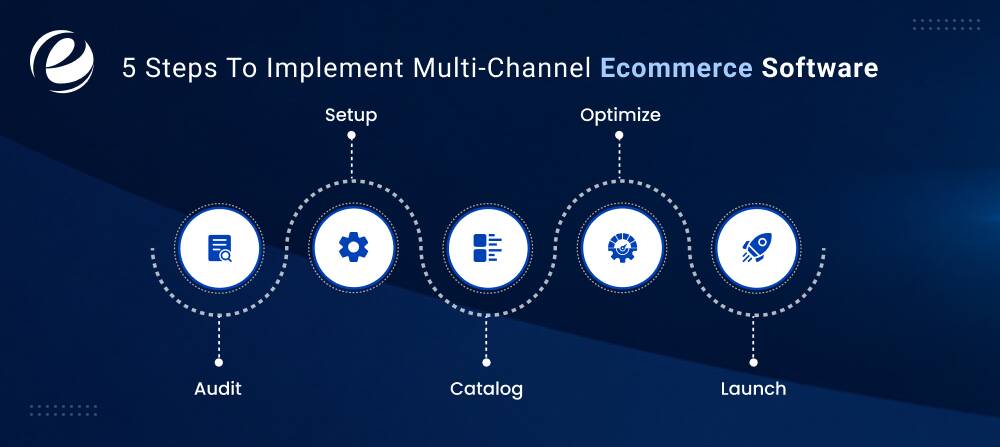
Implementing or adopting new multi-channel ecommerce software isn’t easy, and it can be tiring if you do it the wrong way. During implementation, you may face downtime before everything runs smoothly or, in the worst case, your vendor may not meet your expectations, which can halt your workflows. But getting it right sets the foundation for future business success. To ensure a successful implementation, follow the steps below.
Step 1: Workflow Audit
As discussed earlier, every business is unique, so start by auditing your existing systems, workflows, opportunities, and goals. The workflow audit will clarify your current listing management setup, pricing strategy, and inventory management. Next, clarify whether you plan to use custom integrations or have custom routing preferences. The result is an efficiency evaluation through software configuration that matches your operations.
Step 2: Account Setup
Based on your workflow audit, you can move forward with account setup, guided by your implementation specialist. This includes gathering integration credentials to connect to your software, choosing default routing preferences, setting shipping policies, and creating relevant warehouses.
Step 3: Catalog Creation
This is where you import all your product listings and data into your multi-channel ecommerce software, so you can manage all your catalogs from one centralized place. This includes setting up product groups or variations, kits, multipacks, and other relevant options.
Step 4: Optimization
Once you have all your connections and data in one place, explore advanced options to improve your catalog and workflows. For example, add a custom catalog, merge SKUs to automatically switch between FBA and FBM on Amazon, or provide employee training.
Step 5: Launch
At this stage, you deploy your multi-channel e-commerce software solution and use it to manage a multi-channel catalog, order routing, fulfillment, and analytics in one place. After launch, you also need to review your new workflows.
Common Challenges With Multi-Channel Ecommerce Software
The common challenges associated with multi-channel ecommerce software are as follows:
Inventory Drift and Sync Errors
Inventory drift or sync errors occur when stock levels don’t match what’s actually on the shelf. These errors increase during peak sales and busy weekends, when gaps lead to overselling, canceled orders, and marketplace penalties for high cancellation rates.
Integration Complexity With Legacy or Custom Systems
Generally, growing businesses often already run an ERP and a warehouse management system. Legacy versions of these systems often have limited or poorly documented APIs, making it tough to connect them to a multi-channel ecommerce platform. You’ll likely face challenges like inconsistent data formats, missing endpoints, and restricted API access. When standard connectors cannot cover these gaps, custom integration can be a feasible choice.
Data Security and Compliance (GDPR, Data Privacy)
Multi-channel selling means transferring personal information, such as names, addresses, purchase order history, and payment details, across several systems and third-party apps, and the risk of data leaks is increasingly high. Complying with standards like GDPR and CCPA requires careful data handling and role-based access controls.
How EmizenTech Helps Businesses Build Custom Multi-Channel Solutions
Today’s shoppers are savvy; they browse across brands’ websites and third-party marketplaces like Amazon, eBay, Walmart Marketplace, and even Etsy, and many try to figure out whether you have a personal store before buying. So you need to be present everywhere because you don’t know which channel your shopper will use to buy products.
However, manually managing all these platforms can be confusing, and you may end up giving disconnected customer experiences, inconsistent inventory, and complex order management. If a ready-made platform listed above covers your needs, start from there. However, if your workflows, legacy systems, or growth needs require more customization, partner with an ecommerce development services provider like EmizenTech to develop custom multi-channel ecommerce solutions that integrate multiple sales and operational channels through a unified technology ecosystem.
They will first understand your business model, analyze strengths and weaknesses, and then provide ecommerce consulting services. After evaluating what needs to be done, if your business has complex business processes, they will prioritize custom ecommerce development solutions for your business, and their capabilities include:
- Custom storefronts
- Customized administrative dashboards
- Custom business workflows
- API development
- Custom themes and UI components
- Checkout customization
- Business process automation
This lets you build a commerce platform that reflects your company’s products, customers, pricing structure, and operational processes.
Final Verdict
This guide on multi-channel ecommerce software is more about giving an understanding of what it means and, as an ecommerce business owner, if you are planning or currently handling several ecommerce marketplaces all at once and don’t know how to strategize in managing all of them or are currently making the processes complex, then how multi-channel ecommerce software can help you with it by connecting all these marketplaces in a centralized place. You can also learn about the top multi-channel ecommerce platforms on the market and which ones are the right fit for you. For standard processes, ready-made platforms can be a good fit, but if your workflows or systems are unique, a custom solution may be worth considering.
FAQs
What is multi-channel ecommerce software?
Multi-channel ecommerce software lets businesses sell and manage products listed on multiple online platforms from a centralized place.
What's the difference between multi-channel and omnichannel software?
Multi-channel software focuses more on the brand, while omnichannel software focuses on the customer.
How does multi-channel software prevent overselling?
Multi-channel software prevents overselling by replacing isolated channel numbers with a unified inventory system that syncs stock in real time.
What are the hidden costs of multi-channel ecommerce platforms?
The hidden costs of multi-channel ecommerce platforms are as follows:
-Additional fees for extra users, integrations, or order volume
-Costs incurred in implementation and onboarding
-Time spent on manual fixes when data or systems fall out of sync
These costs are often add-ons and extra services rather than part of the core subscription, so ask vendors for a complete quotation. These hidden costs usually come from pricing add-ons rather than the core subscription.
Can multi-channel software be customized for my business?
Yes, multi-channel e-commerce software can be customized to your business requirements.



 +1 (989) 535-9295
 info@emizentech.com
 emizentech


