
Pods at Charging Stations, Zero Staff on Site, One Subscription for the Whole Country
Modal Access Control — a smart lock and subscription platform for modular pods at EV charging sites, built end to end in eight weeks by our custom software development team.
Overview
Modal Pods puts modular prefabricated buildings at EV charging sites. The logic is hard to argue with — a charging session runs 30 to 60 minutes, and most sites give you a parking space and nothing else. A clean, private, climate-controlled room is worth something at minute twelve of a charge. It’s a pattern we’ve watched play out across automotive and EV software generally: the vehicle problem gets solved first and the human-standing-next-to-it problem gets solved years later.
The hard part was never the building. It was everything that has to happen the moment somebody walks up to one.
Modal wanted no staff on site. Not “minimal staff” — none. Which means the door has to let the right person in, take their money, expire their access, log the whole thing, and do it at every pod in the country without anyone touching a keyboard. They came to us for the software that makes that possible, and we shipped it in eight weeks: a mobile web app, a super admin dashboard, and the backend engine sitting between them.
The Challenge
Four problems that shaped every decision after them.
Nobody is downloading an app to use a restroom
This was the constraint everything else bent around. A traveler stops to charge, needs the pod, and has maybe two minutes of patience. App store, download, account, password, email confirmation — that funnel loses almost everyone. If entry wasn’t near-instant from a cold start, the pods wouldn’t get used.
Picking a lock brand shouldn’t lock the whole company in
Modal started with Yale keypad locks. Reasonable choice. But hardware decisions age badly, and writing the backend directly against one manufacturer’s API means every future brand change becomes a rewrite. That’s a bad trade for a company planning to scale nationwide.
One subscription, every pod — but not every site charges
The commercial idea was a network: subscribe once, open any pod at any site in the country. Genuinely good product thinking. Awkward to model, though, because some sites are promotional and free while others are paid, and pods within a site need to go into maintenance individually without dragging the site down with them.
No staff means the audit trail has to be perfect
When there’s nobody on site, the logs are the operation. Who got in, when, on what credential, and did it succeed or fail. Payment disputes, security questions, compliance reporting — all of it resolves against those records, so they had to be complete and impossible to quietly edit after the fact.
Our Approach
We started at the pod door and built backwards from it.
That sounds like a slogan but it was a real constraint. Every architectural decision got tested against one question: does this add a step between scanning a QR code and the door opening? Anything that did, we moved somewhere else or automated away.
The delivery ran as four two-week sprints over eight weeks. Foundation and design first — UI/UX design in Figma covering every PWA and admin screen, database schema, Seam and Stripe sandboxes, CI/CD — then core backend and the app’s onboarding flow, then the Access Engine and admin panel, then integration, hardening and launch. Modal engaged a dedicated seven-person squad rather than a fixed-scope contract: project manager, designer, two Node.js developers on the NestJS backend, two React developers across the PWA and admin dashboard, QA, DevOps. Teams that hire CRM developers and full product squads this way get the thing most fixed-scope builds can’t give them — engineers still on the project when the schema meets reality and needs to change. Our guide on how to hire a CRM developer covers what to look for if you’re staffing something similar.
The other early call was to put an abstraction layer between the platform and the lock hardware. More on why that mattered below.
Solution Delivered
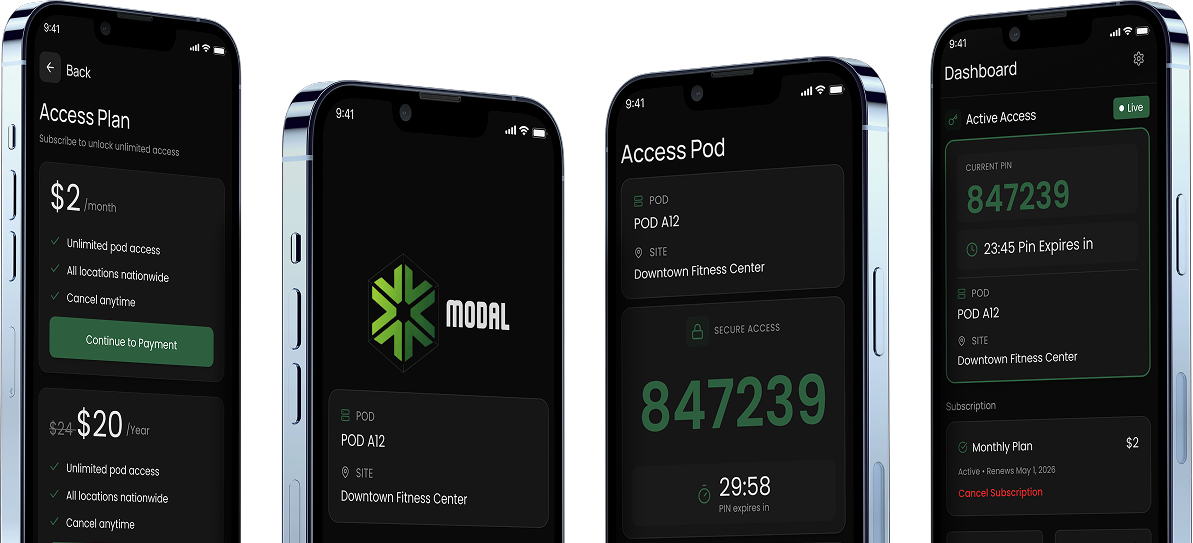
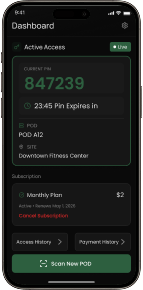
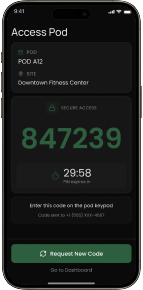
Entry in under two minutes, from a cold start. Each pod has its own QR code on the door pointing at go.modalpods.com/pod/{pod_id}. Scanning it opens the app in the phone’s browser — no install, no app store. The system reads the pod ID, looks up the parent site’s policy, and routes the user to registration or login. Pay (or skip payment entirely at free sites), and a 30-minute PIN lands by SMS and on screen at once.
The PIN works even when the phone doesn’t. Because entry happens on a Yale keypad rather than through the phone, once the code is delivered the unlock doesn’t depend on signal. Which matters more than it sounds when pods sit at highway edges and half-built sites.
An Access Engine that runs the credential lifecycle by itself. Stripe confirms a payment, fires a webhook, the backend verifies the signature, and the Access Engine checks entitlement and calls Seam’s createAccessCode() against that specific pod’s lock. PIN written to the database, sent via Twilio, displayed with a countdown. A node-cron scheduler sweeps every minute and revokes anything expired. Start to finish, no human touches it.
Hardware independence, deliberately. Everything talks to Seam rather than to Yale. Seam is a universal smart lock API, so swapping to August or Schlage later is a device registration exercise, not a backend rewrite. We’d push most clients toward this pattern — the cost of the abstraction is small and the cost of skipping it arrives eighteen months later. It’s the same principle we apply across IoT development work: the device layer changes faster than the business logic, so don’t weld them together.
Sites contain pods, and policy flows downhill. Paid or free is set once at site level and inherited by every pod under it. Default PIN duration too. But an individual pod can be flipped to inactive or maintenance on its own. That hierarchy is why adding a hundred pods across ten sites doesn’t create a hundred configuration problems.
A super admin dashboard that runs the whole business. . Sites and pods with drill-down, perpod QR generation and reprint, user and subscription management, refunds, maintenance passcodes, revocation, filterable access logs with CSV export, and analytics and reporting on revenue by site, peak times and pods with no activity at all. That last report is quietly one of the most useful — a pod nobody uses is either broken or badly sited, and you want to know which.
Audit logs that can’t be rewritten. Database triggers block UPDATE and DELETE on the audit table outright. Every access event records site, pod, user, event type and outcome. Every admin action records who did what.
Payments handled the boring, correct way. No raw card data touches the server — Stripe holds it all, we store tokenized methods and invoice references. Webhooks are signatureverified so nobody can forge a payment event and mint themselves a PIN. Failed payments retry, then suspend access and notify the user. Refunds run full or partial from the dashboard. It’s standard fintech and payments engineering, and it’s the part where cutting corners costs the most later.
Three Modules Nobody Screenshots
The parts of a build like this that never make the demo reel but decide whether the client can operate without calling us.

A CMS for the legal pages.
Terms of Service and Privacy Policy are editable from the admin panel with version history and rich text, built with the same CMS development approach we’d use on any content-managed product. Sounds trivial. It isn’t — those documents change, and a company that needs a developer to update its privacy policy will eventually publish a stale one.

A reports queue
Users submit issues from the app; admins move them through pending, reviewing, resolved or rejected, with the resolution history kept. This is the support function for a business with no staff on site. Someone finds a pod dirty or a lock unresponsive and the report is the only channel — so it needed a real workflow, not an email alias.

Notifications that fire themselves
SMS and email across the events that matter: PIN delivery, OTP for two-factor, upcoming billing, payment failure, subscription status changes. Twilio for SMS, a custom mail service for email.
Glimpses of Modal Pods
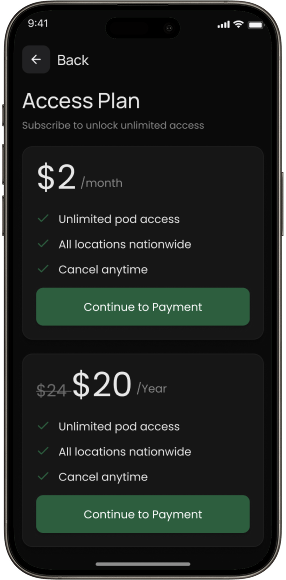

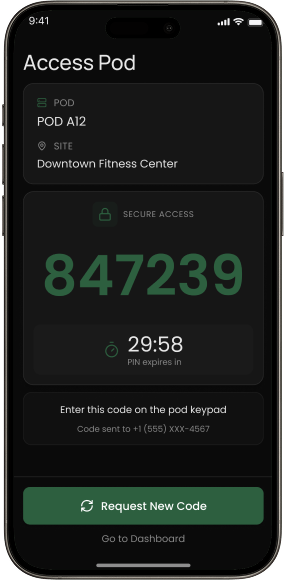
Key Features

QR entry, zero install
Per-pod QR opens the PWA in-browser. Register, pay, get a PIN — under two minutes.

30-minute time-limited PINs
Generated per pod lock via Seam, revoked automatically by scheduler.

Nationwide single subscription
One subscription opens any pod at any site in the country.

Site → pod hierarchy
Paid/free policy set at site level, inherited by pods, overridable per pod.

Webhook-driven automation
Stripe payment → entitlement check → PIN → SMS, in seconds, unattended.

Hardware-agnostic locks
Seam abstraction means changing lock brand needs no backend change.

Four-role RBAC
Super Admin, Site Admin, Regular User, Maintenance — with route-level guards.

Immutable audit trail
Postgres triggers prevent modification or deletion of audit records.

Maintenance passcodes
Admin-issued temporary codes scoped to a single pod with custom expiry.

Operational analytics
Revenue by site, peak access times, most active pods, zero-activity pods.
Results & Outcomes
8 weeks
Kickoff to production launch, across four agile sprints.
Zero staf
Pod sites operate with no on-site personnel at all.
Under 2 min
Scan to unlocked, for a first-time user who has never seen the app.
~95%
Reduction in manual operational tasks through automated credential and billing flows.
Alongside: 100% test coverage on the critical paths (auth, payments, Access Engine) through our software testing and QA practice, OWASP Top 10 compliance with zero critical vulnerabilities at launch, all P1 and P2 UAT issues closed before deployment, and a 99.9% uptime target backed by Sentry and 24/7 monitoring. Two months of hypercare shipped with the handover.
Technology Stack

Backend
NestJS (Node.js/Express), modular architecture

Database
PostgreSQL with Prisma ORM

Auth
JWT with refresh token rotation, bcrypt (cost 12)

Payments
Stripe API + Stripe Elements, webhook signature verification

Smart locks
Seam API (Yale keypad locks at launch)

SMS
Twilio — PIN delivery, OTP, notifications

Scheduling
node-cron for automatic credential expiry


Mobile app
React + Vite PWA, service worker, installable
Admin dashboard
React + Material-UI

Testing / CI
Jest + Supertest, GitHub Actions

Monitoring
Sentry, uptime alerting

Deployment
Docker + PM2, cloud object storage for QR assets
The Part People Underestimate: This Is a Customer System
- Worth saying plainly, because it’s where similar projects go wrong
- Modal Access Control looks like a hardware integration problem. It isn’t, or not mainly. Strip out the locks and what’s left is a subscriber database, a billing engine, a support queue, a permissions model and a set of retention reports. That’s a customer system. The admin dashboard tracks who subscribed, what they pay, whether the payment failed, which pods they’ve used, what they’ve complained about and whether they’re likely to churn — and those are the questions any CRM software development project exists to answer. If the term itself is fuzzy, what CRM software actually is is a decent primer.
- The difference from a standard CRM is the core object. Most platforms model a contact and a deal. Modal’s world is a pod, at a site, under a policy, with credentials and an access history hanging off it. No off-the-shelf tool holds that shape without a fight, which is exactly the situation where custom CRM development beats configuration — and the reason clients come to a CRM development company rather than a platform reseller.
- Connectors to Salesforce and HubSpot sit on the roadmap for when Modal’s sales motion needs them. Building the subscriber and usage data properly first means that integration is a mapping exercise later, not an archaeology project. If you’re weighing build versus buy on similar ground, our custom CRM development cost breakdown is a more honest starting point than most vendor pricing pages.
What’s Queued Next
The platform shipped with room deliberately left in it. On Modal’s roadmap:
Native iOS and Android apps alongside the PWA, for the repeat users who’d rather have an icon than a bookmark. Guest access codes for one-off visitors who don’t want a subscription. Environmental sensors — temperature, humidity, motion — feeding the same platform the locks already talk to. Predictive analytics through AI and ML for occupancy forecasting and revenue modelling. Multi-currency for international sites, a white-label build for partner operators, and Salesforce integration once the sales pipeline outgrows the admin dashboard.
None of that required rework to make possible, which was the point of the architecture decisions in sprint one.
Conclusion
Modal had the harder half of the problem already solved — they know how to build and place the pods. What they needed was software that let a national network run without a national payroll.
Eight weeks, one dedicated squad, and the thing has been live at go.modalpods.com since. The pieces we’d point at as the reasons it worked: designing around the two-minute entry window instead of the admin panel, abstracting the lock hardware before anyone asked us to, and treating the audit trail as a product feature rather than a compliance checkbox.
If you’re building something with the same shape — physical assets, subscriptions, on-demand access, no staff on site — you can hire dedicated developers from us the way Modal did, as a full squad that stays with the build from schema to launch and through hypercare.
Running physical assets with no staff on site?
Let’s talk about what the software behind that actually needs to do.
Schedule a Free Consultation

