 Add us as a preferred source on Google
 CRM is no longer a contact database; it is the engine that has the ability to power your sales, marketing automation, and customer success. In 2026, with AI-driven platforms like Salesforce and HubSpot, business growth depends on having the right CRM developer who can design and manage the CRM system.
Hiring a CRM developer is not about structuring fields because you need someone who understands the automation logic and system architecture of your business. In this guide, you will discover how to hire CRM developer with proven strategies to turn your CRM into a powerful tool.
Why Hiring the Right CRM Developer Matters?
The right developers help your company to get the most out of your CRM by making sure that the data stays clean and integrations run smoothly. Here are the benefits that a skilled CRM developer can offer:
- Clean and Reliable Data: They make sure that your customer and lead information is accurate and free from duplicates.
- Ideal Connectivity: An expert CRM developer connects your CRM with other business tools.
- Scalable and Future-Proofing: As your business grows, your data volume and complexity increase.
- Effective Automation: The developers design workflows that automate repetitive tasks to allow your team to focus on valuable activities.
So, hiring the right CRM developer changes your CRM from a static tool into a dynamic engine that drives the company’s daily operations and strategic decisions. That’s why knowing how to hire CRM developer is crucial for long-term business growth.
6 Steps to Hiring the Right CRM Developer
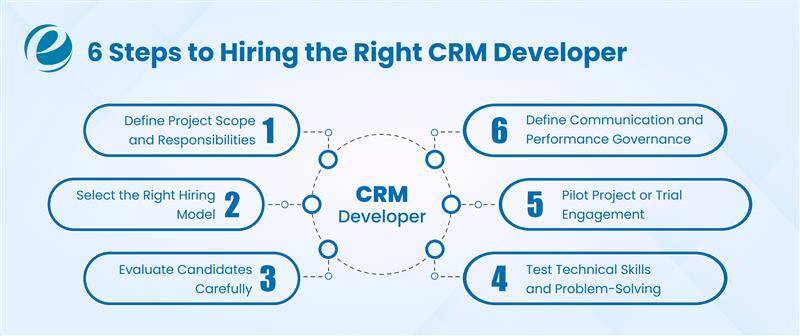
As per the data from teamgate for the state of CRM, 91% of companies with more than 11 employees use a CRM system, showing strong enterprise penetration. Therefore, hiring the right developer is not just a technical decision but a strategic investment in your business’s future. Whether you are in the CRM for manufacturing industry or healthcare, CRM can easily help you boost customer engagement. Below, you will learn how to hire CRM developer who aligns with your business goals:
Step 1 – Define Project Scope and Responsibilities
Before you start searching for a CRM developer, you have to define the “what” and “why” of your CRM implementations. It will help you to avoid hiring a generalist when you need a specialist. Below, you will understand your main concerns about selecting an experienced CRM developer:
- Identify Goals: You have to clearly define if your requirement is a new implementation, a complex migration from a legacy system or custom API integrations.
- Map Responsibilities: Clearly describe your needs between administration (configuration and user management) and development (coding, Apex/Python, and backend integrations).
- Define Required Expertise: You must list the required expertise in a specific platform so that it will be easy for you to select the experienced one.
With this strategy, you can hire a qualified developer so that they can provide you with accurate outputs.
Step 2 – Select the Right Hiring Model
When you are planning to hire a CRM developer for your business, then the major concern is choosing the right hiring model. Select the engagement model that matches the complexity of your project.
- Freelancer: The freelancers are good for short-term projects that require one-time API integration. They are cost-effective; that’s why they are suitable for limited scopes and trial projects.
- Agency: Hiring developers from agencies is a great option for full-cycle applications. They have proven experience, so you can consider them for long-term projects that require full-scale development.
- Staff Augmentation: You can add skilled CRM developers to your existing team for seamless collaboration. It offers flexible scaling while maintaining in-house control for the projects
Step 3 – Evaluate Candidates Carefully
At the time when you are reviewing the companies that provide CRM developers, you must look for proven results. Look at everything that helps you to choose the suitable one by analyzing their past works: Important evaluation areas include:
- Experience and Certifications
- API Integration Skills
- Data migration and security knowledge
- Programming Languages (Java, Python, .NET or PHP)
You can also ask for their past references to assess their performance and ability to meet deadlines. If they are a top-tier developer, they will also articulate their failed projects or toughest challenges.
Step 4 – Test Technical Skills and Problem-Solving
You can prepare a set of questions that reveals their abilities in both technical knowledge and practical experience. In the following section, you will see some common questions that you can ask your developers.
- How do you decide between CRM configuration and customization?
- Can you describe a complex CRM project you have worked on?
- How would you migrate large volumes of data safely?
- How do you integrate CRM with other systems and handle APO limits?
- What are the documentation practices that you follow?
Additionally, it is crucial to examine their technical expertise beyond the traditional CRM tasks. Nowadays CRM platforms are relying on AI features such as chatbot integration for customer support or LLM integration for intelligent insights. However, if the developers understand these AI capabilities, they can easily transform your CRM into an automated business growth.
Also, for API integration, you must assess their knowledge of REST/SOAP APIs because it is crucial for connecting your CRM to ERP or marketing tools.
Step 5 – Pilot Project or Trial Engagement
Before you commit long-term, you can consider giving them a short pilot project. These projects help you to understand valuable insights into a developer’s:
- Work quality
- Adherence to deadlines
- Communication skills
- Problem-solving approach
Are you wondering how to run a pilot project? Let’s see the major concerns:
- Define a 2-4 week small project focused on a single CRM module.
- Provide a clear delivery time and expected outcomes from them.
- Review code quality, documentation, and team collaboration.
- Use this opportunity to make a confident decision before scaling to the full project.
Step 6 – Define Communication and Performance Governance
CRM is not a one-time project; it is an evolving process that requires structured governance. For that, you can ensure long-term success by setting up the right management structure:
- Agile Methodology: Conduct short daily/weekly scrums to review the developers’ progress.
- Set KPIs: Define clear metrics for system uptime, time to resolve tickets or data integrity accuracy to create a successful CRM model.
- Create Feedback Loops: Make sure that the end users are involved in testing so the developer gets quick feedback on usability.
- Comprehensive Documentation: Must establish a documentation repository policy so that all the custom code, API connections and workflows are documented in a shared wiki before completion.
So, these are the steps you should follow before choosing a CRM developer for your projects.
If you operate in the online retail space, you can easily improve customer engagement if you implement the right CRM. Check out our detailed guide on CRM in eCommerce to know how CRM solutions help in sales for eCommerce businesses.
Quick Checklist Before Selecting CRM Developer
Choosing the right CRM developer is a critical step to make sure that your CRM system delivers real business value. If you are still assessing how to hire CRM developer, use this checklist:
- They must have professional experience with your CRM platform.
- Review their past projects, case studies or successful projects.
- Proven ability to customize workflows, modules and automation.
- Experience interaction with CRM with the help of other systems via APIs.
- They must have a solid understanding of databases and reporting tools.
- They should also possess knowledge of industry-specific CRM requirements.
- They should possess problem-solving skills to troubleshoot CRM issues.
- Evaluate their communication style for better understanding.
- Please confirm the post-launch support and maintenance services.
- Make sure to clarify pricing, scope, timelines, and any hidden costs upfront.
Why Choose Our CRM Development Team?
When it comes to CRM development, you deserve a partner who can refine operation and grow revenue for your company. That’s what the Emizentech CRM development team delivers for your company’s growth. With 12 years of experience, 150+ certified professionals, and 1,300+ successful projects worldwide, we merge deep industry insight with cutting-edge technology to craft CRM solutions that fit your business.
Our CRM development company provides developers who have in-depth knowledge of top CRM platforms such as Salesforce, Microsoft Dynamics 365, Zoho CRM, HubSpot CRM, SugarCRM, and more. They understand both the technical and strategic sides of increasing customer retention. If you are still having issues understanding how to hire CRM developer, you can seek our experts’ guidance.
Conclusion
The ideal developer understands customer journeys to translate the business goals into workflows that drive measurable growth. Knowing how to hire CRM developer and investing time in a rigorous selection process ensures your CRM ecosystem will evolve with modern trends. Start building your dream CRM team, who deliver quality solutions by clearly understanding your business goals that help your organization to grow.
FAQs
What does a CRM developer do?
A CRM developer designs, customizes, and maintains a customer relationship management (CRM) system that aligns with a business’s specific needs. They create reports about customer behavior for business heads to analyze the data.
Is it better to hire freelance or full-time CRM developers?
The decision depends on your project's scope; freelancers are best for short-term, specialized projects, while full-time employees are better for long projects or united systems.
How do you handle data migration when implementing a new CRM?
Handling data migration when implementing a new CRM is an operational challenge. But our developers use a methodical, multi-phase approach to ensure data integrity and user adoption.
How do you maintain data security in a CRM?
We make sure that the sensitive data stays secure by giving each user only the access they need. Through customized user access and field security, we carefully manage who can see and edit the data from the CRM.
How do CRM developers integrate with existing business tools?
CRM developers unite with existing business tools using REST/SOAP APIs and middleware platforms to sync data in batches. We also use native integration and custom connectors to connect the CRMs with marketing and accounting systems.
What is the process of implementing a custom CRM solution?
The process of implementing a custom CRM solution follows the key steps below:
1. Requirement gathering and analysis
2. System Design & architecture
3. Customization and development
4. Data migration ‘testing (UAT & QA)
5. Deployment and Go-live
6. Post-implement support and optimization
So, these are the steps with which you can implement a custom CRM solution.


 +1 (989) 535-9295
 info@emizentech.com
 emizentech


