
 Add us as a preferred source on Google
 Adaptive software development has revolutionized the way modern organizations handle complicated projects and is thus a fundamental methodology in the tech industry that is rapidly evolving. As the call from businesses for quicker innovations and more customer-centric solutions gets louder, the use of traditional models is gradually being substituted by dynamic approaches such as ASD. Adaptive software development is among the software engineering trends that have been most widely discussed, and it is considered to be much more flexible and adaptable than the older hard and fast software development methodologies.
Grasping the concept of adaptive software development is a must-have for any tech-driven company that is looking to improve product delivery. The main reason behind the growing popularity of ASD is that it makes the teams keep their responsiveness to unforeseen changes in the market and continuous user feedback.
According to Mordor Intelligence, the Software Development Market size is estimated at USD 0.57 trillion in 2025, and is expected to reach USD 1.04 trillion by 2030, at a CAGR of 12.90% during the forecast period (2025-2030).
Through the use of Adaptive software solutions techniques along with agile practices, companies are in a position to effectively deliver tailor-made solutions while at the same time they are able to keep up with the ever-changing requirements. Hence, ASD is very quickly becoming the first choice of businesses that are in software development and want to be at the forefront of software development trends.
What is Adaptive Software Development?
Adaptive software development is a modern, less stringent approach to software creation that involves iterative progress and is continuously open to feedback. It was developed in the 1990s as a new way of tackling the issues of the traditional methods, and the change addressed was rapidly shifting requirements in dynamic environments.
Its fundamental idea is based on the concept of change, where teams do not try to resist change but rather embrace it, and also, through the use of frequent iterations, they keep refining and upgrading the product. Thanks to its adaptable attribute, ASD is able to deal with complex and ever-changing projects.
By centering their attention on learning and collaboration, ASD teams are able to come up with adaptive software solutions that very well satisfy the current needs of users. This approach has become very popular and is considered to be the most suitable methodology for software development in a world that is very much technology-driven and moves at a rapid
Power of Adaptive Software Development (ASD)
The power of adaptive software development helps the teams to come up with solutions that are not only flexible but also customer-oriented through continuous improvement and collaboration.
Iterative Process
ASD treats the software development as a repetitive cycle that allows the team to get feedback and change their objectives as they see fit, and quite often.
Collaboration
The cooperation between developers, stakeholders, and users that is done at the closest level gives the trinity the assurance of being on the same line and promptly solving the issues that arise.
Flexibility
This method includes the changes that, unlike before, it would be hard for the team to take a different direction from their strategies and requirements if new information comes out.
Customer-Centric Approach
ASD always relies on the users’ opinions as a main point in the software evolution, ensuring that the product meets the real needs and eventually leads to an increase in the users’ satisfaction.
How Does ASD Handle Change and Uncertainty?
ASD is good at handling situations that are hard to predict because it has measures that anticipate them.
- Speculative Planning: The team gets ready for different possible results instead of one fixed plan.
- Continuous Feedback: Development is guided by the constant and frequent involvement of users.
- Learning Cycles: Thanks to reflection, each iteration leads to the next being even better.
- Adaptable Mindset: The teams are never closed and always prepared to deal with changes in the
project.
Benefits of Using Adaptive Software Development
Adaptive software development brings along its unique set of advantages, thus making it the prime option for teams that are chasing flexibility, speed, and customer satisfaction in dynamic projects.
Faster Time to Market
The iterative cycles of ASD allow more rapid deliveries of usable increments of software, thus speeding up the realization of the value.
Improved Customer Satisfaction
The users’ continuous involvement guarantees that the solutions are very much in line with the developing needs and expectations.
Reduced Risk
The practice of early and frequent testing aids in the identification and solving of issues before they become significant problems.
Higher Flexibility in Managing Change
ADP not only accepts changing requirements but also facilitates easy adjustments that do not disrupt progress.
How Does It Improve Project Success and Reduce Risk?
Recognizing ASD’s influence on project results makes it more attractive.
- Early Problem Detection: Ongoing testing reveals flaws early, which saves on costly fixes that would be required later on.
- Adaptive Planning: The changing plans are useful as they assist the teams in making effective pivots when new pieces of information come in.
- Stakeholder Engagement: The regular feedback loops keep the expectations in line and thus lessen the chances of misunderstandings occurring.
- Incremental Delivery: The process of releasing in small amounts lowers the risk of a large failure happening as each feature is validated one by one.
The advantages listed above are the reasons why ASD is the leading methodology in the realm of modern software development services and the trends of changing software development practices.
How Adaptive Software Development Works? Step-by-Step Process?
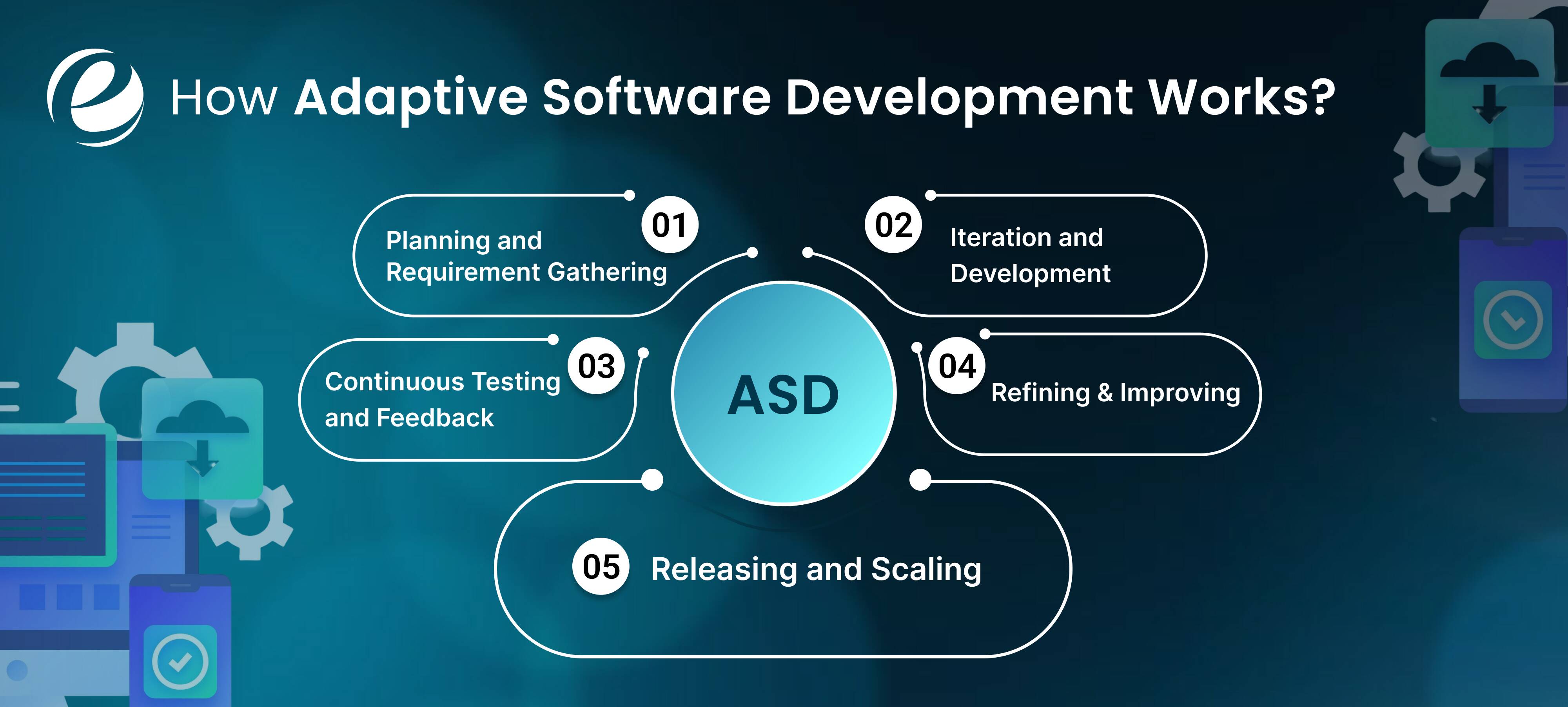
The ASD utilizes an evolving, iterative process that makes the whole thing easier with its properties of flexibility, continuous communication, and improvement, and thus it can eventually get to the point where the project needs to grow and changes are made accordingly.
Planning and Requirement Gathering
The additional development teams have discussions regarding the different goals, and then, through that, the basic requirements are drawn up. This will then serve as the flexible base where long-term Adaptive software solutions development projects can be built.
Iteration and Development
The development takes place over several cycles, which thereby gives the team the chance to progressively develop the functionalities and also respond to suggestions and changes in a timely manner.
Continuous Testing and Feedback
User testing and feedback are constantly conducted, which ensures that the software is in tune with users’ needs all the time, and also, adjustments can be made through the adaptive software tools.
Refining and Improving
The period after every cycle is characterized by a coming together of changes and reflection, which provides an endless loop of adversity and learning for adaptive software development.
Releasing and Scaling
The programmers release the smallest possible sections of the product early, and, while the features are being scaled according to the user feedback that has been collected and the changing business objectives, they do it in the same way as the current software development practices.
What Role do Iterative Cycles Play in ASD?
Iterative cycles are the boon of ASD, which gives the teams the chance to carry out the experiments, learn, and adjust to new situations very quickly.
- Enable Flexibility: The iterations make it possible to change requirements and priorities at a rapid pace.
- Enhance Quality: Cycle testing conducted at regular intervals results in improved reliability of the software.
- Promote Collaboration: Regular cycles lead to better communication between all the teams and stakeholders involved.
- Drive Continuous Improvement: The entire process is continuously refined by taking in the lessons learned along the way.
Such a cyclical pattern of working is what places ASD at the top of the list as a versatile and progressive software development technique.
Adaptive Software Development vs. Agile vs. Waterfall
Adaptive Software Development (ASD), Agile (such as Scrum), and Waterfall are popular methodologies used to manage the complexities of software development but each takes a very different approach to handling change, planning, and uncertainty.
Waterfall follows a strictly linear, phase-based process that requires fully defined requirements at the outset. While this works well for predictable projects, it becomes rigid when new insights or late changes emerge.
Agile improves on this by embracing iteration, fixed sprints, and continuous incremental delivery. It encourages collaboration and allows for changes throughout the development cycle but still within a structured framework.
ASD, however, belongs to an entirely different class. Built on the principles of adaptation, continuous learning, and uncertainty management, it not only accepts unpredictability but actively incorporates it into planning and execution. Instead of requiring all answers upfront, ASD thrives in environments with evolving goals, unknown variables, and rapidly changing user needs. How these approaches compare:
Waterfall
- Strict, sequential stages
- Requires complete requirements before development
- Changes late in the process are difficult and expensive
Agile
- Iterative with time-boxed sprints
- Focuses on constant, incremental delivery
- Flexible, but still follows structured rituals and processes
Adaptive Software Development
- Plans are tentative and evolve continuously
- High emphasis on collaboration, feedback, and learning
- Designed to handle uncertainty and unpredictable project paths
While Agile is widely recognized for its flexibility, ASD takes adaptability even further. It not only allows change-it’s built around it. This makes ASD a significant evolution in the history of agile methodologies and a rising trend in modern software development services.
| Feature | ASD vs. Waterfall | ASD vs. Agile (including Scrum) |
| Approach | Iterative, flexible, learning-based | Iterative, incremental, collaborative |
| Handling Change | Embraces change throughout | Welcomes change but with structured sprints |
| Planning | Speculative and evolving | Detailed short-term sprint planning |
| Risk Management | Continuous feedback reduces risk | Risk minimized by frequent releases |
| Customer Involvement | High and ongoing | High, especially in Scrum meetings |
| Best For | Complex, uncertain projects | Projects with defined but evolving requirements |
When to Choose ASD over Other Methodologies
| Criteria | Choose ASD | Choose Agile (Scrum) | Choose Waterfall |
| Requirement clarity | Low / Uncertain | Medium | High / Clear |
| Change frequency | High | Moderate | Low |
| Project complexity | High | Medium | Low |
| Customer involvement | Continuous | Regular | Minimal |
| Risk level | High | Medium | Low |
| Iterative learning | Essential | Important | Limited |
Essential Tools and Techniques for Effective Adaptive Software Development
The ASD needs particular tools and software development methodologies to handle its traits of flexibility, collaboration, and iterative progress effectively. They make it possible for teams to produce quality adaptive software solutions that are in line with the changes in the project requirements.
| Tool Category | Common Tools |
| Project Management Tools | Jira, Trello, Asana |
| Version Control & CI/CD | Git, GitHub Actions, Jenkins |
| Collaboration Tools | Slack, Microsoft Teams, Confluence |
Software development services that commit to the adaptive software development method cannot go without using these tools, as it is a prerequisite for them to have transparent workflows and be responsive to delivery.
The techniques used here are in line with the trends that are prevailing in the software development industry, which are characterized by agility, continuous feedback, and iterative improvement.
Challenges and Limitations of Adaptive Software Development
Adaptive software solutions development is a complex concept, which, in addition to its benefits, also has negative sides. The knowledge of such problems makes one evaluate options and thus contribute to project success in a constantly changing environment.
Scope Creep
Adaptive methods without proper control may lead to the expansion of project requirements beyond the original scope, thus delivery can be delayed and costs can be increased.
Dependency on Skilled Teams
ASD needs an experienced team that is willing to accept the change of the iteration and is flexible in the work process to be able to keep the progress and the quality at the same level.
Difficulty in Large Projects
Despite the great features of ASD, it can still be very difficult to manage and coordinate big, complicated projects, which can even lead to inconsistencies within the entire project and poor communication among the various teams involved, which may not even be in the same location.
Time and Resource Management
It is challenging to be able to keep in step with the fast iterations and, at the same time, manage the resources in a way that will not result in exhaustion and will also make it possible to maintain productivity in the fast-paced work environment.
Overemphasis on Adaptability
More than necessary adaptability could result in a project not having a clear direction and thus getting delayed or priority getting confused.
Insufficient Documentation
Fast iterations could mean that documentation is not done well, and this could affect the transfer of knowledge and future maintenance negatively.
Misaligned Stakeholder Expectations
A lot of changes call for regular communication; lack of it can result in goals not being aligned and dissatisfaction.
Tooling and Process Overhead
The ongoing flexibility requires up-to-date tools and efficient processes, and if these are not provided, the productivity may be reduced.
Cultural Resistance
The teams that have been using the traditional methods might find it hard to adapt to the practices of ASD, and this would slow down the acceptance and the collaboration.
The above-mentioned risks have posed the question of a balanced management technique that will help get all the advantages of ASD without losing control over the project and the quality.
Industries Benefit Most from ASD
The industries that experience the most rapid changes and have the most elaborate project definition and outcomes are the ones that take the most advantage of adaptive software development. In this way, they are connecting to the flexibility of ASD and making use of iterative methods to bring effective solutions to the intended users.
Financial Services
The use of ASD in the financial services industry (including banks and fintech) companies is one way of dealing with the changing regulations and customer demands, while securing and innovating services.
Healthcare
Hospitals depend on adaptive software solutions development that is both compliant and able to adapt to new medical standards and quickly add patient-facing features.
E-commerce
The adoption of adaptive software in e-commerce businesses is a continuous step towards better user experiences and being able to respond to changing market trends and consumers’ preferences.
Telecommunications
The telecommunication industry is using adaptive software solutions in such a manner that allows them to keep their product development cycles flexible, which in turn enables them to carry out the updates to their networks and customer service tools quickly and efficiently.
Technology Startups
Start-ups make use of the principles of ASD to rapidly iterate based on user feedback and market validation. This approach proves to be very effective when discovering and precisely defining a software area.
The industries that have been using adaptive software development show how ASD has been a major factor by supporting innovation and agility through various sectors that are in high demand and are in line with the current software development trends.
Cost Breakdown and Steps to Implement ASD
| Cost Component | Estimated Expense |
| Training & Workshops | Moderate ($5,000–$15,000) |
| Tools & Infrastructure | Variable ($2,000–$10,000+) |
| Process & Cycle Setup | Low to Moderate |
| Ongoing Collaboration Efforts | Low to Moderate |
The implementation of ASD is associated with an initial investment in training, process establishment, and collaboration tools, among others.
Nevertheless, the long-term rewards in terms of flexibility and accelerated delivery are worth more than the expenses incurred. A list of cost categories and the process of effective implementation are provided below.
Adopting Agile Principles
Match your group with Agile ideas so that the iterative and flexible character of ASD is supported, thus making the adoption smoother.
Training Your Team
Provide training as an investment that empowers both developers and stakeholders to be effective in the navigation of continuous change.
Setting Up Iterative Cycles
Establish iterations with feedback loops that are clearly defined, and thereby allow continuous adjustments and enhancements in the development process.
Fostering Collaboration
Encourage free communication among the different functional teams so that they can keep being transparent and adapt accordingly to the changing requirements.
The organizations that follow the aforementioned steps and manage costs wisely will be able to incorporate adaptive software development in their workflow and hence remain competitive in the field of modern software development trends, besides delivering high-quality adaptive software solutions.
Conclusion
Adaptive software development is a revolutionary method that helps organizations to deal with the difficulties of modern projects by allowing them to be flexible and to undergo continuous improvement. The adoption of ASD will help the teams to change quickly, cooperate, and deliver adaptive software solutions, and also to reduce the risks that are usually encountered in traditional software development methodologies.
It is a process that is iterative and customer-oriented, which corresponds very well with the current software development trends, thus making it the right choice for businesses that are looking for agility and innovation.
The use of ASD increases the success rate of projects and, at the same time, creates an environment where learning and adaptation are part of the organization’s culture, which is a requirement for surviving in the rapidly changing technology landscape of today. The use of ASD is the key to sustained business agility and competitive advantage.
FAQS:
How does adaptive software development differ from agile?
ASD stresses the uncertainty sphere to manage it through speculative planning while agile method proceeds with a well-structured and incremental way of working through sprints.
What industries benefit most from ASD?
The sectors that reap the most benefits from adaptive software solutions development are finance, healthcare, e-commerce, telecom, and startups.
What are common challenges in adaptive software development?
Challenges are the struggle to contain scope that goes beyond what was initially set, reliance on exceptionally skilled teams, and controlling resources during a quick-paced environment.
How does adaptive software solutions development improve business agility?
ASD will grant you the ability to make a quick response to changes, to get continuous feedback, and to improve iteratively, so overall business agility will be increased.
When should my organization implement adaptive software development?
If your projects are characterized by high uncertainty, frequent changes, and demand for rapid development then go ahead and implement ASD.




 +1 (989) 535-9295
 info@emizentech.com
 emizentech


