
 Add us as a preferred source on Google
Have you ever imagined what software is going to look like in the future? Technology is moving fast! Organizations that do not keep pace with their competitors are going to get left behind! That is why it is vital to understand the top software development trends 2025.
Trends like AI-driven automation, cloud native development, IoT, economic development, and cybersecurity first are dramatically changing the way organizations develop, maintain, and outsource technology solutions. These trends are not just because they are trendy; they are improving efficiencies, productivity, reducing costs, and providing better customer experiences.
In this blog, we will break down the top trends in software development 2025 in the context of understanding their relevance across the industry and how important it is to adapt to them, as organizations must continue to be future-ready.
Market Data and Growth Outlook for Software Development from 2025 to 2030
Here are market statistics and estimates about the software development trends 2025 to 2030, published by top sources such as Statista, Mordor Intelligence, and others:
- The global software development market is projected to grow from around $659 billion in 2023 to around $1.04 trillion in 2030, a compound annual growth rate (CAGR) of roughly 12.9%.
- The application development software market is projected to grow from an estimated $86.6 million in 2025 to an estimated $169.7 million in 2030, at a CAGR of approximately 14.4%.
- Cloud computing will dominate, as shown by research estimating 85% of enterprises will leverage cloud services by 2025, and the expected 95% of services will be born in the cloud.
Top Software Development Trends in 2025
The year 2025 would shape the future of software development like never before. Technology is no longer just a lever to increase productivity for a business; it has become the forward-facing engine you drive your business to growth, efficiency, and innovation.
From AI-driven automation to cloud-native and environmentally sustainable coding and practices, today’s particular software development trends must be recognized and engineered in order to remain competitive. Let’s take a closer look at the 20 major software development trends 2025 that are shaping this industry today.
1. AI-Driven Development
AI is no longer just an add-on to how we build software: it is becoming part of the core development experience. Developers can now code with AI, make improvements suggested by AI, and even debug faster. AI code helpers like GitHub Copilot have been adopted widely enough that teams report being able to shorten their development time by up to 50%.
With AI development company, the future of software development in 2025 is influenced by the computational power of generative AI, improved productivity and quality of the products created, and, last but not least, much easier API centric development.
2. Generative AI Solutions
One of the most exciting new software development trends 2025 is generative AI. Not only can generative AI create inventive writing, but it can also create code templates, automatically generate test cases, generate UI components, etc.
All types of businesses incorporate generative AI into their operations to simulate scenarios, increase personalization, and speed up prototyping. An increase in the sophistication of these generative AI models will lead developers to rely on them for repetitive processes so that developer resources can be focused on the strategy.
3. Low-Code/No-Code Development
With the demand for quick and cost-effective solutions, it is no wonder that low-code and no-code platforms are gaining momentum. Low-code and no-code platforms allow non-technical teams to build applications and products through drag-and-drop interfaces.
This is game-changing for newer startups and smaller organizations because these smaller organizations can now develop working products with a small team instead of large teams. This software development trend increases productivity, enables business users, and reduces reliance on IT departments.
4. Cloud-Native Applications
Cloud-native architecture has become the structure to scale business solutions. Instead of traditional systems, businesses are creating applications on top of cloud infrastructure such as AWS, Azure, or Google Cloud.
This allows for less downtime and greater scale and ensures that applications have a universal presence. The emergence of SaaS products demonstrates how far all of this has come.
5. Edge Computing Integration
With IoT and smart devices ramping up, sending all data to the cloud is impractical. Edge computing accounts for processing near the device and reduces latency.
If healthcare (real-time monitoring) and retail (smart POS systems) are any examples, edge computing is having a direct effect on user experience. This is one of the software development trends 2025, with real-time applications gaining momentum.
6. DevSecOps Practices
Security is no longer just the last step in development because it is becoming part of the experience across each step of development. DevSecOps combines development, operations, and security to create safer applications.
This report is particularly relevant in 2025 as costs associated with cybercrime are steadily increasing. Companies can reduce risk and save millions in security breaches by investing in DevSecOps.
7. Cybersecurity by Design
Developers are now creating their apps with a security-first perspective in the design phase, instead of waiting until the app is shipped to patch existing exposures. They are building in encryption, common security practices such as multi-factor authentication, and features such as AI-driven threat detection in the development phase.
With the introduction of stricter data privacy laws around the globe, cybersecurity by design is one of the most crucial trends transforming the software development industry. Informed and secure designs demonstrate trusted compliance from day one.
Well, it is essential for businesses to keep up to date with the top cybersecurity trends and challenges to keep their software and users’ data secure.
8. Microservices Architecture
Modern applications are no longer constructed as a single, enormous application. Rather, applications are developed with a microservices architecture, meaning that applications contain multiple, smaller components that operate independently of each other. Each component can be updated, expanded, or maintained independently, thus avoiding costly upgrades or downtimes to coordinate updates or upgrades for the massive application in ways that would impact all users.
Streamlined, upgraded services and larger applications are now seamlessly provided for millions of users around the globe through the microservices architecture used by companies such as Amazon and Netflix. Now, anyone can tap into microservices methodologies, as in 2025, small businesses are beginning their own journeys in microservices.
9. API-First Development
APIs are the backbone of a digital ecosystem, and in API-first development, developers build APIs prior to building the app itself, making integrations with external tools and platforms easier.
API-first accelerates digitization because it allows apps to be flexible and prepared for future endeavors. An API-first approach is ideal for business growth, and enabling integration and contracts with third-party partners reduces business closure and downtime.
10. Automation & Chatbots
AI-assisted automation is evolving customer support, HR systems, and e-commerce. Chatbots can now answer customer inquiries with a level of human-like precision (or accuracy) that drastically reduces expected wait times.
This means businesses no longer feel bound by human worker costs or the limitations imposed by human work availability. With regard to chatbots specifically, the integration of these programs with natural language processing (NLP) means these bots are now smarter than ever, and capable of reliable response to the ambiguity of situations that involve complicated user needs.
11. Extended Reality (AR & VR)
As of 2025, the software employed to facilitate Augmented Reality and Virtual Reality is not just for gaming. For example, brands and retailers implement AR apps and offer fun & interactive means for “try before you buy”; meanwhile, sectors like education and healthcare are taking advantage of Virtual Reality for immersive training experiences.
With the cost of hardware declining rapidly, AR hardware and VR hardware are quickly becoming common, which means businesses implementing these immersive avenues are able to deliver more engagement in the user experience.
12. Blockchain-Powered Applications
Blockchain is no longer an exclusive technology for cryptocurrencies. Companies now utilize blockchain for secure supply chain tracking, smart contracts, and financial transparency.
Blockchain networks allow companies to track products chronologically through the production phase to the retail establishment, specifically industries that require trust, like finance/legal/healthcare, because clients receive assurance with simultaneous system record and verification that ensures data is immutable. This shift towards developing software that is more secure while offering transparency for transactions delivered through a blockchain-powered model is unexplored territory.
13. IoT-Enabled Software
IoT continues to connect devices and build smarter ecosystems. Software development now involves compatibility with those devices, from smart homes to industrial automation.
Businesses are using IoT apps to capture real-time information and are able to make decisions faster. By the time 2025 arrives, IoT software is providing efficiencies to the logistics, healthcare, and energy sectors.
14. Quantum Computing Exploration
Quantum computing is coming into its own, and it’s definitely one of the most recent software development trends that needs to be monitored closely. Tech behemoths are using quantum-computing-powered algorithms to rapidly solve massive data problems in seconds.
Although quantum coding is in the future, once it becomes commonplace, industries like logistics, healthcare, and finance will reap unbelievable benefits!
15. Progressive Web Apps (PWAs)
Progressive web apps allow the user to combine the best features of web applications with native and mobile applications. PWAs allow the user to access the services directly via a browser, with an app-like feel.
The applications are light-weight, do not need to be constantly updated, and are accessible offline. For businesses, PWAs have lower costs related to native apps, while providing a wider reach. No wonder PWAs are among the preferred solutions for startups in 2025.
16. Sustainable (Green) Software
With a focus on sustainability, energy-efficient green coding has become essential for some companies doing eco-conscious work. Developers are cutting algorithms and eliminating server overload in order to supply sustainable infrastructure.
Eco-friendly software development helps minimize carbon footprints, but it also helps lower hosting expenses in the long run. Eco-friendly software is becoming a competitive advantage for companies.
17. Personalization through AI
Personalization is a massive enhancer of user engagement, from Netflix and e-commerce product recommendations to personalizing every user’s journey and services.
By 2025, every app wanting to remain competitive will invest in personalization because that will be what users expect. Companies using AI personalization see better conversion rates as well.
18. Healthcare Software Development
We are seeing a digital transformation in the healthcare sector, with telemedicine applications, electronic health records, and AI diagnostics. While patients want the benefit of easier key access to fast care, healthcare providers get the analytical tools to improve clinical decision-making.
In healthcare software development, software not only supports improvements in public health but also reduces the cost of services.
19. CRM and ERP Upgrades
Customer and enterprise software have made leaps as a result of AI and better analytics. Organizations incorporating a CRM software development company will be provided with improved insights into sales, automated processes, and an improved relationship with their customers.
ERP Systems now allow for finance, customer relations, human resources, and logistics processes to be visually represented in intelligent dashboards. These types of solutions are going to result in improved workflows across all industries in 2025.
20. Accounting & Payroll Automation
As we all know, finance departments are undergoing modernization with solutions like Accounting Software, CLIque, QuickBooks, and Custom Payroll Software. Automating invoicing, expense records, and salary payments has reduced human error and improved transparency.
As compliance rules become increasingly stringent, Automated Financial Software can allow businesses to remain compliant while saving time and money.
Challenges in Adopting New Software Development Trends 2025
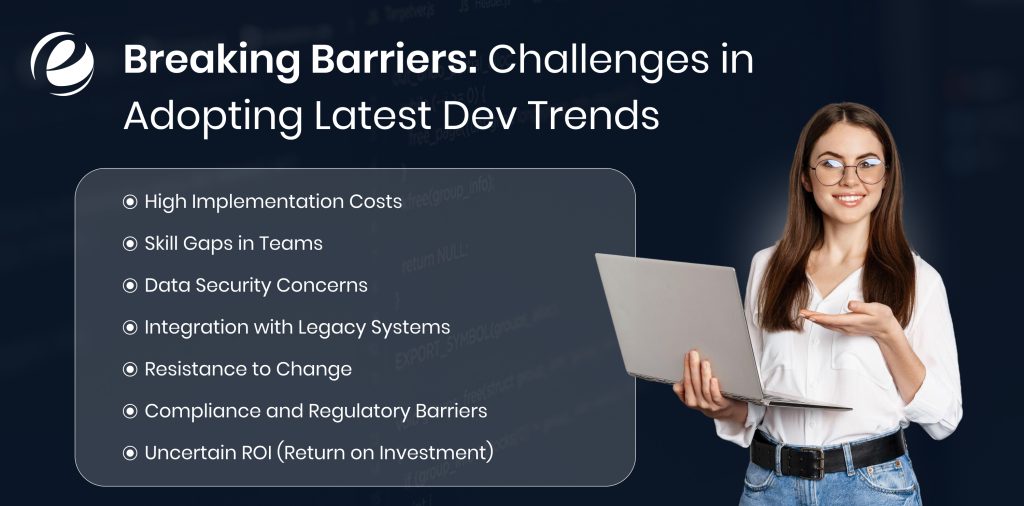
While assuming new software development trends is important for remaining competitive, it is not easy. Companies that embrace new software development industry trends will deal with various challenges regarding costs, security, skills, and integration. Knowing these challenges will help organizations formulate better strategies for dealing with them effectively, so they can avoid typical errors associated with the adoption of new technology
1. High Implementation Costs
New technologies such as AI, blockchain, and cloud-native technologies are often a costly investment. In particular, smaller organizations often struggle to find the budget for the tools, infrastructure, and staff with the right skills. Although these trends may provide a favorable long-term commitment, the costs of setting these up can sometimes seem daunting.
2. Skill Gaps in Teams
Not all developers are equipped to deal with the latest software development trends. For example, many of these technologies demand advanced skills or certifications that developers are in the process of achieving. Upskilling and hiring experts will take time and money against the major deployment timeline.
3. Data Security Concerns
When there are major advances in technology, there also come some vulnerabilities. The AI, cloud, and IoT-based systems can expose sensitive data to these threats if they are not dealt with in the right manner. When businesses adopt new industrial software development trends, they should follow modern security expectations, but unfortunately, not many organizations do this as a priority early.
4. Integration with Legacy Systems
In business, companies that already operate on legacy systems will face many integration challenges trying to integrate more modern technologies, for example, cloud or API first applications will not integrate easily into legacy systems. This can lead to delays, increased costs, and resistance by the team.
5. Resistance to Change
Employees and management will sometimes be reluctant to transition from known systems to newer technology tools. There may be fear of job changes, steep learning curves, or uncertainty regarding an applicable ROI. Establishing a culture that embraces change is vital to overcoming this obstacle.
6. Compliance and Regulatory Barriers
Companies with more stringent regulations, particularly industries like healthcare, finance, and any sort of government involvement, find it more difficult to adopt the latest software development trends, such as AI or blockchain-related programming, when legal counsel is not as rapid as innovation. This will cause delays in adoption, as well as increased compliance costs.
7. Uncertain ROI (Return on Investment)
Every organization desires new developments and trends; however, not every trend offers immediate returns or improvements. In the rush to establish modern technology like new tools, some organizations fail to recognize that the new tools may not fit their appropriate development goals, and added developments to current systems are not a clear example of the original intent or pathway without the proper software development.
Without the guidance of software development services, there is always a risk that the organization can overspend on these systems with no visible improvements.
Industries Impacted the Most by Software Development Trends
From healthcare, finance, to retail, companies are facing large opportunities to innovate around new technologies. These latest trends in software development represent a monumental challenge to execute, serve customers, and remain competitive. Certain industries will be impacted more significantly than others because they will have to innovate faster, smarter, and safer continually.
1. Healthcare
The digital transformation of the healthcare sector with telemedicine, AI-based diagnostics, and remote patient monitoring via IoT devices represents the software solutions’ potential to help enhance patient care by doing it more quickly, more accurately, and more broadly, especially in rural settings. By 2025, specialized Healthcare Software Development promises to be one of the leading indicators in helping to improve healthcare systems globally.
2. Finance & Banking
This sector is utilizing AI-based fraud detection models, blockchain, and artificial intelligence to improve payment options. Custom payroll software and Accounting Software similar to QuickBooks are available to properly streamline, comply, and operate. The software development industry trends in finance are increasing the speed, robustness, security, and transparency of financial services.
3. Retail & E-commerce
Retailers are embracing AI personalization and chatbots alongside immersive AR/VR shopping experiences to engage their customers. Progressive web apps (PWAs), not to mention cross-platform apps, have provided more seamlessness to retail activities online. Due to the increase in competition in the marketplace, retail could be the industry that has been impacted the most by advances in software development.
4. Manufacturing
Smart factories with IOT, automation, and AI efficiencies are decreasing downtimes and standardizing quality control in the manufacturing environment; therefore, software development is especially crucial for many manufacturing companies.
For example, predictive analytics helps manufacturing pros identify forecasting patterns such as demand and bottlenecks. These advancements strive for sustainable manufacturing practices but also demonstrate an industry shift toward a more data-informed power by using in-depth research into software development.
5. Education
E-learning platforms, AR/VR classrooms, and AI-mediated personalized learning (i.e., remote teaching) are molding education systems holistically. Software development industry trends in education can enable instruction by many means, such as real-time data analytics about students when they attend a course online. The latest software development trends that accommodate remote/ hybrid and high-reach learning of students ensure a broad population’s access to reputable education.
6. Logistics & Transportation
The logistics sector is managed by real-time data, sample tracking, and route optimization based on Artificial Intelligence. Fleet operations can be more seamless, deliveries happen quicker, and fuel utilization decreases when we use the right software solution. The increasing demand for e-commerce in 2025 will be headed for software-driven logistics for the smart logistics approach.
7. Energy Sector
The energy sector is using software to monitor smart grids, monitor renewable energy, and do predictive maintenance on its assets. Companies are using AI and IoT to consume energy efficiently. With an increasing focus on sustainability, software solutions are playing an important role in the energy sector to help further green operations.
How We Help You Develop Software Using the Latest Trends?
At EmizenTech, we know that the technology world is ever-changing and businesses must keep up by adopting technology and software development trends. Our team of experts brings together technical knowledge and industry experience to create software that is not only ready for the future but also fits your individual business needs.
EmizenTech creates custom enterprise solutions such as CRM Software Development, Healthcare Software Development, and Accounting Software Such as QuickBooks or Custom payroll applications. Our method is not the “one-size-fits-all ” approach, but rather creating a solution based on your industry and the needs of your organization.
The difference in our organization is that we put more focus on affordability and scalability. Following our approach (software development cost guide), we get your organization comfortable with planning accordingly, while you achieve maximized ROI on your software project. With our recommended frameworks for security, we are experienced in complying with regulatory agencies in global practices and specialized industries such as finance, healthcare, and e-commerce.
Final Words
The technology forecast is unmistakably clear; the software development trends 2025 will herald a tech future dominated by AI, automation, cloud-native solutions, cybersecurity, and other industry-specific solutions. Every industry, from healthcare to fintech and retail and logistics, is transforming into a smarter, more efficient, and secure industry with digital solutions. With challenges such as high costs, a talent gap, and integration hurdles certainly present, companies that proactively take advantage of the trends of software development (and develop it in the appropriate way) will give themselves a significant benefit over competitors.
At this point, it is no longer optional to subscribe to innovation! Taking a full-stack approach to developing custom enterprise apps, adopting Healthcare Software Development, developing accounting software like QuickBooks, or creating CRM and payroll platforms that will scale in the future are just a few examples of how companies should be building to prepare for the future.
Change is necessary to remain relevant in the future, so new solutions must be embraced for today’s innovation. Technology professionals, like the EmizenTech team, will have access to a wider variety of trends, and they will help make sure that you apply and capitalize on the trends into actual business value.
In general terms, the future will belong to companies that can innovate, adapt, and invest into emerging trends in the software development vertical. The software development trends 2025 is just the opportunity to do that at exactly the right time.

FAQs
What are the key software development trends 2025?
In 2025, the major trends in software development include purchasing - AI-led development, No-code/Low-code platforms, cloud-native apps, cybersecurity-first approaches, IoT, blockchain, and hyperautomation.
Why should businesses follow the latest trends in software development?
Keeping up with the latest software development trends helps businesses to compete and discover the most effective ways to save time and money, improve customer experience, and could also help to save money, long-term.
Which industries are most impacted by software development trends?
Software development trends are impacting healthcare, finance, retail, manufacturing, logistics, education, and energy industries.
How much does it cost to develop software with the latest trends?
Costs are based on scale and the level of complexity, as well as features in the program and technology. A Software Development Cost Guide is a great guide for being more accurate and precise when creating a budget.
How can EmizenTech help in adopting these trends?
EmizenTech provides custom software development services, which include CRM, healthcare software development, and accounting software like QuickBooks; therefore, businesses are future-ready and financially viable.




 +1 (989) 535-9295
 info@emizentech.com
 emizentech


