
 Add us as a preferred source on Google
Adobe Commerce Cloud is a leading and powerful e-commerce platform designed specifically to meet the unique needs of B2B businesses. Originally known as Magento Commerce Cloud, it combines the flexibility of an open-source platform with the added benefits of cloud technology. This platform is ideal for both B2B and B2C companies, offering a secure, scalable, and reliable environment for online transactions.
Since its launch as Magento Commerce Cloud, Adobe Commerce Cloud has become a robust tool that empowers businesses and developers with the features they need to thrive in a competitive marketplace. As per BuiltWith Trends, there are currently 1,14857 live websites currently using Adobe Commerce Cloud. Moreover in the US only, there are around 37,616 websites currently operating on Adobe Commerce Cloud. In this blog, we will explore the standout Adobe Commerce Cloud features that set it apart from other solutions for B2B enterprises.
What is Adobe Commerce Cloud?

Adobe Commerce Cloud is a fully managed, cloud-based eCommerce platform. It enables fast and secure setup of scalable online stores. This B2B eCommerce platform includes managed Magento hosting and pre-set infrastructure, making it easier to get your eCommerce store up and running quickly.
In addition to all the essential features of Adobe Commerce, like catalog management, advanced marketing tools, visual merchandising, and customer segmentation. Adobe Commerce Cloud also offers extra features that help eCommerce businesses enhance their branding and grow effectively. These additional include:
- Web Application Firewall (WAF) via Fastly
- Content delivery networks (CDN) through Fastly
- Performance optimization with Blackfire as well as New Relic
- Source code version control using GitHub
- Continuous integration and DevOps (CI)
- Tools for managing dependencies, such as Composer
- Cloud hosting provided by AWS
- Integration of mail by Twilio SendGrid
Connecting Adobe Commerce Cloud with Adobe Experience Manager also makes it easier to take advantage of the full range of functions and tools. Adobe Experience Manager is a customizable and adaptable solution offered by Adobe that assists brands in making their customer journeys smoother and more efficient to increase conversion.
Adobe Commerce Cloud Architecture
Adobe Commerce Cloud is structured around four main environments that support the development, testing, and deployment of your website:
- Master Environment: This is where your website’s code is stored. Developers use this environment to test and debug the code without affecting the live website.
- Production Environment: This is the live version of your website that online users see (but not your internal team).
- Integration Environment: In this environment, the cloud commerce development team will build and test new features or changes on the site.
- Stage Environment: This is where different teams can review the latest version of the website before it is released to production. It’s also used to test the entire system for bugs.
Along with a foundation that supports continuous testing and improvement, Adobe Commerce Cloud also benefits from cloud-native features. As a cloud-hosted platform, it can scale automatically during busy times, reducing the risk of downtime.
Is Adobe Commerce Beneficial for B2B Enterprises?
Adobe Commerce Cloud offers unique features that make it stand out from both the on-premise Adobe Commerce and the open-source version of Magento. These Adobe commerce cloud features make it especially beneficial for B2B businesses.
Let’s take a closer look at the benefits of Adobe Commerce Cloud to understand why it’s the perfect choice for B2B companies.
1. Efficient Order Management Systems
Order management can be challenging for B2B enterprises, but Adobe Commerce Cloud streamlines the entire process. Adobe Commerce Cloud can easily handle bulk orders, repetitive orders, and order subscriptions. This platform ensures accuracy and speed in order processing, as well as inventory and logistics management.
2. Powerful Integration Capabilities
Powerful integration capabilities are the most notable characteristic of Adobe Commerce Cloud. This seamlessly integrates various ERP and CRM systems, essential to the smooth operation of B2B operations. This integration ensures that information is seamlessly transferred between the e-commerce platform and the other business applications, providing a unifying view of the processes and improving efficiency.
3. Customizable Catalogs and Pricing
Adobe Commerce Cloud is the most customizable catalog of products and pricing models. This is an essential feature for B2B companies. With its sophisticated customization capabilities, companies can customize their product offerings and pricing plans to meet the various needs of business customers. This flexibility is an important benefit in a B2B business environment in which product pricing and availability typically differ based on customer segments.
4. Robust Account Management Features
To understand the complicated nature of B2B business operations, Adobe Commerce Cloud offers comprehensive account management capabilities. Adobe Commerce Cloud allows companies to create multiple user types and permission rights mapped to the B2B client hierarchy. This approach provides more granular control and ensures a tailored experience for each user within the same firm.
5. Advanced Analytics and Reporting
Adobe Commerce Cloud is equipped with the latest reporting and analytics tools, which provide deep insights into customer behavior, sales performance, and market trends. This feature is especially beneficial for B2B companies, which can use data-driven information to plan and make educated decisions.
Top Features of Adobe Commerce Cloud for B2B Enterprises
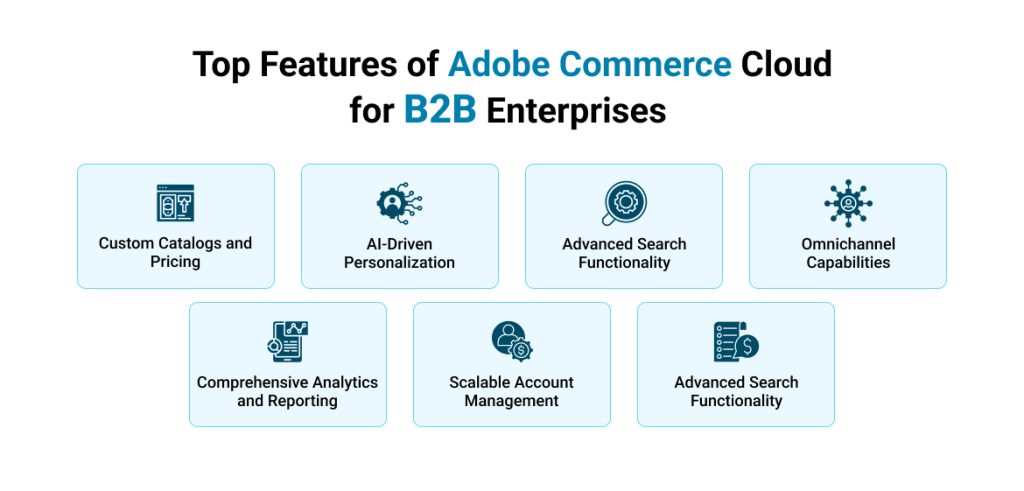
Adobe Commerce Cloud is a robust platform that can be used that can be used for massive B2B operations. Let’s look at the most popular Adobe Commerce Cloud features that make it an ideal choice for companies with large-scale operations.
1. Custom Catalogs and Pricing
One of the best features of Adobe Commerce Cloud is its ability to personalize the content that customers see. You can create up to 500 different customer groups, each with its own catalog and pricing. This is especially helpful for B2B businesses, as you may have different offers for different types of customers.
For example, if you’re selling office products, you can show small businesses a different product selection than you would show to larger corporations. Small businesses may find certain products more affordable, while larger companies could avail bulk discounts. Custom pricing lets you offer special deals to your most important customers without revealing those prices to everyone.
The platform also offers dynamic pricing rules, which let users create detailed pricing structures based on factors like customer loyalty, order size, or contract terms. This allows businesses to automate your pricing to match the specific needs of business relationships, saving time while keeping pricing consistent across all transactions.
This level of customization helps businesses to treat each customer as unique—and they truly are! It’s a great way to build trust and encourage B2B clients to come back. If you want to leverage the benefits of Adobe cloud commerce, check out our eCommerce consulting services.
2. AI-Driven Personalization
Adobe Commerce Cloud uses powerful AI technology called Adobe Sensei. This is not just an add-on, it is built directly into the platform, making the shopping experience more personal and convenient for your customers.
AI examines what each customer has purchased before, what they’ve browsed through, and how they explored your website. It uses this data to suggest products that they are likely to purchase. It’s similar to having an intelligent salesperson for every customer all day long.
However, it’s not all about product recommendations. AI will also make search results more relevant. When a user types in “blue widgets,” the system does not just display all blue widgets. It determines what blue widgets a specific person most likely needs based on their search history and browsing data. This can significantly increase the search speed with which customers can find what they want, and for B2B enterprises, time counts.
AI-driven personalization also improves the entire customer journey. It can adjust your homepage layout, highlight the features customers care about in product descriptions, and personalize marketing emails. This kind of personalization can greatly increase conversions and boost customer satisfaction in the B2B market, where trust and understanding customer needs are key.
3. Advanced Search Functionality
It’s not only about speed. The search feature of Adobe Commerce Cloud is aptly intelligent. It can handle wrong spelling, identify similar words and understand context effectively. If someone misspells ”screwdriver” as “screwdiver” they will find what they’re looking for.
Users can start by searching for something like “laptops” and then narrow down the results by brand, price, or even specific features. This is especially helpful for B2B, where buyers often know exactly what specs they need.
For B2B customers with very particular needs, it offers advanced search functionalities such as SKU search attributes and product documentation browsing. If a customer is searching for the exact part number, or products associated with the specific technological specifications they need, they are able to quickly and efficiently find it.
4. Omnichannel Capabilities
Today, customers want to shop how they like, either online, in-store or via a sales representative. Adobe Commerce Cloud makes this simple by allowing omnichannel shopping. It provides a shopping preference overview of the customers you serve across every channel, ensuring an identical experience regardless of the method they prefer to shop.
For example, a customer might start researching items on their phone. They could add products to their cart on a computer and finish the purchase with a sales representative. With Adobe Commerce Cloud, all information is backed up. Sales representatives can view the items in the cart and continue where the customer has left off.
The platform also works with Adobe Experience Cloud, which offers additional omnichannel functions. You can manage content, customize experiences, and monitor customer journeys across your channels from one location.
For B2B businesses, the omnichannel model extends to other areas, such as customer service and order management. Customers can order online and then contact the company to modify the order. With Adobe Commerce Cloud, your customer service representatives can easily access and modify the order and ensure a seamless experience for customers regardless of how they decide to interact with your business.
5. Comprehensive Analytics and Reporting
In B2B, smart decisions rely on good data. Adobe Commerce Cloud provides real-time insights, showing sales, customer behavior, and inventory levels instantly.
For B2B businesses, the platform offers advanced reporting features like customer segmentation analysis, lifetime value calculations, and detailed purchase history reports. These tools help you identify your top customers, understand their buying habits, and adjust your strategies to better serve them. You can also track key B2B metrics, such as the average order value, repeat purchase rates, and customer acquisition costs.
Storing data is important, but understanding it is equally crucial. With custom dashboards, the platform lets you create reports that display the information you need. For example, you can quickly find out which products sell the most or which customer group is the most profitable. All of this can be done in just a few minutes.
Analytics tools will also help you spot trends and possible opportunities. You can analyze which items are often bought together or see when a product sells more at certain times.
It will guide you to know how to market your inventory and develop your product in the future.
For B2B businesses, the platform offers advanced reporting features like customer segmentation analysis, lifetime value calculations, and detailed purchase history reports. These tools help you identify your top customers, understand their buying habits, and adjust your strategies to better serve them. You can also track key B2B metrics, such as the average order value, repeat purchase rates, and customer acquisition costs.
6. Scalable Account Management
Adobe Commerce Cloud can manage over 100,000 customer accounts, making it perfect for complex B2B marketplace development needs. It lets you create complex account structures, so you can organize and manage your customers the way you want. This makes it easier to handle different business partnerships, all from one platform.
The system also allows you to set up different roles for each account. This is especially useful for B2B businesses where multiple employees may be involved in the purchasing process. You can assign specific roles like buyers, approvers, and administrators, each with their own level of access. This ensures everyone can do their job without interfering with others.
Moreover, it supports a hierarchical account structure, which is perfect for large companies with multiple departments or subsidiaries. Each sub-account can have its own catalogs, settings, and prices, while still being part of the main organization. This flexibility makes it easy to manage and track even the most complex B2B relationships within the platform.
Adobe Commerce Cloud focuses on making things easier for both customers and businesses. Using these account management tools businesses create a smoother and more efficient business flow.
7. Advanced Quote Management
Negotiating is essential in B2B enterprises. Adobe Commerce Cloud simplifies this with its advanced quote management tool. Customers can request quotes directly from their accounts, and your sales team can respond quickly and easily.
The system keeps track of all communication, so you don’t have to worry about losing important information in a chain of emails. Your team can add notes, adjust prices, or even attach documents to quotes. This makes it easier to manage large orders or special service requests.
The best part is how the quote system works seamlessly with other website features. Once a quote is approved, it can be turned into an order with just one click. This reduces the risk of mistakes when transferring data between systems.
The quote management system also supports multi-level approvals, which is crucial for many B2B processes. You can set up workflows that require quotes above a certain value to be approved in multiple stages. This ensures that everyone in high-value transactions is included and there is proper oversight and control.
8. Seamless ERP Integration
For large B2B operations, it’s important that your online store can connect with back-end systems. Adobe Commerce Cloud excels in this area, as it can integrate with almost any ERP system you use and is compatible with most of the ERP software.
What does this mean in real life? Let’s say you get a large order from your online store. ERP integration helps automatically add the order details into your stock management system. Stock levels get updated in real-time, so you always know how much stock you have. If prices change in your ERP system, they will be updated on your website right away.
This seamless connection helps prevent errors and saves a lot of time. You won’t have to manually enter data or worry about whether your systems are synced. Everything is done automatically, allowing you to focus on growing your business instead of managing information.
The integration goes beyond just price and inventory. It can also sync customer details, like order history and customer data, along with more complex pricing rules between the ERP system and Adobe Commerce Cloud. This allows your sales team, customer service reps, and other departments to access up-to-date information, leading to better decision-making and improved customer service.
9. Robust Security Measures
When handling large B2B transactions, security is a top priority, and Adobe Commerce Cloud takes it seriously. The platform is PCI DSS 3.2.1 Level 1 certified, the highest level of security for processing credit card transactions.
But security isn’t just about protecting payment information. The platform also includes advanced built-in fraud protection. It uses machine learning to detect suspicious activity and prevent fraud before it happens. This is especially important for B2B businesses, where transactions are large and complex.
Adobe keeps the platform updated with the latest security patches, so you don’t have to worry about security threats. Adobe’s security team is always working to protect your data and customer information.
On top of these updates, Adobe Commerce Cloud also offers extra security features like two-factor authentication, IP blacklisting, and role-based access controls. These features let you add more layers of protection for sensitive areas of the B2B platform, ensuring that only authorized users can access important information or make major changes.
10. Headless Commerce Architecture
Adobe Commerce Cloud uses a “headless” architecture. While it might sound complicated, it’s actually quite powerful. It separates the front end (what customers see) from the back end (where data and processes are managed). This makes the platform more flexible and adaptable.
Headless Commerce offers great flexibility. It allows you to create custom front-end experiences for different types of customers or devices. For example, you can design a simple mobile interface for smartphone or mobile devices, or a more advanced desktop experience for those shopping from a desktop or laptop.
The platform also follows an API-first approach, making it easy to integrate Adobe Commerce Cloud with other platforms or applications. This is especially useful for B2B businesses that need to connect with various tools or build custom apps.
The headless architecture makes it easier to update and innovate quickly. You can make changes to the front end without affecting the back end, or vice versa. This flexibility allows you to adapt to changes in the market or customer needs without completely redesigning the system. For B2B companies, this ability to quickly adjust can be a game changer in staying competitive.
Unique Key Points That Make Adobe Commerce Cloud Beneficial for B2B Enterprises

Here are the key factors that make Adobe Commerce Cloud stand out in the eCommerce industry for B2B enterprises.
1. High Scalability and Customization
Adobe Commerce Cloud offers unmatched scalability and flexibility. Whether a business is expanding its product range, entering new markets, or handling high-traffic periods, the platform can easily scale to meet these needs. Plus, Adobe Commerce developers can customize the platform to fit the unique requirements of each business.
2. Strong Support and Developer Community
The success of Adobe commerce is driven by Adobe’s strong support and the active Magento Commerce Cloud developer community. This community provides helpful resources, support, and fresh ideas, making Adobe Commerce Cloud a constantly improving and growing platform.
3. Tailored B2B Functionality
One of the key features that make Adobe Commerce Cloud stand out is its extensive B2B capabilities. Adobe has added specialized features to meet the unique needs of B2B businesses, simplifying complex processes and making them easier to manage. This allows B2B companies to streamline their operations and better serve their customers.
These features include bulk or dering, custom catalogs, price negotiation, and advanced account management. The platform allows businesses to create a personalized and efficient buying experience, tailored to the specific needs of clients in manufacturing, wholesale, and distribution industries.
4. Seamless Omnichannel Experiences
In today’s digital world, offering smooth, multi-channel experiences is essential. Adobe Commerce Cloud does this really well, helping businesses provide consistent and personalized experiences across different platforms and touchpoints.
Why Choose EmizenTech for Adobe Commerce Cloud Implementation?
Adobe Commerce Cloud stands out in the B2B eCommerce market because of its features designed specifically for B2B processes, customization options, omnichannel support, and strong developer assistance. It’s a great choice for growing businesses in the B2B eCommerce space.
By partnering with EmizenTech, B2B enterprises can leverage the benefits of Adobe Commerce Cloud development services to easily build and maintain their online stores. We are a leading Adobe Commerce cloud development company that offers Adobe commerce implementation services with continuous support, custom development, and improvements.
The Key Takeaway
Adobe Commerce Cloud is packed with features that make it a great option for businesses handling B2B operations. It can easily manage complex account structures and offer custom pricing. Plus, it includes powerful tools for analytics and search, making it even more useful for large companies.
The platform’s main focus is security. Its flexible design and built-in features allow it to adapt to the unique needs of different organizations. Adobe commerce cloud features help B2B companies provide a smooth, personalized shopping experience and support across multiple channels.
FAQ
What is Adobe Commerce Cloud, and why is it important for B2B eCommerce?
Adobe Commerce Cloud, formerly Magento Commerce Cloud, is a complete eCommerce platform for B2B and B2C markets. It provides secure, scalable, cloud-hosted B2B eCommerce solutions that are flexible and highly customizable.
How does Adobe Commerce Cloud address the specific needs of B2B eCommerce?
Adobe Commerce Cloud caters to B2B needs by offering features like customized catalogs, flexible pricing, efficient order management, and strong account management, all tailored to handle the complexity of B2B transactions.
What are the key benefits of using Adobe Commerce Cloud for B2B companies?
The main advantages of Adobe Commerce Cloud features for B2B companies include customizable product catalogs, modern order management systems, and robust account management. These features integrate smoothly with CRM and ERP systems, which are vital for B2B operations.
Can Adobe Commerce Cloud integrate with other business systems?
Yes, Adobe Commerce Cloud seamlessly connects with ERP, PIM, CRM, and other systems. This is crucial for smooth B2B business operations.
Why is selecting the right Adobe Commerce development partner essential?
Choosing the right development partner is crucial because they will ensure the smooth setup of the platform, provide continuous support, and make sure your business goals align with the capabilities of Adobe Commerce Cloud. This helps maximize its value for your business.



 +1 (989) 535-9295
 info@emizentech.com
 emizentech


