 Add us as a preferred source on Google
Ever wondered if your next “Buy Now” button could bankrupt your business? Click. Pay. Gone. This is how fast a breach can take away the income of an eCommerce company for months, if it does not have fraud prevention as part of its growth strategy.
Ecommerce fraud prevention is a clear protection against scams such as stolen cards and account takeovers. A study done by Research and Markets estimates that this market will grow from $6.97B to $25.92 (2025-2032), and the increase in the number of transactions and the use of sophisticated methods in attacks are the main reasons behind this growth.
Moreover, the top industry reports published by Juniper Research and Statista also reflect the upsurge in eCommerce, and this trend is directly linked to amplified risk and a greater need for eCommerce security. In this guide, you will discover how you can use eCommerce cybersecurity and eCommerce website security to keep fraudsters at bay until your next order becomes their next success.
What is eCommerce Security?
Ecommerce security entails the use of technologies, practices, and processes to shield online retailers from cyber threats and unauthorized access. The primary function of online security standards is to block illegal access to customer information, payments, and services by means of, e.g., encryption, firewalls, and multifactor authentication.
Ecommerce security, in contrast to regular website security, must additionally safeguard payment data, ward off eCommerce fraud, handle chargebacks, and adhere to financial regulations like PCI DSS, etc., besides. The very useful eCommerce fraud prevention practices will discover irregularities as they happen, whereas the eCommerce site security will be preventing data breaches, account takeovers, and loss of sales at the source.
Why eCommerce Security Matters?
Prevents Massive Financial Losses: The use of strong eCommerce fraud prevention measures can greatly reduce chargebacks and refunds, thereby preventing up to 5-10% of yearly revenue from being stolen by fraudsters who take advantage of poor eCommerce website security.
Builds Customer Confidence: Security standards that successfully prevent eCommerce fraud, like secure payment transactions, generate loyalty among customers and consequently, the rate of abandoned carts in ‘high-trust’ environments drops by 30%.
Ensures Regulatory Compliance: E-commerce cybersecurity not only protects the business from legal risks in the world market but also from the non-fulfillment of GDPR/PCI fines.
Boosts Long-Term Growth: The application of security measures during the development of eCommerce websites allows the business to safely scale up even when online threats are increasing.
What Is eCommerce Fraud Prevention?
Ecommerce fraud prevention means the implementation of intelligent tools and methods to restrain the fraudster’s access to money during online shopping. It provides protection against fraudulent orders, credit card theft, and chargebacks by means of real-time alerts and AI monitoring.
Things as easy as address verification and tracking of the device keep the fraud prevention measures in eCommerce in a position to block bad transactions. The payment fraud in the eCommerce domain is a focus of the advanced security system, and at the same time, it ensures that your online store remains safe and your customers satisfied, unlike basic eCcommerce security, which covers the entire eCommerce transaction.
Why eCommerce Fraud Prevention Matters?
Saves Revenue: Ecommerce fraud prevention systems prevent chargebacks and refunds, thus safeguarding 5-10% of the total sales that criminals can steal through weak eCommerce security.
Builds Trust: Dependable fraud prevention in eCommerce lowers the rate of cart abandonment by reinforcing consumer trust and securing eCommerce fraud-free.
Avoids Fines: Keeping up with the standards of eCommerce cybersecurity compliance prevents the infliction of expensive PCI DSS penalties and the legal consequences resulting from data mishandling.
Enables Growth: An eCommerce site with secure security can help to enlarge the business unit without interruption of scaling operations during the peak periods caused by the increased traffic flow.
Ecommerce Cybersecurity vs Ecommerce Fraud Prevention
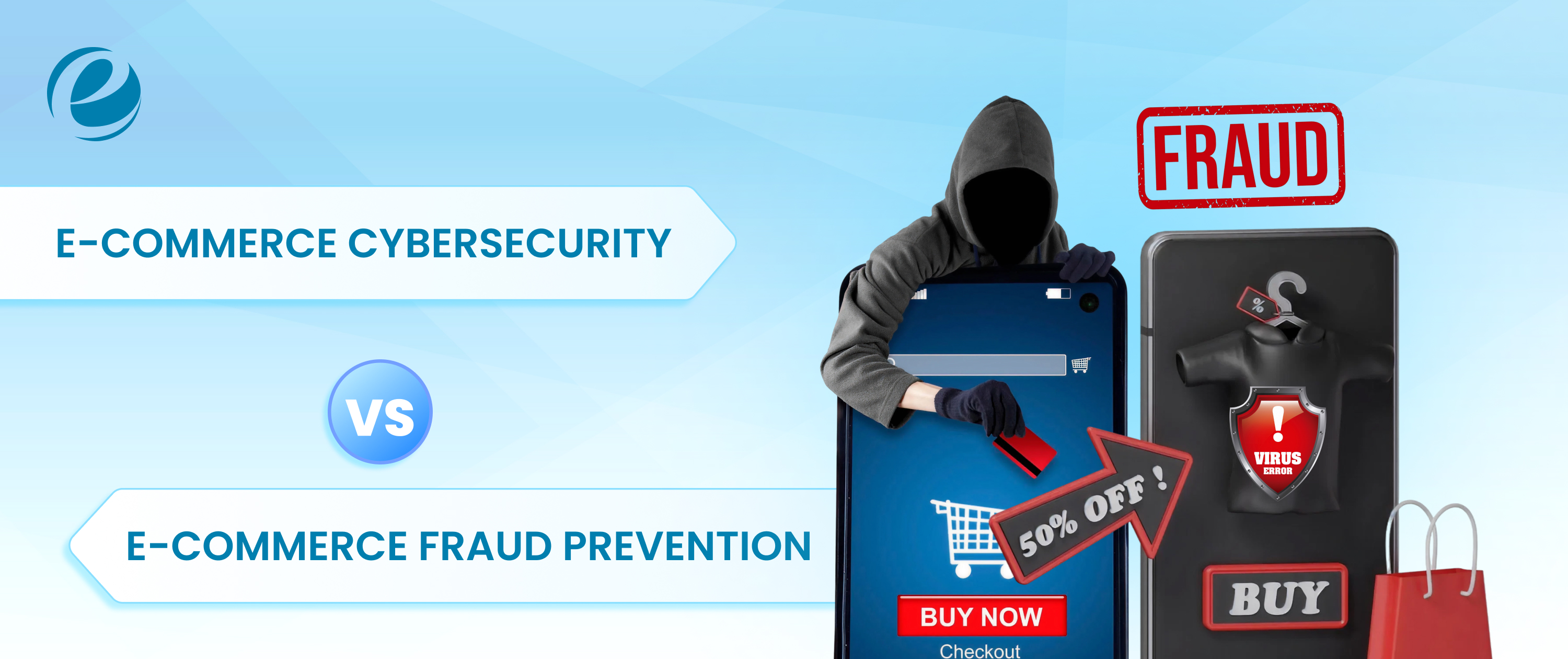
Ecommerce cybersecurity is the shield against technological threats like hacking and disorder by malware throughout the internet ecosystem, but eCommerce fraud prevention controls the financial scams, such as stolen cards and chargebacks. It is a must for dual eCommerce security in the retail landscape of today.
Ecommerce Cybersecurity
Ecommerce cybersecurity is a security that protects the whole platform from various kinds of cyber threats, such as malware, DDoS attacks, and data breaches. It is a multi-layered security that includes firewalls, SSL/TLS encryption, and intrusion detection to keep the eCommerce website safe.
With this type of security, the business does not have to worry about the privacy of its data or the reliability of its systems, or the cost of downtime, which could be in the millions and is suffered by many companies annually.
Ecommerce Fraud Prevention
Ecommerce fraud prevention is all about getting rid of the bad transactions by utilizing technologies such as AI-driven anomaly detection, 3D Secure, and velocity checks.
It also helps overcome chargebacks, account takeovers, and friendly fraud in the area of fraud prevention eCommerce, thus not only protecting the revenue but also the customer trust through real-time monitoring.
Key Differences
| Aspect | eCommerce Cybersecurity | eCommerce Fraud Prevention |
| Primary Focus | Broad protection of infrastructure, data, networks | Specific transaction validation and scam detection |
| Key Tools | Firewalls, antivirus, encryption for eCommerce security | AI scoring, CVV checks to prevent eCommerce fraud |
| Threats Addressed | Hacking, phishing, DDoS attacks | Chargebacks, stolen cards, bot attacks |
| Scope | Entire eCommerce website security ecosystem | Payment gateways and order flows |
| Metrics | Uptime, compliance (PCI DSS) | Fraud rate <1%, chargeback ratio |
| Integration | During eCommerce development | Real-time in checkout for eCommerce cybersecurity |
Common eCommerce Threats in 2026
In the year 2026, eCommerce security finds itself in the midst of the battle against AI-driven bots and sophisticated scams that are already costing retailers billions. Along with the rise in the number of online sales, eCommerce cybersecurity should also grow stronger in order to overcome these threats.
Cybersecurity Threats
- XSS (Cross-Site Scripting): The harmful scripts that are inserted into the web pages are stealing session cookies, which helps them to get past the eCommerce cybersecurity, and the user data on the weak sites is being compromised.
- Phishing Attacks: Fraudsters impersonate trusted sites, making it easy for them to steal credentials and eventually bypass basic security for eCommerce website through social engineering techniques.
- DDoS Attacks: Turn the servers into a place that’s always down, thus causing the sales to be disrupted even during the peak hours when the eCommerce cybersecurity has put up defenses.
- Malware Injection: Hacks up the sites with ransomware and thus encrypts the data, demanding a ransom from the unprepared eCommerce development team.
- Data Breaches: Open customer information to the outside world through SQL injections, consequently making the trust in fraud-preventing eCommerce systems deteriorate.
- Man-in-the-Middle: Plunges unencrypted traffic, thus making it impossible to prevent the eCommerce fraud efforts, and it goes through.
Ecommerce Fraud Types
- Payment Fraud: Almost all purchased items made through stolen cards pose a question to eCommerce fraud prevention, whether it would be through fake information or not.
- Account Takeover: Hackers get to log in through credential stuffing, thus undermining the eCommerce site’s safety.
- Friendly Fraud: Customers who are the actual ones making the payments practice get together to dispute and thus increase chargebacks, even though there are eCommerce security checks.
- Return Fraud: False return of counterfeit goods, instead of being caught by the preventive eCommerce fraud monitoring, the companies get fooled.
- Bot Attacks: The use of automated scripts, either to pretend to be real visitors or scrape the data, is a situation where eCommerce might need to go a step ahead in terms of protecting its cybersecurity.
- BNPL Fraud: Fraudsters who take EMI buy now, pay later eCommerce plans to their advantage, not paying after getting the products, which leads to a significant increase in merchant losses, even though weak eCommerce fraud prevention credit checks exist.
How Does eCommerce Fraud Happen?
Ecommerce fraud is a problem that happens really frequently: thieves are stealing millions every day by taking advantage of insecurities in the checkout flow. The actual cases have shown that eCommerce with bad fraud prevention leads to huge losses.
Case 1 – Stolen Card Checkout Fraud
A hacker takes advantage of Black Friday sales to purchase luxury items with a stolen credit card. The order is shipped out before the cardholder is aware, and the retailer has to give out more than $50,000 in refunds, even when basic eCommerce fraud prevention actions are in place.
Case 2 – Account Takeover & Unauthorized Orders
Hackers gain access into customer accounts by accessing leaked passwords from previous data breaches. They place large, rapid orders to fake addresses and avoid eCommerce cybersecurity by not using multi-factor authentication.
Case 3 – Chargeback Abuse
A buyer continuously disputes rightful deliveries as “non-delivery,” which compels merchants to refund orders and incur fees, revealing weaknesses in fraud prevention, eCommerce processes, and delivery-proof verification.
Case 4 – Friendly Fraud Scenario
A consumer forgets about a subscription fee and charges back for an “unauthorized transaction.” This “friendly” scam has soared after Christmas, making it even harder for eCommerce sites to maintain trust and cutting into their margins.
Case 5 – Bot-Driven Card Testing
Bots try out thousands of stolen cards on your website within a few seconds, and by the time they do it, the alerts have come too late. The blocked attempts mark your merchant account, calling for strong security measures for eCommerce websites, such as CAPTCHA.
Ecommerce Fraud Prevention Best Practices
Ecommerce fraud prevention is a skill that needs to be learned, and the best way to do it is through technology and vigilance, which are the most reliable methods. The use of these tactics completely and significantly reduces the fraud rate to a maximum of 70%.
Secure Checkout and Payments
- Implement 3D Secure: It enhances card payment security and stops fraud from taking place in the first place by creating more layers of authentication, including OTP.
- Tokenization: It replaces card information with symbolic data and strengthens eCommerce security without keeping customers’ confidential information.
Fraud Detection and Automation
- AI-Powered Scoring: Risk evaluation in real-time flags and orders that are suspicious for the fraud prevention review process in the eCommerce sector.
- Velocity Checks: It tracks the quick transactions coming from a single IP, and thus, the web security of the eCommerce site is strengthened.
Chargeback Management
- Proof of Delivery: Automatic notifications, together with tracking, help to prevent abuse of security for eCommerce websites through this method.
- Pre-Authorization Holds: This process ensures that funds are set aside for eCommerce fraud prevention disputes.
Customer Verification
- Address Verification Service (AVS): Addresses that are used for billing and shipping are compared, and the mismatches are blocked in eCommerce security.
- Device Fingerprinting: It identifies user devices, and this is how anomalies are detected.
Platform & Team Training
- WooCommerce Plugins: Fraud protection tools can be used during WooCommerce development to ensure protection is effective and smooth.
- Staff Vigilance: The teams are to be trained to identify the red flags and to incorporate eCommerce cybersecurity consciousness in their daily work.
Advanced Monitoring
- Machine Learning Alerts: The latter works together with the threats through how IoT is playing a role in eCommerce for getting real-time insights.
- Regular Audits: Ensures that there is always compliance in the case of eCommerce fraud prevention.
Ecommerce Cybersecurity Best Practices
Cybersecurity in eCommerce can be extended to a new level with the help of a secure structure of different layers that will protect the sites from being hacked. It is through these practices that a robust and secure eCommerce environment is created, and at the same time, the chances of data loss or downtime are considerably reduced.
Website and App Security
- SSL/TLS Encryption: This method secures the data sent over the web and is the basis for eCommerce-related security during the development of an eCommerce app.
- Regular Updates: Ongoing CMS (Content Management Systems) like WooCommerce will be the tech that secures the base, so keeping it running and updated is critical to prevent us from getting into a disadvantageous position where exploits can be developed through outdated software.
Authentication and Access Control
- Multi-Factor Authentication (MFA): This security feature makes the login process more complex and thus helps prevent unauthorized access to your online store.
- Role-Based Access: Only a few select individuals will be allowed to perform administrative functions, which in turn will decrease the risk of insider attacks against eCommerce security.
Firewalls & Malware Protection
- Web Application Firewalls (WAF): Traffic coming to the site is filtered, preventing a large portion of fraudulent activity connected with eCommerce.
- Antivirus Scanning: The process of malware detection and removal is done automatically.
Data Protection & Compliance
- PCI DSS Compliance: One of the requirements is the secure treatment of card data, which in turn stops eCommerce fraud.
- Data Encryption at Rest: No unauthorized individuals will have access to the stored information that is protected from breaches.
Monitoring and Incident Response
- SIEM Tools: Logs are generated in real-time to enable swift identification of threats that might be involved in eCommerce fraud prevention.
Ecommerce Security Checklist (Step-by-Step)

New Stores require basic security standards, Growing Stores step up their security, and Enterprises expect the highest level of eCommerce fraud prevention. This 5-step checklist adjusts the eCommerce security according to the different levels of the market.
Step 1: Assess Risks (Beginner Stores)
Check your site for weaknesses. Use SSL and basic AVS as the first steps in your security plan for the online store and, at the same time, keep the fraud prevention pitfalls in the early stage.
Step 2: Secure Payments (Growing Stores)
To prevent eCommerce fraud, integrating 3DS and tokenization during the eCommerce development process will make it possible for the layer that handles fraud to scale the traffic without any chargeback spike.
Step 3: Deploy Monitoring Tools (All Levels)
Leverage AI fraud detection and WAFs for immediate notifications, thereby making eCommerce security measures stronger even during expansion with the use of technology.
Step 4: Train and Comply (Enterprise-Level)
Go for MFA and PCI DSS through hire eCommerce developer with expertise. Equip your teams with industry-leading security for eCommerce websites through training sessions.
Step 5: Audit and Optimize (Ongoing)
Security integrates regular scans with eCommerce app development, thus ensuring long-term eCommerce fraud prevention.
Platform-Specific Ecommerce Security Tips
Customize the security standards for your eCommerce platform to achieve the most protection possible. The following suggestions will help you merge eCommerce fraud prevention smoothly with the most widely used systems.
Shopify Tips
Turn on risk analysis in the Shopify Protect feature and apply other solutions such as Signifyd for AI-powered eCommerce fraud prevention. Require 3DS for global transactions to reduce eCommerce fraud.
WooCommerce Tips
Use plugins such as WooCommerce Fraud Prevention during the WooCommerce development process to automatically install the means of fraud-free online shops. Implement CAPTCHA and an IP blacklist for the robust protection of eCommerce on WordPress sites.
Magento/Adobe Commerce Tips
Make adequate use of the built-in fraud prevention tools and the Braintree gateway to secure your eCommerce website. Allow time for continuous core upgrades to avoid being attacked through vulnerabilities.
Custom Platforms Tips
During the eCommerce app development, your security for the eCommerce website will be reinforced with the help of customized WAFs. An eCommerce developer with PCI compliance experience is needed to create personalized security measures.
BigCommerce Tips
Turn on the advanced fraud filters and the integration of EMI buy now pay later eCommerce with tokenized payments for secure processing.
Common eCommerce Security Mistakes to Avoid
Robust configurations can still suffer from insignificant mistakes. Avoiding these traps will help you to improve and keep eCommerce fraud prevention and security solid as a rock.
Skipping SSL Certificates
This action exposes your data to hackers; therefore, HTTPS should always be enabled on your website to reduce susceptibility to ongoing breaches, so ensure that HTTPS is consistently used.
Ignoring Software Updates
Not updating the WooCommerce pod leads to malware getting into your site; thus, your security measures become less effective.
No Multi-Factor Authentication
Account takeovers become extremely easy, thereby circumventing basic fraud prevention. MFA should be enabled everywhere.
Overlooking Mobile App Vulnerabilities
In the case of eCommerce app development, strong APIs can lead to fraud if not tested rigorously for prevention; still, the issue of eCommerce fraud can be postponed for a while.
Storing Card Data Unnecessarily
This practice puts the PCI DSS violations on the risk list of your online store, even if it has implemented top-notch security measures; better use the tokenization solution.
Neglecting Vendor Security
Vulnerability from the third-party plugins is a case that can be found sometimes; thus, plumbers who are the most skilled should still be scrutinized during the hiring process of an eCommerce developer.
Poor Chargeback Handling
Dispute resolution becomes impossible if the fraud prevention eCommerce system is not alerted; hence, automatic proofs for disputes need to be implemented.
What to Do If Fraud or a Cyber Attack Happens?
A breach requires immediate action to reduce the impact caused by the failures of the eCommerce fraud prevention systems. The first step is to isolate the systems involved, followed by investigating and recovering the data, and at the same time, notifying the stakeholders in order to quickly restore the security of the eCommerce site.
Immediate Isolation
The affected systems should be quarantined in order to stop the spread of the incident, thus preserving the security for eCommerce website’s integrity during the crisis.
Notify Customers and Authorities
Disclosures of the incidents should be made according to GDPR and PCI regulations, thus creating customer trust through open and honest communication about the eCommerce fraud prevention measures.
Forensic Analysis
Bring in specialists or hire an eCommerce developer for a root-cause investigation, which will subsequently lead to an improvement in eCommerce website security.
Secure Payments Recovery
Migrate to the use of tokenized gateways and 3DS to avoid eCommerce fraud after the incident.
Strengthen Monitoring
Incorporate AI tools and audits in the development of the eCommerce app for proactive eCommerce security.
Legal and Insurance Claims
Keep a record of everything for reimbursements, thus reducing the financial loss due to lapses in eCommerce cybersecurity.
Team Training Refresh
Practice drills on WooCommerce development security to prevent a recurrence.
Compliance and Legal Requirements
In the context of global operations, it is imperative to deal with eCommerce security regulations. The adherence to the main standards not only strengthens the prevention of eCommerce fraud but also helps avoid the imposition of heavy fines and, at the same time, gains the trust of the customers.
PCI DSS Compliance
Requires the merchants to handle cards securely to keep eCommerce fraud away; if not complied with, the risk of incurring penalties of more than $100K and losing the right to operate.
GDPR for Data Privacy
Necessitates providing a customer with a consent form and notifying them in case of a breach, and this is all part of the eCommerce cybersecurity of the EU customers.
CCPA/CPRA in US
Providing the customers with rights to their data, powerful security is then needed for practices at an eCommerce website to prevent lawsuits.
India’s DPDP Act
Commands data localization and security measures that are in line with the fraud prevention measures in eCommerce for the local stores.
SOC 2 Audits
Confirms the implementation of the controls for the security of the SaaS-integrated eCommerce website, the trust of the enterprises being essential.
Future Trends in eCommerce Fraud Prevention and Cybersecurity
Alongside blockchain technologies, AI will totally change the way eCommerce fraud is detected and prevented by 2030.
AI & Machine Learning
Cybersecurity in eCommerce has predictive analytics that catch strange activities 90% quicker than the traditional rules-based system.
Biometric Authentication
The use of scanning methods for facial recognition and voices in making payments and confirmations helps reduce fraud occurrences.
Blockchain for Transactions
The use of distributed ledgers prevents the modification of payments during the fraud prevention process in eCommerce.
Zero-Trust Architecture
Insider threat protection is done through continuous verification of security for eCommerce websites.
IoT-Enabled Monitoring
IoT influences eCommerce in the form of real-time device tracking that supports proactive defenses.
Conclusion
Ecommerce fraud prevention is a must-have in the digital marketplace today for the very reason of being able to grow sustainably. While guaranteeing protection for the website and being secured, an enterprise can use the various strategies of eCommerce security, cybersecurity, and the proactive efforts of AI detection and compliance to effectively prevent fraud.
When developing eCommerce software and apps, incorporate these tactics, or have the eCommerce developer create custom solutions. Providing EMI buy now paying later to the user is a way to improve user experience; also, through eCommerce marketing, the business can gain more customers, and new innovations can be discovered through how IoT plays a role in eCommerce and in WooCommerce development.
FAQs
How can eCommerce fraud be prevented?
Make AI fraud detection, 3DS authentication, and velocity checks the foundation of the fraud prevention ecommerce plan. During the development of eCommerce, add these various tools to fraud prevention in eCommerce to turn away stolen cards and bots successfully.
What is the biggest eCommerce security risk?
The account takeover stands first among the security threats, exploiting the weak passwords and no MFA setups, thus endangering eCommerce. Support e-commerce security to diminish this threat, which is very common in high-traffic online stores.
Is cybersecurity necessary for small eCommerce businesses?
Of course, small websites are no different from the large ones in terms of facing risks of fraud, and the breaches cost the same amount, thousands. The basic security for an eCommerce site, like SSL and plugins, is enough to start with.
How much does fraud prevention eCommerce cost?
The costs come out to be around $0.01–$0.05 per transaction for the tools or $500–$5,000/month for the security suites for the enterprise eCommerce website. The ROI is achieved through fewer chargebacks.
How does IoT enhance eCommerce fraud prevention?
How IoT playing a role in ecommerce that includes the real-time tracking of the supply chain and device fingerprinting, thus boosting the accuracy of e-commerce cybersecurity.





 +1 (989) 535-9295
 info@emizentech.com
 emizentech


