 Add us as a preferred source on Google
Today, one of the most important things for online businesses to survive is using CRM for eCommerce since the world of online retail is moving very fast. The massive amount of customer data that e-commerce stores process on a daily basis, such as browsing and buying history, is one thing that they have to deal with. This data, if not handled properly, becomes a source of missed opportunities.
By use of CRM for eCommerce, customer relations are made easier, loyalty is increased, and sales are maximized. According to Shopify, global online retail sales amounted to $6.007T in 2024, which would go up to $6.419T in 2025 (6.8%) and $6.88T in 2026 (7.2%). In 2028, it will be $7.89T, thus bringing about the integration of eCommerce CRM software as a power source to convince the CRM for eCommerce strategies.
The timeline of the right eCommerce CRM software to integrate your store puts you in a better position than your competitors. This guide explains CRM for eCommerce, its advantages, and gives a few tips on how to select one. You will find applicable insights regardless of whether you are scaling a Shopify shop or developing custom solutions via e-commerce.
What Is a CRM for eCommerce?
CRM for eCommerce is an explicitly designed e-commerce CRM software for managing online customer relationships and monitoring behaviors such as cart abandonment and multi-channel purchases through easy integration of CRM with eCommerce.
On the other hand, eCommerce CRM software that normally operates with traditional CRM systems gets the data from the websites and apps in real-time. The best CRM for eCommerce provides AI personalization, scalability, and omnichannel syncs, which are excellent features for eCommerce customer relationship management as opposed to the static profiles of the field teams that traditional CRMs focus on. This is the reason why e-commerce CRM systems are a must-have for digital stores, unlike tough old tools that require custom CRM development. Learn more about the basics in our another post on What is CRM and CRM software.
Key components include:
- Customer accounts consist of buying records.
- Automation of processes for reminders.
- Behavior tracking and analytics.
For more personalized installations, think about creating a custom CRM to suit your requirements.
Why do eCommerce Businesses Need a CRM?
eCommerce businesses recap the needs of using the eCommerce CRM, as it not only mirrors sales data from all customer relations points but also unifies that data to deliver better experiences. The market is projected to be worth 8 trillion dollars by 2027 (Statista), eCommerce CRM software, through its integration with the entire business process, is the one that will not allow any sale to slip through unnoticed.
Boosts Retention
The eCommerce CRM solution observes the customer activities and segments them accordingly, thus allowing the running of campaigns which in turn double the repeat purchases by 30% (Forrester), an important factor for growth through eCommerce development.
Streamlines Operations
The most effective CRM for eCommerce automates tasks to reduce support time by 25%, which is the guarantee of smooth e-commerce customer relationship management.
Drives Revenue
The analytical tools embedded in an eCommerce CRM system that work in real-time direct the attention to particular customers who have the potential of being upsold, thus the average order value is increased through predictive insights.
Enhances Personalization
The data from different channels is combined, and personalized suggestions, like those used in manufacturing, are given through the integration of CRM in eCommerce systems.
Scales Efficiently
The custom setups via custom CRM development, hiring an eCommerce developer, or other means are able to grow with the business and outperform the existing tools in the comparison of CRM vs CDP.
Key Benefits of Using a CRM for eCommerce
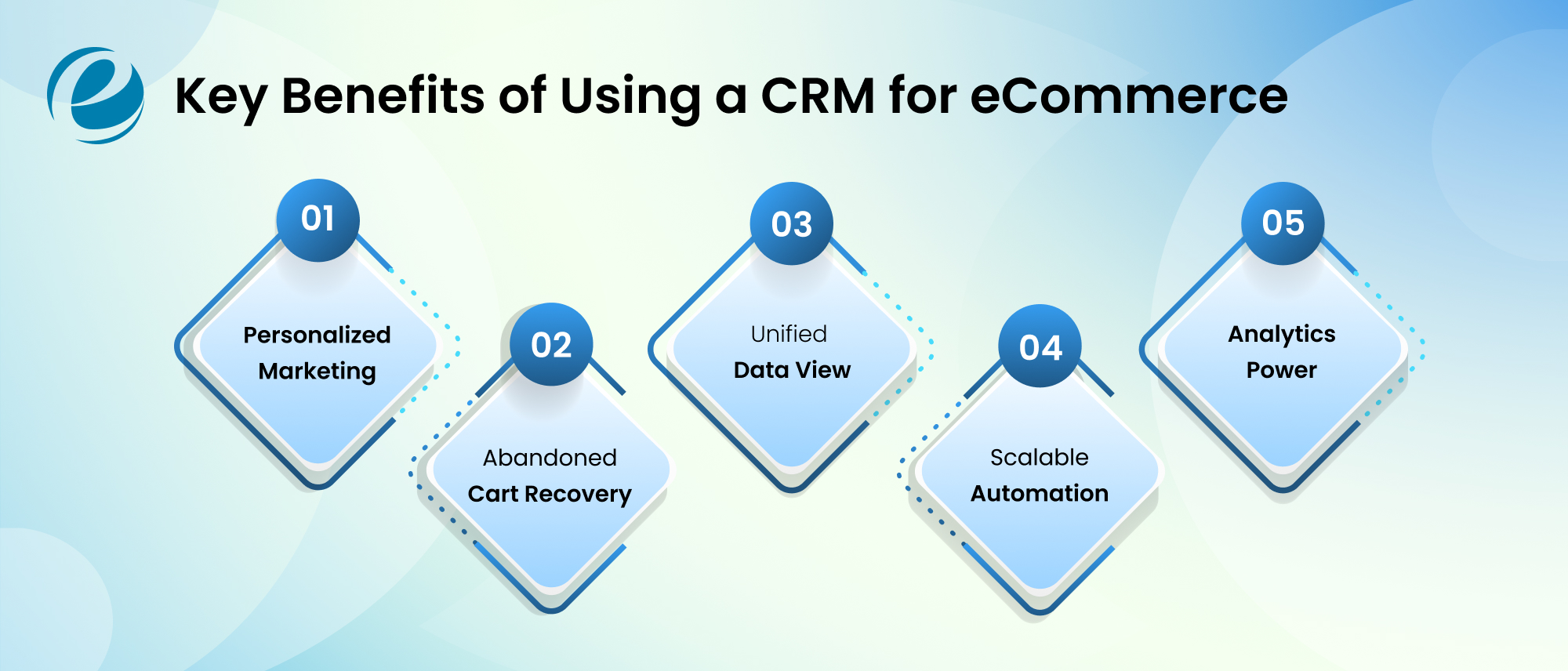
CRM software gives more than one perk through eCommerce CRM, spreading the loyalty and the sales through the seamless integration of CRM in eCommerce. Discover these key advantages.
Personalized Marketing
The eCommerce CRM system is dividing the customers into segments based on their behavior, thus increasing the conversions by 25% through the targeted campaigns via What is CRM and CRM software.
Abandoned Cart Recovery
The Best CRM for eCommerce is sending out automated reminders and recovering 15-20% of lost sales with the help of the timed CRM software for eCommerce emails that are tied to the e-commerce customer relationship management.
Unified Data View
The CRM eCommerce integration is consolidating the data across all the channels, which in turn provides the 360° insights for making easier and smarter decisions through eCommerce development.
Scalable Automation
The eCommerce customer relationship management is able to maintain the volume spikes through the eCommerce development process.
Analytics Power
The tracking of ROI is done through tools that match the precision of the banking industry CRM.
Operational Efficiency
The automation is responsible for the 30% reduction in support time, which allows the teams to focus on growth while scaling the CRM for eCommerce effortlessly.
Revenue Growth
A repeat customer is said to spend 67% more; the e-commerce CRM software is fostering loyalty through predictive analytics.
Essential Features to Look for in an eCommerce CRM
The finest customer relationship management for eCommerce requires it to be integrated and seamless with other channels as the main feature. Look for such eCommerce CRM software that not only suits your current needs but also is capable of growing in the future.
Well, the eCommerce CRM system provides complete customer profiles along with the purchase history, which helps in the system of personalized recommendations through ecommerce customer relationship management.
Native Platform Sync
The leading eCommerce CRM software provides seamless integration of CRM with Shopify/Magento through a plug-and-play method, thus providing real-time inventory through custom CRM development by syncing orders instantly.
AI Segmentation
eCommerce CRM software employs AI for customer grouping based on behavior, and hence the personalized marketing campaigns that are able to engage more people by 25% (Gartner).
Omnichannel Support
An eCommerce customer management system collects data from email, chat, and social media into a single platform that simplifies the use of CRM for manufacturing industry versatility.
Advanced Analytics
The dashboards that come with eCommerce CRM show the trends, and they are better than CRM vs CDP for sales forecasting.
Mobile Accessibility
The responsive application makes it possible for the teams to capture and manage leads while on the move, a situation that is perfect before hiring an eCommerce developer to make the necessary adjustments.
Email and SMS Marketing Automation
Email/SMS marketing automation is the function of the CRM for eCommerce which also regains 15% of the lost sales through the automation of personalized campaigns done via triggered workflows.
How CRM Improves the eCommerce Customer Journey?
CRM for eCommerce connects all channels with the particular software, thereby improving customer satisfaction through clever integration of CRM for eCommerce. Participate in the development of customized solutions for the CRM software. The whole process is optimized by the use of smart integration of CRM in eCommerce.
Pre-Purchase: Lead Capture & Personalization
The best CRM for eCommerce first captures leads from ads/social, then uses e-commerce CRM software to send personalized content to nurture prospects into buyers. This is done through targeted eCommerce customer relationship management.
Awareness Stage Boost
The most efficient eCommerce CRM system captures leads from advertisements/social media and nurtures them through personalized communication, thus shortening the decision-making process.
Personalized Recommendations
The research data for upselling provided by CRM software for the eCommerce industry helps to increase the customer’s cart value by 18% (according to McKinsey).
Frictionless Checkout
eCommerce CRM system preparation of customer information avoids abandonment that would have happened due to non-coordination in the execution of eCommerce development.
Post-Purchase Loyalty
eCommerce customer relationship management, activating thank-yous/user reviews, through retention strategies like those used in the real estate industry.
Support Excellence
Quick access to chat history over CRM eCommerce integration means that issues can be solved swiftly, just as it happens in the banking industry through CRM.
CRM for eCommerce Use Cases (Real-World Examples)
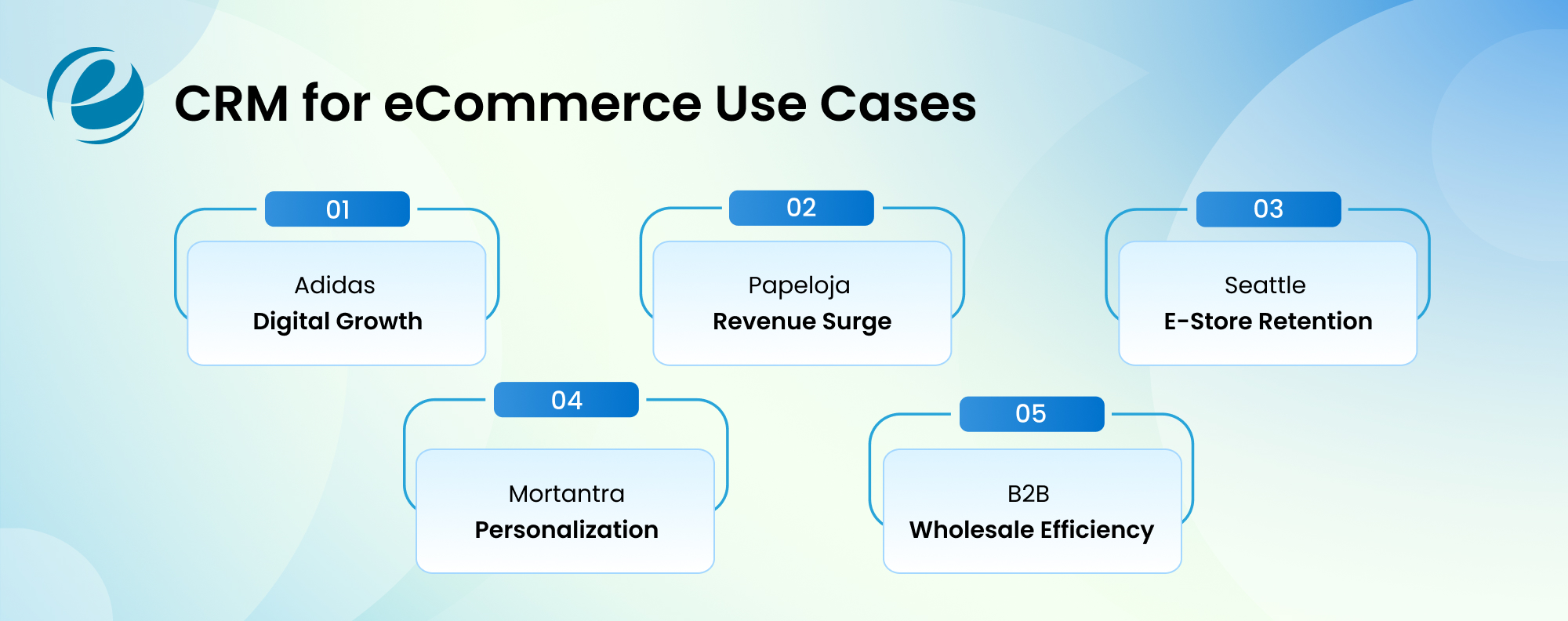
Proven CRM software implementations for eCommerce lead to the discovery of real-world examples. The use cases presented here illustrate the driving of tangible results through CRM eCommerce integration across different industries and sizes of stores.
Adidas Digital Growth
Among the challenges, Adidas managed to have a digital growth of 50% by using the Salesforce Commerce Cloud, which is a CRM software for eCommerce. The main reason was their ability to target customers accurately through personalization.
Papeloja Revenue Surge
The case of Papeloja was that of an 800% increase, and this all happens with the help of Keap CRM for eCommerce that merged the company’s disconnected customer base, thereby ensuring proper customer management and contact.
Seattle E-Store Retention
A site for clothing in Seattle adopted the best eCommerce CRM, thus increasing retention rates by 50% and ROI by 550% through shipping and billing tracking.
Mortantra Personalization
Jewelry brand Mortantra tapped into the customers relationship management in eCommerce through WhatsApp for stylizing conversations, where custom CRM development was involved, which in turn led to an increase in conversions.
B2B Wholesale Efficiency
The CRM setup by iWeb was a great one since it allowed a wholesaler to automate their sales pipelines, thus their productivity was 25% higher, and this is a good point to explore the similarities between the CRM for manufacturing industry.
Best CRM Software for eCommerce (Comparison)
When choosing the most suitable CRM for eCommerce, it comes down to comparing the top eCommerce CRM software options for compatibility. Pay attention to the integration of CRM and the scalability of the system.
| CRM Software | Best For | Starting Price (per user/mo) | Key Strengths | eCommerce Integrations | Ratings (G2/Capterra) |
| HubSpot CRM | SMBs/Startups | Free (premium $20+) | Automation, inbound marketing | Shopify, WooCommerce | 4.4/5 |
| Zoho CRM | Budget SMBs | $14 | Custom workflows, AI (Zia) | Shopify, BigCommerce | 4.3/5 |
| Salesforce Commerce Cloud | Enterprises | $25 | Scalability, AI personalization | All major (Magento, Shopify) | 4.2/5 |
| Klaviyo | Marketing-focused | $20 (usage-based) | Email/SMS flows, segmentation | Shopify-native | 4.6/5 |
| Pipedrive | Sales teams | $14 | Pipeline management | Zapier, Shopify | 4.5/5 |
The data shows the best 2026 choices that are based on features, pricing, and CRM software for eCommerce. So, hire dedicated developers for customization.
1. HubSpot CRM
Starter eCommerce with marketing tools and Shopify integrations for CRM. It has a good scaling option for small and medium-sized businesses.
Pros:
- Free plan for unlimited contacts
- 1,000+ integrations, including e-commerce
- AI-powered automation saves time.
Cons:
- Paid plans are fast becoming expensive.
- Pricing tiers can be difficult to understand
- Only enterprise users can access the advanced features.
2. Zoho CRM
Affordable eCommerce CRM software with AI Zia, custom workflows, and strong CRM software for eCommerce Multichannel support.
Pros:
- $14/user budget-friendly
- Excellent Shopify/BigCommerce sync
- Zia AI for predictions
Cons:
- Steeper learning curve
- Limited free plan features
- Interface feels dated
3. Salesforce Commerce Cloud
The best enterprise CRM for eCommerce with AI personalization and full eCommerce customer relationship management was for large-scale operations.
Pros:
- Unmatched scalability
- Deep platform integrations
- Advanced analytics suite
Cons:
- High cost ($25+/user)
- Complex implementation
- Overkill for small stores
4. Klaviyo
Marketing-first eCommerce CRM system excelled in Shopify flows, segmentation via a seamless CRM eCommerce integration.
Pros:
- Leader in email/SMS automation
- Shopify-native experience
- Revenue tracking excellence
Cons:
- Usage-based pricing scales up.
- Limited non-marketing features
- Sales CRM weaker
5. Pipedrive
Sales-oriented CRM software for eCommerce with visual pipelines and Zapier CRM e-commerce integration for tracking deals.
Pros:
- Easy pipeline management
- Cheap $14/user
- Mobile-friendly design
Cons:
- Limited marketing tools
- Basic reporting
- Fewer native e-commerce syncs
How to Choose the Right CRM for Your eCommerce Business?
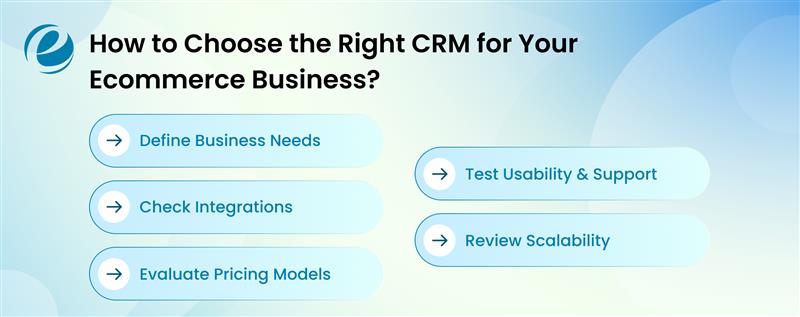
Integrate the right eCommerce CRM with your needs, budget, and growth plans while evaluating eCommerce CRM software. Choose seamless integration and scalability to get the most out of your ROI.
Also, choose the CRM for eCommerce according to your size: HubSpot (free) for startups, Zoho ($14/user) for SMBs, and Salesforce for big companies. Evaluate sales volume, channels (Shopify/one), budget, and tech skills. Ask: “Is eCommerce integration with CRM compatible with my stack? Will eCommerce CRM software support the growth of the company without hiring developers?”
Define Business Needs
Estimate the order volume and channels; the best eCommerce CRM manages your size without custom CRM development.
Check Integrations
Make sure the CRM for eCommerce software is connected with Shopify/Magento through native CRM eCommerce integration so that data is updated in real time.
Evaluate Pricing Models
Analyze the costs of the eCommerce CRM system ($15-100/user); include hiring developers for modifications in your calculations.
Test Usability & Support
Use the trial period of eCommerce customer relationship management tools; the most important thing is to have user-friendly dashboards like CRM in banking industry.
Review Scalability
Select the current options through eCommerce development, winning over the CRM vs CDP limitations.
Common Mistakes When Implementing an eCommerce CRM
Most eCommerce shops have complex relationships with customers when they attempt to use customer relationship management for eCommerce, hence they lose a lot of money on unwise purchases of eCommerce CRM software. Successful integration of CRM in eCommerce should be preceded by planning. First, examine CRM software development best practices.
Skipping Needs Assessment
Taking the best CRM for eCommerce too precipitously without preparing workflows will result in the selection of a non-complementary eCommerce CRM system features.
Ignoring Integration Issues
The pharmaceutical company that is using CRM software is the one that is going to have the most costly data silos. Test this through the eCommerce development process.
Underestimating Training
The training process in e-commerce customer relationship management is very crucial, as it will decide the outcome of the project; the ROI can be delayed if the team resists the process.
Overlooking Data Migration
Corruption will be the result of transferring data in the wrong way through the CRM eCommerce integration, migrating cleanly like the CRM for the manufacturing industry.
Neglecting Scalability
When choosing the rigid tools, it will be necessary to hire developers later; this is opposed to the custom CRM development, which has flexible options.
Choosing Overly Complex Software
The selection of the best enterprise CRM for eCommerce by small teams that only need basic CRM software for eCommerce confuses them.
Poor Data Migration & Setup
Messy transfers corrupt the data of the eCommerce CRM system, which in turn requires custom CRM development.
Not Aligning CRM with Goals
Integration of eCommerce customer relationship management with marketing/sales allows for the realization of CRM eCommerce integration potential, thus avoiding the waste of such potential.
Underutilizing Automation
Not considering CRM workflows for eCommerce leads to manual tasks, thus missing 25% efficiency gains.
Skipping Team Training
The staff that has not been trained resists the eCommerce CRM software, therefore delaying the ROI through poor adoption.
Best Practices for CRM Success in eCommerce
Get the most out of your eCommerce upselling by implementing the right strategies and using proven eCommerce CRM software. Not only does it upsell through strong CRM eCommerce integration and team buy-in result in 30%+ ROI gains, but it also leverages the What is CRM and CRM software foundations for lasting success.
Plan Thorough Integration
Map out early the syncing of CRM software for eCommerce with platforms through CRM integration, thereby avoiding data gaps in the field of eCommerce development.
Train Teams Fully
Train the staff on the features of the best CRM for eCommerce that will allow for quick adoption in eCommerce customer relationship management.
Set Clear KPIs
Use metrics, such as retention rate, that are tracked in your eCommerce CRM system, to mirror the banking industry’s rigor.
Regular Data Cleanup
Keep data hygienic to enable insights, in order to avoid the challenges that are commonly seen in the debates between CRM and CDP.
Iterate with Feedback
Improve your system through custom CRM development or hire eCommerce developer for your scalable growth.
Future Trends in eCommerce CRM
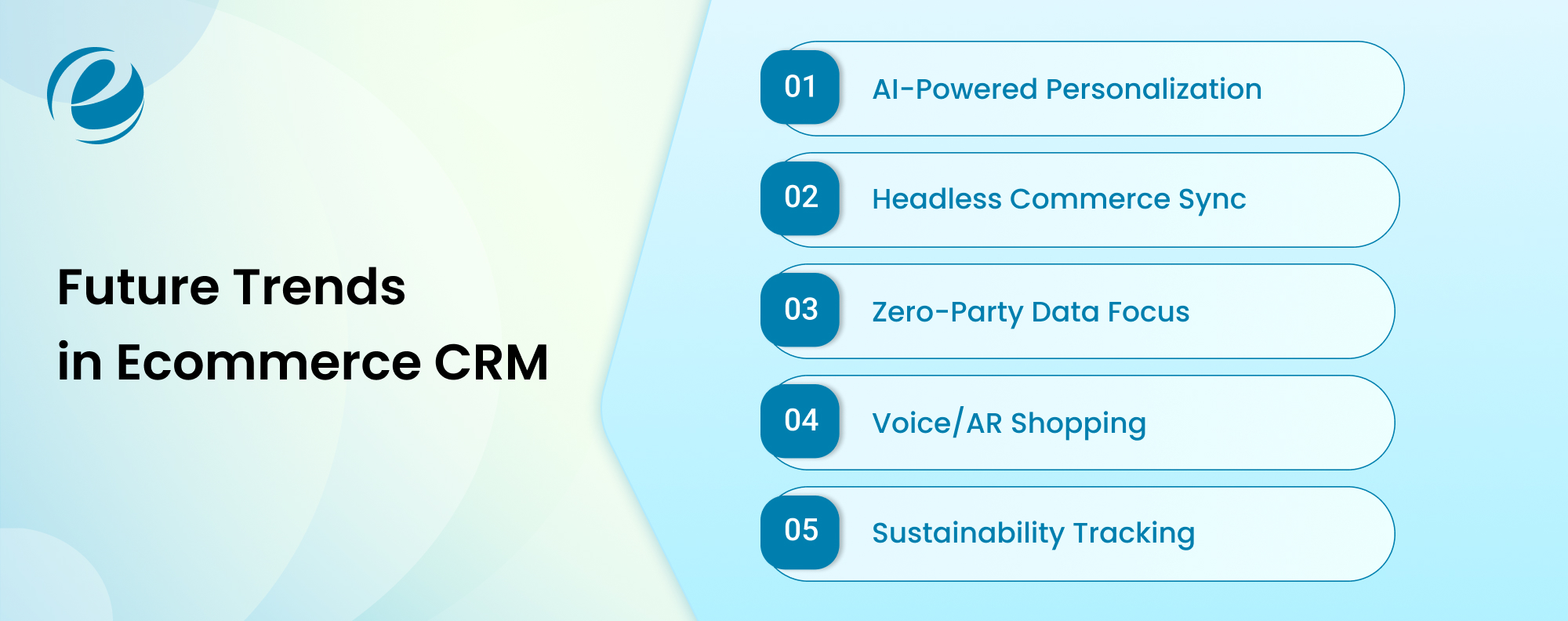
The use of AI and the adoption of multiple channels lead to rapid changes in the eCommerce CRM software; thus, the eCommerce area is constantly changing. Smart CRM integration will definitely take you to the future.
AI-Powered Personalization
The Best CRM for eCommerce is capable of predicting behaviors and overturning the eCommerce CRM system’s insights to generate hyper-targeted ways that result in a 25% increase in conversions.
Headless Commerce Sync
The CRM software for eCommerce apps that is already at the cutting edge of technology can be easily integrated with the composable stack using the latest CRM e-commerce integration techniques.
Zero-Party Data Focus
The eCommerce customer relationship management focuses on only the data that has been consented to, and this is an approach that is very much similar to what is applied in the banking industry as far as privacy is concerned.
Voice/AR Shopping
The future CRM for eCommerce will process voice questions. It will be like custom CRM development, which is present in innovations.
Sustainability Tracking
CRM vs CDP limitations in eCommerce have been surpassed through the tracking of consumers’ eco-preferences tools during eCommerce development.
Is a CRM Worth It for eCommerce?
Absolutely, “CRM for eCommerce” delivers huge ROI through the eCommerce area, among which 67% can be attributed to repeat sales. Consider the integration expenses of the eCommerce CRM system against the progress made through the knowledge of what is CRM and what is CRM Software.
Proven Revenue Lift
CRM for eCommerce secures a 15-30% recovery of abandoned carts through the use of CRM software for eCommerce automation.
Efficiency Gains
eCommerce CRM system support time is reduced by 25%, allowing more time to be dedicated to the development of e-commerce.
Customer Loyalty Surge
Retailers using eCommerce customer relationship management on their customers who are winning in the manufacturing industry, overtaken by the latter’s huge rise.
Scalable Insights
The battle between real-time data vs. spreadsheets is lost by the latter, which is not suitable for pre-hiring developers.
Quick Payback
The majority of companies report seeing ROI in 6 months, while others compare it to the complexity of CRM vs. CDP.
Final Thoughts
CRM for eCommerce revolutionizes online stores with the software that powers CRM, eCommerce integration, personalization, and growth. They recover abandoned carts from e-commerce customers and integrate progressively with the eCommerce market through the best CRM, and thus, the tools generate revenue lifts of up to 30% through the application of smart customer relationship management.
No matter if you are a new company taking advantage of HubSpot’s free tier or a large enterprise making the most of Salesforce, the ecommerce CRM solution is in perfect sync with the 2026 trends, such as AI-driven personalization and omnichannel restocking. Avoid making the usual mistakes, make a better choice through custom CRM development, training of your employees, and monitoring of KPIs.
Are you ready to make a change? Look into CRM software development, hiring an eCommerce developer, or find out how CRM in real estate industry parallels for cross-sector insights. Your CRM for eCommerce journey starts today!
FAQs
What is a CRM for eCommerce?
CRM for eCommerce is perfectly aligned with software that manages customer-related actions, such as data, support, and sales for online stores, by integrating the eCommerce system seamlessly with the CRM.
What’s the best CRM for eCommerce in 2026?
HubSpot and Klaviyo take the first place as the best eCommerce CRM with strong software for the latter and advanced AI tools, along with Shopify sync.
How does CRM eCommerce integration work?
CRM eCommerce integration connects the platforms, such as Shopify, with the eCommerce CRM system, thus providing real-time orders and inventory through eCommerce development.
Why choose eCommerce CRM software over spreadsheets?
eCommerce CRM software handles customer relationship management automatically, thus reducing errors by 40% compared to manual tools, and expands gradually with custom CRM development.
Is CRM worth it for small eCommerce stores?
Absolutely, CRM for eCommerce is a cost-effective way of boosting retention by 30%; free tiers are a promising start before hiring an eCommerce developer for upgrades.



 +1 (989) 535-9295
 info@emizentech.com
 emizentech


