 Add us as a preferred source on Google
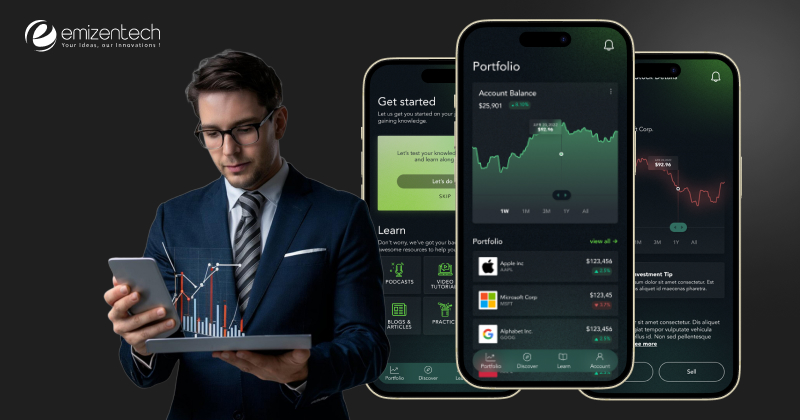
 Trading enthusiasts and seasoned investors are no longer relying solely on their gut instincts, hearsay, and flashy headlines to place trades. They have started approaching the investment market with a data-first mindset. And the credit for this goes to the best AI stock apps in the market!
Financial markets are steadily moving into speed, precision, and number-led intelligence. AI stock apps are introducing new, mind-blowing developments to the investment landscape. These apps are refining the way the financial markets operate, analyzing billions of data points at lightning speed, and in real time.
AI trading apps work 24/7, without getting influenced by emotions, and driven largely by data-backed decisions. And what traders get in return are: a) More returns; b) Less risks. In fact, the AI-driven stock trading platform market size stood at $2.18 billion in 2023, and is forecast to grow to $4.79 billion by 2031 at a CAGR of 10.26%.
AI business ideas are taking the front line across almost every industry including finance. So, if you are planning to build an AI stock trading software, you are in for a win. But how do these apps work? What sets the best AI trading apps apart? Continue reading to know the key features, steps for AI stock trading app development, and more.
What is an AI Stock Trading App?
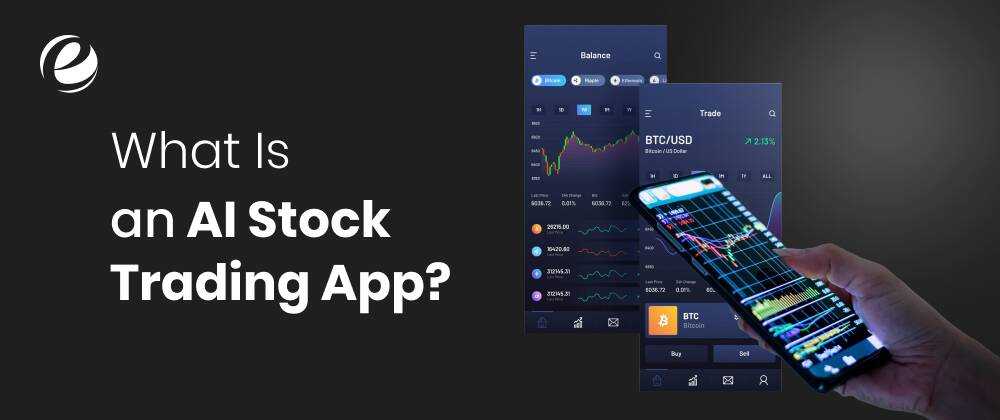
An AI stock trading app is a digital solution powered by a set of revolutionary artificial intelligence technologies and concepts, namely machine learning, predictive analytics, and algorithmic trading. These mobile apps can analyze massive datasets, identify patterns, and even make trading decisions in real time.
And the best thing? They don’t need a human hand for guidance
It’s quite unlike traditional stock trading that relies on human analysts for evaluating financial news, market trends, and historical data. This method is typically:
- Time-consuming
- Emotion-driven, and
- Limited when it comes to scope
AI stock trading software, on the other hand, processes millions of data points in just a matter of a few seconds, detecting hidden scope, and thus, implementing high-speed trades based on statistical probabilities.
Types of AI Stock Trading Apps
AI stock trading apps are designed for various purposes, in different ways, each intending to accommodate varying investment strategies, and the requirements of traders. From AI-driven stock prediction tools to fully automated trading solutions to hybrid models, the industry is a playground when it comes to the range of these apps.
If you are looking for best AI app ideas in investment category, check out this quick roundup of the types of AI stock trading apps:
1. AI-Powered Stock Prediction Apps
AI-powered stock prediction apps are focused on predicting market fluctuations, and trends, all thanks to machine learning, deep learning, and historical data analysis. These apps do not place trades automatically; Instead, they offer data-driven insights that can help traders make better trading moves. This type of AI stock trading apps use technical indicators, sentiment analysis, and economic data in order to forecast price trends. These are ideal for traders who prefer human oversight while also enjoying AI analysis.
2. AI Stock Trading Bots
AI stock trading bots are run by automated algorithms that are designed to trade stocks within a predefined set of parameters. The bots operate on trading platforms, and are quite fast at executing trades. Moreover, this type of AI stock trading apps can be customized to align with market conditions and risk-reward ratios. These are best suited for traders that are in arbitrage trading, scalping strategies, and automated portfolio management. Wondering how chatbot works? Tap to read everything about chatbot app development.
3. Automated AI Stock Trading Platform
Automated AI stock trading platforms are a fully autonomous type of AI stock trading apps. As the name itself gives a hunch, these apps analyze market, and place trades, all without any human intervention. Moreover, the AI models are designed to continuously track fluctuations in the price, trends, and risks. Powered by adaptive machine learning models and pre-set strategies, these automated apps minimize human bias as well as emotion-driven decisions. These are best suited for high-frequency traders and hedge funds.
4. Hybrid AI Trading Apps
Hybrid models are the best of both worlds. Ideal for traders who want a duo of manual trading and AI-generated insights, this type of AI stock trading app provides risk assessment tools, predictive analytics and AI-generated alerts without fully automating the trading process. Moreover, they offer AI-powered trade recommendations without blocking human intervention. These apps are perfect for experienced traders who would like help from AI, but prefer to have hands-on control over trading moves.
5. AI-Enhanced Robo-Advisors for Stock Investment
Robo-advisors are AI-enabled platforms for long-term investors. This type of AI stock trading app can create as well as oversee diversified portfolios based on various factors, such as financial goals, risk tolerance, and market conditions. Robo-advisors leverage AI algorithms to suggest rebalancing strategies, and balance stock allocations. Moreover, these apps do not require active trading, and allow investors to just set their preferences, leaving everything else to AI. These are ideal for passive investors.

How AI in Stock Trading Apps Works?
An AI stock trading apps operate leveraging the integration of multiple AI technologies and analyze stock market trends to execute trades. Here below are the key components of an AI stock app:
- Machine learning algorithms: AI stock apps train on historical market behaviour to identify different trading patterns, and thus, forecast market movements.
- Big data processing: AI-powered stock apps collect historical data and market data in real-time from multiple sources, including social media, macroeconomic indicators, and financial reports.
- Natural language processing: AI scans earnings reports, news updates, and analyst sentiments to gauge markets sentiments, and make better trading decisions.
- Risk management modules: AI keeps on adjusting strategies based on the risk factors, and market volatility.
- AI stock trading bots: AI stock bots automatically place trades based on the AI-generated insights, eliminating human-led errors.
Key Features of AI Stock Trading Apps
An AI stock app is more than just about autonomous platforms for buying and selling stocks. These solutions are pro at decision-making, risk management, and predictive analytics, which can help investors of different backgrounds ace stock trading.
Let’s catch up on the winning features of AI stock apps:
1. AI-Driven Market Analysis
Any AI stock app, in its very essence, is all about the ability to analyze massive sizes of historical data as well as real-time market data, all within seconds. Unlike traditional market research that usually demands hours of manual analysis, AI-powered stock trading software can scan stock performance charts, financial reports, and more within milliseconds. This enables traders and investment entities to identify hidden patterns, detect scope of profits, and take immediate action as per market changes.
AI stock market prediction apps, for example, can foretell potential price movements before they even occur, simply by recognizing shifts in the trader’s sentiment and analyzing all the past behaviors. These apps continuously gather data from different sources, like financial news, reports, and even social media platforms. This degree of ease seamlessly eliminates the lag that is often experienced by manual traders, and helps miss crucial entry/exit points.
2. Predictive Analytics for Stock Movements
Predictive analytics is the lifeblood of AI trading software. AI stock prediction apps read into past market behavior with the help of machine learning models, and predict future trends with high accuracy. AI can proactively recommends best trades based on complex algorithms that are driven by:
- Macroeconomic factors such as global financial trends, GDP growth, and interest rate hikes.
- Technical indicators like Bollinger Bands, Relative Strength Index, and moving averages.
- Company-based financial reports, including earnings, market capitalization, and debt ratios.
If a hedge fund, for example, uses an AI stock market prediction app, they would get insights indicating that a particular stock is most likely to experience a surge based on past performance. The fund, instead of waiting for analyst recommendations or news, can act preemptively on the stock and perhaps, gain a competitive edge.
3. Risk Management and Portfolio Optimization
Risk management is as crucial and important in AI-driven trading as profit maximization. Advanced AI software for stock trading can continue reading into market conditions to minimize risks and refine trading strategies in real time. One of the best ways these apps do this is through dynamic stop-loss orders and automated hedging mechanisms. Moreover, if an AI trading platform detects any sudden downturn in the market, it can quickly sell off the vulnerable assets or simply move investments to a more stable security. This feature facilitates adaptability which ensures investors don’t have to suffer heavy losses if or when the market suddenly crashes.
In addition to that, AI-powered portfolio optimization allows traders to seamlessly diversify their investments. AI stock trading software can calculate the optimal asset allocation, based on factors like historical performance, project market conditions, and risk tolerance. This eliminates the need for traders to rely solely on their gut instincts.
4. Real-Time News and Sentiment Analysis
While markets move on numbers, they also react to corporate announcements, news, politics events, investor sentiment, and more such factors. AI stock trading apps function on natural language processing that analyzes social media updates, analysts’ reports, and of course, financial reports. This helps the app to read into market moods, and recommend trading movements accordingly.
If a company is expected to report earnings, the AI stock prediction app will perform the analysis through various sources to evaluate whether the earnings Will likely miss the bar or exceed. Such insights help traders stay on the top of their investment game.
5. Automated Trading Execution
Time and speed are everything in stock trading, and that’s what makes AI stock trading bots the need of the hour. AI stock apps make sure all the trades are executed instantly, and at the best price. While human traders may hesitate or act emotionally on a particular stock, AI bots make quick, calculated, and accurate decisions just in a fraction of a second.
Here’s one thing to underscore: A well-developed AI stock trading software operates on predefined rules, and at the same time, adapts well to market changes. If an AI trading bot spots a sufficient drop in the price of a stock that historically rebounds within a quick timeline, it will hit a buy order quickly before other traders even come to know of the opportunity. These bots can easily manage multiple trades in one go, across different stock exchanges, and maximize liquidity as well as efficiency.
6. Multi-Asset Support and Exchange Integration
Here’s one of the most important features of AI stock trading apps: They can support multiple asset classes, encompassing forex, cryptocurrencies, commodities, and ETFs. These apps ensure that traders can access diverse markets and investment opportunities, thanks to their integration with global stock exchanges.
This feature is especially valuable for businesses and hedge funds since it enables cross-market arbitrage where AI can check for price differences across different exchanges, and place trades accordingly (and automatically).
10 AI Stock Trading Bots
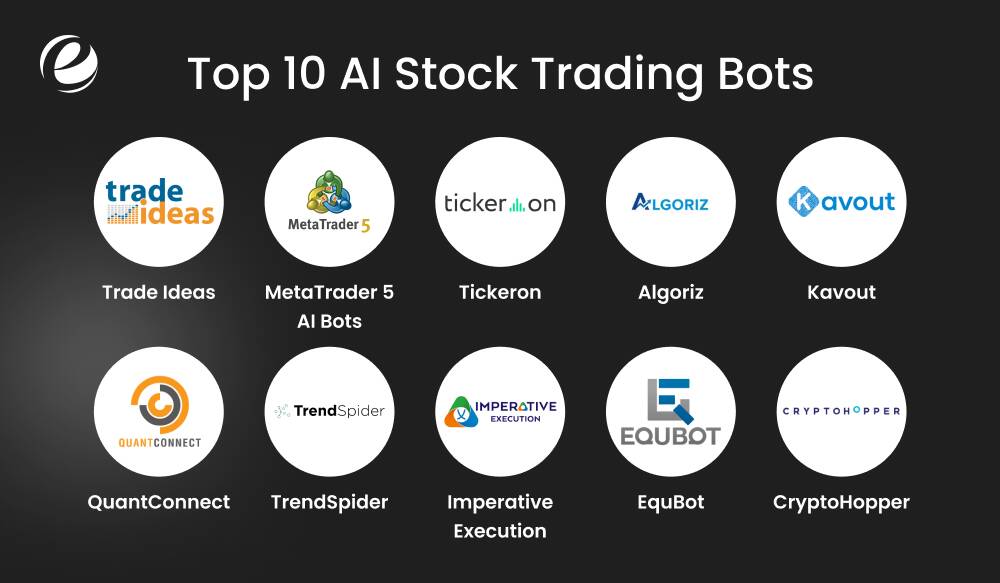
AI stock trading bots are redefining the way traders analyze market conditions, place trades, and also, manage risks. Enabled by algorithmic trading and machine learning, these AI stock bots process billions and billions of data points and identify the opportunities for profit. Not to mention, they do it faster than any human trader would, and in real time.
Let’s take a closer look at the 10 most robust AI stock trading bots that are exemplifying the future of automated trading:
1. Trade Ideas
A leader in AI stock trading, Trade Ideas offers Holly, an AI-driven bot that operates a world of best-tested strategies every day. While the bot predicts market movements with ease, it also adapts and evolves to become an even more dynamic bot to be available out there.
2. MetaTrader 5 AI Bots
MetaTrader 5, also known as MT5, is a marketplace for AI-backed trading bots that assist traders with automated strategies based on market sentiment, real-time indicators, and more factors.
3. Trickeron
Trickeron is pro at real-time chart pattern recognition, reversals, trend formations, and also, detecting potential fallouts. It’s great for traders looking to leverage AI-driven predictions to make number-backed decisions in volatile conditions.
4. Algoriz
Algoriz is made for traders looking to develop AI-powered trading strategies, but without coding. This bot comes with an intuitive interface for seamless back testing and placement of trades.
5. Kavout
Kavout makes the best use of machine learning as well as predictive analytics for assigning a K-score to each stock. It ranks them based on their scope of price appreciation in the future.
6. QuantConnect
QuantConnect is an algorithmic trading platform that facilitates collaboration between traders and developers to build custom stock AI prediction apps.
7. TrendSpider
TrendSpider is a bot that automates trendline detection, multi-timeframe analysis, and more, making complicated technical trades seamless for investors.
8. Imperative Execution
The AI bot of Imperative Execution is one of the popular AI stock trading bots. It is focused on minimizing slippage and optimizing execution. This bot is commonly used by institutional traders and hedge funds.
9. EquBot
EquBot is yet another top-notch AI stock trading bot. It is fuelled by integration of sentiment tracking, AI-driven fundamental analysis, and market signals. This helps the bot optimize stock selection.
10. CryptoHopper
While CryptoHopper is most famous for crypto trading, it has also been expanded to offer AI-driven stock trading, providing automated trade execution, and portfolio management.
Best AI Stock Trading Apps in 2025
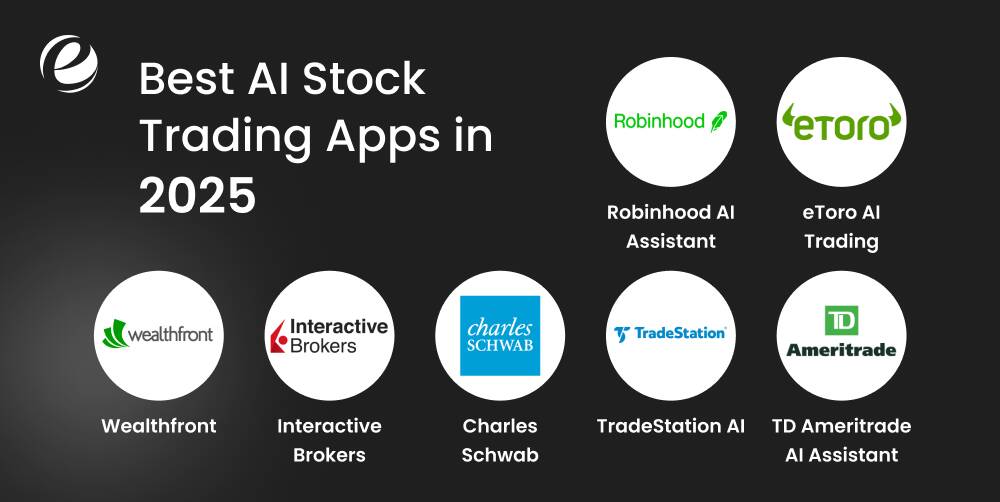
With AI-powered trading apps soaring and redefining the investment landscape, sophisticated machine learning models are becoming accessible to everyday traders. AI stock apps take efficiency levels up, automate decision-making, and reduce guesswork. This allows traders to capitalize on market conditions more smartly, without even being glued to their screens.
Here below are the top AI stock trading apps in 2025:
1. Robinhood AI Assistant
The AI integration of Robinhood provides users with personalized recommendations, analyzing market sentiments and behavioral patterns. It also analyzes price movements in order to suggest profitable strategies.
2. eToro AI Trading
With an AI-enabled trading assistant by eToro, investors can mimic expert traders’ portfolios, which the ML algorithms of the platform offer trend analysis and risk management solutions.
3. Wealthfront
Wealthfront, a robo-advisory platform, leverages AI algorithms to rebalance investment portfolios, ensuring an optimal risk-return balance.
4. Interactive Brokers
IBKR integrates AI-powered tools to assess sector performance, market depth, and volatility, offering traders a data-driven approach to investing.
5. Charles Schwab
A fully automated AI-based investing app, Charles Schwab analyzes financial goals, risk tolerance, and market trends to create a balanced investment strategy.
6. TradeStation AI
TradeStation’s AI-driven alerts, predictive analytics, and algorithmic trading capabilities make it a favorite among active traders and institutional investors.
7. TD Ameritrade AI Assistant
Thinkorswim, TD Ameritrade’s AI-powered trading platform, provides real-time predictive modeling, automated trading signals, and deep market analysis.
How to Develop an AI Stock Trading App
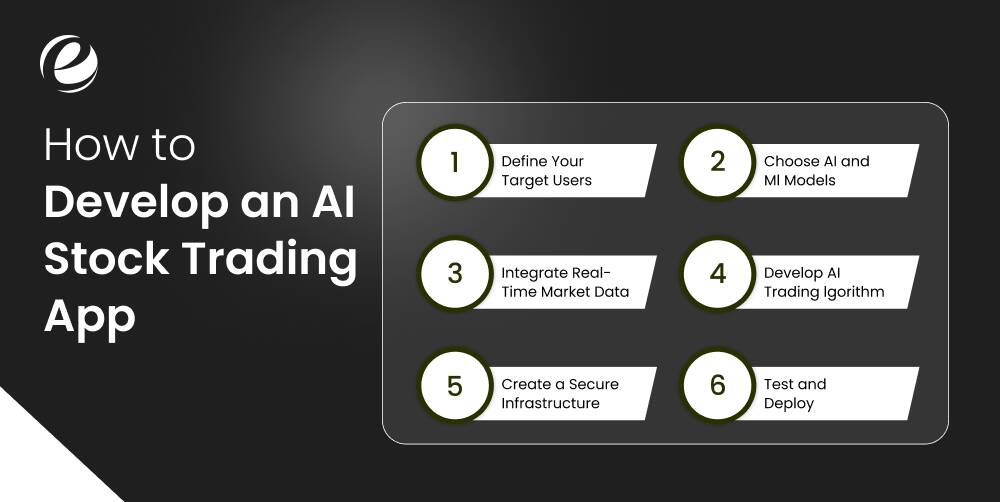
AI stock trading app development requires a strategic and structured approach, involving a combination of advanced technologies, and high speed trade execution. These steps are a blueprint of how to build an effective, scalable, and not to mention, secure AI trading platform:
1. Define Your Target Users
The first step of AI stock trading app development is all about the objectives, and the users you are targeting. Identify the primary users of your AI trading app. Who is this app for? Institutional traders? Retail brokerage firms? Or Hedge funds? The functionality of the app will largely depend on target users.
2. Choose AI and Ml Models
Those underlying machine learning models will play a big role in the effectiveness of your AI trading app. So, the next step is to choose the right ones. Deep learning algorithms and neural networks can detect complex patterns in the price movements, while reinforcement algorithms allow the AI to adapt strategies based on market conditions. If a platform needs to analyze financial updates, NLP can extract sentiment from social media, and market reports in order to gauge fluctuations. The key is to make sure your AI is well-trained on high-quality financial data.
3. Integrate Real-Time Market Data
A successful AI trading app should be capable of processing millions of data points per second. The next step for you in this process is to integrate real-time market data APIs from Alpha Vantage or IEX Cloud, or any direct feeds from stock exchanges like NYSE and NASDAQ. If you are looking for high-speed trading, you can consider co-locating servers within exchange data centers and reduce latency.
4. Develop AI Trading Algorithm
One of the most crucial steps in this process is to develop the best AI trading algorithms. After all, it is the core of the application which will determine when to buy, sell, and manage risk. Choose from strategies such as momentum trading, mean reversion, or arbitrage, depending on your target market. Before deployment, conduct extensive backtesting using historical data to refine the algorithm’s performance under different market conditions. Implement risk management features like stop-loss orders, position sizing, and dynamic allocation to prevent excessive losses during market fluctuations.
5. Create a Secure Infrastructure
Security and compliance are critical when developing an AI trading platform. Protect sensitive data with encryption, multi-factor authentication, and real-time fraud detection systems. Use cloud-based solutions like AWS, Google Cloud, or Microsoft Azure to ensure your app can scale seamlessly during peak trading hours. Additionally, ensure your platform meets regulatory requirements such as SEC (U.S.), MiFID II (Europe), or SEBI (India) by working closely with compliance experts.
6. Test and Deploy
Before your hit open your AI trading app launch, ensure it has been rigorously tested under real-world market conditions out there. To do this, you can simulate different scenarios, including high volatility and market crashes, and evaluate AI responsiveness. Beta testing with real traders is the ultimate way to ensure successful app development as it will unlock and provide insights into usability and algorithm performance. After everything is optimized, you can deploy the app using a phased rollout strategy, allowing for real-time monitoring and continuous improvements.
How Much Does It Cost to Develop an AI Stock Trading App?
After all the awe-inspiring stuff we have read about the best AI stock trading apps, it’s natural to wonder: How much does it cost to develop an AI platform for stock trading?
Well, implementing AI in fintech is a complex, intricate, and resource-intensive task. When it comes to the cost of AI stock trading app development, you must consider multiple factors to figure the numbers. These factors are mainly:
- AI development and data training
- Stock market API integration
- Backend development and infrastructure
- Security and compliance
- UI and UX
The cost for developing best AI apps for stock trading may be lower, ranging between $50,000 to $100,000 in case of startups or companies choosing white-label AI trading solutions. If you are looking for a fully customized AI stock trading software with proprietary AI models and institutional-grade security, then the cost can exceed $500,000.

Use Cases of AI Stock Trading Apps
AI is making new waves in stock trading, unleashing all-new standards of speed, accuracy, and number-driven decisions. From retail traders to institutional investors, AI stock trading bots can help level up efficiency, and boost profitability across different financial operations.
Here’s a glimpse of the top AI stock trading app use cases:
1. Automated Trading
AI stock trading bots can execute trades within a matter of milliseconds, leveraging predefined strategies. These bots help eliminate the bias which usually is the roadblock for manual trades, and help optimize high-frequency trading.
2. Personalized Portfolio Management
ML models analyze historical data, macroeconomic factors, and technical indicators to forecast stock price movements. Moreover, NLP further spruces up the insights by scanning social media and financial news to understand market sentiment. This enables traders to anticipate the swings happening in stock prices.
3. AI Stock Market Prediction
AI-backed robo-advisors are equipped with capabilities to make tailored investment portfolios, simply by evaluating risk tolerance, and market trends. This results in dynamic adjustments of allocations as market conditions change.
4. Fraud Detection
This has to be one of the most important use cases of AI platforms for stock trading. AI continuously tracks trading patterns to identify unusual transactions, market manipulation, and insider trading. Institutions can make the most of this technology for market surveillance and regulatory compliance.
Best Practices for Using AI Stock Trading Apps
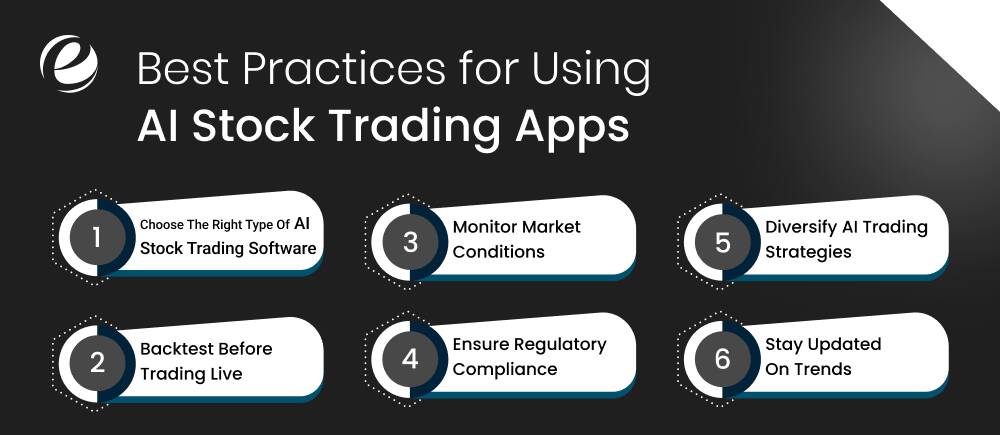
While trading apps are great for powerful automation and unlocking market insights, the below practices are a must to ensure you maximize their potential with the right approach:
1. Choose the Right Type of AI Stock Trading Software
Not all AI stock apps are the same. While some apps are intended for autonomous day trading, others are best for long-term strategies. So, the key is to:
- Evaluate accuracy of AI predictions
- Assess latency of trade execution
- Check up on integration with stock market APIs
These practices are crucial to ensure the app is fulfilling your purpose, aligning well with your goals.
2. Backtest Before Trading Live
Before you launch an AI trading bot, make sure it undergoes rigorous backtesting with historical stock data. This practice is a BIG must for ensuring that the AI technology is not overfitted to historical trends and is capable of functioning well in real-world market conditions as well.
3. Monitor Market Conditions
AI trading apps work best in specific market scenarios. For example, if an AI trading bot is designed for a bull market, it may not perform well during a market crash. Traders must ensure AI models are regularly retrained and then, adjust risk parameters based on economic events and volatility.
4. Ensure Regulatory Compliance
AI trading apps should comply with financial regulations in order to avoid any fallout in the future (like legal repercussions, hefty penalties, and bad marketing). Traders should make sure that their AI models are not involved in any kind of market manipulation or illegal insider trading.
5. Diversify AI Trading Strategies
Traders should never just rely on single AI models. Instead they should use a combination of different AI strategies, including sentiment analysis, and mean reversion. The idea is to reduce risk and maximize profitability in different market scenarios.
6. Stay Updated on Trends
AI trading algorithms learn and evolve consistently. On the other side, market scenarios aren’t always the same either. So, traders must make it a point to continuously update AI models and stay updated on new innovations and development in the AI space.
Future Trends in AI Stock Trading Apps
Al stock trading is burgeoning at a fast pace, with real-time analytics, deep learning, and more such components reshaping the investment space. On this note, let us take a look at the Al stock trading trends that are expected to launch all-new heights of investing in impending years:
1. Quantum Computing
Quantum Al analyzes trillions of data variables in a blink or two. This enables near-instant execution of trades and is a revolutionary function by all means. Several tech and finance giants across the world are already investing in this technology, and it is expected to soon make its way to retail investors as well.
2. Reinforcement Strategies
Gone are the days of waiting for traditional trading models to do their job. Reinforcement learning is setting the bar of efficiency high. This self-improving ऐ learns from news sentiment, economic trends, and market shifts, ultimately adapting to the evolving scenarios. Moreover, this reduces excessive reliance on static algorithms.
3. Al-Human Hybrid Models
One of the exciting Al trading future trends is the fusion of Al and human brains. Next-gen trading will have a nuance of Al precision and human intuition working in synergy. AI platforms for stock trading will provide real-time insights and risk analysis while enabling traders to intervene when required.
4. Al-Human Hybrid Models
One of the exciting Al trading future trends is the fusion of Al and human brains. Next-gen trading will have a nuance of Al precision and human intuition working in synergy. Al platforms for stock trading will provide real-time insights and risk analysis while enabling traders to intervene when required.
5. Personalized Portfolio Management
Future Al trading apps are expected to serve as financial assistants too. Yes, from crafting investment strategies to setting financial goals, the best Al stock trading apps will be able to do it all.
Why Choose Emizen Tech for Al Stock Trading App Development?
EmizenTech, a leading AI app development company, leverages years of experience and expertise in financial markets and Al to build futuristic Al stock trading apps. Our team specializes in Al trading app development using PyTorch, TensorFlow, and more such frameworks. We make sure that every solution we develop is highly secure and regulation-compliant by incorporating encryption, fraud detection, and multi-factor authentication. From goal setting to custom Al model development to post-launch app optimization, we offer end-to-end support to help you meet your goals and maximize returns.
Wrapping Up
AI stock trading apps offer both retail and institutional investors unmatched intelligence, lighting speed, and greater levels of accuracy, transforming the financial markets. While AI trading bots and AI stock prediction apps optimize decision-making, humans are still required to oversee these operations to balance strategy and risk. Opting for a reliable AI trading software development partner like EmizenTech can help you unlock the competitive edge in a fierce market out there. Get in touch with us today and let’s make the best use of the winning opportunities available to embrace innovation.
FAQs
Is AI stock trading profitable?
AI stock trading can be profitable, making the most of data-driven strategies to detect patterns, and thus, optimize trades. However, the success also depends on market conditions, algorithm quality, and not to forget, risk management.
Can AI predict the stock market?
AI can analyse billions of datasets to identify trends and forecast conditions. However, it can not guarantee accuracy considering the volatile nature of the market.
What are the risks of AI trading?
AI trading risks involve algorithmic errors, overfitting to past data, and market anomalies. These factors can lead to significant losses. Moreover, excessive dependency on AI can also pose the risk in trading.
How to build AI for trading?
AI stock trading app development involves collecting financial data, training machine learning algorithms, and designing predictive models. It also demands aggressive backtesting and risk management to ensure quality performance in real-world conditions.
What is the AI trading app?
An AI stock trading app is a digital platform that operates on artificial intelligence and machine learning technology to execute trades. AI stock apps analyze market trends, assess risks, and forecast stock and price movements, ultimately simplifying the process of trading for all kinds of investors.
Is AI good for stock trading?
Yes, AI stock trading apps have many advantages for investors. These solutions process and analyze massive amounts of data, identifying patterns to seamlessly execute trades. This helps reduce emotional biases, and boost efficiency. However, AI stock apps do not completely remove fluctuations in the market and unpredictability.
Is AI stock trading safe?
AI stock trading apps are generally safe when used wisely. However, it is important to keep in mind that while AI platforms for stock trading make investment processes easier, unforeseen economic conditions can still attract financial losses. Thus, it is advisable to use these solutions responsibly.



 +1 (989) 535-9295
 info@emizentech.com
 emizentech


