 Add us as a preferred source on Google
Ever wonder why some brands have such loyal customers? Google says that 53% of app users like using apps more than websites to check their loyalty card details. Loyalty and rewards app are great at using rewards to build strong relationships with customers and keep them coming back. It’s a smart way for brands to make sure their customers stick around.
The digital age is transforming the world, and the use of loyalty and reward apps is crucial for any business trying to enhance the customer experience and retain customers. These apps encourage customers to return for more purchases through discounts, rewards, and personalized shopping experiences.
Myer One is a popular loyalty and rewards app that rewards frequent shoppers. Customers earn points when shopping at Myer, which are converted into rewards vouchers that can be used towards future purchases. This allows shoppers to reduce their expenses while enjoying the items they love most.
Creating a loyalty and rewards apps like Myer One involves multiple factors, with costs ranging from $30,000 to over $300,000 depending on the application’s sophistication, features, and design. What causes such a wide cost range? What determines the cost of the app you develop? Understanding the costs of developing a loyalty and rewards app like Myer One is essential for businesses looking to spend wisely.
In this post, we’ll guide you through everything you need to know about the costs of developing a loyalty and rewards app like Myer One. We’ll cover hidden factors and offer methods to help reduce your costs.
Market Statistics Of Loyalty And Rewards Apps
Let’s take a look at some key statistics about loyalty and rewards app to better understand the marketplace.
- The global market for loyalty management is estimated to reach $10.67 billion in 2023. It’s projected to grow at a CAGR of 9.2% between the year 2024 and 2030.
- The loyalty management market is forecast to hit $12 billion by 2026.
- It is estimated that the U.S. loyalty market will grow by US$23.57 billion in 2024, reaching US$44.73 billion by 2029.
- 75% of people like to shop at stores and brands that offer reward points. Also, many companies say most of their money comes from repeat customers, not new ones.
What Is Myer One?
The Myer One app does an excellent job of using all the necessary features to attract customers and help the brand stand out in a crowded market. When it comes to customer loyalty, Myer is a name to reckon with among the best loyalty and reward service providers.
Myer One is the loyalty program of Myer department store. It’s free to join, and when you sign up, you’ll have the opportunity to earn credits when shopping in stores or online. With features like earning points with each purchase, claiming Myer One rewards, and getting personalized deals, this app has become a huge hit with shoppers.
With over 500K downloads, 4.3 million active shoppers, and more than 7 million registered users, the Myer One app has contributed significantly to Myer’s overall revenue. In the first period of 2024 alone, it generated over $1.82 million. This is a clear testament to the value of an effective rewards program for a company’s financial success and customer satisfaction.
How Does The Myer One App Work To Provide Loyalty & Rewards?
The Myer One app goes far beyond the typical loyalty program and is now a full customer engagement platform for Myer, a leading Australian department retailer. The Myer One app allows users to easily earn points for each dollar spent, which is later redeemed for vouchers that offer discounts on future purchases. Additionally, the app lets users track receipts electronically, receive customized offers, and enjoy a shopping experience tailored to their needs and previous purchases.
The user-friendly design of the Myer One app makes sure that the app users can easily navigate as well as make the most of the benefits offered, enhancing their overall shopping experience. The app’s simplicity has helped attract large numbers of users and significantly boosted customer engagement and satisfaction. The overall impact of the loyalty and rewards app is evident in its ability to generate repeat customers, which in turn increases Myer’s sales and fosters customer loyalty.
Through sophisticated data analytics, Myer One gathers actionable insights into consumer behavior and helps plan the future of loyalty and reward programs, providing customers with an enhanced, personalized experience.
In simple terms, the popularity of the Myer One app is proof of its effectiveness. The app demonstrates the value of loyalty programs in today’s retail market. By offering valuable insights into consumer behavior as well as preferences, loyalty programs allow retailers to personalize their offers and marketing, ensuring customers receive relevant and appealing benefits that promote regular engagement and spending.
Advantages Of Developing a Loyalty And Rewards App Like Myer One

The concept of customer loyalty is a profitable resource that successful companies know how to leverage. One of the most efficient ways to build loyalty is by using loyalty and rewards apps. In this section, we will review the major advantages of creating a loyalty program app like Myer One.
1. Enhancing Customer Retention and Minimizing Churn
The value of retaining valuable customers cannot be overstated. Retaining customers leads to higher revenue (loyal customers spend generally 67% more than new customers). It’s also more cost-effective to retain clients than to acquire new ones. If your business experiences high turnover rates and isn’t capitalizing on opportunities to retain customers, a loyalty and rewards app like Myer One can significantly boost customer retention, turning first-time clients into loyal customers.
2. Augmenting Customer Lifetime Value (CLV)
Loyalty and rewards apps like Myer One allow customers to stay connected with your brand. Customers enjoy earning discount points and rewards. Once they realize the benefits, they’ll return to shop again and again. It’s cost-effective to retain existing customers than to acquire new ones. Losing customers means losing revenue, but a loyalty app keeps customers satisfied and encourages them to keep coming back.
3. Transforming Customers Into Brand Advocates
Loyalty programs encourage consumers to buy more. When they are rewarded for their purchases, they are more likely to return and shop again. Over time, their overall spending increases. This, in turn, boosts the company’s revenue. The longer customers remain loyal, the more money they will spend, which helps the business grow.
4. Increasing Sales and Profits
When customers earn rewards, they are more likely to make additional purchases. A loyalty app encourages them to shop more. When given the choice between two stores, customers are more likely to choose the one that offers reward points. This leads to more sales for the business. Increased sales translate into higher earnings, contributing to overall revenue growth.
5. Selling More Even in Slow Seasons
Some businesses experience a drop in sales during certain months. A loyalty and rewards app helps by offering special discounts during these slow periods. Extra points, discounts, or exclusive rewards motivate people to buy even when the market is slow. This ensures your business operates efficiently throughout the year. Without this, certain periods could see a drop in revenue.

Cost To Create a Loyalty and Rewards App like Myer One
The total cost of developing a loyalty and rewards app like Myer One depends on the complexity and scope of the application. Here’s an average breakdown of the cost for loyalty and rewards app development:
- A basic loyalty app with simple features (such as user profiles, point tracking, and basic rewards) is priced between $30,000 and $60,000.
- Apps with moderate complexity, which include advanced features like customized services, push notifications, and analytics, can cost between $70,000 and $120,000.
- If you’re looking for an enterprise-grade application that integrates with systems like CRM or POS systems, and features custom designs, you can expect to pay anywhere from $150,000 to $300,000 or more.
Factors such as the location of the development team, the platforms (iOS, Android, or both), and the design style can influence the price. For example, hiring a U.S.-based company may be more expensive than outsourcing to a team in Eastern Europe, while a custom-designed, elegant interface can significantly impact your budget. With so many options available, it’s essential to define your exact specifications and budget before starting the development process.
Factors Affecting The Cost To Build a Loyalty and Rewards App Like Myer One
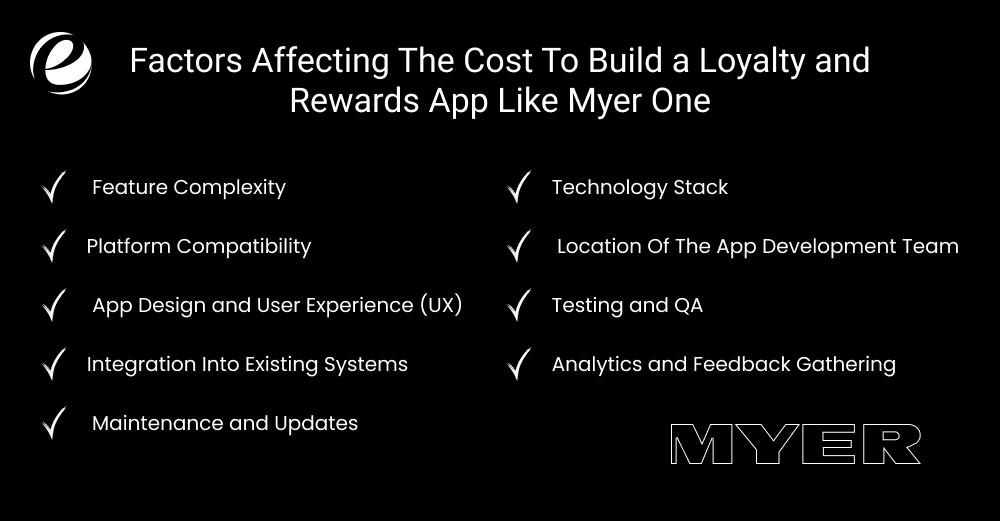
Building a loyalty software or app like Myer One involves several factors that can significantly impact the total cost. Understanding all these elements is very important for effective planning and budgeting. In this section, we’ll explore the factors that influence the development costs of a loyalty and rewards app like Myer One:
1. Feature Complexity
The features complexity of the loyalty app will determine the cost of building a loyalty and rewards app like Myer One. Simple features, like user profiles or point tracking, are less expensive to create compared to advanced features such as real-time analytics and AI-driven personalized recommendations. Each additional feature increases the development time and requires higher-level skills, which can drive up costs.
2. Platform Compatibility
Creating apps that work across multiple platforms, such as iOS, Android, or the web, can increase the overall cost due to the need for different capabilities and resources to ensure the app runs smoothly on each platform. Native apps designed particularly for a single platform are typically more expensive than cross-platform apps that use shared codebases. However, cross-platform apps may offer lower performance and may not be fully optimized for each platform.
3. App Design and User Experience (UX)
The level of sophistication in the design and user experience directly impacts the costs of building a rewards app like Myer One. Custom, complex designs require more time and skilled developers, which adds to the cost. Simple designs can be faster and more affordable to create, but they may not engage users as effectively as customized designs tailored to meet user needs.
4. Integration Into Existing Systems
The complexity of integration can vary widely. Simple integrations using common APIs are less expensive. In contrast, custom integrations with legacy databases or complex systems require more time and expertise, significantly increasing the total cost of developing a loyalty and rewards app like Myer One.
5. Technology Stack
The technology stack plays a major role in determining the total cost of development. Choosing popular frameworks like React Native or Flutter can help save money. These frameworks allow app developers to build loyalty apps for both iOS as well as Android using a single codebase. This speeds up development, reduces costs, and makes updates easier. Using widely supported technologies also ensures better quality, security, and long-term support for your app.
6. Location Of The App Development Team
The location of the development team is one of the most important factors affecting the cost of developing a rewards app like Myer One. For example, hiring developers from North America or Western Europe typically costs more than hiring those from Asia. Companies looking to get high-quality app development at a lower cost often choose to outsource app development to dedicated companies in regions with lower labor costs.
7. Testing and QA
Quality checks and testing ensure that the app functions properly. If an app isn’t tested, it may have issues that can lead to customer dissatisfaction. Fixing these issues later will incur additional costs. A loyalty and rewards app like Myer One requires thorough testing to function efficiently and securely protect data. Inadequate testing can lead to malfunctions or errors. A well-designed testing process saves money and keeps customers satisfied, as loyal customers help the company grow.
8. Analytics and Feedback Gathering
Implementing analytics tools and gathering feedback involves initial setup costs, as well as ongoing costs for data storage and software to analyze the data. These tools are important for understanding the user behavior and improving the user experience. However, they require investments in both expertise and technology to manage the collected data. As a result, they can influence the cost of developing rewards apps like Myer One.
9. Maintenance and Updates
Regular maintenance and updates are very important for keeping the loyalty app secure and functional. This will increase the overall cost of building a rewards app like Myer One. Maintenance includes server expenses, monitoring, debugging, upgrading to the latest operating systems, and potentially adding new features to keep Myer One like app competitive.

Hidden Costs Of Developing a Loyalty And Rewards App Like Myer One
A loyalty application is a fantastic concept, but it’s more than just about creating the app and launching it. Numerous hidden costs arise during development and even after the app has been launched. If business owners don’t anticipate these costs, they could end up spending more than expected.
Now, let’s look at some of the hidden costs of developing a loyalty and rewards app like Myer One.
1. Marketing and Customer Engagement
A loyalty and rewards app won’t succeed if people aren’t aware of it. Businesses need to invest timely in marketing efforts to attract users. This could include running advertisements, promoting special offers, and sending out promotional emails.
Additionally, keeping customers engaged costs money. Companies may need to send notifications, launch loyalty campaigns, and create regular offers to maintain interest.
2. App Store Fees
Making a loyalty and rewards app available on platforms like the Apple App Store or Google Play Store isn’t free. The stores charge fees for listing apps and take a percentage of any in-app purchases.
Companies must also follow app store guidelines, which can change from time to time. These rule changes might require additional design work. If your app doesn’t meet the store’s standards, it could be removed, leading to extra costs for fixes.
3. Legal and Compliance Fees
Loyalty and rewards apps must adhere to various regulations, including privacy laws and data protection guidelines. Companies may need to hire lawyers to ensure compliance with all applicable regulations. Failure to comply can lead to fines or legal challenges. Each country has its own rules, so if an app is used in multiple regions, compliance costs can be much higher.
4. Regular Bug Fixes
No app is perfect when it goes live. There are always minor issues, such as buttons that don’t work, slow-loading pages, or problems when users try to redeem rewards. Developers need to fix bugs regularly to keep the app running smoothly.
Each time a bug is discovered, companies must pay developers to resolve it. If there are multiple bugs, fixing them can become costly. Without regular bug fixes, users may stop using the app because it becomes frustrating to navigate.
5. Data Migration
Many businesses store customer information across multiple platforms. In the case of creating a loyalty program, all of the data must be transferred to the application. This process, known as data migration, may seem straightforward, but it can actually be complicated and costly.
If the data is not stored in a standard format or contains errors, developers need to clean and organize it before the transfer. If done incorrectly, customer data could be deleted or duplicated, causing issues in the application.
How Does a Loyalty and Rewards App Like Myer One Make Money?
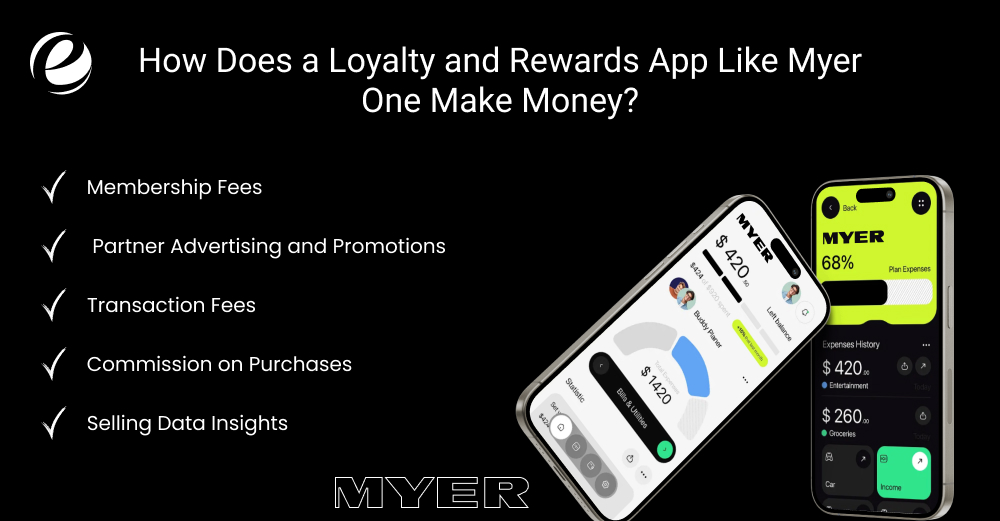
Loyalty and rewards apps, such as Myer One, generate income through multiple streams, all contributing to the profitability of the business. Understanding the revenue models of these apps provides insight into how they can sustain and develop in terms of financial performance.
1. Membership Fees
Membership fees are the primary business model for the Myer One app. It offers membership plans for its customers, including Gold and Silver Premium options. These membership levels provide users with various benefits based on their chosen plan. Notable benefits include discounted rates, exclusive offers, and early access to sales. Users pay a fee to access these services, generating consistent revenue for the app.
2. Partner Advertising and Promotions
The loyalty and rewards app, like Myer One, also earns profits by displaying advertisements for different brands or promoting specific offers and products. Businesses pay certain amount of money to advertise their services or products within the app, aiming to reach the app’s loyal audience.
3. Transaction Fees
If you create a loyalty and rewards app like Myer One, you could earn money by charging transaction fees to companies each time users make a purchase or redeem rewards through the app. This fee may be a small percentage of the amount spent, but it can serve as a reliable source of revenue. A business that uses the app for customer transactions may be charged a 1-2% fee for each transaction.
4. Commission on Purchases
The app earns a fee when a customer makes a purchase through it. This is one of the most popular ways rewards apps generate revenue. They partner with businesses or brands that provide a portion of the sales generated by the app. This arrangement encourages the app to expand its customer base and boost sales for its partners.
5. Selling Data Insights
With user permission, rewards apps can gather valuable and relevant information about shopping habits and preferences. This data can be sold to research firms or retailers looking to improve their products and marketing strategies.
Tips To Optimize Loyalty App Like Myer One Development Cost
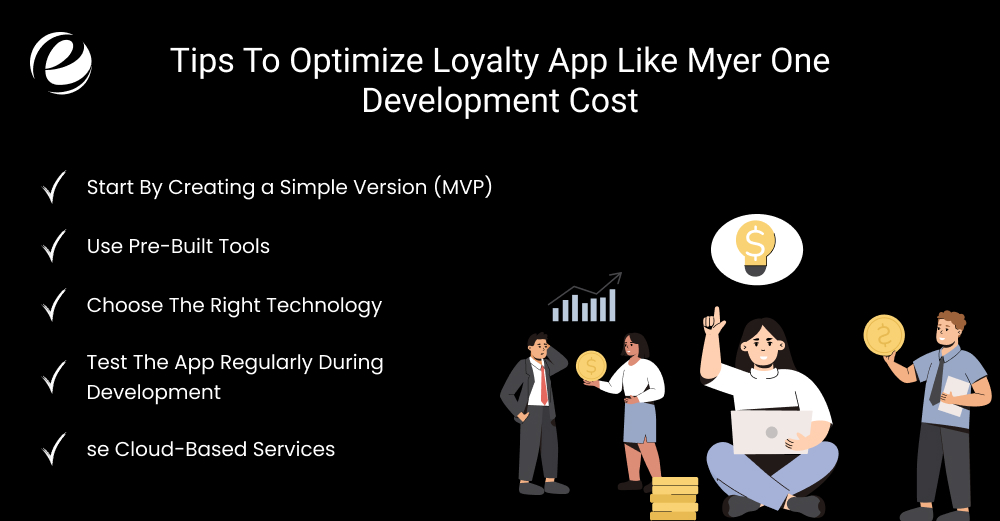
Building a loyalty and rewards app can be costly, but businesses can save money by being strategic. Instead of cutting corners or creating an app that isn’t worth the investment, it’s better to find clever ways to reduce costs while still building a functional and appealing app. Below are some simple ways to reduce costs when developing a loyalty and rewards app like Myer One.
1. Start By Creating a Simple Version (MVP)
Many businesses try to develop a feature-rich, complex app right from the start, which is costly and time-consuming. It’s better to begin with an MVP (Minimum Viable Product). This is a basic version of the app that includes just the essential features, such as earning points and redeeming rewards. After the app launches and users start using it, companies can gradually add new features based on customer needs. This saves money and avoids wasting time and resources on unnecessary features.
2. Use Pre-Built Tools
Building everything from scratch can be expensive. There are many platforms and tools available that can help you create loyalty programs more efficiently and at a lower cost. Businesses can use existing software to handle functions like user logins, payment processing, and push notifications, rather than hiring developers to build these features from the ground up. This speeds up development and saves money.
3. Choose The Right Technology
Some programming languages and platforms are more affordable and easier to manage than others. Companies should choose platforms that allow for quick updates and adjustments. For example, open-source platforms like Flutter and React Native enable businesses to create one app that works on both iOS and Android. This saves money, as there’s no need to build separate apps for each platform.
4. Test The App Regularly During Development
Fixing errors after the app is launched can be costly. By testing the app during development, businesses can identify and address issues early on. Regular testing ensures the app runs smoothly and avoids problems that could drive customers away. A well-tested app also requires fewer updates, which can reduce maintenance costs.
5. Use Cloud-Based Services
Setting up as well as maintaining servers can be expensive. Cloud-based solutions like AWS, Google Cloud, or Microsoft Azure offer flexible pricing. With cloud hosting, businesses only pay for the resources they need. As more users begin using the app, resources can be added without upfront costs. This helps reduce expenses and ensures the app runs efficiently throughout the day.
Why Choose EmizenTech To Develop Your Loyalty and Rewards App?
We at EmizenTech, specializes in the development of cutting-edge loyalty and rewards apps tailored to meet your specific business requirements. Our team is proficient in modern technologies and methods, ensuring that your app is built on a solid and flexible foundation. Whether you’re in the early stages of a new venture or managing an established business, we’ll make sure you have a smooth development process that balances quality and affordability.
With years of expertise in loyalty and rewards app development, we create apps that are feature-rich, easy to use, and adaptable. From initial design to post-launch support, we’ll be with you every step of the way.
Do you want to turn your loyalty app concept into a reality? Contact us today to get started!
Conclusion
Creating a loyalty application can pay off by boosting customer retention, increasing brand loyalty, and driving higher revenues. Loyalty and rewards apps, such as Myer One, help businesses keep clients coming back with points, rewards, and discounts. They drive more sales, enhance the customer experience, and foster lasting brand loyalty. Businesses invest in loyalty programs because they can boost profits and strengthen customer relationships.
However, developing a rewards app like Myer One comes with several costs. The cost of creating a loyalty and rewards app depends on its features and complexity. Understanding the factors involved will help you plan your project better and make more informed decisions.
To save money, companies should carefully plan their strategies, starting with an initial version and using cloud-based services. An effective loyalty app can make a significant difference in keeping customers satisfied and helping the business grow.
FAQs
What's the average time to develop a rewards-based app similar to Myer One?
The development of a rewards application like Myer One typically takes 9 to 10 months. The duration is dependent on the scope of the project and the complexity of features as well as the process's efficacy.
How can I create an app to reward customers on iOS and Android?
Yes, it is possible to opt for cross-platform development with frameworks such as React Native or Flutter to reduce time and costs.
What factors most affect the cost of developing loyalty apps?
Factors like app features, platform choice, the app design complexity or Backend systems, as well as integrations with third party vendors have the biggest effect on the total cost.
What can I do to reduce costs for developing my loyalty application?
Here are simple ways to save money:
1. Start with a basic version of the app (MVP).
2. Use ready-made tools instead of building everything from scratch.
3. Hire developers from places where costs are lower.
4. Focus only on the essential features at first.
5. Avoid adding extra features you don't need in the beginning.



 +1 (989) 535-9295
 info@emizentech.com
 emizentech


