 Add us as a preferred source on Google
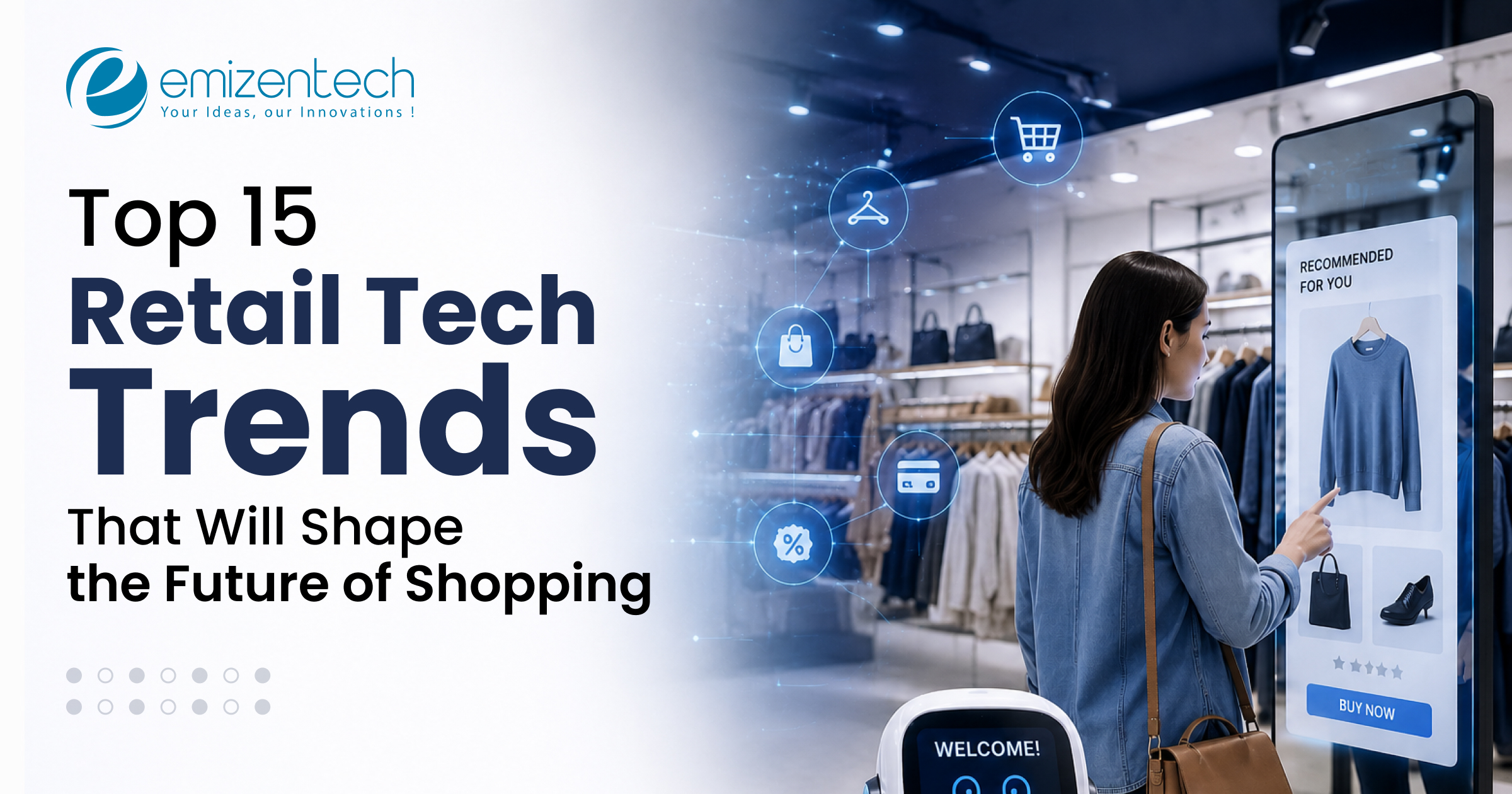
 Shopping has changed more in the past five years than in the previous two decades combined. Contactless checkout, AI-powered product recommendations, and augmented reality fitting rooms are now appearing in everyday retail and were once distant concepts that have become a reality. And the pace is not slowing down.
According to the Forbes article, global retail e-commerce revenue is expected to cross $7.9 trillion by 2027. That number does not grow on its own. Behind it lies a wave of technology, some flashy, some quietly operational, that reshapes how people discover, purchase, and receive products.
This blog covers the 15 most important retail tech trends driving that change, who needs to pay attention, and how to actually put them to work without chasing every new tool that comes along.
How Retail Technology Trends Are Transforming Modern Commerce
Not long ago, “retail technology” meant a POS system and maybe a barcode scanner. Today it means AI that predicts what customers want before they search for it, IoT sensors that monitor inventory in real time, and AR tools that let shoppers virtually try on clothing from their living rooms.
The change is structural. Retailers are not just selling products anymore, they are creating experiences. And the gap between those who invest in new technology in retail and those who don’t is growing fast. Businesses that have embraced retail technology are seeing real gains in conversion rates, customer retention, and operating efficiencies. Those who are holding back are increasingly playing catch-up.
The core change is that retail has become a data business. Every click, purchase, return, and even in-store browsing pattern is a signal. Retail tech trends today largely focus on capturing those signals, acting on them faster, and building systems that get smarter over time rather than requiring constant manual input.
Who Must Adopt These Retail Tech Trends to Stay Competitive
Retail tech trends don’t belong to just one industry. Their impact cuts across a wide range of sectors.
- Fashion and Apparel: Brands are using and implementing virtual try-ons & AI-powered personalization to reduce return rates and boost conversions.
- Grocery and Food Retail: Retail tech chains are turning to smart automation checkout systems and IoT-powered inventory management to cut operational costs.
- Consumer Electronics: Retailers are using AR to let shoppers visualize products at home before buying.
- Luxury Retail: This market segment is deploying blockchain to provide product authenticity and deliver exclusive customer experiences.
- Pharmacy and Health: Retailers in this sector are using data analytics and personalized recommendations to improve customer outcomes.
- Home Furnishing and Décor: Stores are using 3D visualization tools to let buyers see how furniture fits in their space before purchasing.
- Multi-brand Marketplaces: These industries are benefiting from automation and supply chain intelligence to handle volume at scale.
Logistics, fintech, and hospitality companies are even reaching into the retail ecosystem in ways that require tech adoption. If you want to sell to end consumers, then retail tech trends in 2026 are your playbook.
Top 15 Retail Tech Trends Redefining the Modern Shopping Experience

Modern retail technology is shifting away from simple transactions and towards highly personalized, “phygital” experiences. The retail tech era is driven by Agentic AI, augmented reality, and autonomous checkouts, as these innovations merge the convenience of e-commerce development with the tangible engagement of physical stores to meet modern shopper expectations.
Here are the top 15 retail tech trends that redefine the shopping experience:
Artificial Intelligence and Machine Learning
AI is the backbone of nearly every major retail tech trend right now. Retailers use it to personalize homepages, automate customer service, detect fraud, and forecast demand, often simultaneously. Businesses using AI and ML solutions are seeing measurable gains in engagement and conversion.
According to McKinsey research, the global B2C retail market could generate $3 trillion to $5 trillion from AI, and that value is just part of a broader opportunity, with AI enabling 60-70% savings in execution-related tasks.
Real-world example: Amazon’s recommendation engine, which drives roughly 35% of its revenue, uses ML models that improve with every interaction.
Hyper-Personalization
Customers have moved well past tolerating generic experiences. A truly personalized shopping experience now means dynamic website content, tailored emails, location-aware promotions, and recommendations that reflect actual purchase behavior rather than guesswork.
Retailers building this level of personalized customer experience are seeing stronger loyalty and higher average order values. The technology behind it combines behavioral data, real-time triggers, and predictive modeling, and it scales in ways that manual segmentation never could.
Real-world example: Starbucks Deep Brew AI personalizes drink suggestions based on time of day, weather, location, and order history, driving measurable increases in repeat purchases.
Augmented Reality for Shopping
AR is closing the gap between browsing online and seeing something in person. Shoppers can now preview furniture in their own rooms, virtually try on glasses, or test lipstick shades before buying, all right from their phone.
This shopping technology directly addresses one of the biggest barriers to online conversion by reducing customer uncertainty. When a customer can visualize a product in context, the level of confidence increases and the rate of returns decreases.
Real-world example: IKEA’s Place app lets users position true-to-scale 3D furniture in their rooms using AR, which significantly improves purchase confidence among users who engage with it.
Cashierless and Autonomous Checkout
Long queues are a friction point modern shoppers have little patience for. Cashierless checkout uses computer vision, AI, and sensor fusion to let customers pick up items and walk out, billing happens automatically in the background.
This also frees up store staff to focus on service rather than transactions, which tends to improve the overall in-store experience.
Real-world example: Amazon Go stores set the standard for such operations at a large scale. Customers enter via an app, shop freely, and are charged on exit, with no manual scanning required.
Internet of Things (IoT) in Retail
Smart shelves that flag low inventory, connected fitting rooms that suggest complementary items, and environmental sensors that optimize lighting and temperature are examples of how IoT is turning physical retail spaces into data-rich environments.
For supply chains, IoT enables real-time tracking from warehouse to doorstep. That visibility is central to effective retail business management automation and reducing costly operational errors.
Real-world example: Walmart uses IoT sensors throughout its supply chain to monitor product freshness and cold-chain integrity, significantly reducing spoilage and stockout rates.
Voice Commerce
Voice search is growing steadily as smart speakers become standard household devices. People are reordering essentials, checking delivery status, and discovering products without touching a screen.
For retailers, the trend means rethinking their online retail marketing strategy to account for conversational, long-tail queries, as voice users actually use and speak very differently from how people type searches.
Real-world example: Amazon Alexa and Google Assistant both support full voice-driven checkout experiences, reaching millions of users every month across major retail platforms.
Retail Automation and Robotics
Robots are no longer a novelty on warehouse floors, they are a competitive necessity. Retail business management automation through robotics reduces labor costs, minimizes picking errors and dramatically increases throughput during peak periods.
This is one of the retail tech trends that delivers clear, measurable ROI, especially for high-volume operations.
Real-world example: Ocado, the UK online grocer, runs fully automated fulfillment centers where robots handle picking, packing and dispatch. Major retailers worldwide have licensed the model.
Omnichannel Retailing
Today’s shopper browses on mobile, compares on desktop, buys in-store and returns through a drop-off kiosk. Omnichannel is about making every interaction point feel like part of the same coherent experience, not separate channels that barely know each other exists.
Getting this right requires unified inventory, consistent customer data, and seamless handoffs between digital and physical. Businesses building toward this goal should look at what retail software development partners can offer in terms of integrated commerce infrastructure.
Real-world example: Target fulfills over 95% of its online orders from physical store locations, making its stores serve double duty as fulfillment centers, which is a real omnichannel model in action.
AI-Powered Supply Chain Intelligence
Supply chain disruptions in recent years put inventory management front and center for retailers worldwide. AI-driven supply chain tools analyze historical patterns, external signals such as weather and port delays, and real-time logistics data to predict and prevent disruptions before they hit shelves.
This is one of the tech trends in retail with a direct bottom-line impact; smarter forecasting reduces both overstocking and stockouts simultaneously.
Real-world example: Zara’s parent company, Inditex, uses AI-driven demand forecasting to replenish stores within 48 hours of a trend emerging, which is a key driver of the brand’s speed-to-market advantage.
Social Commerce
Social media has evolved from a discovery channel into a full transaction platform. Shoppers can now find a product on Instagram or TikTok, tap once, and complete a purchase without leaving the app. For brands targeting younger demographics, social media is where buying decisions increasingly occur.
Any serious online retail marketing strategy in 2026 needs to account for social selling as a primary channel, not an afterthought.
Real-world example: A major example of this retail trend is Gymshark, a fitness apparel brand that uses Instagram Shopping to post workout Reels and high-quality images of athletes wearing its latest collections. Users can tap clothing items directly on their screens, view exact sizes and prices, and purchase sportswear immediately without ever leaving the Instagram app.
Blockchain for Transparency and Authentication
Consumers want to know where products come from. Blockchain lets retailers create a tamper-proof, verifiable record of a product’s journey from raw material to the shelf, which is especially valuable for food safety, luxury goods, and ethical sourcing claims.
It is also being explored for loyalty programs, where points can be stored and transferred on a shared ledger across brands.
Real-world example: Walmart partnered with IBM on a blockchain-based food traceability system that reduced the time to trace leafy greens from nearly a week to just 2.2 seconds.
Generative AI for Content and Discovery
Generative AI is changing how shoppers find products and how retailers create content at scale. It writes product descriptions, personalizes email campaigns, generates lifestyle images, and powers conversational search where a shopper describes what they want and the AI surfaces the best match from thousands of SKUs.
As explored in detail in Generative AI in Ecommerce, this technology is transforming how brands engage their digital shoppers. For retailers managing large catalogs, it is a genuine force multiplier.
Real-world example: Shopify has integrated AI-powered product description tools into its merchant platform, helping store owners create SEO-ready listings in seconds.
Data-Driven Loyalty Programs
Traditional punch cards are long gone. Modern loyalty programs use analytics to deliver personalized rewards, tier-based incentives, and real-time surprises that feel relevant rather than mechanical.
Also, they are a valuable source of first-party customer data, which is becoming more important as third-party cookie tracking becomes less effective. Emizentech is one of the emerging technology companies in the loyalty space that is actively building solutions.
Real-world example: EGO, a fashion retailer, uses a fully integrated loyalty solution to create a more seamless customer experience and strengthen their platform.
Computer Vision for In-Store Analytics
Computer vision enables retailers to understand how shoppers behave in physical stores without intruding. Heatmaps show idle time, shelf analytics reveal what shoppers pick up but do not purchase, and queue management systems optimize staffing in real time.
This turns a physical store into something closer to an e-commerce platform in terms of data richness and enables the same kind of continuous, evidence-based optimization.
Real-world example: Standard Cognition provides computer vision-based autonomous checkout solutions that enable retailers to remove traditional checkout counters entirely, improving throughput and the experience simultaneously.
Sustainable Tech and Green Retail
Sustainability has moved from a brand value to a buying criterion. Shoppers are actively choosing brands that reduce waste, operate transparently, and take their environmental commitments seriously.
Retail tech is a real enabler here, where AI-driven demand forecasting reduces overproduction, IoT reduces energy use in stores, and digital receipts eliminate unnecessary paper waste. Among retail tech trends 2026, this one ties operational efficiency directly to consumer trust.
Real-world example: Patagonia uses digital supply chain tools to communicate its environmental commitments to customers in real time, making transparency a core part of what the brand actually sells.
How to Choose the Right Retail Tech Trends for Your Business
Of the 15 retail tech trends we discussed above, not every trend is the right fit for every business right now. Here’s how to approach the right retail technology for your business:
Start with the customer journey
Map out your biggest friction points, such as checkout, discovery and returns, then figure out which technologies solve those pain points. If you’re facing cart abandonment, your first investment might be in personalization or AR. If supply chain delays are hurting you, AI-powered forecasting or IoT should be first on your list.
Assess your existing infrastructure
There are tech trends that require substantial foundational work to deliver value. Omnichannel retail, for instance, requires clean, unified data to deliver value. For blockchain to deliver value, you need your supplier’s buy-in. Audit what you have before you go after what you want.
Focus on ROI, not novelty
You might be tempted to go for the shiniest tech available, but the question is, does the solution increase conversion, reduce costs or increase loyalty? Automation and AI-powered supply chain tools tend to provide quicker, more measurable returns than AR, which takes longer for customers to adopt.
Think scalability
As new technology companies continue to develop new tools, the best strategy is to build on flexible, modular infrastructure that can grow with you. Retail software development best practices provide the architecture that allows platforms to add capabilities without rebuilding.
Build on flexible architecture
The best technology decisions today are those that do not lock you in and do not require rebuilding when requirements change. Plan for scale from the start, and pilot new capabilities in a limited scope before rolling them out broadly.
Conclusion
The retail industry is in the midst of a technology-driven transformation that shows no signs of slowing. From AI and automation to AR and blockchain, the retail tech trends shaping commerce today will define which businesses thrive and which fall behind over the next decade.
The good news is that you don’t have to adopt everything at once. Start with the trends that most closely align with your customer’s pain points and your business goals. Build the infrastructure to support growth, and partner with teams who understand both the technology and the retail landscape.
Whether you’re looking to build a smarter loyalty program, launch an omnichannel shopping experience, or automate your warehouse operations, the opportunity is real, and the tools are ready.
FAQs
How do retail tech trends improve customer experience?
Retail tech trends are the bridge between what shoppers expect and what brands deliver. Shopping technology accelerates and enhances every touchpoint for the individual, from personalized experiences driven by real-time data to retail business management that automates processes and reduces wait times.
What are the latest retail tech trends?
Retail tech trends for 2026, such as agentic AI, omnichannel integration, AR/VR in-store experiences, and conversational commerce, are using new technologies like automated checkouts and predictive inventory, which are changing how they do business. Emerging technology companies are also leading the way in online retail marketing strategy and frictionless fulfillment.
How is AI changing the retail industry?
AI is increasingly becoming the central decision-maker in retail technology, moving beyond just support. It enables personalized shopping experiences, flexible pricing, demand prediction, and supply chain efficiency. In today's retail industry, AI serves as essential infrastructure rather than an optional add-on, forming the backbone of large-scale retail management and automation.
What are the primary tech-driven retail trends in upcoming years?
Retail is shifting rapidly toward agentic AI, in which autonomous software agents curate and make purchases directly for busy consumers. This retail-tech trend enables hyper-personalization, dynamic pricing, and automated inventory systems that accurately predict local demand before checkout.
What consumer behaviors will dominate the retail industry?
Value-focused consumers prioritize affordability and premium private labels over traditional name brands due to ongoing cost pressures. Additionally, sustainability is now a non-negotiable expectation, driving massive growth in second-hand markets, eco-friendly logistics, and transparent sourcing.



 +1 (989) 535-9295
 info@emizentech.com
 emizentech


