 Add us as a preferred source on Google
 In the digitized world, creating strong and lasting relationships with patients is more important than ever. That’s where CRM in healthcare industry comes into play. This is the condition under which the CRM system in the medical sphere is implemented. CRM is a software solution that is used by various medical facilities and healthcare providers to take care of patient data, manage communication, and provide the necessary personalized care.
For the most well-informed minds in this world, CRM in healthcare industry is not only a tool, but also a very useful means of providing patients with personalized care while at the same time building the strength and smoothness of internal operations.
This blog can be the right fit if you want to know what is CRM in healthcare, how it could revolutionize your medical practice, or how to create one. The blog will clear all the doubts you have about CRM and make it a part of your daily operation in a very understandable and easy-to-follow way.
Overview Of CRM in Healthcare Industry
Customer Relationship Management (CRM) in health industry has enhanced customer-business relationships, data management, and the improvement of the services provided in a way that makes a revolution very visible. The healthcare industry is the one where technology proves itself and is making the most critical impact of the digital age. If healthcare CRM software is integrated with such advanced solutions, then personalized patient experiences, efficient communication, and improved care coordination are possible. The success of these applications lies in their ability to satisfy the needs of patients and be very beneficial in the business operations of a healthcare establishment.
According to Globe News Wire, the global healthcare CRM market is set to record remarkable growth in the upcoming years. The market generated a value of nearly USD 17.87 billion in 2023, and it is likely to rise to USD 30.65 billion by 2030, with Rivington’s CAGR of 7.7% from 2024 to 2030. This rise is due to the development of digital healthcare CRM solutions
Several factors are answerable for this growth, such as information on artificial intelligence in CRM systems, a more patient-centric care model, and the focus placed on the engagement of patients. The use of healthcare CRM software is a necessary part of the strategies of healthcare providers who wish to achieve better patient relationships, more efficient administrative processes, and overall global healthcare delivery.
The healthcare sector is going through a phase of change that will see the dominance of powerful CRM systems so as to implement a sustainable, competitive business environment and deliver quality, patient-centered care.
What is the Use of CRM Software in the Healthcare Industry?
Healthcare CRM software is a new technological development. This software is both a time and a cost-saver for all medics and the healthcare industry. Thus, with its help, communication becomes more comfortable and efficient; the most relevant caretakers can be found. A CRM in healthcare industry, by virtue of data centralization, makes it easier for professionals to understand the needs of patients and facilitates better interaction and timely treatment.
Below are some of the cases of CRM software usage in the healthcare industry:
Improved Patient Engagement
CRM software for healthcare industry
- Communication with patients is made easier, and they are also informed about their conditions and the need to get involved, which in turn ensures higher overall satisfaction and better outcomes.
- Example: Automatic appointment reminders help to decrease no-shows and to raise patient involvement.
Centralized Patient Information
A software tool for managing relationships with clients in healthcare gathers all of the patient’s data in one place, including the medical history, drugs, and communication logs.
- That means that the information is federated, and the hospital staff can access it without the hassle. access across the departments is also a possibility, and thus, it is coordinated.
- It’s also further supplemented by the end of the search for information on the one hand and a decrease in the chance of being misunderstood on the other.
Personalized Patient Care
CRM software in healthcare that is driven by data gives doctors the power to use insights so they can come up with treatment plans that are custom-tailored for the individual patient’s needs.
- By utilizing CRM systems, doctors can identify patient preferences and behavior, and the result is a more accurate and patient-centered form of care.
Efficient Administrative Workflows
CRM carries out tasks without human interference, such as patient registration, billing, complaints follow-up, and feedback collection.
- This has the added benefit of both improving the personnel’s productivity and removing some of the administrative duties from their shoulders.
- Staff can deal directly with patient care rather than focusing on the paperwork.
Marketing and Outreach Campaigns
Hospitals use their CRM software to send health promotion content to the target population and for health awareness campaigns and wellness programs.
- Physicians who have health care software are in a position to create relevant messages for different groups in the population and thus are able to attract and retain their target audience.
- It is a quick and efficient method of informing people about new healthcare services, new screenings, or the latest health tips for every season.
Better Follow-Up and Patient Retention
With the help of CRM systems, doctors can monitor patients’ follow-up schedules and give them alerts in time.
- This not only promotes a good rapport but also makes sure that the patient gets the right treatment and has good health.
Integration with Other Systems
Modern CRM is being used in the medical field in such a way that it can be interconnected with other health systems, such as EHR, telemedicine, and billing processes.
- The total system that includes one’s information about health and the administrative and even his/her financial processes will be made less error-prone and will cut the delay in response to the customer.
CRM is not only about managing contacts in the healthcare sector, but it also focuses on customer satisfaction in medical institutions. It lowers the running costs, thus making the patients feel that their health providers can rely on them, and hence building their trust with the providers.
Benefits of Having a Healthcare CRM
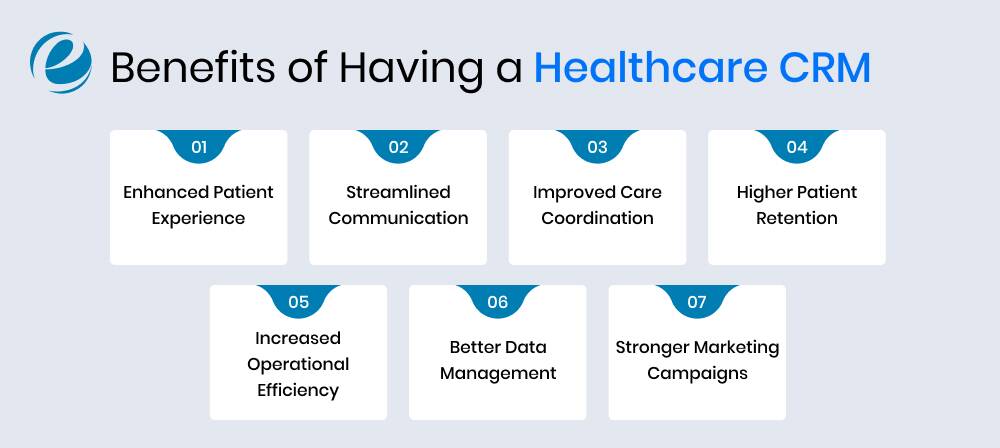
Utilizing a CRM in healthcare industry not only exceeds patient care but also enhances hospitals’ and healthcare professionals’ operational efficiency. A well-thought-out healthcare CRM can be effectively utilized by clinics, hospitals, and healthcare professionals to improve customer experience. Healthcare CRM software simplifies the tasks that need to be done every day and helps in providing more personalized services to patients, thereby creating the most modern and efficient healthcare environment.
The following are the main advantages of implementing CRM software for the healthcare industry:
Enhanced Patient Experience
Healthcare CRM software enables you to know your patients’ needs and, at the same time, provides them with personalized communication and care.
- Patients appreciate timely reminders, health tips, and follow-up messages matching their health conditions.
- This enhances trust and loyalty.
Streamlined Communication
All interactions logged within one system allow your team to answer patient questions and consult the communication history more efficiently.
- Timesaver (There is no need to repeat questions or be a part of confusing conversations.)
- This results in a better outcome for the patient.
Improved Care Coordination
Healthcare CRM solutions
- Having the same information accessible to all involved in the patient’s care will prevent medical errors and achieve good follow-up care.
Higher Patient Retention
CRM systems render possible continuous follow-up and check-ins, as well as the launching of customized outreach programs.
- The patients who are engaged are likely to return to the health facility in the future.
- It is a good way to cause patients to become your lifelong friends.
Increased Operational Efficiency
Using automated procedures is one way to handle appointment scheduling, billing reminders, and patient feedback tasks.
- It is the opposite of human error as it decreases not only the staff workload but also the possibility of mistakes by any staff member.
- It is the very opportunity to become more concentrated on patient care.
Better Data Management
A Healthcare CRM solution is one that can gather all patient data into one place, which is further updated, accessed, and secured easily.
- It not only enables us to comply with necessary rules but also stops information from getting lost or put in danger.
Stronger Marketing Campaigns
Healthcare CRM software would be very effective in the organizing phase of marketing campaigns and training sessions for the staff.
- Break down patients into categories of age, disease, or treatment record to send worthwhile content.
- It is primarily used to advertise medical services such as immunizations, health checkups, and wellness programs.
The use of CRM software cannot only improve patient and physician experience in the healthcare industry but also significantly reduce providers’ workloads. It is a necessary investment to bring about a high level of service and patient-centeredness.
Key Challenges in Healthcare CRM and How to Overcome Them
The healthcare sector can leverage CRM for a variety of benefits, but the difficulties related to its implementation in practice should not be underestimated. Healthcare professionals have several challenges that may interfere with their efforts to relish the benefits of a healthcare CRM system, such as threats to data security and privacy issues, alongside user adoption hiccups. The acknowledgment of these issues and the understanding of the ways to tackle them can be attributed to the cycle of successful CRM implementation, resulting in substantial financial, social, and operational gains.
Here is an outline of the significant problems with the use of CRM software in healthcare and the ways to solve them:
Data Privacy and Security Concerns
Patient data that is sensitive and requires strict regulatory compliance like HIPAA or GDPR.
- Solution: Healthcare CRM systems with robust cryptography, secure access control, and audit trails are the best approach to ward off data security breaches.
- Check if your CRM provider keeps all the healthcare regulatory requirements to ensure the integrity, confidentiality, and privacy of the patient’s information.
Integration with Existing Systems
Many healthcare facilities already have electronic health records (EHRs), billing software, and scheduling tools in place.
- Solution: Bring a healthcare CRM on board that is easily compatible with your current technologies.
- APIs and middleware with the correct configuration can enable the healthcare CRM to communicate effectively with legacy software.
Staff Resistance to New Technology
Medical professionals and healthcare administrators may be slow to adopt new systems because of their fear of the unknown.
- Solution: User-friendly CRM interfaces should be made available, and learning sessions should be given to the staff.
- Involve end-users in the process of choosing and putting strategies into practice so they may feel like they are the owners of the work.
High Implementation Costs
The high cost of implementing CRM systems in healthcare is one of the disadvantages; for example, these systems are systems that a smaller clinic might not be able to afford.
- Solution: Start with the most basic options and gradually add more features when needed.
- Also, cloud-based software often has reduced costs, and the price is paid as and when the service is used.
Data Silos and Incomplete Information
Disconnected systems often result in data that only represents one fragment of the patient, and they also lead to poor decisions.
- Solution: Use a CRM system that gets all the data from one platform to have clean and integrated data of the patients.
- Regular checks against the data can ensure that all the necessary details are filled in and that they make up the most recent data, making the information complete and accurate.
Customization and Scalability Issues
CRM systems developed by cutting through the edges of generality may miss the point where they are supposed to be used in the healthcare ecosystem, hence making the entire workflow problematic.
- Solution: Choose a CRM software capable of being tailored and grown in its features in the health sector.
- Using CRM platforms designed particularly for a particular industry, like Salesforce in healthcare, can save time and money while providing the same or better results than getting the system developed from scratch.
Dealing with the mentioned concerns in advance of time facilitates a smoother healthcare journey with CRM. It ensures that healthcare professionals are able to fully leverage the power of healthcare CRM solutions. A well-crafted strategy also enables the smallest practices to excel in using a CRM system.
Why Healthcare CRM is a Game Changer for Modern Medical Practices?
Now, hospitals and even small and medium-sized health facilities need to use CRM in the healthcare industry to be able to give excellent medical care, which is the kind of medicine that is tailored to meet the needs of each patient in the shortest time possible. Besides merely enabling the management of patient data, this technology revolutionizes the entire process of provider-patient interactions, resulting in good quality care, prompt and efficient communication, and operational excellence.
Automation features that facilitate daily office work and those that engage the customer are the necessary tools that modern clinics need to give them a competitive advantage in the market. Patients will also have the added benefit of their data covering their health attitudes, treatment responses, financial transactions, lab test results, and more details should they decide to share the most up-to-date information. In this way, a CRM empowers the patient, improves loyalty, and builds trust at the same time.
See how CRM software for the health industry is changing the delivery of patient care:
Boosts Patient-Centered Care
An excellent healthcare CRM software identifies the patient’s medical history and the doctor’s participation in communication and engagement.
- First, this allows for trust-building and satisfaction improvement through the personalized care that physicians provide.
- Systems that are connected and integrated allow patients to receive the right message at the right time, regardless of whether it is a follow-up reminder or a wellness tip.
Streamlines Daily Operations
In healthcare, a variety of activities like paperwork and scheduling often lead to chaos. This is where a CRM that works for health should come in, which provides mechanisms for the automation of appointment booking, billing, reminders, and more.
- The increase in staff efficiency is accompanied by a decrease in errors made on the job.
- In addition, having a close relationship with tools for healthcare software development allows CRMs to be adapted easily to specific workflows of the practice.
Improves Patient Engagement and Retention
The experience of consumer involvement starts once they have left a clinic. With a CRM management system, healthcare providers can let their patients know about new updates, send appointment alerts, and remind them of their health status via email or SMS with the help of automation tools.
- These touchpoints at the same level across these communication channels allow the patient to stay informed and remain with the services.
- Also, with CRM tools, patients can be clearly categorized according to health issues, and segmentation will further enhance communication with patients to make engagement levels go higher.
Centralized Data for Better Decision Making
With a healthcare CRM solution, a 360-degree patient view is available for the medical team without having to switch to various systems for data.
- It only takes a few clicks to get access to the data stored in a central location and make well-informed decisions.
- In addition, it is the fastest way to perform a regulatory report, and it prepares the company for audits.
Enhances Team Collaboration
Using CRM, doctors, nurses, and administrative staff are allowed to access all the data with no delays, which enables the medical staff to make interventions and even keep the patients informed of their health condition.
- When working with others, healthcare professionals can make a quantum leap in improving their own performance, and at the same time, their patients will receive practical care from them.
- The team’s connection to the systems, which have been built from the ground up with the help of CRM Software Development, means the team’s cooperation is smooth.
Well, having a CRM system in healthcare is not just a move toward new technology; it is a strategic decision for a more connected and patient-centered care service. If you are managing a small clinic or a large hospital, healthcare CRM solutions
Future Trends in Healthcare CRM Solutions
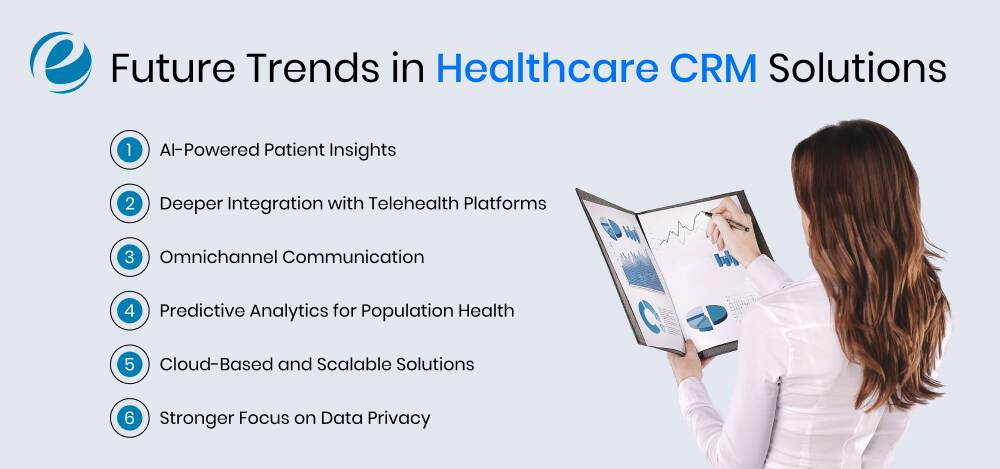
Due to technological changes happening every day, CRM in the healthcare industry is also changing and shifting in concert to keep pace with the intensifying requests of modern medical practices. The upcoming healthcare CRM solutions
Below are some of the biggest trends that will drive CRM software for the healthcare industry:
AI-Powered Patient Insights
It is expected that in the future, healthcare CRM software will provide patient insights based on AI algorithms to help predict patient needs and suggest the most personalized care.
- One of the bright ideas AI can do is analyze patients’ historical actions and, based on this information, point out the necessity for a medical checkup or notify the physician of patients who are more at risk for early intervention.
- Thus, patients are offered more proactive and practical support for their healthcare, which is one of the advantages.
Deeper Integration with Telehealth Platforms
Without any doubt, setting the patients free from the traditional medicine practice hustle and keeping them quarantined or isolated were the major forces to accelerate telemedicine by.qe.more(ethylene. Following the guidelines to ensure virtual consultations and safe practices, it is essential to make decisions with the patients while maintaining their rights through the same CRM system.
- Thus, all virtual consultations, test outcomes, and follow-ups are handled through the same CRM system, ensuring continuity of care without the presence of patients.
- Even if patients do not physically visit the hospital, the care they are receiving is seamless and continuous.
Omnichannel Communication
The future of healthcare CRM solutions
- It changes the way of communication between patients and providers, thus making engagement more comfortable and more regular.
- Teamed with Patient CRM software, this will allow timely and targeted communication for all patients.
Predictive Analytics for Population Health
CRMs will get more involved in analyzing the health condition of the public by using the population-level data, and this approach will help detect the changes, prepare for possible disease outbreaks, and make plans for health campaigns.
- Healthcare providers can implement data-driven outreach programs with the help of CRM tools.
- Further, this shift in the industry not only impacts public health management but also individual care.
Cloud-Based and Scalable Solutions
More and more businesses are adopting cloud-based CRM for the healthcare
- Cloud solutions are obviously cheaper and offer faster updates, which are key to the development of different practices in businesses.
- Apart from that, it is easier to connect the third-party tools that are developed through CRM software development.
Stronger Focus on Data Privacy
New CRMs will address privacy and compliance by default as regulations on data become stricter.
- Encryption from end-to-end, access given according to the role of the person, and keeping records of what happened will be the general practice for this.
- This step ensures that the patients maintain trust in the system and that the providers have more legal protection.
These trends indicate how data storage of patient information and the use of that data to provide more informed, quicker, and more customized care are growing in the healthcare field. Improved with the assistance of bright fixtures like Salesforce in healthcare and software provided by Healthcare Software Development, CRM tools are established as the digital backbone of current healthcare practices.
Partner With Emizentech to Develop CRM Software for Healthcare Industry
Emizentech knows that the healthcare industry’s future is a technology that delivers personalized, efficient, and patient-centric experiences. That’s why we provide the healthcare industry with reliable, scalable, secure CRM software that we can tailor to meet the exact needs of modern medical practices. Whether you are running a clinic, hospital, or health tech startup, we have professional developers who are able to make intelligent healthcare CRM solutions that not only help you save money and improve patient care but also provide regulatory compliance.
Due to our success in both the field of Healthcare Software Development and CRM Software Development, we have all the means to guide healthcare professionals through their digital transformation journey.
The reasons that healthcare organizations prefer Emizentech as their business partner are as follows:
- Our developers develop a completely personalized CRM for the healthcare industry that is in sync with your workflows, specialties, and patient engagement objectives.
- Our CRM developers, experienced in the field of healthcare, and IT experts, collaborate with you to deliver highly secure, compliant, and high-performing software.
- We make sure that your CRM is flawlessly integrated with other systems, such as EHRs, telehealth tools, and platforms such as Salesforce in healthcare, to act as a coordination center for all operations.
- We believe in creating CRM software for healthcare industry
that is not only user-friendly for employees but also scalable for your future growth so that you can expand your business without having to change systems. - From strategy to deployment and after, our team is still there, giving you continuous support, updates, and training so that your CRM can always run smoothly.
- We are committed to ensuring data privacy and protecting compliance with industry standards, such as HIPAA and GDPR, to keep patient information secure, which is always our utmost priority.
- Our professionals speed up the process of getting patients attended to and, at the same time, can use one application to do the previous work, with one of the major results being the increase in patient satisfaction, hence operational efficiency.
With Emizentech as your technology provider, you not only get the software but also have a team of dedicated professionals who are committed to establishing a new CRM era in the healthcare sector together. Let’s work together to define the future of CRM in healthcare industry.
Wrapping Up
Nowadays, the healthcare industry is a place where the patient’s focus is the center of discussion, and everything is moving quickly. Having the tools that are ideal for managing patient relationships is no longer just another possibility; it has become a necessity. A strong healthcare CRM enables doctors, clinics, and hospitals to deliver better patient care, operate more efficiently, and outperform competitors. Starting from CRM in healthcare industry concepts and concluding future trends, as well as benefits, challenges, and the development approach, this blog is a complete guide on the issue.
If you are a healthcare provider of any size, your purchasing of CRM for healthcare
When you partner with a company like Emizentech that has been in the business for a long time, you will get the right person to install the system developed by professionals who know and understand the IT industry.
Suppose you want your hospital to look different and stand out. In that case, you can start your digital journey by using software like Patient CRM and Salesforce, and even get healthcare and CRM software services from competent providers. Let technology do the dirty work for you, and simultaneously for the patients you are serving.
FAQs
What is CRM in healthcare
Customer Relationship Management (CRM) aimed at the healthcare industry facilitates the keeping of patient information, the organization of communication and appointments, and the care coordination that results in the improvement of both patient experience and operational efficiency.
How much does it cost to develop healthcare CRM software?
The development of CRMs specifically for the health sector is priced at $15,000 - $80,000. The scale of this cost may vary in some cases if the features and complexity are reevaluated. Generally, the increasing amount of the sum is connected with the development company's location.
How long does it take to build a healthcare CRM?
It generally takes about 3 to 6 months to get a basic healthcare CRM software with average features. Going far beyond a standard, feature-rich, and completely customized platform could potentially call for 6-12 months to be fully developed and operational.
What technologies are used to build CRM for healthcare industry?
Standard tech stacks include: Frontend: React, Angular, or Vue.js Backend: Node.js, .NET, or Django Database: MySQL, PostgreSQL, MongoDB Cloud: AWS, Azure, or Google Cloud Others: APIs, HIPAA-compliant security tools, Salesforce Health Cloud (for Salesforce in healthcare)
Why should I choose Emizentech to develop my healthcare CRM?
Emizentech is the right choice if you are interested in collaborating with a skilled team of developers, tailored fitting solutions, the most advanced selection of technology options, and uninterrupted support throughout the whole process of the project. We have a special interest in healthcare industry solutions, so you are more than welcome to start by checking out our Healthcare Software Development services at Emizentech.



 +1 (989) 535-9295
 info@emizentech.com
 emizentech


