
 Add us as a preferred source on Google
 As everyone knows, the competition in the real estate market is very high and tough, because managing multiple clients, property listings, and follow-ups can quickly become overwhelming. Real estate agents deal with large amounts of data, which range from client details and inquiry tracking to meetings and document handling. Because of many concerns, CRM in real estate industry has come in, as it is instrumental in bringing about a turnaround in the agents’ work process. With CRM (Customer Relationship Management), agents are able to keep things in order, respond to customers’ needs quickly, and record every activity in a single place so that the system runs seamlessly without losing a lead or opportunity.
A real estate CRM software not only saves time but also boosts productivity by automating everyday tasks like sending emails, scheduling follow-ups, and updating property status. Such allows both agents and agencies to have strong relationships with clients through personalized communication and timely updates. It is a fact that both an individual agent and a team member using a CRM system can make their workflow leaner and at the same time gain the upper hand in the resale process with a minimum of worry.
With the help of this specific guide, you will explore the multiple qualities of the CRM part in real estate, bring out the advantages, the most important features, and elaborate on how it will be able to create growth opportunities for business in the coming years.
Market Stats About CRM Software for Real Estate (2023-2030)
According to Verified Market Research, it is forecasted that the global real estate CRM software market will be a market of considerable size in the coming years. Initial estimates suggest that in 2023, the size of the market will be USD 10.81 bn, growing at a 3-year CAGR of 8.1% to nearly USD 17.13 bn in 2030. This projected growth is attributed to the rise in the use of some of the tools offered by the sales department for better management of property, client communication, and the sales process, said Jessica McFarland, a senior leader in the sales section of the research company.
In the same trend, the general real estate software market, which includes CRM solutions, is on an upsurge, and it is expected to grow sturdily as well. A report by Grand View Research said that the market will have a compounded annual return of 12.8%, from being worth USD 10.24 bn in 2022 to USD 25.39 bn in 2030. This growth is a clear indication of the new real estate realities, where the industry is moving towards technology-intensive platforms that integrate all business processes in the property sector, client management, and are no less than all-in-one.
What is Real Estate CRM Software?
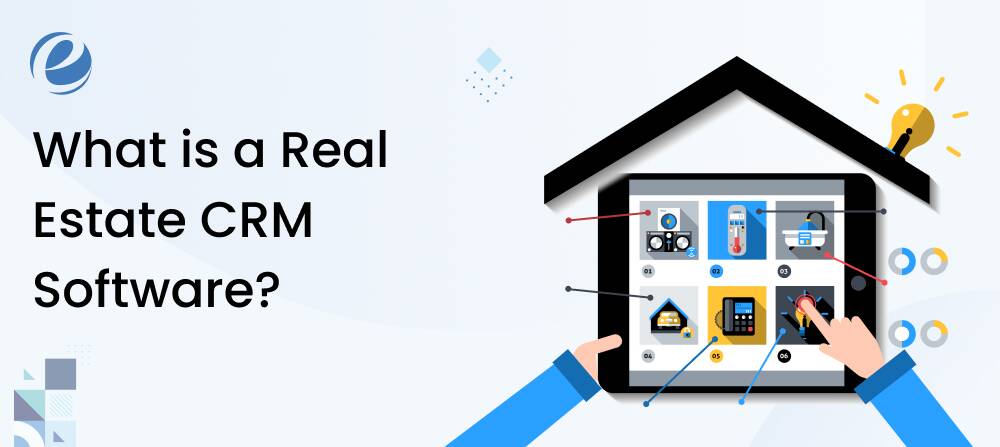
Real Estate CRM (Customer Relationship Management) software is a utility used by real estate professionals to manage interaction with customers, leads, and the buyer and seller of real estate. It works as a virtual assistant that not only records client information but also organizes communication, keeps track of appointments, and instructs real estate agents about their actions.
This software can help agents to be more efficient at their work, such as following up on leads, some technical matchings, and closing efficiently. Quite simply, Real Estate Cmer relationships can be done in a very smart and polite way.
Importance of CRM Software for Real Estate
Here are the key reasons why Real Estate CRM software is essential:
Efficient Lead Management
The tool assists in lead acquisition, lead storage, and lead administration of the contacts that come from different platforms such as Internet sites, advertisements, and social media.
Why it is important: Instead of forgetting to follow up on leads, agents can reach out to each of them, and thus their chances of making deals are higher.
Centralized Client Information
Information of every client, like the mobile number, the type of property that he/she was interested in, and all his/her previous conversation records, etc., is recorded in one place.
Why it is essential: With a deep understanding of customer needs, the agents are in a much better position to provide a personalized service and present property suggestions.
Automated Follow-Ups
Here, CRM software refers to working on an automated basis via sending emails or SMS messages to the required customers and prospects at the right time.
Why it is essential: You do not have to remember the dates on your own, it is a very good way to save time for yourself and keep you from your own engagement with your clients by talking to them or any other way more frequently, and so, increase conversion rates.
Task & Schedule Management
This part is of great assistance to local agents in the management of their day-to-day work, property shows, and meetings with the aid of calendars and reminders.
What is the point: It is most helpful in coordinating the activities and makes sure that you meet your commitments without carrying out many negotiations or interactions.
Property Tracking and Matching
Some customer relationship management (CRM) software provides functionalities that enable agents to match clients’ preferences with properties.
Why this is important: It helps one quickly find the required properties for the right buyers. As a result, both buyer and seller save time.
Improved Collaboration
Any participant from the team can acquire the same set of the client’s data, notes, and updates through the CRM platform.
Why it matters: It is the best way to be certain that teamwork is smooth and communication is consistent in all segments, sales, marketing, and customer service.
Better Insights Through Analytics
With the help of CRM software for real estate, one will be able to enter the section with sales performance, lead source, and customer behavior reports and insights.
Why it matters: This will allow you to utilize the data available to make decisions and make the necessary modifications to your marketing or sales strategies.
Higher Customer Satisfaction
When timely communication and personalized service are the standard features of the processes, the clients will be much more satisfied.
Why it matters: Satisfied clients are very significant in the real estate industry, and they can be the most solid ground for a better network and repeat business.
CRM software for real estate
Furthermore, our next section will act as a guide to comprehending the working and profit-making strategies and improving sales for today’s real estate business using CRM solutions of the highest order.
Benefits of Using CRM Software for Real Estate Industry
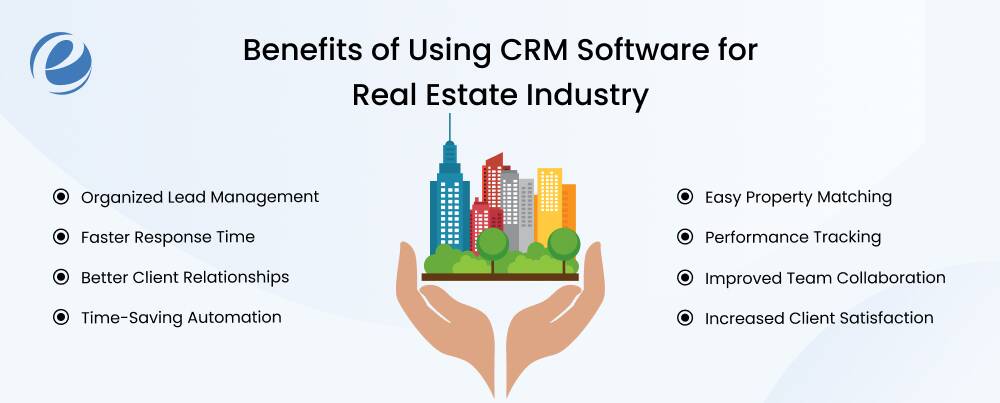
Organized Lead Management
Using customer relationship management (CRM) software, real estate agents acquire and handle leads from various sources such as websites, social media, and advertisements.
Why is it important: As opposed to working with spreadsheets or sticky notes, all the lead pieces of information are kept in one place, with no effort needed in following them up and converting them into clients.
Faster Response Time
If you have automated alerts and follow-up reminders, you will be in a position to answer customer inquiries promptly.
Why it matters: Fast replies show that you are a professional and increase the chances of arranging property visits and sales.
Better Client Relationships
The software keeps a record of the conversations that have happened earlier, the properties that have been shown to clients, and the client meeting details.
Why it matters: Such abilities enable you to give better service by allowing clients to feel special, and so convincing that they entrust you with their real estate matters.
Time-Saving Automation
Sending emails, scheduling meetings, and setting reminders are some of the tasks that the software can manage on your behalf.
Why it matters: This frees the agent up from the tedious work and gives them time to concentrate on selling and customer interaction more.
Easy Property Matching
Most real estate CRM software uses this feature to match the customer’s needs with the properties available.
Why it matters: The facility is beneficial to both agents and clients by showing them the recommended properties only and, therefore, saving them time.
Performance Tracking
Managing contacts, sales, and team performance are some of the activities included in CRM software.
Why it matters: This is basically telling you what is going excellently and what needs to be tweaked to grow your business wisely.
Improved Team Collaboration
Having a team, the best thing you need is to keep a pool of data that all the members can access and receive updates in real-time.
Why it matters: This ensures a hassle-free atmosphere between colleagues and teams, and at the same time, it forms great conversation with the customers.
Increased Client Satisfaction
Organized, accessible, and personalized binding agents can give a faster and smoother buying or selling experience.
Why it matters: When the client is satisfied, they will be more likely to refer to a new business, and at the same time, they will return to the same agent.
Using a trustworthy CRM solution for real estate industry, makes real estate agents look more professional and, in this way, boosts productivity and the income of the real estate business with less effort and more results.
Key Use Cases for Real Estate CRM Software
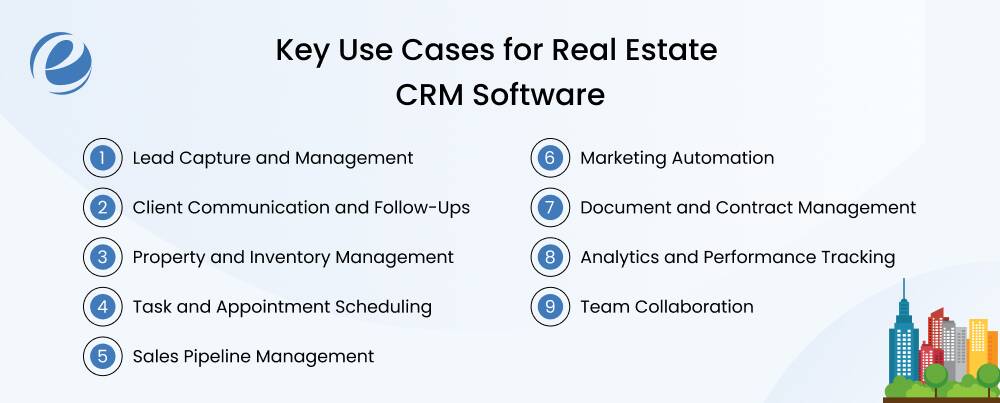
CRM software for the real estate industry is not only a place where you can keep the records of your customers, but it is also a powerful tool that assists in the performance of multiple daily tasks and achieving various business objectives. Here are the most widely used and significant uses of CRM in real estate industry:
Lead Capture and Management
What it does:
A CRM system can capture leads without any manual labor via its integration with and capturing from websites, landing pages, property portals, and social media.
How it helps:
Instead of doing it all manually and inserting each new request, leads will come into your system instantly as they arise. The agent can, from the same place on the dashboard, manage residential and their status, assign leads, control the most important contacts, and follow up on changes to avoid missing out on any opportunity.
Client Communication and Follow-Ups
What it does:
CRM systems track the customer contact history through emails, SMS, and phone calls, as well as record the schedule of the required follow-up.
How it helps:
The agents are therefore able to track every chat, one by one, through the whole labyrinth of the automated reminders that will ensure the communication is kept, and no client is missed, resulting in improved service and increased sales. This is specifically beneficial in the context of long sales cycles.
Property and Inventory Management
What it does:
CRM software has the functionality to arrange and stock listings of properties and their complete specifications, including images, traditional sale prices, and the status of availability.
How it helps:
They can even take an instant match between the client’s preferences and the available listings, thus creating satisfied customers and saving the servants’ time. Thus, a property’s status (like sold, available, or under negotiation) is changed and visible in real-time to the entire team.
Task and Appointment Scheduling
What it does:
To manage visits to the property, to run meetings, and make calls, you can add these appointments to the CRM system, most often along with certain calendar events.
How it helps:
It will decrease the number of scheduling mistakes, and the agents will also be able to have a more organized day, which will result in a higher productivity level. Regular notifications will be received, and no one will be left out.
Sales Pipeline Management
What it does:
In this system, the CRM software uses graphs and other visuals to represent the current position of the customer in the sales process- are they recent leads, in discussions, or going to make a purchase?
How it helps:
Representatives can dedicate all their attention to the most promising leads and therefore qualify them faster and with larger success rates.
Marketing Automation
What it does:
Several CRMs provide users with marketing tools, such as the ability to send a newsletter, updates on a property, and targeted campaigns through email or SMS.
How it helps:
Automated marketing is a great way to keep customers engaged and updated, and it is especially useful for top clients. Through it, you can easily bring up new properties, discounts, and conduct open houses.
Document and Contract Management
What it does:
CRMs can store documents that are crucial to the core and the legality of the business, such as contracts, ID proofs, or legal papers.
How it helps:
It helps by maintaining everything in one place that can be easily reached and shared with clients, which accelerates the process of completing the deal and precludes the chance of postponing.
Analytics and Performance Tracking
What it does:
The system produces detailed reports on customer interactions, sales, team response rates, and marketing efforts.
How it helps:
From the reports, you can easily see the activities that are leading to good results and which ones are not. This will allow you to make decisions based on facts that will help and grow your business.
Team Collaboration
What it does:
CRM software for real estate
How it helps:
It cracks down on communication errors and enhances enthusiasm in team members, which is especially beneficial in larger real estate firms or multi-location agencies.
Through these case studies, we recognize that the CRM in real estate industry is more than a simple database; it’s a sophisticated and cohesive platform for managing the day-to-day, upping sales, and driving satisfied customer journeys. This advanced technology is a tool for sales and customer service, and by using the CRM, a growing company at whatever level it is will only enjoy the great benefits it presents, such as increased performance, efficiency, and client satisfaction.

How To Choose the Right CRM for Real Estate Agents?
The decision to choose the perfect CRM for real estate agents is genuinely significant. Such software is designed to help you stay organized and to grow your company. But the real challenge is to find one that perfectly fits your business. Thus, a very important part of the CRM software is learning how to manage leads through the platforms, also to automate tasks, and how to grow the business, while if one chooses the wrong CRM, it can result in a lot of wasted time and money.
Below are the main factors to be taken into account when finding the best CRM software for real estate industry agents:
Industry-Specific Features
Look for: A CRM prepared exclusively for real estate.
Why it matters: Standard CRMs might not have information regarding property listings, site visit scheduling, or property-client matching. A real estate CRM will carry features that are customized according to your duties.
Ease of Use
Look for: An interface that is clear, simple, and user-friendly, and additionally, easy to learn and carry out.
Why it matters: No agents should find that understanding the system is something time-consuming if they can’t do it by themselves. A simple design will make sure that the team is taking up the tool and using it effectively.
Lead Capture & Management Tools
Look for: A lead capture system that is automatic through the conveniences of a website, ads, and social platforms.
Why it matters: A real estate agent CRM that is the right fit should be capable of gathering leads from various sources and keeping them all in one place. In addition, it must have the power to track the journey of the leads from generation through to conclusion.
Integration with Other Tools
Look for: It is synchronized with your email, calendar, MLS listings, and all your marketing platforms.
Why it matters: It’s one system, and it allows you to have enough time due to the smooth integration, which, in turn, will enable you to administer.
Automation Capabilities
Look for: Automated emails, reminders for the second follow-up, task plans, and drip programs.
Why it matters: The automation mechanism enables you to receive feedback from potential customers without making a call every single time. As a result, the engagement is much better, and there is a lot of time saved.
Mobile Access
Look for: A CRM that has an app for mobile or a mobile-friendly dashboard.
Why it matters: Agents of real estate are always in a rush. It is important to be able to connect to your CRM from your phone or tablet so that you can stay in touch with your leads and schedule meetings at all times.
Customizability
Look for: CRM systems that let you add fields, pipelines, and workflows.
Why it matters: Each real estate agency has its own process. A customizable CRM will be great because it will enable you to configure it according to your process and requirements.
Data Security & Support
Look for: Strong data protection, backups, and responsive customer support.
Why it matters: You’re keeping clients’ private information. The system should be secure and responsive to your needs to prevent incidents that could damage your reputation or productivity.
Analytics and Reporting
Look for: Included in this is the usage of dashboards, performance reports, and lead tracking.
Why it matters: Great reporting enables you to make correct decisions, whether it’s about knowing which media is the best performer or who the agents are closing the most deals.
Pricing and Scalability
Look for: A CRM that is within your budget and can grow at your pace.
Why it matters: There is no reason to pay for functions that you will not make use of. Then again, you should be sure that your team or client base will not outgrow the CRM.
All the mentioned tips can help real estate agents select a CRM in real estate industry that truly aligns with the goals of their business. No matter if you are just a single agent or you belong to a team in the progression stage, if the right CRM software is used, it can save your time, enhance your relationships, and take your sales sky high.
Top 10 CRM for Real Estate
Deciding on the most appropriate CRM software can significantly affect the way real estate agents handle leads, properties, and customer interactions, and this is where a comparison of the best CRM in real estate industry is going to be of great help to you. It is not easy to choose one of the best, but with the help of this table, you can compare the best ones. With this, you can find out all you need to make an informed decision.
| CRM Software | Launch Year | App Size | Platforms | App Ratings | Downloads |
| Follow Up Boss | 2011 | ~50 MB | Web, iOS, Android | 4.5★ (iOS) | 100K+ |
| Pipedrive | 2010 | ~60 MB | Web, iOS, Android | 3.7★ (iOS) | 500K+ |
| Salesforce | 1999 | ~150 MB | Web, iOS, Android | 4.6★ (iOS) | 1M+ |
| Wise Agent | 2002 | ~45 MB | Web, iOS, Android | 4.4★ (iOS) | 50K+ |
| Zoho CRM | 2005 | 397.6 MB (iOS) | Web, iOS, Android | 4.5★ (iOS), 3.6★ (Android) | 1M+ |
| Real Geeks | 2010 | ~40 MB | Web, iOS, Android | 4.3★ (iOS) | 100K+ |
| Freshsales | 2016 | ~70 MB | Web, iOS, Android | 4.4★ (iOS) | 500K+ |
| HubSpot CRM | 2014 | 170.9 MB (iOS) | Web, iOS, Android | 4.7★ (iOS) | 1M+ |
| Propertybase Inc. | 2010 | ~80 MB | Web, iOS, Android | 4.2★ (iOS) | 100K+ |
| Top Producer | 1982 | ~35 MB | Web, iOS, Android | 4.1★ (iOS) | 50K+ |
| kvCORE | 2011 | ~60 MB | Web, iOS, Android | 4.3★ (iOS) | 100K+ |
Why Choose Emizentech to Develop CRM Software for Real Estate Industry?

Retail industry professionals need to be well-equipped with modern tools to improve their interactions with consumers and increase the conversion rate of their stores. Using a retail-specific CRM system allows companies to manage customer data, sales, marketing campaigns, and lots of other activities, all within one single platform. Thus, Emizentech is one of the best for these kinds of challenges. Our CRM for real estate app development service perfectly matches the definition of top-notch retail solutions.
- Emizentech understands the challenges the retail sector faces and is, therefore, capable of providing the system functionality that addresses the demands of the sector, such as inventory tracking, customer segmentation, and sales automation.
- With our designers designing a CRM system based on your business objectives, sales processes, and customer journey, you can always keep in touch to make all changes necessary for the company’s growth.
- With this process, you can have all customer touchpoints unified in your CRM to deliver high-quality, personalized experiences each time.
- They would include the latest and most advanced features like automated email campaigns, loyalty programs, and sales analytics in their suite of tools.
- We have created CRM software that is meant to be scalable and trustworthy, thanks to its state-of-the-art security features that are dedicated to protecting customer data.
- Emizentech’s team of skilled professionals, including developers, UI/UX experts, and project managers, is a proven expert with years of experience in building retail and enterprise solutions.
- Our developers don’t forget about the most user-friendly and reactive layout UI that makes your users comfortable while using the system.
- We provide different pricing options so that every budget can find something that meets their purse best, and clearly states that there are no hidden costs.
In cooperation with Emizentech, retail companies get the opportunity to use high-quality and CRM software designed for the retail industry that fosters business expansion and client retention. Whether your goal is automation of your activities or an effective way of interacting with customers, we provide you with the right tools for each case.
Wrapping Up!
Without a second thought, adopting CRM in real estate industry improves the manner in which realtors handle their work smoothly, such as managing leads and clients and closing deals more quickly. Using a real estate CRM software that is well-designed and efficient helps with the entire CRM process, and thus, the agents’ daily operations are more productive, and the workflow is easier.
Regardless of whether you are a single agent or you run a real estate agency that is on the rise, getting the real estate CRM for real estate agents would have a positive impact on the customer relationships and, as a flow-on effect, your sales performance would be through the roof. If you want to develop a customized CRM that is more suited to your business, consider Emizentech, which will provide you with a secure, scalable, and user-friendly product.
In the contemporary world of business, engaging in innovative CRM for real estate is not a matter of choice, but a must-have condition for the company’s successful existence in the market. Is the idea of revolutionizing your real estate business through a new set of CRM tools something that you’re open to? Go ahead and discover your path!

FAQs
Can a CRM be customized for my real estate business?
Of course, most CRM development companies, such as Emizentech, provide software that can be easily modified to meet your business requirements, team size, or any other needs you have.
Why is CRM important for real estate agents?
CRM is a vital tool in the hands of real estate agents because it unclutters the work of the agent, speeds up the process of collecting and retrieving the details of the listings, and keeps customer relations at the top of the agenda without the need to change the workspace for each activity.
How much does it cost to develop a real estate CRM software?
The exact cost to develop a custom real estate CRM system will vary according to the features of the software, the platform (web or mobile), as well as the development complexity, but on perfect days, the cost would range from $10,000 to $50,000 and even more. For a more accurate price, the conversation with a development company would be your best option.
What technologies are used to build CRM software?
Commonly secure and scalable CRM systems are usually built with the help of different technologies such as React, Angular, Node.js, Laravel, Python, and cloud platforms like AWS or Azure.
How long does it take to build a real estate CRM system?
The development time period basically depends on the list of features, the design set, seamless connections, and whether the product is a custom build or a ready-made solution. In some cases, it can go as short as 2 months or up to 6 months, but give or take a few days.




 +1 (989) 535-9295
 info@emizentech.com
 emizentech


