
 Add us as a preferred source on Google
 Nowadays, Modern businesses have never been so dependent on customer data to drive their decisions and innovate the customer experience. The most popular tools for this are CRM (Customer Relationship Management) and CDP (Customer Data Platform). Although both are for handling customer data, they achieve different goals.
CRM systems are tools for dealing with customers, their main focus being sales, salesforce implementation, and support. On the other hand, CDPs source their data from many different channels to create a comprehensive profile with which they mainly do marketing and personalization.
The question is, why is this comparison so relevant in 2025?
In fact, the customer data is a more valuable asset now compared to all other times. The global CRM market is supposed to exceed $112.91 billion by 2025 (source), whereas CDP sales have increased by 15% annually, reaching $2.3 billion in 2023 (source).
In this blog, we cover everything like the realization of CRM v/s CDP, which is the basic understanding for the one presenting such a new business in 2025 to hastily figure out the perfect one with which to work and which tools of enterprises are best.
What is a CRM (Customer Relationship Management)?
A CRM (Customer Relationship Management) tool is software that helps businesses manage and improve their relationships with customers. It not only enables companies to get hold of information about customers but also allows them to organize the connections, and thus there are many benefits of salesforce CRM like in the decision-making, sales, and customer service attempts.
Definition and Purpose
CRM software is designed to collect all the personal data of the customers such as contact information, emails, past purchases, and communication history. The main purpose is to assist businesses in creating better relationships, supporting customer service, and increasing the number of sales by having everything organized in one place.
Key Features of CRM Systems
- Contact Management – Save and manage customer details.
- Sales Tracking – Keep an eye on the deals, opportunities, and pipelines.
- Task and Activity Management – Schedule appointments and follow-ups.
- Email Integration – Use the system to send and receive emails directly.
- Reporting and Analytics – Have an understanding of customers’ buying behavior and sales performance.
- Automation – Do jobs automatically, such as sending a welcome email or assigning leads.
Common Use Cases of CRM
- CRMs are instruments that are employed by Sales Teams to manage leads, track deals, and close sale leads.
- CRMs are used by customer support teams to track support tickets and resolve problems immediately.
- CRMs are one of the elements that marketing teams use to send personalized emails and stay in contact with potential customers.
Examples of Popular CRM Tools
- Salesforce – A powerful, customizable CRM used by large enterprises.
- HubSpot CRM – A user-friendly tool that’s great for small to medium businesses.
- Zoho CRM – A budget-friendly option with strong features.
- Pipedrive – A simple CRM software focused on sales pipeline management.
What is a CDP (Customer Data Platform)?
A Customer Data Platform (CDP) is software that generally assembles customer information from diverse sources with a view to conceiving a single, unified customer profile. It also helps businesses a lot in understanding the behavior of their customers and offering personalized marketing.
Definition and Purpose
A customer data platform (CDP) is a system that collects customer data from websites, apps, emails, social media, etc., into one place.
The main objective of this system is to provide marketers with a comprehensive, real-time overview of their customer’s journey, which enables them to run targeted promotions and perfect customer satisfaction.
Key Features of CDP Systems
- Data Collection – Brings data in from multiple sources like websites, mobile apps, CRM, and emails.
- Identity Resolution – Merges customer data to form one readable entirety.
- Segmentation – Helps split clients into groups based on behaviour, interests, or demographics.
- Real-Time Updates – Keep an eye on your customer profiles and get them to be updated without your involvement.
- Data Activation – Drives out customer data to such tools as email platforms or ad networks for laser-focused marketing.
- Privacy Compliance – Gets customer’s agreement and kinds of support such as GDPR, CCPA, etc.
Common Use Cases of CDP
- Personalized Marketing – Generate customized content and offers for distinct customer types.
- Customer Journey Mapping – Be aware of the different touch points through which clients interact during their buying journey.
- Behavioral Targeting – Display advertisements or messages that are based on the customers’ behaviour.
- Audience Segmentation – Make automated groups that are customer-centric and use them for promotions.
Examples of Popular CDP Tools
- Segment – This top salesforce CDP is widely recognized for its excellent support of integrations and appeal to developers.Tealium – Tealium is big on real-time data tracking and customer privacy.
- mParticle – Mobile-first businesses like to use it to trace user behaviour and user activity.BlueConic – A marketer-styled platform with strong segmentation features.

What is the Difference Between CRM and CDP?
CDPs and CRMs enable businesses to manage customer data but in different ways. These tools target different types of users and are mainly used by different teams. A clear understanding of these differences will help you choose the suitable tool that matches your business requirements.
1. Data Collection and Storage
- CDP is a tool that can collect data from various sources, including websites, apps, email, and ads. The tool holds both identified and anonymous data in order to be able to prepare a more complete picture of the consumer.
- CRM, on the other hand, is a storage of direct confrontations like the client’s contact details, emails, and sales specifics. Talking with customers or leads who are identified only is the platform that’s most appropriate for this tool.
2. Customer Data Management
- CDP gets rid of harmful and duplicative data, and then it proceeds to join these individual profiles to form a master record.
- CRM calls for traditional engagement and very little automation and resides more on the customer’s relationship and the history of communication.
3. Real-Time Data Handling
- CDP is able to automatically update the customer details when a customer creates accounts in real-time and this can be used for the display of the most recent content or the offers that are now most valid.
- CRM data is generally updated during the time when the sales or support team is in contact and communication with the customers. The outdated nature of the previous transaction can lead to delays.
4. Integration Capabilities
- You could usually expect CDP to find it less of a hassle to share data with other marketing, advertising, or analytics apps, all thanks to its technical capability.
- While CRM is modified to suit various tools, the main focus of a CRM is on customer service or sales applications.
5. Personalization and Segmentation
- CDP is quite capable of creating very targeted customer segments with the help of behaviour, location, or action, and it can use these to send emails. It is very easy to send an email message just as the recipient likes, according to the results from the monitoring of the customer journey.
- CRM can perform only the most basic forms of segmentation, typically for lists of emails or sales promotions, while it is not very good at profiling consumers and their habits.
6. Analytical Capabilities
- You won’t find it challenging for CDP to supply you with a complete bunch of facts after gathering and analyzing the information. The information provided is so strong that it will effectively support and even determine your marketing strategies.
- CRM is centered more on sales tracking, pipeline reports, and forecasting, with little marketing analysis done.
7. Primary Users (Sales vs. Marketing)
- CDP is mainly utilized by marketing departments to launch campaigns on a specific target and monitor customer activities.
- CRM mainly focuses on sales and support teams for managing leads, closing deals, and providing customer service.
Similarities Between CRM and CDP
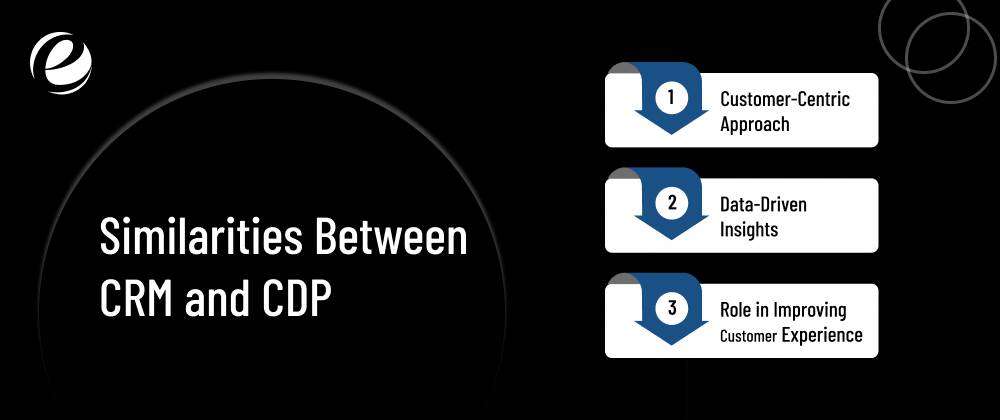
While CRM and CDP are used for different purposes, some of their purposes are the same. The main purpose of both systems is to leverage customer data to achieve better business results and provide the best customer experience. Here are the most common features:
1. Customer-Centric Approach
The customer is at the core of both CRM and CDP. They are instrumental in solving customer requirements, identifying preferences, and figuring out a way to improve connections with customers. Personal customer communication (CRM) and customer behavior tracking (CDP) are both aimed at serving the customer better at the end of the day.
2. Data-Driven Insights
For both, their data is the tack on which they operate. They get, store, and filter customer details to come up with the information that is needed. With the help of the generated insights, businesses are more capable of taking smart actions, such as deciding on the most efficient sales strategies via CRM or executing a more targeted promotion using a CDP.
3. Role in Improving Customer Experience
Primarily, the end goal for both is to win customer satisfaction by way of a smoother customer experience. The application of CRMs is achieved by the companies through the offering of fast assistance and personalized communication, while CDPs facilitate the provision of more pertinent marketing and frictionless customer trips in all channels. In either situation, the aim is to have customers who are satisfied and reliable.
CRM vs. CDP: A Feature-by-Feature Comparison Table
| Feature | CRM (Customer Relationship Management) | CDP (Customer Data Platform) |
| Main Purpose | Manage customer relationships and sales interactions | Collect and unify customer data for marketing and personalization |
| Data Type | Known customer data (e.g., contact info, emails, purchase history) | Both known and anonymous data (e.g., web behavior, app activity, ad clicks) |
| Data Collection | Manual or through direct interactions (e.g., forms, emails) | Automatic from multiple sources (web, mobile, CRM, social, etc.) |
| Data Storage | Stores data related to sales, support, and service | Stores complete customer profiles across all touchpoints |
| Real-Time Updates | Limited real-time capabilities | Updates customer profiles in real time |
| Segmentation | Basic, usually by status or stage in sales process | Advanced, behavior-based and real-time segmentation |
| Personalization | Limited to sales or service interactions | Enables personalized marketing across channels |
| Analytics & Reporting | Sales-focused reports (e.g., pipeline, revenue) | Marketing and customer behavior analytics |
| Primary Users | Sales and customer service teams | Marketing and analytics teams |
| Integration Focus | Sales tools, support platforms, email | Marketing tools, ad platforms, analytics systems |
| Customer View | Partial view (based on direct interactions) | Full 360-degree view (combines all data sources) |
CRM and CDP: Can They Work Together?
Yes—CRM and CDP can absolutely work together, and the result is that businesses get the best of both worlds.
Instead of opting for a single solution to the situation, numerous companies have started using both systems simultaneously, which in turn helps them create a holistic and powerful data strategy for customers. Joining forces ensures a readable view of every customer and allows the teams to provide more personalized and smooth experiences.
Integrating CRM and CDP for Unified Customer View
When CRM and CDP work together, companies can seamlessly connect real-time behavioral data (collected by CDP) with sales and service data (stored in the CRM). It is a symbiotic relationship where the new customer profile includes information on each interaction with a customer, such as a visit to the website, click on email, the latest shopping, and submitted support requests. This level of interaction enables marketing, sales, and support teams to access the richest information to operate effectively.
Use Cases of Combining CRM and CDP
- Personalized Campaigns – The marketing department can use CDP information (for instance, browsing history) along with CRM data (for example, the status of the customer) to send highly targeted messages.
- Smarter Sales Outreach – Through the insights gained from CDP, sales reps can see what products a lead has shown interest in and thus shape their presentation accordingly.
- Better Customer Support – The support team can not only know the steps the customer has taken but also understand the customer’s journey in full and can hence solve issues using the data from the two tools in an integrated and fast way.
- Customer Journey Mapping – The amalgamation of CRM and CDP data facilitates the tracking of the whole customer experience, thereby enabling organizations to spot the weak parts and enhance the experience.
Top 10 AI CDPs in 2025
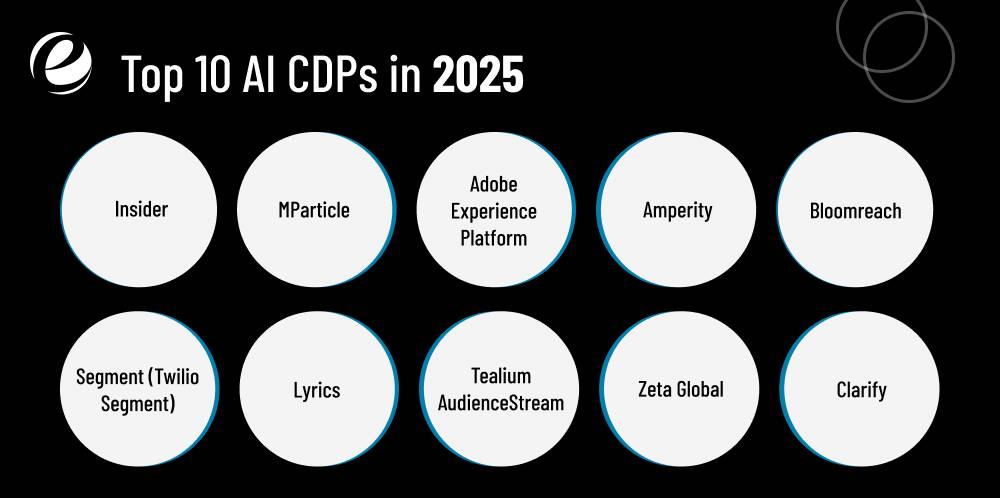
By the year 2025, the input of artificial intelligence (AI) into Customer Data Platforms (CDPs) has transformed the way companies gather, analyze, and operationalize customer data. AI-driven CDPs redefine customer experience through hyper-personalization, predictive analytics, and real-time data processing that result in companies carrying out more detailed and impactful marketing decisions. Here are the best 10 AI-based CDPs that will be advanced in 2025 and will leave the most visible trace:
1. Insider
Insider offers a complete system which makes it possible for you to shorten your customer data, follow your conversions, and also track the return on your investment. Its AI-intent engine is a forecasting tool that anticipates customer attitudes and, in turn, simplifies the whole customer journey from your website to your smartphone through WhatsApp and SMS.
2. mParticle
mParticle provides companies with their client workflows, customer retention, schema management, audience segmentation, creation, and prediction, which gives them a greater share of the world’s market. The AI of mParticle ensures controlled customer data and better marketing, sales, and customization.
3. Adobe Experience Platform
Adobe Experience Platform is an AI-based environment that is able to know the true customer profiles at any given time, offer advanced segmentation and be on point with the predictive analytics for the future behaviour of the target audience. This data intelligence of Adobe gets the right customer interactions and makes such fantastic breakthroughs in branding and customer service.
4. Amperity
Amperity gathers data from silos by using AI and then gathers the data into a customer 360 view. It is a platform that is supported by AI which cleans customer data and makes them predictive for better strategy decisions.
5. Bloomreach
Bloomreach is an AI search and merchandising platform for digital commerce experiences that allows companies and e-commerce businesses to render personalized content and product recommendations to their digital customers, hence increasing engagement and satisfaction.
6. Segment (Twilio Segment)
Twilio Segment is an AI-driven customer data platform for the collection, governance, and segmentation of customer data sets. The customer profile becomes the essential mine that solitary marketing specialists can exploit during their campaigns.
7. Lyrics
Lytics AI is responsible for significantly up-scaling the quality of customer profiles and predictive models thus allowing marketing and sales departments to deliver targeted content and also to increase brand-customer relationships and satisfaction.
8. Tealium AudienceStream
Tealium’s AudienceStream CDP is connected with AI technology that is able to create extensive client profiles which are useful for implementing the personalization of the customers in real-time and providing improved customer experiences.
9. Zeta Global
Zeta Global’s AI-powered marketing cloud that depends on AI and consumer signals makes it possible not only to gather more customers but also to retain, grow, and engage the customer in product/service matters.
10. Clarify
AI-powered Clarify comes with a unique platform that is completely AI-driven and helps bring together customer data, automate tasks, and enable customer data hidden in messages, notes, and other communication channels.
Through the application of AI technology, these Customer Data Platforms (CDPs) are changing how businesses operate by deriving valuable insights using artificial intelligence, resulting in improved customer personalization, predictive analytics, and on-the-fly decision-making.
How to Choose Between CRM and CDP?
Choose CRM if:
- You want to keep your leads, deals, and customer support in an organized manner.
- It’s time for your sales and service teams to have more efficient tools for keeping track of their interactions.
- You are willing to engage in better communication with your existing customers.
- It is important to you to build relations with the clients and to close the deals.
Choose CDP if:
- You are looking to source data from across the web, apps, and advertisements and store it in one place.
- You need to have a 360-degree customer view in order to create personalized marketing.
- You believe in on-the-spot segmentation of your customers and creating unique segments for them.
- You want your marketers to get a more detailed view of the actions your customers are taking.
Choose Both if:
- You wish to have a clear understanding of the customer journey which includes marketing and sales to the support part.
- You like to have a better collaboration between your marketing, sales, and support employees.
- Does your business look for the best relationships with customers and, at the same time, strong data analytics? It is a business the company relies on.
Trends in CRM and CDP (2025 and Beyond)
CRM and CDP platforms are going through a period of significant development, becoming much more intelligent, quicker, and, most importantly, customer-oriented. In the next five years or so, we will witness a radical transformation as AI, stricter privacy regulations, and the rapidly increasing demand for real-time, data-driven marketing will take over. So, the question is, what are the most preferred trends that will govern CRM and CDP by then?
- AI and ML Integration: AI and machine learning technologies are being widely incorporated into CRM and CDP solutions, understanding the data and delivering results to the end customer. The end result is the automation of tasks, prediction of customer behaviour, and the extraction of useful insights, thus making decisions that are more appropriate.
- Privacy Regulations (GDPR, CCPA): The protection of data in all segments of society has become the central concern, such that the software is improved, thus giving businesses the capability to be appreciative of the most severe worldwide data laws, such as GDPR and CCPA.
- Future of Customer Data Platforms: CDPs will, undoubtedly, continue growing, which will make them the most important part of the process of customer data unification and, consequently, lead to the provision of even more personalized and predictive customer experiences.
Real-World Examples and Use Cases
If we take a look at some real business cases, it is easy to see how CRM and CDP can be put to good use. Here, we discuss the common and most important scenarios for using each:
CRM Use Cases
- Sales Tracking and Lead Management – CRM is used by salespeople to save their communication with leads, thus closing deals faster. Sales teams use CRMs like Salesforce or HubSpot to track leads, follow up with potential customers, and manage sales pipelines more effectively.
- Customer Support and Service – A CRM storage serves as a ticket system for support teams to register customer issues, solve their problems, and hold a conversation to remember them for future service.
- Email and Call Tracking – The CRM system logs all the email communication and phone calls to be able to provide updates and to support team members so that they stay updated and consistent in all their communication channels with customers. CRMs record email conversations and phone calls so teams can stay updated and provide consistent communication.
- Customer Follow-ups and Reminders – Clients can be directly reached out to or informed about the progress of the implementation via CRM tools, setting reminders to follow up with clients or send updates, and no opportunity is missed.
CDP Use Cases
- Personalized Marketing Campaigns – CDPs are used to make customer and product data actionable, and they are used by Marketers to connect product views and clicks in behaviour data to send personalized emails or ads. Marketers use CDPs like Segment or Tealium to collect behavioral data (e.g., product views, and clicks) and send personalized emails or ads to each customer.
- Real-Time Customer Segmentation – CDPs support real-time customer classification according to their last actions on a website or in the app, for example, and are used by Marketers to engage with those customers who are most profitable. CDPs automatically group customers based on their actions, like frequent buyers or abandoned cart users, allowing for targeted marketing.
- Cross-Channel Customer Journey Tracking – With a CDP, companies can trace the movements of their customers on their web pages, in their mobile applications, on social media, and even in their email inboxes. A CDP is used by the business to track customer activity across websites, mobile apps, social media, and emails, building a complete view of their behaviour.
- Ad Targeting and Optimization – Better return on ad spend comes as a result of CDPs that can send data to ad platforms (e.g. Facebook, Google Ads) for more accurate ad targeting. CDPs push audience data to ad platforms like Facebook or Google Ads, improving ad targeting and return on investment (ROI).
Why Opt for Emizentech for CRM and CDP Development?
Having the best companion for the development of CRM and CDP determines the success of your customer data strategy. Emizentech, a trustworthy technology partner, is offering solutions personalized to the needs of the industry. This comes with an assurance of businesses being able to manage their customer relations and data all while being aware of the changes in the market and technology.
Key Reasons to Hire Salesforce Developers From Emizentech
- Get fully customized platforms designed to match your business needs, whether for sales, marketing, or data analysis.
- Emizentech covers the whole process including strategy and design to integration and support.
- One such case would be AI-powered features (most commonly for smarter workflows, personalized marketing, and better customer insights) that can be taken advantage of with the aim of automating the organization’s processes.
- With the help of connectors, integration with other platforms is effortless hence fruitful. For example, tools like Salesforce, HubSpot, Segment, Tealium, and marketing platforms can be used.
- Protected with an infrastructure that is not going to be susceptible to breaches, for example, in GDPR, CCPA, and other privacy laws.
- E-commerce, finance, healthcare, travel, and salesforce CRM for real estate are some of the domains with which Emizentech operates and where they have achieved good results.
- Emizentech utilizes the best and most effective methods for flexible, efficient, and fast project delivery.
- Guarantee the smooth operation of the system through ongoing technical help and updates that Emizentech offers to their clients.
Conclusion
Let’s discuss the conclusion: CRM v/s CDP are no less important technologies, but it is worth mentioning that they are intended for different purposes. CRM solutions are deals for managing customer relationships, sales, and customer support interactions. On the other hand, CDPs are systems that gather and organize customer data obtained from various sources for the purpose of creating personalized marketing.
For certain situations, if you are in command of the sales department and lead generation, you should opt for the CRM software program. Otherwise, when you want to undertake marketing activities that are heavily dependent on data and keep track of your customers wherever they are, then the CDP system is the best.
Most growing businesses find that using CRM and CDP together is the ideal solution to understand their customers comprehensively and to improve their sales, marketing, and support departments’ productivity.
So, connect with Emizentech to get an estimation of salesforce implementation cost and start your project creation right now!
FAQs
What are CRM and CDP's major differences?
While CRM is utilized to keep good customer and prospect relationships, track sales and provide support, CDP uniquely integrates and standardizes customer data from multiple sources for marketing and analysis.
Which of the two is costly— CRM or CDP?
It's up to the functionality and attributes of the specific CRM and CDP. CRMs are less costly because they typically target small teams. Alternatively, CDPs are more expensive because they are enriched with advanced functions.
What are the pros of using CDP for marketing teams?
CDP is the better option for marketing as it allows the marketing team to get instant customer data, initiate segmentation, and run personalized campaigns.
Should small businesses have CDPs?
No, not in all cases. The strategy for small businesses here may be to launch a CRM and later increase the functional capability with an additional CDP from their data and marketing.
Are data privacy laws compliant with CRM and CDP tools?
Although businesses have to implement them properly, the majority of the modern CRM and CDP systems are designed to support GDPR, CCPA, and the rest of the privacy regulations.


 +1 (989) 535-9295
 info@emizentech.com
 emizentech


