 Add us as a preferred source on Google
 If you are considering using Salesforce in your business, you might be curious to know about the Salesforce health cloud v/s service cloud. The two products are built on the same salesforce foundation but cater to different types of business demands and industries.
Health Cloud is designed for healthcare and life sciences companies. It allows healthcare companies, payers, and care teams to create patient relationships, manage care, and facilitate regulatory compliance. It optimizes personalized patient care and enhances operational workflows with functionalities such as patient timelines, related data sources, and AI-driven insights.
On the other hand, Service Cloud is built to enhance customer service across any enterprise. It assists companies in handling customer inquiries, automating service flows, and engaging agents with AI-driven suggestions. Utilized by over 150,000 businesses, Service Cloud has already proven to enhance customer satisfaction by 34% and is therefore an enterprise-level solution for those businesses which desire to automate customer support and interaction.
Below, we will describe in greater detail about the Salesforce service cloud v/s health cloud, analyzing their respective features, benefits, and real-world applications to help you determine which solutions best suit your business needs.
Overview of Salesforce Health Cloud
Salesforce Health Cloud is planned in a manner that the healthcare groups remain linked and thereby provide seamless care to the patients, irrespective of the number of professionals. Since salesforce in healthcare has strict security policies in place, the patient’s data is secured and is made available for official healthcare professionals concerning the privacy policies.
Health Cloud is a Salesforce Industry Cloud, i.e., industry-specific for the healthcare industry. It combines the powerful CRM capabilities of Salesforce with industry-driven features that enable hospitals, payers, pharma organizations, and medical device organizations to provide more personalized and effective care. From patient engagement to care coordination, Health Cloud integrates it all under one roof and makes healthcare more accessible and integrated.
How Health Cloud Makes Healthcare Better
- 360-Degree Patient View – Provides physicians and healthcare professionals with real-time, all-encompassing views of a patient’s treatment, appointments, and history.
- Care Team Coordination – Gets all physicians and healthcare professionals who are involved in a patient’s care on the same page through ongoing communication and improved treatment plans.
- Data Security & Compliance – Safeguards sensitive health information and complies with stringent legislation such as HIPAA to ensure that patient data is secure.
- Personalized Patient Engagement – Leverages intelligence to enable healthcare professionals to provide individualized care, enhancing patient health and satisfaction.
Overview of Salesforce Service Cloud
Salesforce Service Cloud is a CRM application that allows businesses to provide better customer support and service. It is based on the foundation of Salesforce’s Sales Cloud but optimized for service teams.
Using Service Cloud, organizations can effortlessly manage customer issues, process support cases, and deliver personalized assistance. Service Cloud assists service agents to be more efficient, hence rendering quicker responses and greater customer satisfaction.
By simplifying customer interactions and providing capabilities such as automation, AI-powered insights, and self-service, this helps organizations build stronger customer relationships while enhancing the overall quality of services.
Why Companies Use Salesforce Service Cloud:
- Faster Case Resolution – Automates redundant effort and assigns customer queries to appropriate agents for faster response.
- Omnichannel Support – Engage with customers via phone, email, chat, and social media from a single interface.
- AI-Powered Assistance – Leverages AI to propose resolutions, understand customer behavior, and enhance service productivity.
- Self-Service Portals – Allows customers to discover solutions on their own using knowledge bases and self-service chatbots.
Salesforce Health Cloud v/s Service Cloud
Salesforce Health Cloud and Service Cloud meet varying business demands. Health Cloud features care coordination, patient engagement, and health workflows, whereas Service Cloud features customer service, case management, and industry-specific services.
Knowing their difference in functionality, cost, and features can allow you to make the right choice for your company. The following is the comparison.
| Aspect | Salesforce Health Cloud | Salesforce Service Cloud |
| Purpose | Specially designed for the health and life science sectors to deal with patient relationships, health records, and care coordination. | A customer service system designed for multiple different industries to deal with customer care, case management, and services operations. |
| Target Audience | Physicians, medical payers, pharmaceutical firms, medical device companies. | Retail companies, financial organizations, telecommunications companies, IT sectors, etc. |
| Key Features |
|
|
| Compliance | Designed with healthcare regulations such as HIPAA, to securely process patient data. | Basic security provided but not specifically designed for healthcare compliance. |
| Customization | Healthcare domain-specific data models and workflows to process medical procedures. | Highly customizable to process different service procedures in multiple industries. |
| Integration | Smooth integration with healthcare systems and EHRs to provide a single platform for patient information. | Integrates with a wide range of business systems, including CRM and ERP solutions. |
If you still do not know which one to utilize, it is best to seek a recommendation from an expert in Salesforce.
Use Cases of Salesforce Health Cloud
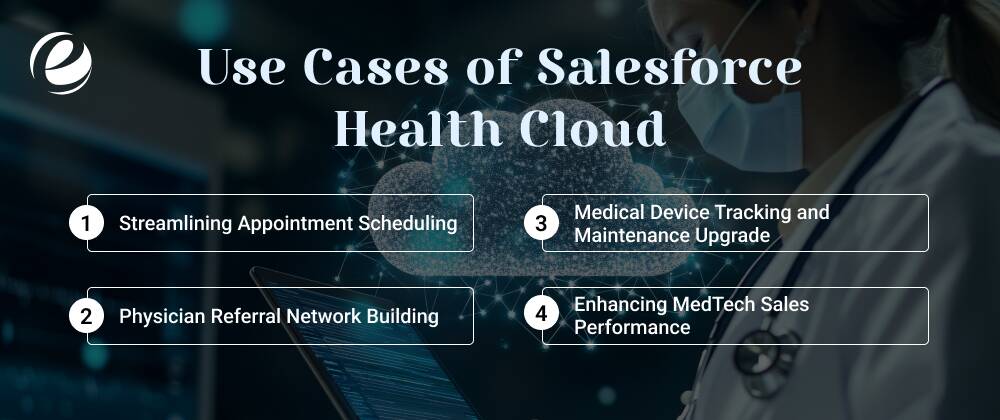
Salesforce Health Cloud is applied in the majority of industries, and businesses utilize it to enhance patient care, automate, and facilitate collaboration. Some applications are cross-industry applicable, while others are industry-specific.
Some of the most important areas where businesses have been able to implement Health Cloud successfully are mentioned below.
1. Streamlining Appointment Scheduling
Appointment scheduling can be complicated, being likely to be delayed and inefficient. Providers can automate appointment schedules and have patients easily schedule open slots through Health Cloud. The system is able to recognize provider-approved and self-service appointments.
Example: A hospital automates appointment scheduling using Health Cloud, cutting patient wait times by 30%. By integrating with electronic medical records (EMRs), the system also monitors previous visits and follow-ups, facilitating coordination.
2. Physician Referral Network Building
Physician referral management and growth are paramount to healthcare organizations. Health Cloud allows providers to monitor referrals, build relationships, and recruit new partners.
Example: The Arizona Center for Cancer Care (AZCCC) used Salesforce to automate its referral network and achieved a 15% boost in provider referrals in months.
3. Medical Device Tracking and Maintenance Upgrade
Health Cloud is utilized by healthcare device businesses using Salesforce Field Service to track equipment automatically, manage field work, and schedule timely maintenance. Through QR codes, the field workers can update device information in real-time, maintaining a proper inventory and service history.
Example: A MedTech manufacturer issues mobile apps to its field service technicians that integrate with Health Cloud. Scanning the device’s QR code allows technicians to immediately update its status in the system, enhancing maintenance efficiency and cutting equipment downtime.
4. Enhancing MedTech Sales Performance
Health Cloud assists medical technology firms in identifying top healthcare professionals, monitoring sales activity, and optimizing engagement strategies.
Example: Gynesonics employs Salesforce automation to track physician training and engage with active professionals through sales campaigns. Likewise, Cardiofocus increased closed deals by 50% and recorded five times more surgical cases after using Health Cloud for tracking sales.
By incorporating Health Cloud into their operations, companies can streamline things, enhance patient experiences, and achieve improved healthcare and medical technology outcomes.
Use Cases of Salesforce Service Cloud
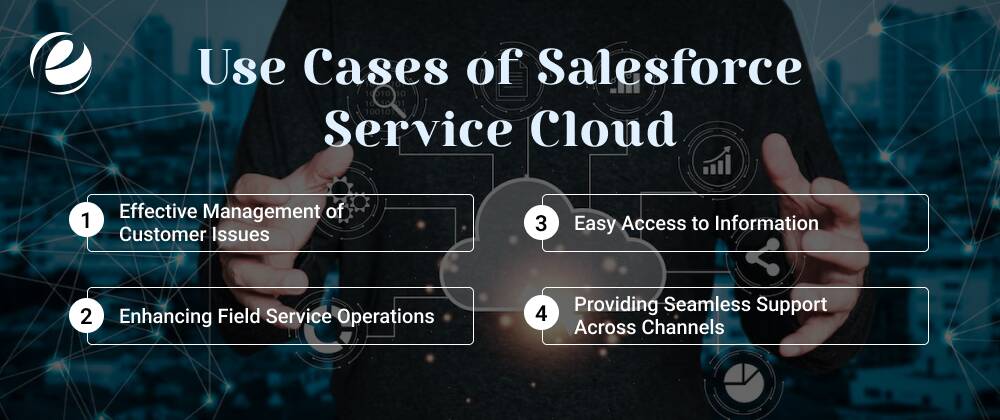
Salesforce Service Cloud implementation assists companies in managing customer service across various channels such as phone, email, chat, and social media. Some real-life examples of how companies utilize it to improve customer support functions are given below.
1. Effective Management of Customer Issues
A sophisticated case management process guarantees that each customer inquiry is driven from start to finish. With Service Cloud, each time a customer contacts via email, phone or social media, there’s an auto-case created and directed to the right team.
For instance, when a customer complains on a company’s Facebook page, it can be tracked by the Service Cloud team and escalated to the right department for processing. With this, companies are able to respond promptly and take better control of affairs.
2. Enhancing Field Service Operations
Planning field technicians effectively is paramount to those companies that offer in-house services. Service Cloud makes it easier by automatically dispatching technicians, booking appointments, and allocating tasks.
For instance, if a client places an online order for a repair service, the system automatically allocates the closest available engineer and provides him with all information necessary to successfully finish the work. This prevents delay and brings satisfaction to customers.
3. Easy Access to Information
Companies can put a knowledge base in Service Cloud where customers may search for the answers and don’t need to reach out for support. It reduces the load on service representatives but provides quick access to meaningful information to the customers.
As an example, a customer wants to know the return policies in a business site. They would be routed via a guide in the walk-through of Service Cloud knowledge base that informs them how to initiate a return.
4. Providing Seamless Support Across Channels
Customers ask for support across numerous channels, including chat, social media, call, or email. Service Cloud’s omnichannel ensures that no request is ever lost, routing questions to the right agent based on availability and subject-matter expertise.
For instance, if a customer asks via Twitter regarding a recent purchase, the Service Cloud automatically creates a case and routes it to the most suitable support agent to give an instant and flawless reply.
Pricing and Licensing Consideration

Salesforce offers standalone products for specific business needs, like Health Cloud and Service Cloud. They both offer a separate pricing model and licensing considerations. Below is a brief summary of their cost structures:
Salesforce Health Cloud:
Health Cloud is intended for healthcare organizations and offers patient management, care coordination, and clinical system integration.
Health Cloud Enterprise: $325 USD per user/month (annual subscription). This edition offers:
- Clinical and Insurance Data Models
- Integrated Care Management
- Omnistudio and FlexCards
The cost may be dependent on the number of users and some organizational needs. For the latest and tailored details, it is advisable to get in touch with Salesforce development company.
Salesforce Service Cloud:
Service Cloud focuses on augmenting customer service functions across sectors through case management tools, omnichannel service, and automation.
- Starter Suite: $25 per user/month. Suitable for small business, this suite offers basic sales, service, and marketing applications.
- Professional Edition: $80 per user/month. Provides full-service CRM for teams of any size.
- Enterprise Edition: $165 per user/month. Offers customizable CRM for end-to-end service solutions.
- Unlimited Edition: $330 per user per month. Provides unlimited CRM power and support.
Note: There may be additional expenses incurred through add-ons like Service Cloud Voice or Einstein for Service, which provide telephony integration and AI functionality, respectively.

Licensing Considerations:
- User Licenses: Service Cloud and Health Cloud both are licensed on a user-per-year, per-month basis.
- Add-Ons: Support for extra functions may be licensable or incur extra costs. Incorporating AI abilities or advanced analytics, for example, can incur extra charges.
- Customization and Integration: Integrating the platform with bespoke business processes or third-party systems incurs additional charges.
- Support Plans: Salesforce has multiple support packages (Standard, Premier, Signature) that can impact the overall cost.
Due to the flexibility in pricing depending on organizational requirements, users, and functionality needed, it’s advisable to directly approach Salesforce authorities. This way, one gets familiar with all the costs in detail and has an easier time choosing the most apt edition and add-ons for your organization.
Which One is Right for Your Business?
Businesses often ask, “Do we utilize Service Cloud or Health Cloud?” And the answer is founded on their needs.
The easiest way to conceive of the difference is to consider Health Cloud a healthcare particular offshoot of Service Cloud—created particularly for the healthcare sector. They both give enhanced customer service, but Health Cloud goes a step further to give them tools specially designed for what they need.
Healthcare organizations need more than great service; they need solutions that enable better patient care, automate, and offer real-time intelligence. Implementing the salesforce health cloud in your organisation allows them to do referral tracking, patient-level customized engagement, and end-to-end 360-degree health insights.
Proper Salesforce selection is a pivotal decision that outlines productivity, business prosperity, and customer satisfaction. A complete awareness of the competency of each Cloud ensures companies that their CRM endeavor is aligned to the needs of individual industries. Whatever the cause for customer support, sales, marketing, or handling information is, Salesforce introduces customized solutions to tackle each issue.
Why Select EmizenTech for Salesforce Development?

The choice of an appropriate Salesforce partner is important to success and hassle-free implementation. Sufficient experience guarantees maximum exploitation of the capabilities of the platform, resulting in successful business outcomes.
Our seasoned experts with considerable Salesforce implementation experience have rolled out solutions in various industries to meet specific business needs. We are platform specialists, ensuring trouble-free integration and processes.
What differentiates us is our customer-centric philosophy—taking the time to learn about your mission and needs, offering strategies aligned with your vision, and every contract we sign is predicated upon open communication, integrity, and trust.
Our team includes certified Salesforce masters who keep up with the industry trends. Ongoing research enables us to tackle your business with superior solutions at their best.
We get up close with your processes and craft bespoke solutions to enhance efficiency and growth.
Call us today and let us propel your business on Salesforce!
Conclusion
Health Cloud Salesforce is specifically designed for health organizations and helps them in patient relationship management, tracking of referrals, and personalized care on a 360-degree patient view. Service Cloud targets customer service and case management and is therefore well-suited for businesses whose top priority is good service and customer satisfaction.
Selecting between salesforce service cloud v/s health cloud depends on your company and indwant to improve patient care and healthcare operations efficiency, then Salesforce Health Cloud is an ideal option. If you want to improve customer support and case management, then Service Cloud is the perfect choice. Your selection between Salesforce Health Cloud and Service Cloud can also depend on factors such as customization, integration, and price. Receiving assistance from Salesforce professionals guarantees you with the best solution having smooth implementation.
FAQ’s
How does AI enhance Health Cloud and Service Cloud?
Both offerings leverage Salesforce AI (Einstein) for automation and intelligence. In Health Cloud, AI predicts patient needs, automates follow-ups, and optimizes care outcomes. In Service Cloud, AI enhances chatbot conversations, case routing, and customer self-service options, making overall support more efficient.
Can Salesforce Health Cloud and Service Cloud be combined?
Yes, the two solutions can be combined by firms. For example, a health organization can use Health Cloud to handle patients and can use Service Cloud to handle run-of-the-mill customer service requests, billing-related questions or appointment booking.
Is Salesforce Service Cloud applicable in the healthcare sector?
While Service Cloud can be bolstered with health-specific functionality through third-party integration, it has no out-of-the-box components like clinical data management, care plans, or provider-patient engagement workflows. Health Cloud better suits health organizations that need pre-built health offerings.
Does Health Cloud enable telehealth and remote patient monitoring?
In fact, Health Cloud virtual consultation, patient portal, and remote monitoring capabilities are some of the things that enhance patient engagement and telehealth services for it to become an inclusive software for modern health delivery.





 +1 (989) 535-9295
 info@emizentech.com
 emizentech


