
 Add us as a preferred source on Google
 The banking sector is evolving fast with the customers demanding faster, easier, and better-tailored services. While most banks and financial institutions cannot do so while still upholding trust, following rigid rules, and staying competitive as well, the challenge is real—to acquire and retain new customers, provide personalized financial solutions, and go compliant all simultaneously could be overwhelming.
That’s where Salesforce Financial Services Cloud (FSC) comes in. It’s not only a CRM, FSC links data, streamlines processes, and allows financial institutions to do what matters most—connect with customers. It allows businesses to deliver one-to-one financial guidance, create multi-channel experiences, and automate routine work, so they can look around corners and sense customers’ needs before they occur.
With 80% of Fortune 500 companies relying on Salesforce for its scalability and enterprise-grade security, FSC provides financial institutions with a robust, future-ready solution to drive digital transformation.
Here in this salesforce financial services cloud implementation guide, we’ll walk you through everything you need to know about FSC. From its most significant features that solve typical industry problems to effective salesforce service cloud implementation techniques in real-world scenarios, we’ll give you the information and real-world uses. At the end of it, you will be aware of why FSC is not only an upgrade of technology but also a strategic investment for financial institutions who want to stay ahead in a changing market.
What is Salesforce Financial Services Cloud?
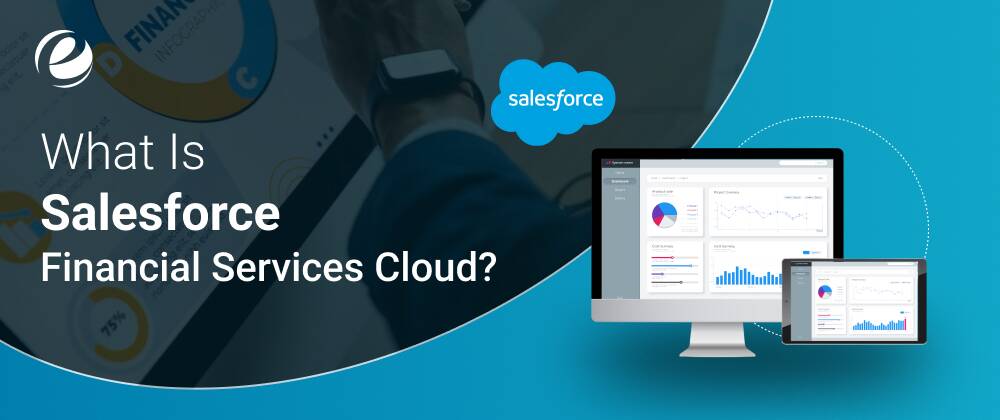
Salesforce Financial Services Cloud (FSC) is a cloud specifically designed for banks, wealth management firms, and insurance firms. It consolidates all customer data from different financial systems in one place and provides an end-to-end view of all customers. The solution enables organizations to leverage automation and AI to deliver personalized customer experiences, automate workflows, and drive financial planning.
With FSC, financial institutions and banks can improve customer relationships, lower onboarding, and maximize service efficiency with compliance. It enables data integration to generate actionable insights, fuel growth and long-term customer trust.
Why Salesforce Financial Services Cloud?
Salesforce Financial Services Cloud allows financial institutions to organize customer relationships, improve efficiency, and safeguard information. Its strongest advantages are:
1. Embracing Digital Transformation
Those were the days of the past waiting in the bank queue and complicated transactions. Now, banking is in the palms with artificial intelligence chatbots, blockchain, and mobile banking. The customer can pay, send funds, and invest with a few button clicks on a mobile phone application.
Automation and cross-platform syncing of data have also helped banks in reducing errors, automating routine, and end-to-end customer experience.
2. Intelligent Decisions Through AI and Analytics
Banks now do not take smart guesses on what customers need. AI and analytics sort through enormous sets of data to know how customers spend money, predict the movement of money, and give targeted advice.
For example, a bank can monitor the customer’s historical transactions and provide customized saving schemes or budget assistance, easing and streamlining budgeting.
3. Open Banking for Enhanced Flexibility
Customers are no longer subjected to the inconvenience of physically going around to buy banking products from institutions. Open banking allows secure information sharing between third-party providers and financial institutions via APIs so that customers can have access to a broader array of financial services.
Open banking is customer-centric, enhances service levels, and is pro-competitive. For instance, DBS Bank in Singapore, uses AI to track transaction patterns and detect malicious transactions, thereby avoiding loss of millions of dollars.
4. Personal Banking Experience
Imagine this: logging into your banking app and being offered personalized money advice based on your habits and aspirations. AI-based suggestions are now feasible to make this a reality, ranging from personalized investment suggestions, savings strategies, and cash management features with full details.
This personalization revolution in the banking industry not only empowers customers to get the best out of their money but also enhances customers’ confidence and engage more with banks.
5. Enhancing Cyber Security and Data Protection
Data protection is the top most priority in the banking sector. Banks such as Bank of America have sunk billions of dollars into cyber security features in order to ensure customers’ details are protected against cyber attacks.
Salesforce Financial Services Cloud has strong security features to meet data privacy laws like GDPR and CCPA. These include such things as security for sensitive financial information, making customers feel confident.
Key Features of Salesforce Financial Services Cloud
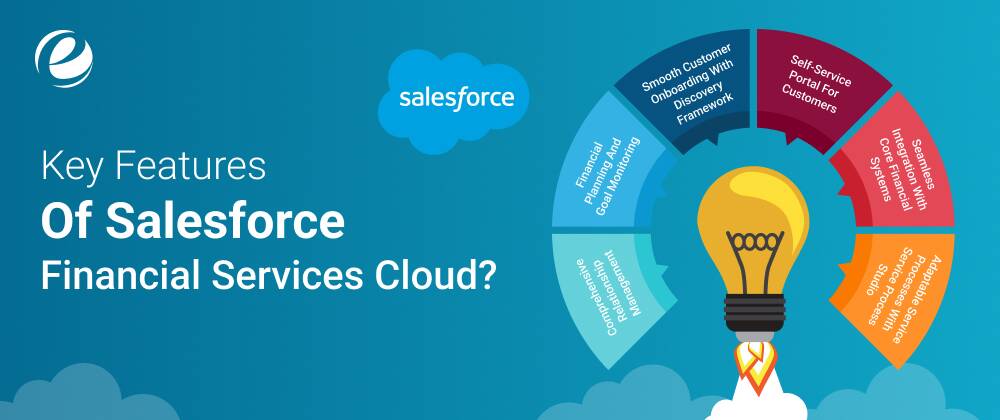
Salesforce Financial Services Cloud (FSC) equips financial institutions with compelling relationship-building, business intelligence simplicity, and regulatory compliance. Driven by the power of automation, analytics, and customer insight, financial cloud salesforce empowers financial advisors, bankers, and service teams to deliver a unified, personalized customer experience. The following features are some of the key capabilities that make FSC an invaluable asset for financial companies.
1. Comprehensive Relationship Management
FSC provides the whole picture of customer relationships so that financial advisers can see how people are related in a company or family. This helps advisers determine who the decision-maker is and operate financial strategies successfully. For family wealth planning or corporate banking, FSC makes it easy to understand and optimize financial relationships.
2. Financial Planning and Goal Monitoring
With financial services cloud salesforce, advisors can establish, monitor, and adjust clients’ financial goals in real time. FSC provides reports on spending, investment performance, and savings patterns, allowing advisors to make active recommendations. In the event of a change in a client’s finances, FSC allows their plan to be updated quickly so that they may remain on course to meet their goals.
3. Smooth Customer Onboarding with Discovery Framework
The Discovery Framework streamlines onboarding by obtaining all required customer information in an appropriate manner. Pre-defined questions in financial organizations can be leveraged to derive the correct data for compliance as well as targeted service. The systematic process saves labor, eliminates errors, and enhances the customer experience from the beginning.
4. Self-Service Portal for Customers
FSC has a customer-facing self-service portal where users are able to access their financial data anytime, anywhere. Customers can see account balances, set financial goals, request support, and even interact with advisors—all in one place. This feature adds to interaction, reduces dependency on manual customer service, and boosts overall satisfaction.
5. Seamless Integration with Core Financial Systems
Among FSC’s most appealing attributes is the integrated nature that comes with bank, wealth management, and insurance platforms. An effortless flow of data among systems is enabled using definitions of integration and preconfigured connectors. All this means ending manual data input, reducing errors, and enables institutions to better make decisions based on more relevant information.
6. Adaptable Service Processes with Service Process Studio
FSC’s Service Process Studio enables banks to design, change, and manage service processes without writing a lot of code. Such flexibility makes it possible to easily tailor services to customer and business requirements. Automating core processes is likely to make the process more efficient, quicken response, and deliver a more personalized experience.
Which Financial Industries Can Benefit from Salesforce Financial Services Cloud?
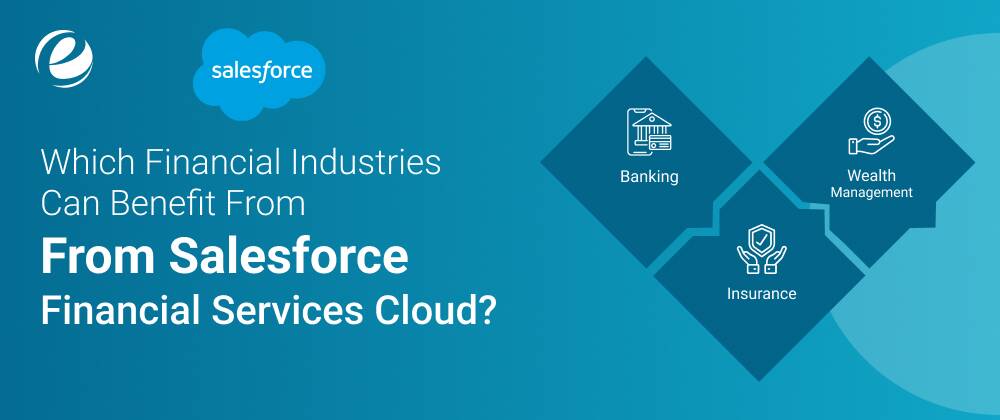
Salesforce Financial Services Cloud (FSC) is aimed at empowering different financial industries by automating customer relations, workflow management, and regulatory compliance. The most important industries that can derive maximum benefits from FSC are listed below.
Banking
Banks deal with huge volumes of customers’ data on a daily basis, and FSC provides tools to automate the process as well as enhance customer interaction and operating efficiency.
- 360-Degree View of the Customer: Banks have a comprehensive view of the customer’s interaction, transaction behavior, and money management habits that are used for personalized service and customized products.
- Loan & Mortgage Management: The application tracks the whole loan process from application to approval and disbursements integrated together in a harmonious manner, thereby creating a perfect customer experience.
- AI-Financial Health Scores: Banks can use AI-based insights to determine the financial well-being of a customer and provide customized guidance on better money management.
- Commercial Banking Solutions: FSC facilitates corporate banking operations by structured relationship management in business lending, trade finance, and treasury solutions.
- Optimizing Retail Banking: Retail Banking Console streamlines high-activity transactions with multiple bank officers all using the same console to drive effective customer loans, deposits, and account operations.
Wealth Management
Financial services cloud salesforce enables wealth managers and financial planners to provide more personalized and fact-based financial advice, resulting in improved client relationships and investment planning.
- Portfolio Management: Advisors have real-time visibility into clients’ investments, enabling them to provide informed recommendations that are in line with financial objectives.
- Automated Financial Planning & Advisory: The site uses AI-based technology to provide customized financial plans to a client based on his/her income, risk tolerance, and investment objectives.
- Regulatory Compliance & Risk Management: With compliance inherent in the platform, FSC allows advisors to remain compliant with industry regulation and reduce risk to clients and firms.
- Improved Client Engagement: FSC facilitates active client participation through automated reminders, targeted messages, and frictionless digital transactions.
Insurance
FSC facilitates streamlined policy management, customer interactions, and settlements of claims through insurance companies’ automation features and business intelligence capabilities.
- Frictionless Policy Management: FSC automates policy issuance, renewals, and changes and maintains adequate record-keeping with regulatory rule adherence.
- AI-Driven Customer Engagement: Insurers are able to use salesforce benefits to process customer information, policy recommendations appropriate for the customer and preventive benefits, claims, and renewals.
- Faster & Smarter Claims Processing: Claims processing is streamlined by automated processes for decreasing processing time, accuracy, and customer satisfaction.
- Fraud Detection & Risk Prevention: Advanced analytics power fraudulent detection and risk prevention via suspicious transactions or claim detection.
- Self-Service Customer Portals: Policyholders are able to look up their insurance details, make claims, and view policy details independently, providing an improved overall customer experience.
Salesforce Financial Services Cloud Implementation Steps
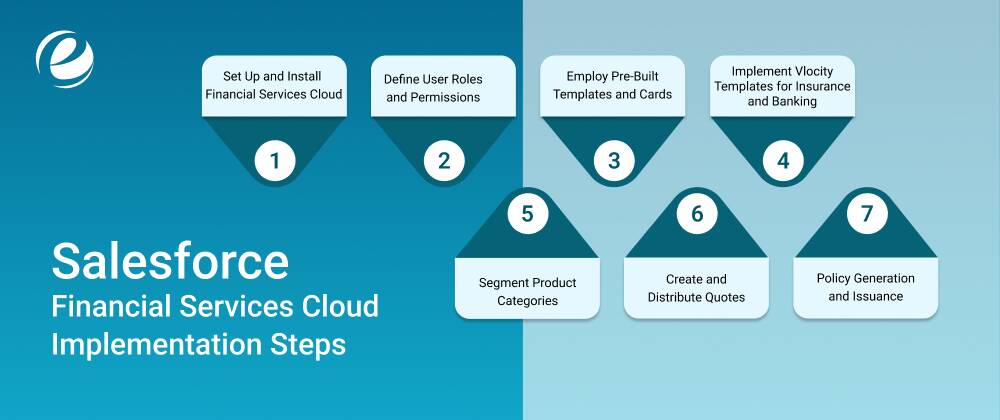
For the installation of salesforce for financial services, planning and preparation are done to have FSC installed in a smooth way and at peak performance. Following is a detailed step-by-step guide on the proper installation of FSC.
1. Set Up and Install Financial Services Cloud
It should be ensured that your Salesforce environment meets the technical requirements of both FSC and Vlocity Insurance before the installation of FSC.
- Verify Compatibility: Ensure that your Salesforce organization is compatible with Vlocity Insurance and FSC.
- Install FSC Components: Install required FSC modules based on your business requirements.
2. Define User Roles and Permissions
Appropriate access of users is vital to security and appropriate workflow management.
- Assign User Profiles: Associate financial advisor, customer service group, and other party roles.
- Control Data Access: Establish rules of sharing to determine the flow of data between groups.
- Enhance Security Measures: Configure data security settings according to industry compliance.
3. Employ Pre-Built Templates and Cards
FSC has pre-built items that streamline financial processes.
- Utilize OmniScript Designer: Use application such as Vlocity OmniScript to implement financial templates and cards.
- Personalize when necessary: Tailor templates to suit the procedures of your organization.
4. Implement Vlocity Templates for Insurance and Banking
Templates save implementation time through pre-formatted template workflows.
- Choose Appropriate Templates: Choose templates for your own financial companies, i.e., banking, wealth management, or insurance.
- Customize as Required: Configure settings to accommodate business processes.
5. Segment Product Categories
Classification of products is required to efficiently manage financial products.
- Define Product Segments: Segment products on the basis of underwriting eligibility, financial risk, and service type.
- Ensure Appropriate Configuration: Maintain product information current across the lifecycle.
6. Create and Distribute Quotes
Quote generation assists in offering customized financial service products to clients.
- Generate Client-Specific Quotes: Use FSC tools to generate quotes according to customer requirements.
- Include Significant Information: Enter risk analysis, coverage options, and price quotes.
- Complete and Share: Complete and share quotes with clients for approval and examination.
7. Policy Generation and Issuance
After a client approves a quote, policies need to be generated and finalized.
- Confirm Quote Approval: Validate clients approve the terms given.
- Prepare Policy Documents: Use FSC to create policy contracts with filled-in coverage details.
- Issue Policies: Deliver policies to customers while verifying all the requirements are fulfilled.

Use Cases of Salesforce Financial Services Cloud
Salesforce Financial Services Cloud (FSC) also aims to facilitate financial institutions in managing customer relationships better, automating, and enhancing productivity. Some of the most important ways organizations can use FSC in an attempt to enhance services are outlined below.
1. Enhanced Client Relationship Management
Some of the most compelling advantages of using FSC are encapsulated in its ability to bring together customer data, providing a single view of the client to financial experts.
- Integrated Client Profiles: Consolidates information across multiple systems to establish a point of truth.
- Personalized Client Engagement: Remembers client history, interests, and past transactions for customized services.
- Growth Opportunities: Enables financial institutions to recognize likely cross-sell and up-sell opportunities.
- Customer Retention Strategies: Enables banks to deliver segmented experiences, which foster client loyalty.
2. Simplifying Loan Origination and Management
Loan processing and approval can be complicated, but FSC streamlines the process via automation and real-time visibility.
- Automated Loan Processing: Reduces manual intervention by automatically processing application gathering and verification.
- Clear Pipeline Visibility: Provides real-time visibility of the loan status for faster decision-making.
- Enhanced Collaboration: Provides enhanced collaboration among loan officers, underwriters, and customers.
- Regulatory Compliance: Ensures all loan procedures are compliant with financial laws and regulations to avert risks.
3. Enhancing Wealth Management Services
Wealth management firms can employ FSC to provide evidence-based, client-oriented advisory services that align with customer goals.
- Comprehensive Client Profiling: Allows advisors to measure financial risk and investment bias.
- Smart Financial Planning Tools: Allows goal-based investment monitoring and portfolio management.
- Reminders Alerts: Reminds clients automatically for any significant financial activity, on time.
- Improved Advisor-Customer Relationship: Facilitates better communication and coordination between wealth managers and customers.
4. Enhancing Insurance Operations
FSC can help insurers by automating critical processes and enhancing customer experience.
- Policy Management Effectiveness: Automates policy underwriting, issue, and change.
- 360-Degree Client Vision: Offers brokers an integrated view of policyholders and coverage history.
- Claims Processing Automation: Automates claim handling, accelerates the process of claim handling, and minimizes customer wait time.
- Improved Coordination: Facilitates communications among brokers, agents, and policyholders for a seamless experience.
Salesforce Financial Services Cloud Pricing
Salesforce Financial Services Cloud (FSC) is a cloud-based product on subscription, whose prices differ owing to many reasons. The following determines the financial services cloud pricing:
- User Licenses: The prices are normally per user and based on many different levels of licenses providing differing levels of access and functionality. Some users might require only basic features, and others might demand unlimited access such as client management, advanced reporting, and automated capabilities.
- Additional Features: If you need AI-driven insights, more sophisticated analytics, or industry-specific settings, these features usually have an extra cost.
- Implementation & Support: FSC installation involves onboarding, customization, and integration with existing systems. Large organizations with specific needs may require additional support, which impacts overall cost.
In an effort to better understand which financial services cloud pricing model will be ideal for your company, it is advised to talk to a Salesforce expert.

The Future Trend of Financial Services Cloud
Salesforce Financial Services Cloud (FSC) is only getting more sophisticated, and subsequent releases promise to introduce even more capabilities. Here’s what the future of FSC might look like:
1. Industry-Specific Enhancements
Salesforce is extending FSC by providing industry-specific solutions for banking, insurance, and wealth management. Financial institutions will receive industry-specific functionality that streamlines processes, enhances compliance, and provides improved customer experiences. For example, industry-specific insurance applications will automate policy administration and claims handling.
2. Smarter Customer Insights with Enhanced 360
Future FSC enhancements will bring more customer insight through comingling of insights across multiple interaction touchpoints. Banks and other financial institutions will be able to build seamless and customized services and enhance customer interaction through a broader Customer 360 view.
3. AI-Driven Automation for Optimization
Salesforce is integrating AI to improve decision-making in the case of credit scoring and anti-money laundering and fraud prevention. Such technologies will decrease errors, accelerate financial processes, and improve accuracy, enabling institutions to run more efficiently.
4. Empowering Businesses with Low-Code/No-Code Solutions
The addition of no-code and low-code development platforms to FSC will enable the creation and customization of applications by non-technical users. This will enable financial institutions to respond to new challenges in a timely manner, create innovative solutions, and increase operating flexibility.
Why EmizenTech for the Salesforce Financial Service Cloud?

It takes expertise in the platform and the financial services sector to implement a financial service cloud on Salesforce. EmizenTech is a trusted implementation partner because:
- Industry Specific Expertise: Substantial experience of the financial services sector and regulatory law.
- Proven Success: Several decades of successful FSC implementation for numerous types of financial institutions.
- Customized, Flexible Solutions: Solutions designed to be flexible enough to adapt as business needs evolve.
- Seamless Integration: Easy integration with your existing platforms and tools.
- Compliance Focus: Compliance and data security standards regulation priority.
- Extended Training: Empowering your people to get the most out of FSC use with hands-on training.
- Agile & Streamlined Implementation: Process streamlined to minimize disruption and optimize productivity.
- Ongoing Support & Optimization: Post-implementation assistance to optimize and enhance performance.
Selecting EmizenTech is to gain a partner who not only successfully implements Salesforce FSC but also that it leads to long-term business achievement.
Conclusion
Salesforce Financial Services Cloud is designed to help financial institutions create more meaningful customer relationships, automate, and make smarter decisions with real-time insights and sophisticated analytics.
We at EmizenTech are experienced Salesforce professionals for implementing Salesforce solutions for financial institutions. With 300+ Salesforce certified staff members, we deliver seamless deployment with maximized productivity and minimum business disruption.
FAQs
How does the Financial Services Cloud differ from other wealth management applications?
Unlike different wealth management systems, Salesforce Financial Services Cloud (FSC) is an integrated CRM solution designed completely for the financial enterprise. It permits banks, insurance firms, and monetary advisors to display client relationships, economic making plans, banking products, and compliance in one place. Instead of needing to use numerous systems, FSC gives a single client view, making it easier and more effective to do business.
How safe is client data within the Financial Services Cloud?
Safety is also front-of-mind for Salesforce, and FSC is regulated under strict security controls to safeguard customer information. It has role-based access control, encryption, multi-factor authentication, and compliance with global laws like GDPR and HIPAA.To that end, Salesforce's robust data center security and monitoring around the clock serve as protection from unauthorized access or potential attack.
Does Financial Services Cloud connect with other software and systems?
Yes, FSC is designed to blend seamlessly into your existing tools and systems. Whether you're using accounting packages, analytics tools, or other financial management software, FSC simply integrates so that you don't have to switch platforms.
How does Financial Services Cloud speed the deployment of new financial products?
Native automation, real-time data reporting, and templates for compliance already in place, FSC allows financial institutions to create, pilot, and take new products to market much quicker. It streamlines product development, improves risk management, and facilitates rapid response to shifting market demand, providing businesses with a competitive advantage.
What are the competitive benefits that financial institutions achieve through Financial Services Cloud?
Financial institutions realize the following competitive benefits from the use of FSC:
1. Improved client relationships through tailored services
2. Compliance management to ensure regulatory compliance
3. Improved operations with automated processes and data-driven decision-making
4. Increased agility in reacting to market fluctuations and customer requirements





 +1 (989) 535-9295
 info@emizentech.com
 emizentech


