
 Add us as a preferred source on Google
 A digital twin in manufacturing is a live virtual copy of a machine, a line, or a whole plant. It ingests sensor data in real time, mirrors how the real thing behaves, and lets you test changes on screen instead of on the floor. Most plants still run on educated guessing. A supervisor hears a bearing whine and books downtime. A plant manager signs off a layout change because the spreadsheet said so. Sometimes the guess is right. Often enough it isn’t, and you find out at 3 am when the line stops.
Digital twins swap that for a model that keeps pace with reality. Key stats show unplanned downtime can drop 20 to 50 percent. Other benefits include maintenance cost reductions of 10 to 40 percent and more. Treat those as ranges, not promises. The low end is common. The high end usually shows up in plants that already had decent data before they started. In this blog, you will get all the information on what a twin actually is. The four types. Full architecture, layer by layer.
What is a Digital Twin in Manufacturing?
A digital twin in manufacturing is a synced virtual model of a production asset. It continuously pulls sensor data, updates its own state, and sends predictions or recommendations back to the people running the machine. Three things have to be true. Live data going in. Feedback going back out. And the model has to behave the way steel and hydraulics actually behave, not the way a brochure says they should.
Digital Twin vs. Traditional 3D CAD / Simulation
CAD gives you geometry. Simulation gives you one snapshot under assumptions somebody picked. Neither one knows spindle 4 ran hot last Tuesday.
| Aspect | 3D CAD | Traditional Simulation | Digital Twin |
| Data source | Design intent | Modelled assumptions | Live sensor feeds |
| Update frequency | Manual revisions | Per study | Continuous |
| Feedback to asset | None | None | Closed loop |
| Lifecycle coverage | Design only | Design and testing | Design through decommissioning |
Evolution in Industry 4.0 and 5.0
Industry 4.0 wired the factory. Sensors, connectivity, somewhere to put the data. Digital twins in manufacturing only became workable once that plumbing existed and IoT solutions got reliable enough to stream telemetry that didn’t lie.
Industry 5.0 changed the full equation by putting everything on the same screen for a simplified overview of energy per unit, carbon intensity, and operator ergonomics. They are designed to be easily optimized for the specific business workflow.
The 4 Main Types of Digital Twins in Manufacturing
Digital twins in manufacturing are categorized based on what they represent within the production lifecycle. Each type serves a unique purpose, helping manufacturers improve design, operations, maintenance, and overall efficiency.

Component / Parts Twin
Smallest unit. A bearing. A valve. A weld joint. You model fatigue, thermal expansion, stress cycles. Worth doing when one part going means hours of lost output. Aerospace and medical device people live at this level because they have to.
Asset / Equipment Twin
One machine, modeled properly. A CNC lathe. An injection press. A welding cell. You watch vibration signatures, spindle load, coolant temperature, whether cycles are drifting. This is where most manufacturers start, and it’s usually the right call. A predictive maintenance digital twin at this level is where the first real win usually comes from.
System / Production Line Twin
Several assets plus everything moving between them. Line twins catch what asset twins can’t see: interaction. Machine A at 98 percent efficiency is meaningless if it starves Machine B. Bottlenecks, buffer sizing, changeover losses. All of it shows up here and nowhere else.
Process / Factory Floor Twin
The whole plant. Layout, logistics, energy, people moving around, scheduling. This is where you answer the strategic questions. Where does the new line go? What happens if we add a second shift? Can we cover the order book without spending capital?
Technical Architecture of a Manufacturing Digital Twin
Let’s understand the technical architecture of a digital twin. Digital twin technology in manufacturing sits on five layers. Skip one, and you’ve built a very expensive dashboard.
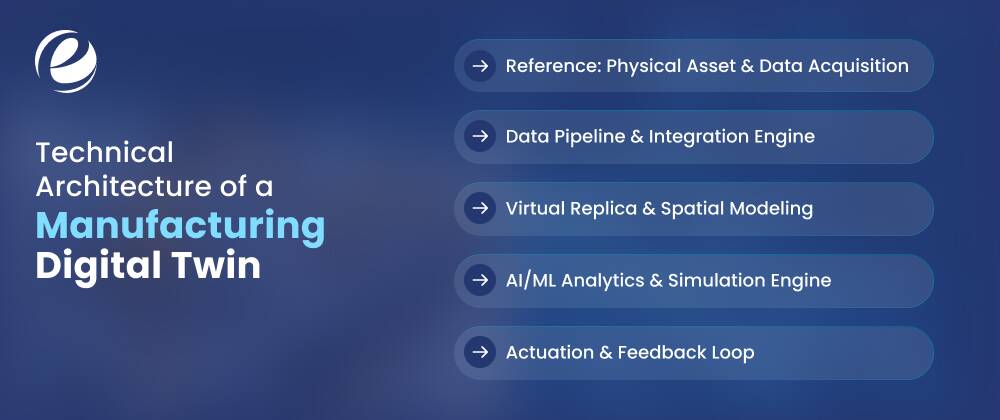
Reference: Physical Asset & Data Acquisition
Sensors, PLCs, SCADA endpoints, edge gateways. Accelerometers, thermocouples, current transducers, vision, RFID. Sampling rate matters more than sensor count, and people get this wrong all the time. A pump failing from cavitation shows up at kilohertz frequencies. Sample once a second and you see a flat line right up until the thing dies. Edge devices do the first cut. Raw waveforms rarely need to travel anywhere.
Data Pipeline & Integration Engine
Ingestion, normalization, time series storage, context. This layer marries OT telemetry to IT records. Machine data alone tells you a press is vibrating. Pair it with ERP data on batch, material lot, and who was running it, and you find out why. Protocol translation happens here too. All of it has to land in one schema. This is where enterprise application integration eats your schedule alive. Budget a third of the project for it.
Virtual Replica & Spatial Modeling
The model itself. Geometry from CAD, kinematics, physics rules, material properties. Spatial modeling earns its cost when the twin drives AR overlays or robot path planning. For straight analytics, a lightweight behavioral model beats a heavy 3D scene almost every time. Fidelity is a budget call, not a technical one. Model what you plan to act on.
AI/ML Analytics & Simulation Engine
Anomaly detection, remaining useful life, what-if runs, optimization. Physics-based models handle failure mechanics you already understand. Machine learning picks up patterns nobody thought to write down. Hybrids tend to beat either one alone when failure data is thin, which it always is. That’s the real constraint. Your plant has ten thousand hours of everything running fine and eleven recorded failures. Getting AI and ML consulting input early saves teams from building models that just memorize noise and then look confident about it.
Actuation & Feedback Loop
Recommendations come back out. Setpoint tweaks, work orders, schedule changes, alarm thresholds. Closed-loop control on anything safety-critical needs validation gates and a human in the middle. Start in advisory mode. Nobody has ever regretted that. Without this layer, you don’t have a twin. You have monitoring. Cloud handles the heavy simulation compute. Picking between cloud computing service providers comes down to data residency, latency tolerance, and what your enterprise agreement already covers. Hybrid works for most people. Edge inference, cloud training.
Top 6 Business Use Cases & Applications
Businesses are using digital twins to solve real-world challenges and unlock new opportunities. These top applications show how organizations can improve performance, cut costs, and drive innovation.
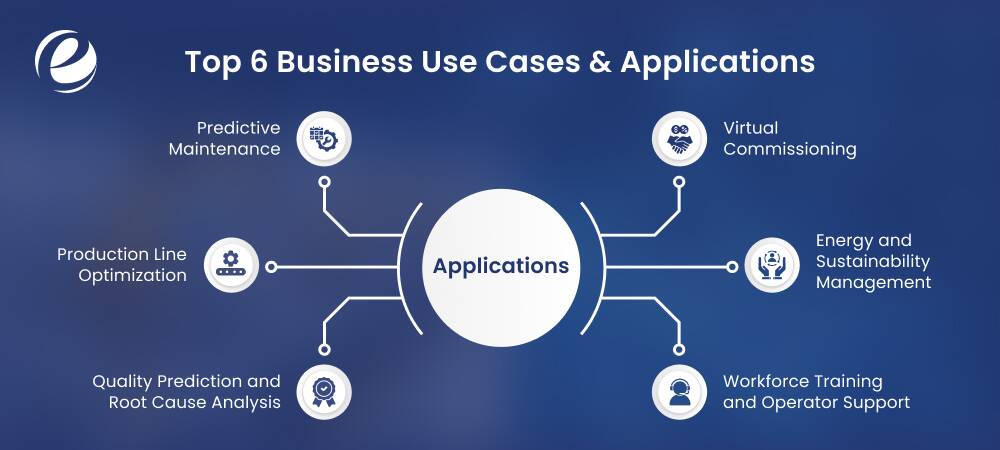
Predictive Maintenance
A predictive maintenance digital twin takes vibration, temperature, and load, compares live behavior to a healthy baseline, and flags degradation weeks out. The win isn’t only avoided downtime. It’s doing maintenance when the machine needs it, not when the calendar says so.
Production Line Optimization
Test buffer sizes, cycle times, changeover order, all without stopping anything. Line twins keep proving bottlenecks operators already suspected but couldn’t justify.
Quality Prediction and Root Cause Analysis
Tie process parameters to defect rates. When scrap spikes, the twin replays the conditions so you can identify the variable. Data analytics services built on twin output move quality upstream instead of leaving it at final inspection.
Virtual Commissioning
Run your control code, robot paths, and interlocks against the twin before the hardware even ships. Commissioning drops from weeks to days. This one sells itself.
Energy and Sustainability Management
Model draw per unit at machine level. Idle consumption, air leaks, thermal waste. Regulatory reporting turns into a query instead of a three-month project.
Workforce Training and Operator Support
Train on the twin. New operators run failure scenarios that would be expensive or dangerous on the real thing.
Business Benefits & ROI Summary Table
Let’s review the Business benefits and potential ROI in a carefully curated table.
| Use Case | Primary Benefit | Typical Impact | Payback |
| Predictive maintenance | Downtime avoidance | 20 to 50 percent reduction | 9 to 18 months |
| Line optimisation | Throughput gain | 5 to 15 percent OEE lift | 12 to 20 months |
| Quality prediction | Scrap reduction | 10 to 25 percent less rework | 12 to 24 months |
| Virtual commissioning | Faster ramp-up | 30 to 60 percent shorter commissioning | Per project |
| Energy management | Cost and carbon | 8 to 20 percent energy savings | 18 to 30 months |
| Operator training | Competency speed | 40 percent faster onboarding | 12 to 24 months |
Step-by-Step Roadmap: How to Implement Digital Twins in Manufacturing
Building a digital twin works best when it follows a defined sequence, not a scattered rollout. Manufacturers usually start small, prove value on one asset or line, then widen the scope.
Step 1. Pick one asset and one measurable problem. Not a portfolio. One press, one failure mode you keep paying for, one number you intend to move. Vague scope has killed more twin programs than any technical problem.
Step 2. Audit your data and be honest. Walk the floor. Check what sensors are actually there, what they actually report, and where the historian has holes. Most teams find out their tag naming has been inconsistent.
Step 3. Fill the instrumentation gaps. Add sensors the model needs. Don’t add sensors because they’re cheap.
Step 4. Build the pipeline before the model. Ingestion, storage, integration first. A great model on broken data produces confident nonsense, and confident nonsense is worse than no model.
Step 5. Build a minimum viable twin. Behavioral model, one failure mode, advisory only. Validate against events you already know happened.
Step 6. Run it in shadow mode. Twin predicts, humans decide. Track hit rate and false alarms through at least one full maintenance cycle. Longer if you can stand it.
Step 7. Wire it into the systems people already use. Work orders into CMMS. Schedule changes into ERP platforms. A twin nobody acts on is worth exactly nothing.
Step 8. Scale by copying, not rebuilding. Template the asset twin. Roll it across similar machines. Then go up a layer.
Step 9. Set up model governance on day one. Assets drift, models rot. Someone owns it. Someone retrains it. Someone watches for drift. Decide who now, not in year two.
Common Implementation Challenges & How to Overcome Them
Most digital twin projects stall for predictable reasons, not technical impossibility. Data quality gaps, legacy machinery, unclear ownership, and shaky ROI cases account for most failed rollouts. Knowing where these problems surface makes them far easier to plan around.
Dirty, siloed data. OT and IT don’t speak. Build a normalization layer and enforce tagging standards before anyone writes a model.
Old equipment with no sensors. Retrofit externally. Vibration pucks, clamp-on current sensors, thermal cameras. Works fine on machines built before Ethernet.
Scope that grew legs. Teams model the entire plant and deliver nothing for eighteen months. Stay on one asset until it pays for itself.
Nobody has all three skills. Twin work wants controls engineering, data engineering, and ML in the same room. Almost no plant has that. Bringing in outside help or hiring dedicated developers flattens the learning curve.
Model drift. Tools wear, materials shift, someone adjusts a setpoint and forgets to tell you. Retrain on a schedule. Watch your residuals.
Security exposure. Connecting OT to the cloud opens doors. Segment the network. Use one-way data diodes anywhere safety systems live.
People not buying it. Maintenance techs with twenty years on a machine will not trust an algorithm that contradicts them, and frankly they shouldn’t at first. Run advisory long enough for the twin to earn it.
Future Trends: What’s Next for Digital Twins in 2026 and Beyond?
Generative AI is showing up in twin interfaces. Ask a question in plain English, get a simulated scenario back. That drops the skill barrier considerably, which is either great or slightly alarming depending on who’s asking.
Composable Twins and Cross-Enterprise Twins
Composable twins are pushing out monolithic builds. Standard components snap together, and each new asset class takes less time than the last. Cross-enterprise twins are starting to appear. Suppliers share asset twins with OEMs so both can simulate disruption. Cloud manufacturing platforms make that federation possible without handing over proprietary process detail.
Sustainability Twins
Sustainability twins are shifting from nice-to-have to required as Scope 3 reporting tightens. And autonomous closed-loop control keeps creeping past advisory. Some plants already let twins adjust non-critical setpoints unsupervised. Regulation is nowhere near caught up. Patterns are crossing over too. Continuous monitoring approaches proven in IoT for healthcare and environmental modeling are landing in manufacturing twins, largely intact.
How Emizentech Helps Manufacturers Build Scalable Digital Twins?
Emizentech builds manufacturing digital twins from sensors to closed-loop deployment. Work starts with a data readiness audit rather than a pitch deck, because we’d rather find the problems early. Teams handle sensor integration and edge architecture, pipeline engineering that joins OT telemetry to enterprise records, hybrid physics and ML modeling, and integration into whatever MES and ERP stack already exists.
Custom software development covers the connective work that platform vendors leave for you to figure out. Where AI does the analytical lifting, our AI development services and AI software engineering practices deal with model selection, training on thin failure data, and drift over time. Deployment runs phased. One asset. Prove it. Then copy it.
Final Verdict
Digital twin technology in manufacturing is past the pilot theatre stage. Architecture is well understood, tooling is mature, and enough deployments exist to plan against real ROI ranges instead of vendor claims. What separates a working twin from an expensive dashboard is discipline, mostly. Narrow scope. Clean data. Feedback that actually closes. Governance that keeps the model honest as the machine ages. Pick one machine and one failure mode that already costs you money.
Frequently Asked Questions
What is the difference between a digital twin and IoT?
IoT collects and transmits sensor data from equipment. A digital twin uses that data to run a live behavioral model, simulate scenarios, and produce predictions. IoT is the input layer.
How much does it cost to implement a digital twin in manufacturing?
One asset twin usually costs $50,000 to $200,000, covering sensors, integration, and modeling. Line- or factory-scale work starts around 500,000 dollars.
Can digital twin technology be retrofitted onto older factory equipment?
Yes. External retrofit sensors like vibration accelerometers, clamp-on current transducers, and thermal cameras pick up enough signal without touching machine internals.
What tools and frameworks are used to build digital twins?
Common options include Azure Digital Twins, AWS IoT TwinMaker, Siemens Xcelerator, PTC ThingWorx, and Ansys Twin Builder.




 +1 (989) 535-9295
 info@emizentech.com
 emizentech


