 Add us as a preferred source on Google
 A customer adds a sofa to their cart, waits for delivery, then returns it because it looks nothing like the photo. This happens millions of times a year, costing retailers billions in reverse logistics and eroding trust before a second purchase happens. Shoppers stare at flat images and guess at scale, color, and fit, then blame the store when they’re wrong.
Augmented reality in retail solves this by layering 3D digital models onto the real world through a phone camera, tablet or smart mirror, letting shoppers preview how an item fits or looks before they buy it. According to Shopify’s case study data, shoppers who viewed a product in AR were 65% more likely to complete a purchase. This guide covers what is augmented reality in retail, how AR works, its biggest benefits and where the technology is headed next.
What is Augmented Reality in Retail and How Does It Work?
Augmented reality (AR) in retail displays 3D digital models, images and data onto the physical world through smartphone cameras, tablets, or smart mirrors. It lets you test products virtually, view clothing on digital avatars (or virtual try-ons), or preview furniture in your home to make confident choices; it can also lower your return rates, and help your sales to expand.
How does AR work in Retail?
Some of the factors, and technologies that explain how augmented reality in retail works and how retail tech trends are redefining the modern shopping experience include:
- Environment Scanning: The device’s camera & sensors scan the physical room, floor or your face to map the surface, and lighting.
- 3D Display: A 3D digital asset of the product is projected onto the screen so that you can interact with it in real time.
- Motion Tracking: AI matches your item movement to the real-time body, or facial positions.
- Data Processing: Retail software uses computer vision so you can analyze spatial dimensions, and scale objects correctly within the live view.
AR in Retail: Market Growth and Key Statistics
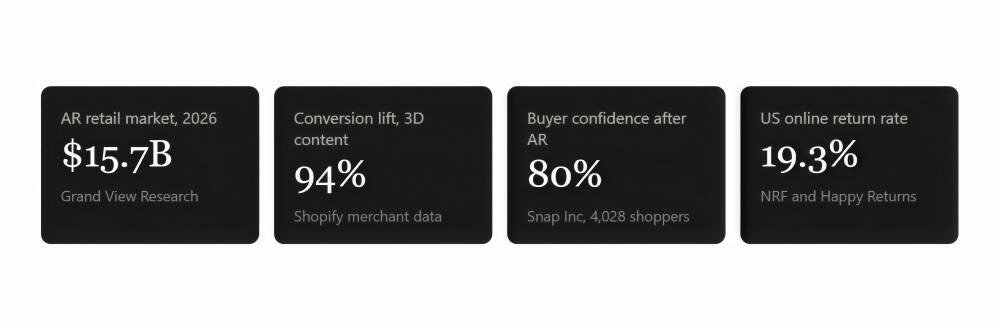
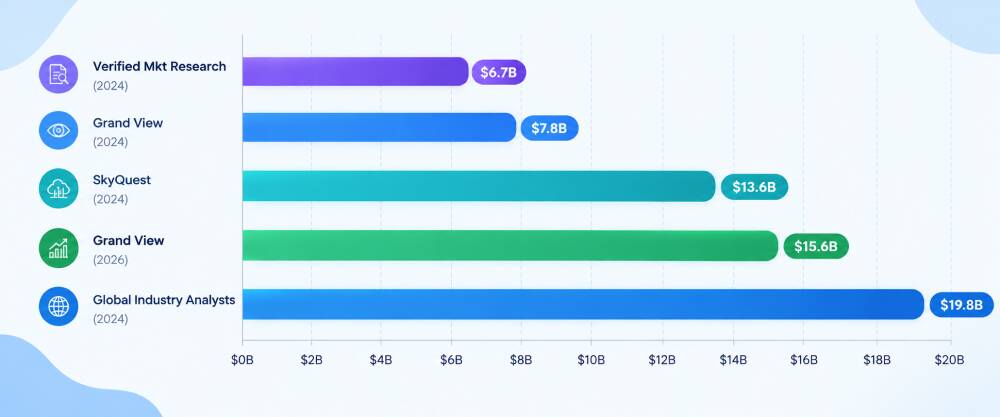
 Anyone quoting a single AR retail market size is quoting one vendor’s segmentation choice rather than a measured number, because Grand View Research values 2024 at $7.8 billion while SkyQuest models the same year at $13.68 billion and Global Industry Analysts published $19.9 billion. Forward numbers split just as badly, with Grand View projecting $15.7 billion for 2026 and $105.9 billion by 2033 at a 32.4% CAGR against SkyQuest’s $159.74 billion and a far more cautious $64.6 billion by 2030. The evidence worth building on comes from operators, since Shopify reports a 94% average conversion lift for merchants adding 3D content, Snap found 80% of AR shoppers felt more confident, and NRF puts 2025 US returns at $849.9 billion with online returns at 19.3%.
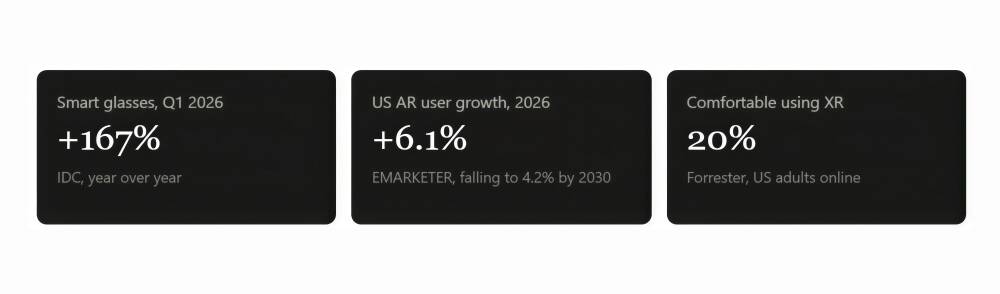
Recent technology developments also suggest the same thing, because Meta and EssilorLuxottica launched a $299 Meta Glasses line on 23 June 2026, roughly $80 below entry level Ray-Ban Meta, and now hold above 80% of a still small category (CNBC), then shipped prescription frames into optical retail on 14 April while Google and Samsung previewed Android XR glasses with Warby Parker and Gentle Monster, leading with the frame rather than the silicon, which tells you the constraint is adoption and not capability (The Gadgeteer), even as the $799 Ray-Ban Display widens its launch.
Types of Augmented Reality Used in Retail
You can apply the technology through augmented reality frameworks as retailers use four primary types of Augmented Reality to bridge the gap between digital convenience and physical interaction.
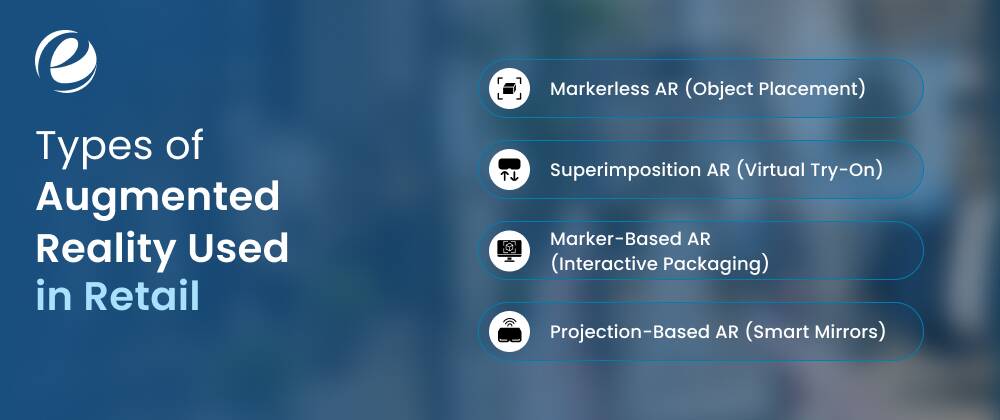
1. Markerless AR (Object Placement)
- How it works: Uses a smartphone camera and sensors to detect flat surfaces (floors, walls) and place a true-to-scale 3D model into the real environment.
- Example: The IKEA Place app allows you to virtually position a 3D sofa in their living room to check dimensions and color match before buying.
2. Superimposition AR (Virtual Try-On)
- How it works: Uses facial tracking, body mapping and object recognition to overlay digital products directly on your body.
- Example: Sephora’s Virtual Artist scans your face so you can test different shades of lipstick or eyeshadow dynamically in real time.
3. Marker-Based AR (Interactive Packaging)
- How it works: Triggers a specific digital experience or animation only when the camera scans a physical marker, such as a QR code, unique image or product label.
- Example: 19 Crimes wine features labels that come to life with animated talking historical figures when scanned via a smartphone app.
4. Projection-Based AR (Smart Mirrors)
- How it works: Projects light and digital graphics directly onto physical surfaces, or high-tech glass displays without requiring wearable gear or personal phones.
- Example: H&M and Timberland use interactive fitting room mirrors that project alternative clothing colors and sizes onto your physical reflection
Top Benefits of Augmented Reality in Retail
Augmented reality in retail transforms your journey by connecting the digital, and physical worlds. It improves sales conversion rates by up to 94%, and reduces product return rates by 20% through virtual try-ons and realistic room placements and increases average order values by driving advanced brand engagement. Below are some of the benefits of AR in retail:
- Higher Conversion Rates: You can use AR feature which are significantly more likely to complete a purchase, as you can visualize products accurately.
- Fewer Product Returns: Virtual try-ons and location-based previews reduce buyer hesitation, regret and sizing mismatches.
- Increased Engagement: Interactive AR displays keep shoppers on websites and in apps for longer durations.
- Personalized Shopping: You can instantly test custom colors, sizes and styles on your bodies or in your own personal spaces.
How Augmented Reality Is Changing the Retail Industry
Augmented Reality in retail is redefining itself by shifting from a unique feature, to a standard conversion tool. The global AR in retail market is expanding rapidly from $3.52 billion in 2025 to approx. $4.63 billion in 2026 as merchants use virtual try-ons & 3D visuals to build your confidence & to avoid returns of the product.
- Virtual Try-Ons: You can use mobile cameras, or in-store smart mirrors to test cosmetics, clothing and even eyewear instantly which drives 94% higher conversion rates for products with 3D, or AR content.
- In-store AR Navigation & Data: Retail staff, and customers use real-time AR overlays for indoor pathfinding, rapid shelf auditing and instant spec checks.
- 3D Room Visualization: Furniture, and home decor stores project life-size digital models directly in your living spaces through smartphones, minimizing size and style guesswork.
- Decreased Return Rates: Studies show that 80% of AR-empowered shoppers feel more confident in their purchase and 66% are less likely to return items which directly attacks the $400+ billion annual cost of US returns.
Challenges of Implementing Augmented Reality in Retail (How to Avoid Them)
Implementing augmented reality in retail cuts return rates by up to 25% to 40% and boosts conversion rates over 90%, yet 60% of projects stall, due to high 3D asset creation costs, poor app performance and low user adoption. Here are key challenges you may face when setting up an augmented reality application, and how to avoid them in the future of AR in retail:
High Development Costs
- The Problem: Building custom 3D models & AR infrastructure drains budgets which exceeds $50,000 per product catalog.
- The Fix: Use cloud based 3D asset platforms and photogrammetry APIs to automate model generation at a 30% lower cost.
Technical Performance and Latency
- The Problem: Heavy app load times over 3 seconds cause a 50% user drop-off rate before the AR view even displays
- The Fix: Install a standard WebAR, to bypass app store downloads and compress polygon counts, to under 50,000 triangles per asset.
Low User Engagement and Discovery
- The Problem: Customers rarely search for hidden AR features which results in below 5% adoption rates.
- The Fix: Place clear QR codes directly on physical product packaging and in-store advertising to drive instant POS (point of sale) activation.
Steps to Implement AR in Retail
A successful augmented reality applications starts with a clear strategy, the right technology and continuous optimization. Follow these five practical steps to build an AR in retail experience that improves customer engagement, increases conversions as well as delivers measurable business results.
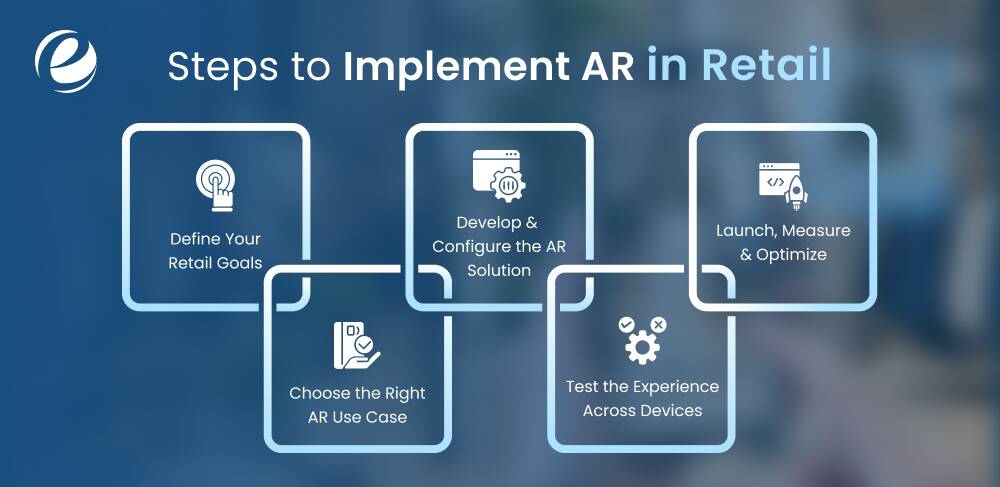
- Define Your Retail Goals
Identify the specific problems you want to solve in AR in retail, such as, improving customer engagement, reducing product returns or increasing conversions
- Choose the Right AR Use Case
Select augmented reality cases & experiences that match your business needs, like, virtual try-ons, 3D product visualization, interactive store navigation or virtual showrooms
- Develop & Configure the AR Solution
Build the AR experience while using AI development services and connect it with your eCommerce platform, mobile app, CRM, inventory system and payment workflows for a smooth & user-friendly customer journey
- Test the Experience Across Devices
Test the AR solution on different smartphones, tablets, and browsers to verify accurate tracking, fast performance, and an effortless user experience
- Launch, Measure & Optimize
Roll out the AR experience, monitor key metrics like engagement, conversions, and return rates, gather customer feedback, and continuously improve the solution based on gathered data
Future of AR in Retail
Technologies like AR and VR are not going away anytime soon, as market.us suggests that the augmented reality market is expected to rise to $591.7 billion by 2033 with 103.9 million US consumers projected to use AR monthly and increasingly expect engaging, convenient shopping experiences, and are likely to continue to extend even further into in-store and ecommerce retail spaces.
Brands and retailers are continuing to use types of augmented reality applications to deliver personalized experiences through which consumers can visualize products before buying them. Social media platforms like Instagram, Facebook and Snapchat have all made a huge bet on brands selling through the use of 3D and AR.
But with its ability to combine digital spaces with real-life storage units, the future of AR in retail is likely to highlight enjoyable experiences as well as functionality. The technology enables gamification, virtual shopping and interactions that pair consumers’ favorite characters and celebrities with their favorite products. Augmented reality in retail is all about creating highly engaging and immersive shopping experiences that build customer loyalty.
AR Retail Development Cost Breakdown
The total cost to develop an augmented reality retail application ranges from $25,000 to $300,000+, depending heavily on the complexity of the 3D assets and whether it is deployed via WebAR, or as a standalone native app.
Below is the complete cost breakdown of augmented reality in retail industry across development phases and project scopes.
1. Development Cost Breakdown by Project Scope
This framework reflects the typical allocation of a mid-range, custom retail AR project ($100,000 budget) where 3D content pipeline generation stands as the largest single cost driver.
| Project | Cost Share | Cost Range (approx.) | Deliverables & Notes |
| Discovery & UX/UI Spatial Design | 15% – 20% | $15,000 – $20,000 | User journeys, spatial interaction wireframes, gesture mapping. |
| 3D Asset Pipeline & Modeling | 30% – 40% | $30,000 – $40,000 | Photorealistic 3D modeling, texturing, optimization for mobile. |
| AR Core Engineering | 25% – 30% | $25,000 – $30,000 | Integration of ARKit/ARCore, surface/face tracking, custom APIs. |
| E-commerce & Backend Sync | 10% – 15% | $10,000 – $15,000 | Product catalog syncing, payment gateway, real-time inventory. |
| QA & Spatial Environment Testing | 10% | $10,000 | Device compatibility testing, lighting calibration, bug fixing. |
2. Project Costing by Retail Complexity Tier
The deployment medium (SaaS WebAR platforms versus custom native apps built on Unity or Unreal Engine) dictates the final pricing tier.
| Complexity Tier | Pricing Range | Timeline | Examples |
| 1. Basic / WebAR SaaS MVP | $5,000 – $25,000 | 2 – 6 weeks | Marker-based triggers, basic 3D preview, hosted tools. |
| 2. Mid-Range Retail Feature | $25,000 – $75,000 | 2 – 4 months | Virtual Try-On (VTO) or room visualizers added to an existing app. |
| 3. High-End Standalone App | $75,000 – $150,000 | 4 – 8 months | Full native iOS/Android build, cross-platform tracking, custom CMS. |
| 4. Enterprise AR Ecosystem | $150,000 – $300,000+ | 6 – 12+ months | AI-driven personalizations, multi-user sync, thousands of optimized SKUs. |
3. Essential Post-Launch & Operating Costs
Initial development accounts for roughly 60% of the true cost of ownership where ongoing operation requires standard recurring budget lines.
| Cost Category | Pricing Model | Estimated Cost | Budget Considerations |
| Annual App Maintenance | Recurring | 15% – 25% of dev cost | OS updates (iOS/Android), API patches, performance optimization. |
| 3D Asset Scaling (New SKUs) | Per Unit | $50 – $300 / SKU | Costs scale linearly as you add new seasonal inventory or products. |
| Cloud Hosting & CDN | Usage-based | $50 – $500 / month | Heavy data pipelines needed to stream 3D assets to consumer phones quickly. |
Build Innovative AR Retail Apps with EmizenTech
Augmented reality in retail only pays back when it is engineered into the buying journey rather than simply added on as a demo, which is exactly where EmizenTech earns its place, because 12+ years of delivery, 1200+ projects and a 4.9 Clutch rating sit behind a team that pairs retail domain in depth with the commerce engineering that makes product visualization load fast, convert reliably and hold up under real traffic.
What that looks like in practice:
- Retail software development built around live catalogs, inventory and checkout rather than isolated AR experiments.
- Mobile app development across iOS, Android, Flutter and React Native, so try-on runs natively on the devices shoppers already carry.
- Enterprise ecommerce integration across Shopify, Adobe Commerce and Shopware, placing 3D assets inside the product page where conversion actually happens.
- AI and ML layered on top for sizing accuracy, personalization and measurable returns reduction.
Start with the free sixty-minute consultation and bring the category where the imagination gap is costing you most.
Conclusion
Augmented reality in retail has moved past novelty and become a source of sales and confidence for online shoppers. Retailers who add virtual fitting tools, 3D previews or indoor navigation see fewer returns, longer browsing sessions, and stronger conversion. The technology keeps getting easier to build and cheaper to maintain, so waiting no longer makes sense for brands competing on customer experience. So, you should start small, measure the impact on your store, and expand from there.
FAQs
How does AR improve customer experience?
Augmented reality improves the customer experience by bridging digital browsing with tangible context, enabling shoppers to interactively visualize, size, and place 3D products directly inside their personal physical environments before making purchasing decisions.
Which retail industries benefit most from AR?
Furniture, fashion, beauty, luxury goods, and automotive sectors benefit most. These industries heavily rely on physical fit, personal appearance, or spatial alignment, where visual representation directly eliminates consumer hesitation and uncertainty.
Can AR reduce product returns?
Yes, AR significantly reduces product returns. By providing accurate size, scale and color previews, it closes expectation gaps, giving buyers high pre-purchase confidence that minimizes costly mismatched orders.
What technologies are required for AR retail solutions?
Essential technologies include WebAR or native app frameworks, 3D product modeling engines, spatial tracking sensors, computer vision, and cloud infrastructure to render real-time overlays smoothly on standard consumer smartphones.
What do photogrammetry APIs mean in retail?
A photogrammetry API in retail is a software tool that turns a series of 2D product photos taken from multiple angles into a precise, textured 3D digital model. Retailers use these automated APIs to scale up augmented reality shopping, virtual try-ons, and 3D product displays cost-effectively.




 +1 (989) 535-9295
 info@emizentech.com
 emizentech


