
 Add us as a preferred source on Google
 In this fast-paced digital age, staying on top of technological advancements is not just an option but a vital strategy for the survival of businesses operating in the e-commerce sector. The pace of change is accelerating, customer demands are rising, and competition is intensifying. How can companies stay ahead of the curve, streamline their operations, and make a mark in an increasingly competitive market? The answer is to implement an e-commerce AI agent.
AI agents are designed to enhance the customer experience by automating a wide range of tasks on behalf of the human representative. They can help customers find products, navigate websites, and complete purchases with minimal effort from the shopper. However, their value extends beyond mere convenience. eCommerce AI agents are also reshaping how online stores operate, opening up new avenues for customer acquisition that go beyond traditional SEO strategies.
There’s no doubt that dominant players will push back. Still, the rise of AI agents is profoundly reshaping the digital landscape, particularly in terms of who captures value and owns the customer relationship, which is the ultimate goal in today’s digital economy.
For e-commerce businesses, investing in AI agents is not only a strategic advantage, but it is also becoming essential for staying relevant, competitive, and future-ready. These intelligent tools streamline operations, enhance customer experience, and unlock new growth opportunities.
In this blog, we’ll explore what eCommerce AI agents are, their core benefits, and the most impactful use cases within the eCommerce industry.
Market Statistics For AI Agents
The AI agent market is expanding rapidly as a variety of industries increasingly utilize AI, and advancements in technology, such as self-learning and generative agents, are driving up demand. Let’s look at the most critical market data before you invest in an eCommerce AI agent.
- The AI agent market is expected to grow by a staggering 5% from $5.1 billion in 2024 to $ 5.1 billion in 2030. This remarkable growth is underscored by a substantial compound annual growth rate (CAGR) of 44.8% from 2024 to 2030.
- Did you know that 90% of large e-commerce companies have attempted to utilize AI to enhance their supply chains, and 29% plan to increase their spending to improve them further?
- The machine learning segment led the market until 2024, accounting for more than 30.5% of global income. Machine learning software enables AI agents to analyze vast volumes of information and make informed, rapid decisions.
- 39% of people are confident in AI agents who schedule meetings for them.
- 44% of Gen Z consumers are comfortable working with AI agents that create more relevant and helpful media for them.
Understanding eCommerce AI Agents
AI agents for e-commerce are virtual assistants that utilize artificial intelligence to complete tasks. They are intelligent agents designed to recognize the nature of events in the environment, analyze data, and make decisions based on that data. One of the most sophisticated capabilities of AI agents that sets them apart from other AI models is their ability to learn and adapt independently to new developments. This makes it significantly easier for eCommerce AI agents to improve their capabilities rapidly.
For example, a chatbot on a website that helps you find a product or track your order is an AI agent. It can chat with many people at once and never gets tired. Some AI agents also watch what shoppers like or buy. Then, they suggest similar items they might want next time.
AI agents also help store owners; they can identify popular products, set more competitive prices, or determine when to restock items. This saves time and enables the store to generate more revenue. eCommerce AI agents make shopping smoother for customers and easier for businesses. They work all day, learn from data, and improve with time. As technology advances, these intelligent assistants will become increasingly prevalent in online shopping.
Key Benefits of Adopting AI Agents in eCommerce
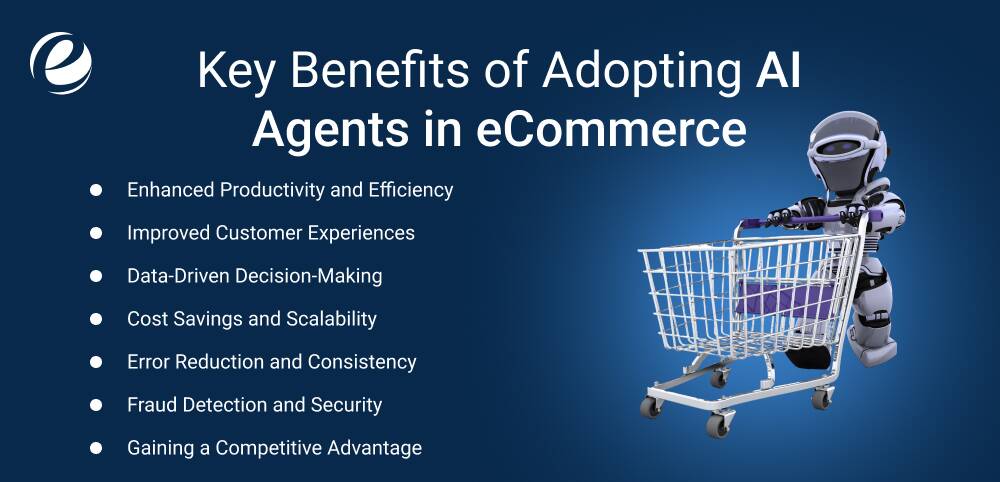
AI agents are not just an additional tool; they have the potential to transform e-commerce businesses looking to improve their workflows and drive growth. In this section, we will examine how these intelligent machines are poised to transform work practices, drive innovation, and address complex problems.
1. Enhanced Productivity and Efficiency
The most significant benefit of AI agents in retail and e-commerce is their ability to perform repetitive, time-consuming tasks. AI agents can handle a range of activities, such as scheduling, analyzing records, and performing data analysis. This enables employees to focus on essential tasks. For example, AI-powered chatbots can respond to most customer service inquiries when human staff are unavailable, saving time and reducing operational costs.
2. Improved Customer Experiences
eCommerce AI agents help online stores provide superior customer service. Customers can interact with them instantly, receive responses at any time, and receive product recommendations based on previous shopping behavior. As a result, shopping becomes faster and more personalized. This reassures customers, making them feel valued and encouraging them to return. Innovative systems transform everyday shopping into a seamless and enjoyable experience for every client.
3. Data-Driven Decision-Making
AI agents for e-commerce
4. Cost Savings and Scalability
AI agents don’t require salaries, breaks, or time off, enabling businesses to save on labor costs. An AI-powered system can manage multiple tasks simultaneously, such as customer service, inventory management, and marketing. As your business grows, the same AI tools can handle more tasks without the need for additional staff. This makes it easier and more affordable to scale your business, especially during peak periods or unexpected surges.
5. Error Reduction and Consistency
Humans make mistakes, but AI agents do not. eCommerce AI agents follow procedures and processes flawlessly every time, reducing the risk of errors in order processing, billing, and customer support. Furthermore, they can operate 24/7 without losing focus. The consistency of AI ensures that businesses can offer reliable services and build customer trust. Over time, fewer errors lead to happier customers and lower costs associated with resolving issues.
6. Fraud Detection and Security
Fraud detection is a key advantage of AI agents, enabling businesses to secure their websites. E-commerce platforms often face the risk of fraud, requiring significant time and effort to prevent. AI agents in e-commerce can play a vital role in safeguarding your site. With features like real-time fraud detection and regular store audits, they can easily identify fraudulent or suspicious transactions.
7. Gaining a Competitive Advantage
AI agents collect and analyze real-time data, enabling them to understand consumer preferences. They can segment customers and tailor marketing efforts to deliver the right message to the right person at the right time. This enables businesses to offer more competitive deals, execute more effective marketing campaigns, and maintain a competitive edge. In a highly competitive market, AI provides businesses with the edge they need to stand out and attract more customers.
Top Capabilities of AI Agents in Retail and E-commerce
AI agents are revolutionizing retail and e-commerce by enhancing data management, streamlining operational procedures, and improving decision-making and customer interactions. An e-commerce AI agent can automate routine tasks and play a crucial role in strategic planning and enhancing the customer experience.
1. Analysis and Data Collection
AI agents are skilled at gathering, cleaning, integrating, and merging data from various sources, like ERP systems, social media platforms, and customer feedback. These agents function as advanced analytics tools, providing the necessary forecasts and strategic insights to make informed decisions.
2. Autonomy
AI agents operate autonomously, which is essential for performing routine tasks like adjusting pricing or reordering based on real-time market data. Their ability to work seamlessly without constant human involvement allows companies to respond swiftly to market fluctuations.
3. Automating and Optimizing Processes
AI agents for e-commerce streamline and improve regular tasks, including managing inventory, processing orders and returns, and handling order fulfillment. They can resolve errors, exceptions, and mishaps, continually learning from any anomalies to enhance efficiency. Specifically, task-oriented agents can adjust prices dynamically in response to competition, demand, and other external factors.
4. Collaboration
They also facilitate collaboration among different departments, including warehouse personnel, marketing teams, and customer service staff, ensuring that all processes are coordinated and well-informed. This is essential for seamless operations, from inventory management to customer service.
5. Implementation and Decision-Making
AI agents aid in making informed decisions regarding inventory levels, logistics, marketing strategies, and customer engagement, ensuring that choices are based on solid data insights. They can also take actions to improve the user experience, such as offering personalized discounts.
6. Adaptability
AI agents learn from their interactions, helping to personalize the shopping experience and effectively manage stock levels. They adjust their responses and strategies based on consumer behavior and feedback, continually improving their effectiveness.
7. Mobility
Thanks to their ability to operate across diverse digital environments, eCommerce AI agent collect and utilize data about consumer behavior across various platforms. Their mobility allows them to track customer preferences and interactions seamlessly, enhancing their ability to provide personalized services.
Future Trends of AI Agents in eCommerce
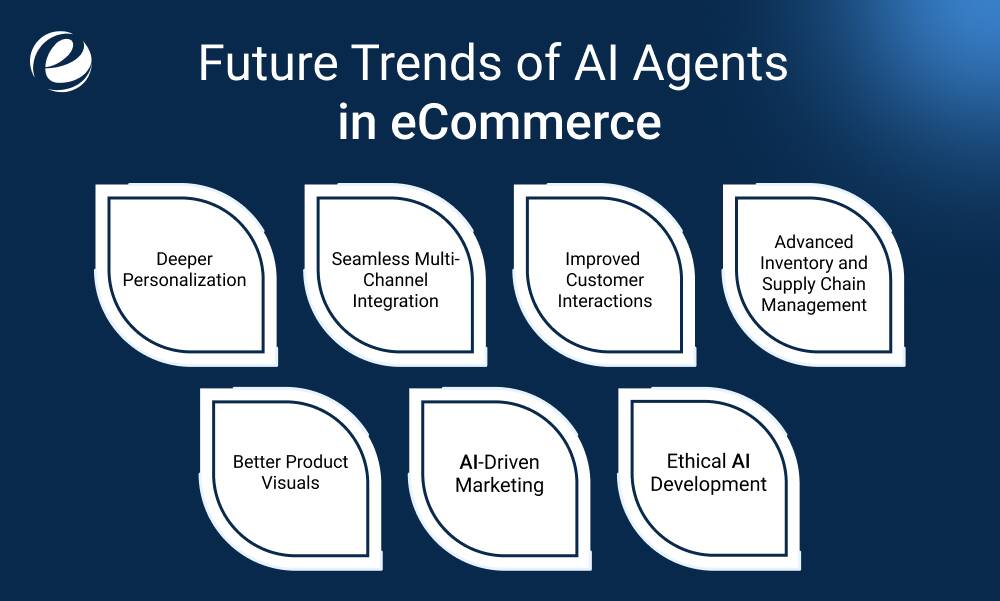
The future of the e-commerce AI agent is inspiring. As AI technology advances, these agents will become more intelligent, more intuitive, and better at anticipating and understanding customer needs. Below are the trends we can expect in the future:
1. Deeper Personalization
AI agents can create highly personalized experiences by analyzing detailed customer preferences, habits, and behaviors. They will not only offer recommendations based on past purchases but will also predict what a customer may need next, even before they realize it.
By studying browsing patterns, social media activity, and past interactions, AI agents can personalize content, recommend products, and tailor pricing and discounts. The ability to personalize the shopping experience makes online shopping feel more like a friendly conversation rather than a transaction, improving customer satisfaction, loyalty, and ultimately increasing sales for retailers.
2. Seamless Multi-Channel Integration
Shortly, eCommerce AI agents will offer a smooth experience across all retail channels, including online stores, mobile apps, social media platforms, and even physical retail stores. Wherever a user engages with a brand, AI agents will be able to remember their preferences, ongoing orders, past inquiries, and even abandoned carts.
For example, a consumer might start browsing on their mobile device, switch to their laptop, and then complete a purchase in-store, without losing any context. This seamless integration helps brands stay connected with their customers and provides a consistent, smooth shopping experience.
3. Improved Customer Interactions
Advancements in NLP will allow AI agents to engage in real-time conversations that feel authentic and human. Rather than relying on scripted or robotic responses, these agents will be able to understand tone, context, and intent, allowing them to provide quicker and more accurate answers.
AI can become an intelligent and friendly assistant, offering helpful service without causing frustration, and enabling businesses to provide excellent support without needing a large team of human customer service agents.
4. Advanced Inventory and Supply Chain Management
AI is set to take inventory and supply chain management to the next level by more accurately forecasting demand and reacting in real time. By analyzing historical sales data, weather patterns, trends, and local events, AI can predict what products will be in demand and when.
AI will also track the shipping process, monitor inventory levels, and automate reordering to avoid overstocking or shortages. This system will reduce costs, minimize waste, and ensure that products are available when customers need them, allowing businesses to stay productive and profitable in a competitive market.
5. Better Product Visuals
AI agents in e-commerce will help create product visuals that appeal to a broader audience. By analyzing customer interests, demographics, and other factors, AI can generate images that increase the likelihood of boosting sales.
AI will also assist with designing illustrations for online retailers by determining which items to feature at specific times, selecting the right slogans, background colors, and more. This helps the marketing department efficiently create high-quality graphics within the required timeframe.
6. AI-Driven Marketing
AI agents in retail and e-commerce are set to revolutionize marketing by analyzing vast amounts of customer data to design and optimize marketing campaigns in real time. They will select the right strategies, messages, and timing to reach customers, making marketing more personalized and effective.
For example, AI could send a discount to a customer who is likely to make a purchase soon, or display an ad to someone who frequently engages with similar content. AI systems will learn from each interaction and instantly adapt, allowing brands to improve their results and reduce uncertainty, leading to better marketing outcomes and a higher return on investment.
7. Ethical AI Development
As AI continues to grow in e-commerce, it’s crucial to develop systems that respect privacy, uphold human values, and ensure fairness. Ethical AI development involves creating agents that are transparent, fair, and do not misuse personal data. Customers should feel confident that their personal information is protected and not exploited.
Retailers must adhere to strict guidelines, clearly communicate how data is used, and offer privacy control options. Ensuring the trustworthiness of AI agents will help build strong customer relationships and ensure that technology is used for the benefit of all.
Use Cases and Applications of AI Agents in E-commerce
AI agents are transforming e-commerce and retail through automation, enhancing customer experiences, and leveraging data to drive decision-making. They allow e-commerce businesses to streamline their operations and stay ahead in dynamic markets. Below are some key applications of AI agents in retail and ecommerce:
1. Personalized Product Recommendations
AI-powered agents help present relevant products to customers. They analyze products you’ve searched for, items you’ve previously purchased, and products currently in your shopping cart. From this, they generate a tailored list of items you might enjoy. This makes shopping faster and more convenient, eliminating the need to waste hours browsing.
The AI agent uses advanced algorithms and techniques like “collaborative filtering” and “content-based filtering.” These methods help the AI understand what you like and recommend similar products. Major websites like Amazon and Flipkart utilize this feature to help shoppers find products suited to their preferences, making the shopping experience feel more personalized.
2. Consumer Sentiment Analysis
AI agents can detect and analyze consumer sentiment. They study reviews, social media posts, and customer feedback to determine whether people feel happy, upset, excited, or disappointed about a product. It’s like having a machine that listens to all opinions at once. If most people are unhappy with a product, companies can address the issue. If the majority love a product, businesses can capitalize on that success.
This ability allows businesses to make informed decisions. Companies like Amazon and Netflix use sentiment analysis to improve their services. The AI can recognize emotions across different languages, helping businesses to always stay connected with their customers and ensure satisfaction.
3. Content Creation
e-commerce AI agent in combination with generative AI, can autonomously produce documents, blog posts, reports, and scripts tailored to specific audiences and objectives. AI-powered design tools can also create branded images or social media content with minimal human input.
For audio and video production, similar software tools can edit video footage and generate voiceovers. Unlike previous AI tools that required constant human input, agentic AI enables creators to scale content production quickly with minimal oversight, while maintaining high quality and consistency.
4. Dynamic Pricing Strategies
Unified commerce systems can utilize customer data, including products viewed, shopping cart contents, abandoned carts, and historical returns, in real-time to deliver personalized shopping experiences tailored to individual preferences. AI agents analyze competitor pricing, sales trends, inventory levels, and market demand to inform their decisions.
They can even process news feeds for e-commerce, evaluate market conditions, and adjust prices in real time. These price changes can maximize profits while remaining competitive. Personalized pricing not only boosts sales but also fosters customer loyalty.
5. Logistics and Route Optimization
AI agents assist truck and delivery drivers in determining the most efficient routes for delivering parcels. They take into account weather, traffic, and road conditions. If a route is congested, the eCommerce AI agent will suggest an alternate path, saving time, money, and fuel. This ensures that customers receive their orders on time and helps businesses optimize dispatch decisions.
The AI handles all route planning and can even adjust the course in the event of accidents or adverse weather conditions. This intelligent planning reduces costs and ensures timely deliveries, much like having a highly advanced GPS that always selects the optimal route.
6. Customer Feedback Analysis
AI agents play a crucial role in analyzing customer feedback on platforms like reviews, surveys, ratings, and social media. Instead of manually reading thousands of messages, AI can quickly scan and discern the overall sentiment of customers whether satisfied, unhappy, or neutral.
It also highlights aspects customers appreciate, such as design, quality, usability, or pricing. By transforming feedback data into valuable insights, companies can make informed decisions, improve their services, resolve common issues, and build stronger relationships with customers. This results in higher customer satisfaction, and an excellent brand reputation.
7. Virtual Shopping Assistant
Virtual shopping assistants is one of the best ecommerce mobile app features and it is like a helpful guide whenever you shop online. The assistant can talk to you, showcase the latest trends, and suggest outfits suited for various occasions. For example, if you’re looking for clothes for a wedding or party, it will help you select attire that complements your style.
It also keeps track of your previous purchases or preferences, using this information to offer better suggestions in the future. It’s like having a personal stylist or store assistant available 24/7, making shopping more enjoyable and time-efficient.
8. Enhanced Product Search
eCommerce AI agent help you find products more efficiently on the online store. You can type in a phrase like “shoes for men,” and the AI understands your request, thanks to natural language processing. This means it comprehends your language the way a human would. It then displays the top results without needing exact keywords or search functions.
The AI analyzes the words you use and shows you the best products accordingly. The search process is simple and fast, helping customers find what they need quickly and enabling retailers to boost sales. It’s like having a smart search bar that understands exactly what you’re looking for.
9. Automated Customer Interaction
AI agents can interact with customers to resolve issues. If a customer has a question or concern, the AI can provide a solution or forward the issue to the appropriate person. Additionally, it creates an account with all relevant details, ensuring no information is lost. The AI can categorize tickets as “urgent” or “simple,” allowing the support team to prioritize tasks.
This process saves time and helps companies respond to customer inquiries faster. AI operates around the clock, ensuring assistance is always available. It’s like having a dedicated assistant who listens to and helps each customer promptly and with care.
10. Better Inventory Management
AI-powered agents assist stores in keeping track of their inventory. They know how many items are left and which ones need to be replenished. If an item is running low, the AI alerts the store to restock. If there are too many products, it stops the creation of new orders.
This way, retailers don’t run out of items, and they also avoid using up unnecessary space. The AI monitors everything at all times, so people don’t have to. It even helps move items between locations if needed. It’s like having a smart manager who keeps everything balanced. Customers can find what they’re looking for, while stores save space and money.
11. Communicating Order Statuses
When people place an order online, they often want to know where their order is and when it will be delivered. Many customers ask the same question repeatedly. The support staff can get overwhelmed, even with regular daily tasks. AI agents can help by checking order systems and sending automatic updates to customers.
They notify customers when an order is being packed, shipped, or ready for delivery. This saves time for everyone. Customers get answers quickly even late at night. They’re happy, and it reduces the pressure on support teams. It’s like having a smart assistant that always knows where your package is.
12. Issuing Returns and Refunds
There are times when people aren’t pleased with their purchase and are looking to return their purchase or have their money refunded. AI agents can assist in this regard right away. They are able to handle return or reimbursement requests right from the beginning until the refund get credited. Customers won’t have to wait around for someone to assist.
The AI agent is quick, courteous and is available all day, every day. It is also able to detect negative messages, or mistrust from customers’ words. If someone is very angry or upset, the AI will refer the issue to a person for specific assistance. It keeps people at ease and ensures that issues can be resolved swiftly and with kindness.
How To Develop An Ecommerce AI Agent
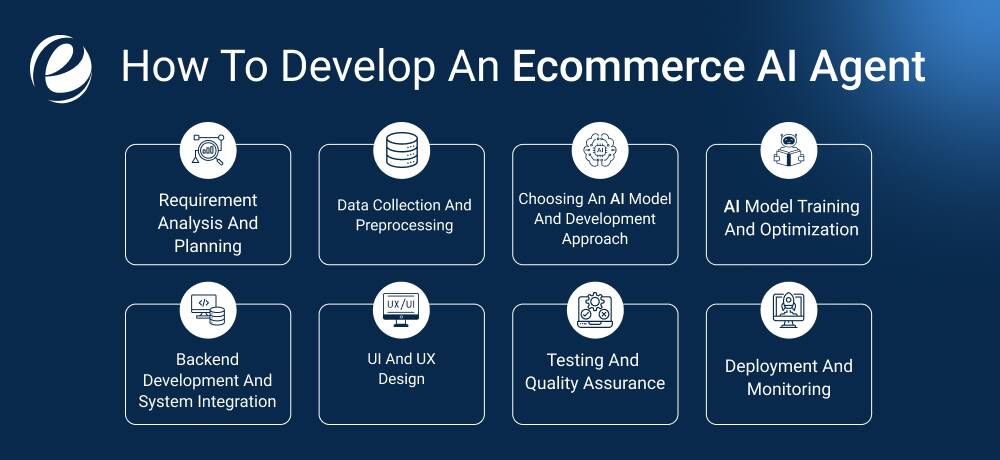
Creating an AI-powered e-commerce system requires a well-planned approach from defining needs to deployment and ongoing maintenance. It involves a variety of steps, including data collection, AI model training, and system integration. This ensures the eCommerce AI agent enhances the customer experience and improves business operations.
1. Requirement Analysis and Planning
The first step of developing an AI agent is to identify business requirements and setting goals. It is essential to understand customer issues, trends in the market and the particular AI capabilities that are needed.
Companies must decide if they will require the use of an AI chatbot as a voice assistant, recommendation system or to detect fraud. Figuring out the most important numbers to track (called KPIs) at this stage helps you know how well the AI agent is working.
2. Data Collection and Preprocessing
AI agents are dependent on massive amounts of data to operate efficiently. It means businesses need to collect data from customers such as customer interactions, purchase history, customer browsing history, and support queries.
The raw data is subsequently cleaned, structured, and labelled formatted such that it is free of inconsistencies and ready for efficient training. Preprocessing is the important step of processing data as it directly affects the working of AI algorithms.
3. Choosing an AI Model and Development Approach
The next thing to do is to select the best AI model, based on the capabilities of the AI agent. Companies can choose to utilize already-trained AI models offered by companies like OpenAI, Google AI, or IBM Watson or develop custom AI models to tackle specific tasks.
If advanced decision-making and personalization is required, then machines learning (ML) as well as deep-learning (DL) algorithms are used. The choice of development approach like custom-built AI, third-party AI APIs, or hybrid AI solutions affects both cost and flexibility.
4. AI Model Training and Optimization
Once the AI algorithm is selected, it is trained on the collected data. ML algorithms identify patterns in customer behavior to improve product recommendations, fraud detection, and personalized interactions.
The model is continuously refined using supervised or unsupervised learning techniques, adjusting parameters for better decision-making. Natural Language Processing (NLP) can be integrated into chatbots and voice assistants to enhance conversational abilities.
5. Backend Development and System Integration
The eCommerce AI agent must be seamlessly integrated into the e-commerce platform. Backend development includes connecting the AI model to mobile apps, websites, CRMs, and payment gateways.
APIs and cloud-based AI services are used to ensure smooth communication between the AI system and existing infrastructure. Integration ensures that AI-driven recommendations, chatbots, and automation tools work with minimal delay.
6. UI and UX Design
For AI-powered chatbots and virtual assistants, intuitive UI/UX design is essential to drive user engagement. The AI agent should be easy to interact with through voice, text, or graphical interfaces. Multi-language support, personalized recommendations, and interactive design elements enhance user satisfaction and adoption.
7. Testing and Quality Assurance
Testing and quality assurance are essential before launching the AI agent. This involves verifying that the AI performs as expected in various scenarios. Functional testing ensures accurate responses and actions. Performance testing evaluates how the system handles high traffic. Security testing identifies vulnerabilities in data protection. A/B testing compares different versions. These processes eliminate errors and improve reliability and accuracy.
8. Deployment and Monitoring
After successful testing, the eCommerce AI agent is deployed in a live e-commerce environment. It is continuously monitored for performance, user interaction, and business outcomes. Analytics dashboards help track customer engagement and refine AI capabilities. Regular updates and patches address emerging issues and ensure sustained performance.
How Much Does It Cost to Develop an E-commerce AI Agent?
Understanding the cost to develop an ecommerce AI agent is crucial for any business planning to create AI-powered solutions. The cost of building an AI agent depends on several factors, including complexity, features, tech stack, and the development approach. Typically, AI agent development costs range from $20,000 to at least $60,000.
Here’s a detailed breakdown of three different types of AI agents, along with the estimated cost for each:
1. Simple AI Agent ($20,000 – $30,000)
A basic eCommerce AI agent is built using rule-based systems with minimal learning capabilities. It can perform repetitive tasks such as answering questions, filling out forms, and handling basic actions. Most of these agents rely on preset models that require little customization, making them simple and inexpensive to develop.
2. Advanced AI Agent ($30,000 – $45,000)
An advanced AI agent uses natural language processing (NLP), basic machine learning, and can integrate with various platforms. It provides more intelligent and responsive interactions. It also works with structured data and is commonly used in online stores and customer service apps to suggest products based on users’ habits over time.
3. Enterprise-Level AI Agent ($45,000 – $60,000)
Enterprise-level AI agents make use of deep learning to make complicated choices, and communicate with huge business systems. They use data analysis to forecast patterns, customize user experience and can automate large jobs. The powerful AI agents are employed in areas such as finance and healthcare, in which speed, accuracy as well as scalability are essential.
Factors Affecting AI Agent Development Cost
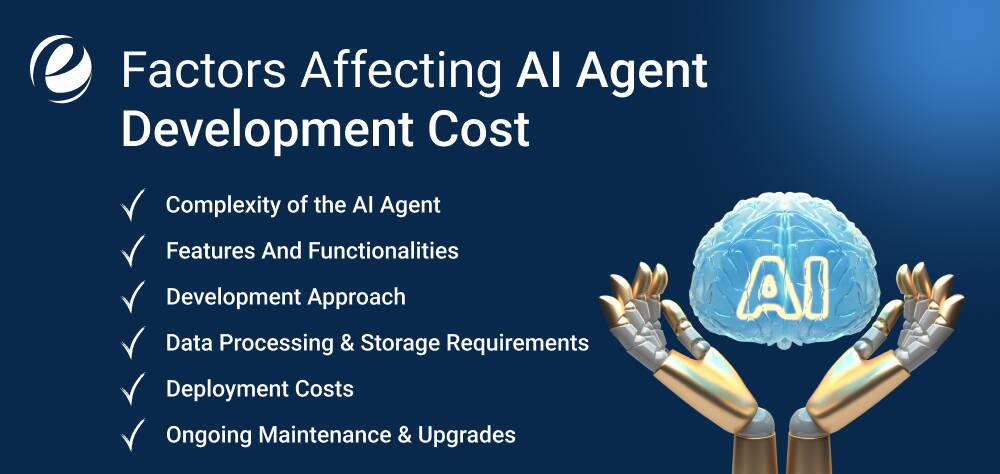
Now, let’s take a closer look at the main factors that affect the cost of developing an AI agent:
1. Complexity of the AI Agent
The complexity of the AI agent significantly impacts development costs. Basic AI agents are more affordable. Medium-complexity agents cost more due to training and data handling. Advanced agents are the most expensive to develop, deploy, and maintain. The more advanced the AI, the higher the cost.
2. Features And Functionalities
Costs also depend on the number of features you plan to integrate into your e-commerce AI agent. Such as tailored suggestion engines, voice search, Predicative analysis, etc. Every new feature results in increased cost of development for the AI agent.
3. Development Approach
The process used in the creation of the AI agent has a significant impact on the development process, time for customization and the overall price. Business owners can build completely from scratch, building on open-source software, or utilizing AI-as-a-Service, according to the budget of their company and what they require.
4. Data Processing & Storage Requirements
AI agents depend on huge databases for training, inference as well as continuous learning. The processing capacity and size of these databases directly affect the cost of development. Cloud-based storage (AWS, Google Cloud, Azure) can be scaled and cost-efficient, traditional solutions require costly hardware, maintenance as well as IT assistance.
5. Deployment Costs
AI agent deployment prices vary depending on the infrastructure requirements, the scalability requirements, as well as security needs. Enterprises can opt for cloud-based, on-premises, or hybrid deployments having different costs.
6. Ongoing Maintenance & Upgrades
AI agents require constant monitoring, updates and further optimizations to keep up with efficiency, accuracy, and security. Maintenance costs are contingent on fixes for bugs, AI model re-training, and the scalability needs.
How Can Emizenech Help You Build AI Agents for Retail and E-Commerce?
Emizentech is a reputable e-commerce development company that specializes in creating cost-effective e-commerce AI agents while ensuring high quality, flexibility, and efficiency. With expertise in artificial intelligence and machine learning, we ensure that AI agents enhance customer experience, improve operational efficiency, and boost sales.
Whether you need a conversational chatbot, product recommendation engine, AI-powered customer support, or fraud detection system, our team develops solutions that align with your goals. We build AI agents that are trained specifically on e-commerce data, so they make accurate decisions and fit right into your existing systems. With EmizenTech’s deep expertise in AI, we help retail and e-commerce businesses improve customer experience, streamline operations, and stay ahead of the competition.
So what are you waiting for? Contact us today to discuss your requirements.
Conclusion
The rise of e-commerce AI agent has created many new opportunities for e-commerce businesses to grow quickly using advanced technology. By investing time and resources into AI, businesses can scale themselves faster and even get ahead of their competitors.
In the future of retail and e-commerce, AI agents will play an even greater role, moving us closer to a new era of technological innovation and customer engagement. However, the growth of AI agents also brings the responsibility to implement them ethically and responsibly, with a strong focus on consumer privacy and data protection.
The e-commerce sector should continue to evolve ensuring AI agents are not only tools for profit but also a way to enrich the overall shopping experience.
FAQs
How does an AI agent enhance customer experience?
AI agents personalize the shopping experience by analyzing customer behavior, preferences, and past purchases to provide tailored recommendations. They also offer 24/7 support through chatbots, automating responses and assisting with product inquiries and complaints, ensuring a seamless shopping experience.
Can AI agents be integrated with existing e-commerce platforms?
Yes, eCommerce AI agent can be seamlessly integrated with a wide range of e-commerce platforms. They are compatible with existing ERP systems, payment gateways, and marketing tools, enhancing overall business efficiency.
How long does it take to build an AI agent for e-commerce?
Developing an AI agent for e-commerce typically takes between 4 to 12 weeks, depending on features, data availability, and complexity. This timeline may vary based on your business’s unique requirements.
How can AI agents improve ROI for businesses?
AI agents boost ROI by increasing efficiency, reducing manual tasks, enhancing customer interactions, and automating workflows all of which contribute to cost savings and higher productivity.



 +1 (989) 535-9295
 info@emizentech.com
 emizentech


