
 Add us as a preferred source on Google
 SAP is System Applications & Products in Data Processing, which centralizes the data management and delivers all business functions through a trusted perspective. SAP functions as an automation solution and modular business management to streamline your workflow. Increased efficiency with effortless access to real-time data-driven insights across the enterprise. It leverages the organization with better return on investment, enhanced productivity, fast-tracked workflows, and a flawless customer experience.
Companies that don’t adopt digital transformation run the risk of falling behind their rivals by 2025. Long-term success is ensured by the future-proof business model offered by the Rise with SAP Services platform.
Adopting a future-ready ERP is essential for long-term company growth.
- uninterrupted, smooth digital transformation.
- Automation driven by AI to increase productivity.
- Agility and scalability for company growth.
- Optimizing costs using a cloud-based model.
- Improvements to data security and industry compliance.
Businesses that invest in Rise with SAP Services now will outperform their competitors, increase productivity, and reap financial rewards in 2025 and beyond.
What is SAP Commerce Cloud?
SAP commerce cloud is an e-commerce platform that connects B2B2C, B2C and B2B commerce expertise into one platform for your growth. SAP is essential for hassle-free and compatible user experiences because of its AI abilities for a more personalized interaction and increased productivity for your team. It functions as an expandable library for seamless functioning to ensure the success of your commerce project. SAP automates and regulates the whole process from the very beginning until the end, which ensures that your project gets release codes from the repository to the cloud.
SAP Commerce Cloud allows you the leverage of an adjustable and versatile platform for enhancing customer experience with modernization. It functions as an expandable library for seamless functioning to ensure the success of your commerce project. It automates and regulates the whole process from the very beginning till the end, which ensures that your project gets release code from the repository to the cloud.
Beyond the CX Suite, SAP Commerce Cloud’s native integration with SAP ERP and S/4HANA is its unique selling proposition. This ensures a tight, end-to-end process from the initial customer click to order fulfillment, inventory management, and financial settlement. This connection is what distinguishes it from standalone e-commerce platforms.
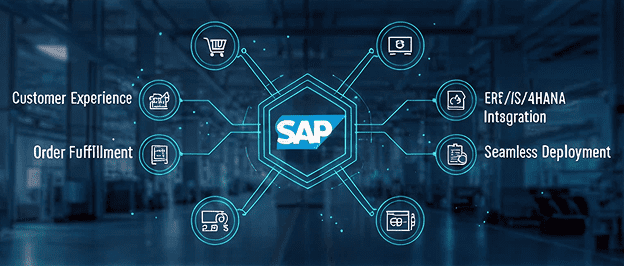
Why Do Businesses Choose SAP Commerce Cloud?
SAP has emerged a global leader in the growing eco-system of digital commerce with robust SAP commerce cloud benefits such as managing high traffic without any hassle. This makes the whole shopping experience flawless even if thousands of people are purchasing frequently together. SAP allows for integration and scale best software which allows for fine-tuning by mix and match features and software as per your specific business framework.
SAP played a significant role in the digital transformation by enhancing the function at every level in the world of modern businesses. It becomes very crucial for productivity and improved efficiency with performance reports and IoT network devices with advanced analytics. The SAP ensures continuous support for predictive maintenance and allows leverage of data-driven insight for real-time informed decision-making by gathering and processing data.
Core Features of SAP Commerce Cloud
For remaining competitive in this rapidly growing ecosystem of businesses, one needs solutions that are tailored to their specific business needs. SAP Commerce cloud features have got it all covered with extensive cloud solutions that cater to the specific business framework of B2B2C, B2B and B2C.
Omnichannel commerce: SAP Commerce Cloud features allow for a seamless shopping experience with varied channels for today’s shoppers. This allows for seamless collaboration between online and traditional sales without any hassle, which makes the whole shopping process flawless across the platforms. From physical stores to websites and mobile applications, it ensures a streamlined purchasing experience.
Product content management (PCM): The most interesting feature that streamlines the functioning of e-commerce benefits is the management of the catalog. It allows for strong product content management to maintain the consistency and accuracy of the systematic distribution of product details in a structured and enriched manner.
AI-driven personalization: SAP gives you the leverage of machine learning and artificial intelligence for offering messages and content as per the user’s purchase history. It allows for personalized suggestions for enhanced engagement and drives better conversions for the business.
Order management & fulfillment: SAP allows for unified order management for increased efficiency and customer satisfaction. From inventory tracking to order capturing, it provides an extensive range of features with OMS multi-channels.
Cloud-native flexibility: Cloud-native applications work on a frequent fine-tuning model, which substantially improves application features. Compared to the old-fashioned monolithic apps, they are flawless for management and use agile and DevOps processes with iterative improvements. This also eliminates all the potential threats and downtime for a flawless user experience.
Benefits of SAP Commerce Cloud for Enterprises
SAP has numerous benefits, such as providing unified solutions for a panoramic view of your business and delivering a flawless user experience across varied facing channels. It also fast-track the whole process with CRM and ERP integration.
Faster time-to-market: The integration of futuristic SAP commerce cloud and headless technology empowers businesses to provide digital experiences and fresh products and services. This gives you the benefit of faster time to market without focusing extensively on development work.
High scalability for peak demand: SAP platform ensures seamless performance even during peak traffic events like flash sales or holidays. Leveraging cloud-based infrastructure, our solutions automatically scale to meet sudden increases in demand, guaranteeing your site remains fast and responsive. This means your business can handle high visitor volumes and transactions without the risk of crashes or slowdowns, providing a reliable and stable experience for your customers.
Integration with ERP & CRM: SAP specializes in integrating your e-commerce platform with your existing Enterprise Resource Planning (ERP) and Customer Relationship Management (CRM) systems. This creates a unified data flow, allowing for real-time inventory synchronization, automated order processing, and overview of your customer. By connecting your systems, we help you streamline operations, improve data accuracy, and deliver personalized customer experiences.
Improved customer experience: SAP e-commerce futuristic features allow significantly improved customer experience with personalization and with flexible pricing. This also increases the revenue and sales with flawless checkout procedures for enhanced customer conversion.
SAP Commerce Cloud Architecture
SAP commerce cloud architecture is based on the foundations of service-oriented architecture. It also gives you the leverage of seamless deployment as well as modular and scalable solutions with its capability of headless commerce with a decoupled backend and frontend. SAP allows for a tailored storefront and allows for hassle-free integration with third-party systems with reduced downtime and a cloud-native approach.
API-first approach: The API-first approach focuses on API-driven solutions. The majority of the project revolves around the structure. It allows for reduced cost of building an app from scratch with reusability and simplifies the creation of an API that can be reused as well. It significantly reduces the chances of failure with a robust and reliable API, which supports extensibility without redesigning the entire system.
Headless commerce capabilities: Headless commerce simplifies the whole process by separating the front-end of applications from the back-end. This allows for both ends to operate in an independent manner, which does not allow one end to affect the other one. Headless commerce gives you the added benefits of faster time to market for faster and reliable launch with a dynamic front end. It allows you to change the storefront without any lengthy process and eliminate all the potential expenses in the long run.
Who Should Use SAP Commerce Cloud?
SAP commerce solutions simplify your business operations and assist you in achieving multiplied efficiency. It has features that are compatible with B2B2C, B2B, and B2C, which sort your business operations, such as streamlining complex order processing, self-service accounts, contract pricing, and purchase of bulk orders.
Now if you are wondering what industries or who should use SAP commerce, here is the curated list of the top most industries which are benefitted from the SAP Commerce.
Automobile
From carmakers, dealerships, and suppliers, the automobile industry had its efficiency increased with industry-ready software. Ensure sustainable business operations with profitable running of your business. SAP provides end-to-end solutions, from building a robust supply chain with a capable data ecosystem to identifying new revenue sources via mobility services. The integration of SAP unifies the vehicle and customer data as well as the adoption and manufacturing of batteries for electric vehicles.
Banking
Ensure seamless customer experience with industry-specific software solutions from SAP. It gives you the leverage to fine-tune the customer experience with data-driven insights for achieving operational efficiency by making the product lifecycle digital. Effective management of recruits for higher employee retention with economical costing for sustainable growth with industry-ready software solutions for banking.
Construction
Specifically tailored solutions for construction and real estate management for reduced complexity and sustainable growth. It allows you to scale and manage your construction projects as well as bridges the gap between project teams for frequently delivering quality projects. From logistics and procurement to planning with futuristic tech-driven solutions, you can minimize environmental impact with responsible practices. Enhance your supply chain management and informed decision-making with data-driven insights.
Defence
SAP has marked its presence in disaster and crisis management with futuristic technology software solutions that simplify the operations of cyberspace. It provides end-to-end solutions for security and defense budgeting and enhanced financial management. A focused approach on the welfare of military personnel to provide data-driven insights for transforming the data into more of a strategic asset.
Ed-Tech and Research
The integration of SAP in research and education simplifies the business operations and increases software adaptability to deliver a seamless user experience. Ensure cost-effective solutions for sustainable and efficient operations with accountability. It fast-tracks the process of research with futuristic AI-based technology as well as allows for smart campuses for an absolutely polished student experience. Data-driven insights with advanced data and analytics for optimizing operations by simulating operation scenarios.
Healthcare and medics
SAP modernizes the healthcare and medical software solutions that are proven to be crucial in life-saving causes for patients. It drives a sustainable approach for healthcare as well as clinical software solutions for medicines and drugs with a faster time to market. It makes the whole process of healthcare seamless by providing data-driven insights with embedded AI for profitable and reasonable business with effective clinical trials. From supply chain management to spending, SAP has it all covered for improving quality with economical cost.
SAP Commerce Cloud Pricing: What Businesses Should Know?
Pricing Model
-
Users pay monthly or yearly fees to use SAP Commerce Cloud software during the subscription period.
-
The subscription usually comes with named-user licenses, which means that each user who needs access must have their own license.
-
There are different pricing tiers for different types of users, such as professionals, functional users, and self-service users, to meet their needs for usage and access.
-
Prices are often shown as a fee per user or unit, and sometimes there are tiered discounts for larger orders.
-
For business contracts, billing usually happens once a year in advance, but in some cases, it might be possible to negotiate monthly billing.
Things That Affect Cost Scale: More users or transactions usually mean higher subscription costs, but discounts for large orders may be available.
Customization: SAP Commerce Cloud is known for having a rigid platform structure, which means that customizing and developing the platform can greatly increase the costs of implementing and maintaining it.
Integration: SAP has some built-in integrations with its ecosystem, but integrating with other systems usually needs custom development or middleware, which can make things more complicated and cost more.
Ongoing maintenance and optimization need their own resources, which adds to the total cost.
Total Cost of Ownership (TCO) The TCO includes the costs of subscriptions, setting up the system, customizing it, integrating it with other systems, ongoing maintenance, support, and upgrades, Because of its complicated architecture and the need for specialized teams to keep it up to date and fix problems, SAP Commerce Cloud’s TCO is usually high.
The platform is less flexible than some competitors, and adding more storefronts or features costs a lot of money and takes a long time to get to market. The way the platform is built often leads to vendor lock-in for businesses, which limits their options and could raise costs over time.
SAP Commerce Cloud has a subscription-based pricing model that is heavily influenced by the number of users and how much they use the service. Costs are affected by things like scalability, the level of customization, and integration needs. Businesses should carefully think about its TCO when making plans for their digital commerce strategies because it is very high due to its complexity and need for maintenance.
Challenges of SAP Commerce Cloud
While SAP Commerce Cloud is a powerful platform, businesses may face some challenges:
- The biggest of which is that it is very hard to set up. This is because it has a lot of features and requires specialized knowledge, which often means hiring highly-skilled Java developers and taking longer to finish the project.
- The cost vs. ROI concerns are also significant, as the platform’s high licensing fees and implementation costs represent a substantial upfront investment. The financial commitment can be too much for many businesses, especially those that don’t already have a SAP ecosystem. It promises a high return on investment by increasing revenue and efficiency.
- While it works well with other SAP products, connecting to third-party systems that are not SAP can be hard and require custom API development, which can make the project take longer and cost more.
- To get around these problems, companies should work with experienced implementation partners, carefully plan the project’s scope to avoid making unnecessary changes, and do a thorough cost-benefit analysis to make sure the investment fits with their long-term goals.
Future of SAP Commerce Cloud
The goal for SAP Commerce Cloud in the future is to become a smart and compatible platform that works easily with the rest of the SAP ecosystem.
AI and predictive commerce are a vital aspect of the platform’s roadmap. SAP uses machine learning to make customized product suggestions, dynamically adjusted prices, and make content automatically.
A key part is better integration with SAP S/4HANA and SAP CX, which makes sure that data flows smoothly from sales to core business functions like finance and inventory. This lets you see the customer in real time and from all angles.
SAP Commerce Cloud is also becoming more important in headless and composable commerce. Its API-first approach and the creation of the Composable Storefront let businesses use the platform as a powerful commerce engine while building custom, best-of-breed frontends with any technology they want.
SAP Commerce Cloud vs Other eCommerce Platforms
Now that you understand the commerce cloud architecture and wondering how to choose the best suitable fit for your business then don’t get confused you will get all your answers .we have sort this for you as well in this table you will get the detailed comparison of SAP with its other alternative to choose the best suitable fit for your specific business framework.
| Features | SAP commerce cloud | Magneto | Salesforce Commerce | Shopify Plus | Big Commerce |
| Core Audience | Multinational corporations ranges from B2C and B2B | Ranges from large corporations to mid-size corps, tailored solutions | Multinational B2C brands with native Saas and marketing automation | Exponentially well growing organizations and company level business | Large organization to middle market for B2C and B2B |
| Architecture Model | Headless commerce with API-first and solid backend, separate frontend | Works on APIs like GraphQL and REST for seamless compatibility with headless commerce and service-oriented architecture. | Assist you with the framework for storefronts with composable headless solutions and separate backend and frontend. | Allows the leverage of storefront API for tailored frontends for seamless and flexible approach. | Tailored frontends with headless architecture with API first and cloud based approach for enterprises scalability. |
| Integration | Pre-built integration with seamless compatibility, SAP ecosystem with CRM, S/4HANA, ERP , frequent fine-tuning for custom development. | Flexible integration with a third party system with an open source community with enhanced and extensive solutions. | Easy integration with salesforce products and cloud marketing with pre-built integrations. | Assist you with the leverage of low-code approach with strong API, complex enterprise-level integration. | Extensive API with easy integration with external systems with frequent fine-tuning and enhanced connectivity with CRM,s and ERP,s . |
| Tailored solutions | Industry specific solutions for fast-tracking B2B and other sectors with pre-configured solutions and customization. | Leverage of Building custom models as well core modification with seamless customization with open source platforms. | Focused approach on industry solutions and AI for B2C and B2B for product personalization and extensive suite of tools. | Custom scripts for frequent tailoring and personalized checkout experience with deep level of coding and customization. | Varied range of built-in features for B2B and B2C that reduce the need for apps with headless architecture and robust backend. |
SAP Commerce Cloud vs Legacy SAP Hybris: What Changed?
- Moving from legacy SAP Hybris to SAP Commerce Cloud is a step forward from an on-premise, monolithic solution to a modern, cloud-native, and headless Platform-as-a-Service (PaaS).
- The core B2B features are still there, but the new model puts the responsibility for hosting and infrastructure on SAP.
- This makes running a business easier and lowers its total cost of ownership (TCO).
- This strategic rebranding focuses on a new API-first architecture that separates the frontend from the backend.
- This makes development more flexible and gives customers a unified experience that is deeply connected to the larger SAP Customer Experience (CX) Suite.
- The cloud version is now the only one that gets new features and improvements, making it the best choice for businesses that want to keep their digital commerce operations up to date.
Is SAP Commerce Cloud Right for You?
Choosing SAP Commerce Cloud is a smart move for big, well-established businesses with complicated needs, especially those that are already using SAP products. If you need a strong, flexible platform that can handle a lot of transactions and complicated B2B, B2C, or B2B2C models, this is the right choice. If your main needs are deep integration with ERP, a single platform for all of your global operations, and long-term, enterprise-grade solutions.



 +1 (989) 535-9295
 info@emizentech.com
 emizentech


