 Add us as a preferred source on Google
 Fashion eCommerce has changed faster in the last two years than in the decade before it. AI styling, social checkout, virtual try-on, and same-day delivery have gone from experimental to expected, and shoppers now compare every brand against the best experience they’ve had anywhere online, not just against competitors in the same category.
Keeping up with these fashion eCommerce trends isn’t optional anymore; it’s closer to the baseline for staying in business. This piece covers the eight fashion eCommerce trends actually driving sales, discovery, and retention in 2026, what each trend means for a brand your size, and how to prepare your store before it becomes table stakes.
Fashion Ecommerce Market Size & Growth
The numbers explain why nobody can afford to sit this one out. The global fashion eCommerce market is on track to hit roughly $957 billion in 2026, and the broader fashion and apparel sector has already crossed $997 billion, with analysts expecting it to clear $1.6 trillion by 2030. That’s not gentle, predictable growth; it’s a sector rearranging itself while everyone’s still trying to keep up.
A few numbers worth sitting with:
- Apparel alone should bring in close to $579 billion in online revenue this year, up more than 10% from last year.
- Resale platforms are expected to drive close to $40 billion by 2029 in sales.
- Clothing remains the single most common category people use buy-now-pay-later for.
- Asia is now the biggest region for online fashion spending, with China alone projected near $298 billion in 2026 revenue.
- Europe isn’t far behind at roughly $220 billion, and North America keeps posting double-digit growth even with tighter household budgets.
- Cart abandonment in fashion still runs slightly above the eCommerce average, which tracks fit and sizing worries are a big part of why, and we’ll get to that later.
The short version for brand owners: this market isn’t just growing, it’s splitting into more channels than it used to have, and the brands paying attention to these fashion eCommerce trends are the ones pulling ahead of everyone else.
Top Fashion Ecommerce Trends in 2026
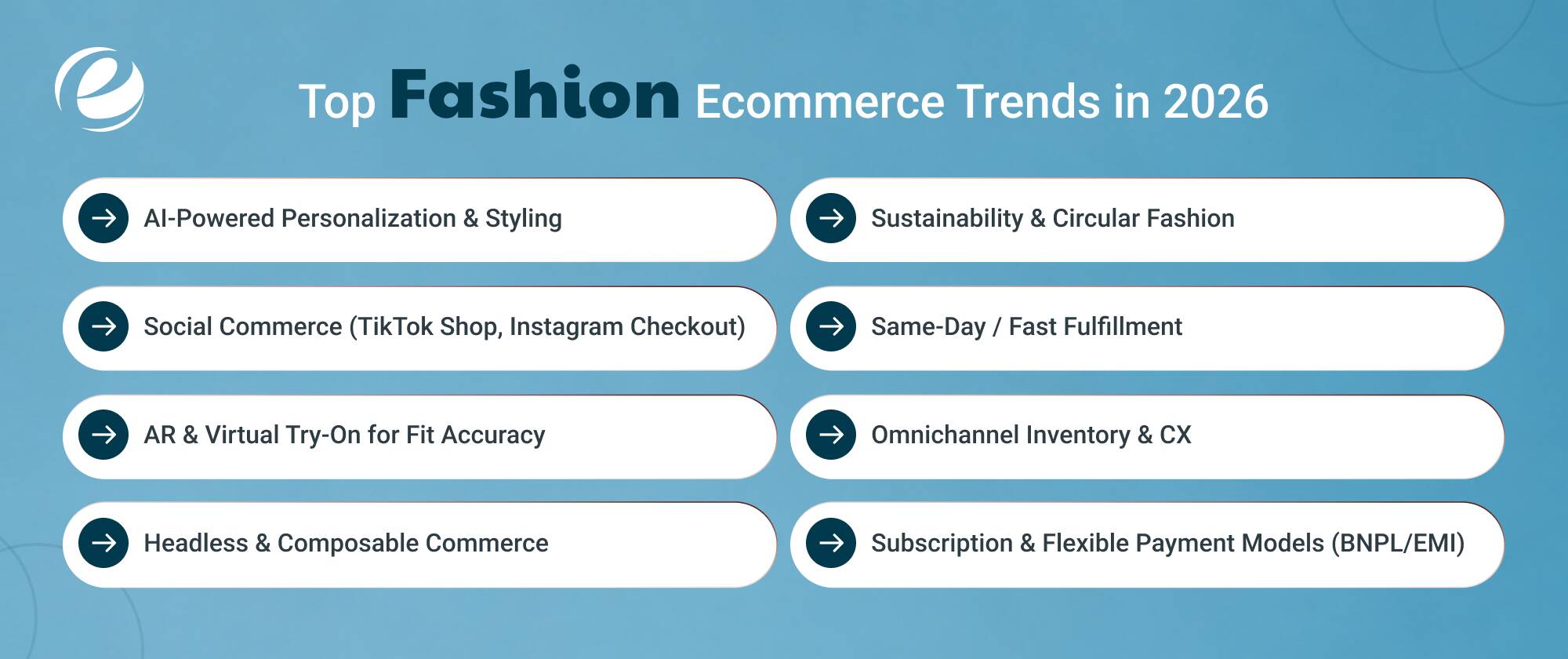
Here are the eight fashion eCommerce trends actually influencing buying decisions, conversion rates, and retention this year.
AI-Powered Personalization & Styling
Generic product grids just don’t convert the way they used to. Shoppers expect recommendations, styling suggestions, and size predictions that are actually built around their own browsing and return history, not the same static homepage every visitor sees. Brands doing this well are seeing noticeably higher order values, mostly because the experience finally feels like it’s for them instead of for everyone.
This is probably the most talked-about of all the fashion eCommerce trends right now, and honestly, it deserves the attention. It touches discovery, merchandising, and even post-purchase emails all at once. If you’re curious how this actually gets built into a storefront, this piece on generative AI in eCommerce covers the practical side beyond chatbots: dynamic product descriptions, AI-generated styling picks, and restocking that catches a bestseller before it actually sells out.
Social Commerce (TikTok Shop, Instagram Checkout)
Discovery and checkout have basically become the same thing. Fashion eCommerce brands aren’t just running ads that send people to a website anymore; they’re selling right inside TikTok Shop and Instagram Checkout, which cuts the whole path to purchase down to one tap.
Creator-led drops and livestream shopping are converting better than banner ads have in years. Any brand still treating social platforms as pure top-of-funnel is quietly leaving money on the table. Younger shoppers, especially now, find a product, watch a creator wear it, and buy it without ever opening a browser tab, which makes native social checkout one of the fastest-moving fashion eCommerce trends to act on this year.
AR & Virtual Try-On for Fit Accuracy
Fit uncertainty is still the number one reason people abandon a fashion cart; nothing else comes close. Augmented reality try-on, letting a customer preview how a jacket or a pair of shoes actually looks on their own body, is starting to close that gap. The virtual try-on market is projected to approach $46 billion by 2030, and the brands who got in early are already seeing fewer size-related returns and better checkout completion.
It doesn’t have to be a full 3D avatar setup either. Even something simpler, AR overlays paired with a decent-sized chart and a two-minute fit quiz, cuts down a lot of the guesswork that drives fashion returns in the first place.
Headless & Composable Commerce
Rigid, all-in-one platforms are struggling to keep up with how fast fashion merchandising moves now: new drops, flash sales, and region-specific storefronts, all on tight timelines. Headless and composable architecture separates the frontend from the backend, so a fashion eCommerce platform can update the shopping experience without touching everything underneath it.
It’s a bigger upfront investment, no question, but it’s quickly becoming the default for brands scaling across several markets. Platforms like Shopware fit naturally here, and if you’re weighing implementation options, it’s worth a look at Shopware implementation services before locking in an architecture.
Sustainability & Circular Fashion
Resale, rental, and take-back programs have gone from niche to pretty much mainstream. The secondhand market is growing nearly three times faster than new apparel sales, and a surprising chunk of people’s wardrobes, especially handbags, is already secondhand. Apparel and footwear brands building resale or trade-in programs into their model aren’t just chasing a sustainability headline; they’re keeping a customer who’d otherwise go buy secondhand from someone else entirely.
Circularity is turning into a trust signal too. More shoppers are checking whether a brand even offers a take-back or resale option before they buy anything at all, which means this trend now shapes first-time purchases, not just the repeat ones.
Same-Day / Fast Fulfillment
Delivery speed has become a reason people buy, not just something they notice afterward. Given two similar products, shoppers will often pick whichever ships faster. Same-day or next-day windows, once something only big retailers could pull off, are now expected from mid-size brands too, pushing more of them toward regional micro-fulfillment and tighter links between inventory and last-mile carriers.
Return speed matters just as much, if we’re being honest. Fast, low-friction returns have quietly become one of the more underrated fashion eCommerce trends on this list, since a painless return is often what actually turns a one-time buyer into someone who comes back.
Omnichannel Inventory & CX
Shoppers move between the app, the website, and the physical store without a second thought, and they expect the brand to keep up. Real-time inventory syncing, buy-online-pickup-in-store, and consistent service across every channel aren’t differentiators anymore they’re just expected. A huge share of shoppers research online before buying in a store, or the other way around, so any gap between channels shows up almost immediately as a lost sale.
A solid mobile experience matters a lot here too. This guide to fashion mobile app development walks through what’s actually driving repeat purchases: on-device push-based restock alerts, in-app try-on, loyalty tracking, and that kind of thing.
Subscription & Flexible Payment Models (BNPL/EMI)
Buy-now-pay-later has become the default way a huge share of people pay for clothing; roughly a third of shoppers choose it at checkout, and BNPL volume is expected to keep climbing through 2030. Subscription boxes and flexible EMI options are following the same path, giving budget-conscious shoppers a way to buy something more expensive without talking themselves out of it.
Brands offering these at checkout are consistently landing bigger cart sizes than the ones that don’t bother. Digital wallets are quickly becoming the thing that ties BNPL, loyalty points, and saved payment methods together into one checkout flow instead of three separate ones.
The Ultimate Platform Showdown: Architectural Foundation for Modern Fashion Brands
None of the fashion eCommerce trends above matter much if the underlying tech stack can’t support them. Picking the right foundation: Adobe Commerce, Shopify Plus, or a fully custom composable build comes down to catalog complexity, what stage the brand is at, and how much control the team wants over the stack.
| Feature | Adobe Commerce (Magento) | Shopify Plus | Custom Composable / Headless |
| Best For | Large catalogs, complex B2B/B2C hybrid brands | Fast-growing DTC brands wanting speed to market | Enterprise brands with unique workflows and multi-market operations |
| Customization | Deep customization, requires dev resources | Moderate, app-ecosystem driven | Full control, built for the brand’s exact needs |
| Scalability | Strong, but infrastructure-heavy | Very strong with built-in scaling | Highest ceiling, scales independently by component |
Shopify Plus usually wins on speed. Brands wanting the faster path can start with this guide on how to build a Shopify store to get the setup basics down before customizing further. Adobe Commerce tends to suit brands with heavier catalogs or B2B requirements, while composable, headless setups are best left for brands that actually have the budget and dev team to manage a more modular architecture long-term. Don’t reach for headlessness just because it sounds impressive; it’s overkill for a lot of stores.
Fashion eCommerce Strategies for 2026 & How to Prepare Your Store
Turning these fashion eCommerce trends into actual results comes down to sequencing, more than anything else. Start with whichever trend is closest to your current bottleneck: if returns are eating your margin, prioritize AR try-on before chasing social commerce. Look at your current stack against where you want to be in 12 months, not where every competitor already is, because chasing all eight trends at once usually stalls every single one.
It helps to set one measurable goal per trend before rolling it out, too a real drop in size-related returns for AR try-on or a specific checkout share for social commerce instead of adopting something just because a competitor announced it last month. Trends without a number attached tend to quietly get abandoned halfway through.
Preparation also means the infrastructure underneath all of this. A fashion eCommerce platform built five years ago genuinely can’t support real-time AR rendering, headless storefronts, or AI personalization without a lot of rework first. This is where a retail-focused development partner earns its keep. EmizenTech has spent years building and modernizing storefronts for clothing, footwear, and accessories brands, handling everything from platform migrations to AI integration to mobile app builds.
Their retail software development services cover the technical groundwork a brand needs before layering any of the trends above on top: inventory syncing, headless architecture, payment flexibility, all of it. Whether you’re retrofitting an existing store or starting from scratch, getting the foundation right first is what makes these fashion eCommerce trends pay off instead of becoming another disconnected feature nobody uses.
Conclusion
The fashion eCommerce industry isn’t waiting around for anyone to catch up. AI personalization, social commerce, AR try-on, flexible payments; all of it has gone from experimental to expected, and the sector’s growing fast enough that hesitating actually costs something now. Brands treating these fashion eCommerce trends as an ongoing roadmap, not a list they glance at once a year, are the ones setting themselves up for real growth into 2027 and beyond. Pick the trend closest to your biggest gap, get the platform underneath it right, and build outward from there.
FAQs
What is the biggest fashion eCommerce trend in 2026?
AI-powered personalization tops the list of fashion eCommerce trends this year, driving higher order values through tailored recommendations, styling suggestions, and predictive sizing. Social commerce and AR try-on aren't far behind, both tackling the discovery and fit issues that have hurt fashion brand margins for years.
How big is the fashion eCommerce market in 2026?
The global fashion eCommerce market is projected at roughly $957 billion in 2026, with the broader apparel and accessories sector near $997 billion and expected to top $1.6 trillion by 2030. Apparel alone should bring in close to $579 billion in online revenue this year.
Is AI personalization worth it for small fashion brands?
Yes, as long as it's scoped realistically. Small fashion eCommerce brands don't need an enterprise AI suite; even a lightweight recommendation tool or an AI-assisted size guide can lift conversion and cut returns. The real ROI comes down to matching the tool's cost to your actual catalog size and traffic.
What causes high return rates in fashion eCommerce?
Fit uncertainty is the biggest driver, followed by inaccurate product photos and sizing that's inconsistent across styles. AR virtual try-on, detailed size charts, and AI-based fit prediction go straight to this problem, which is why they're among the most impactful fashion eCommerce trends for cutting return costs.



 +1 (989) 535-9295
 info@emizentech.com
 emizentech


