
 Add us as a preferred source on Google
 The finance industry is undoubtedly expanding, and it is at the forefront when it comes to new tech adoption and swiftly adapts to the rapid pace of change. This catalyzes the growth of new businesses and attracts more clients. This industry includes venture funds, banks, investment platforms, and trading platforms. Almost every company in this sector needs to invest in financial software development. It’s a key tool that helps businesses manage finances, track transactions, and make smarter decisions.
For any company dealing with finances, having reliable, secure, and efficient software is crucial. It not only helps businesses run more efficiently but also minimizes risks, enhances decision-making, and drives growth. In today’s fast-moving market, investing in financial software is not just an option; it’s a necessity for staying competitive and also sustainable in the long term.
So, how can you develop financial software that perfectly works for your business? That’s exactly what we are going to discuss in this blog.
Market Statistics For Financial Software Development
Financial software is experiencing significant growth, driven by the rising demand for online banking services and the disruptive impact of tech companies within the traditional financial industry. Before we explore the financial software development details, here are some key market statistics that you should not overlook:
- It is estimated that the global financial management software market will reach $49.9 billion by 2033, up from $17.9 billion in 2023. The market is expected to grow at a CAGR of 10.8% from 2024 to 2033.
- The enterprise financial management software market was valued at $9.33 billion in 2024. It is forecasted to reach $26.25 billion by 2031, growing at a rate of 13.80% from 2024 to 2031.
- The global financial analytics market was estimated at $9.68 billion in 2024. It is expected to expand to $10.70 billion by 2025 and reach $ 22.64 billion by 2032, growing at an annual rate of 11.3% over the forecast period.
- The worldwide financial management software market is expected to be worth $24.4 billion by 2026.
What is Financial Software Development?
Financial software development involves creating digital tools and systems to help individuals and businesses manage their finances more effectively. The tools range from basic applications, such as budgeting software, to more complex systems used by banks and investment firms for tasks like stock trading or managing vast portfolios of financial assets.
The primary goal of custom financial software development is to make financial operations faster, more accurate, and easier to manage. It aims to automate processes like tracking transactions, managing investments, generating profits, and producing financial reports. Businesses can streamline payment management, control cash flow, and analyze financial data to make better decisions. Financial software helps companies save time, reduce human error, and increase efficiency. Additionally, it enables clients to make better financial decisions by providing easily understandable information and insights.
Why Investing In Financial Software Development Is a Smart Move
Today, the world is rapidly shifting toward digitalization. Financial services software development has emerged as a key area in technology, offering numerous benefits for various industries, including investment, insurance, banking, payments, and more. Now is the time to explore the advantages outlined below:
1. Streamlining Financial Operations
Financial software automates processes and reduces the chance of errors, increasing efficiency. It provides access to financial data to support decision-making. Machine learning simplifies tasks like invoicing and expense tracking. These tools help businesses manage payments, monitor receipts, and track financial records, improving efficiency and reducing manual effort.
2. Enhancing Customer Experience
Financial software focuses on user-friendly interfaces and service options to boost customer satisfaction. Features like secure transactions, promotions, and financial advice through chatbots make services more accessible. For instance, digital wallets offer both convenience and security, providing a positive user experience that fosters trust in the highly competitive fintech market.
3. Expense Tracking
Financial software enables businesses to control financial data by filtering out unnecessary information. It monitors income and expense patterns to assist with budgeting and financial planning. By consolidating data from various systems, it improves access, producing accurate financial statements and identifying trends that help improve financial control.
4. Improved Efficiency
Automation tools like Robotic Process Automation (RPA) simplify routine tasks, speeding up decision-making processes such as claims or loan processing. Blockchain technology also enhances efficiency by enabling fast, secure transactions, especially across borders. These tools help companies save time, reduce costs, and streamline operations.
5. Reporting and Analytics
Next-gen financial software offers data, making it easier to track costs, investments, and trends. AI-driven analytics help detect anomalies and Key Performance Indicators (KPIs), facilitating informed decision-making. Accurate reports allow businesses to adjust their strategies, recognize financial risks, and monitor financial health more effectively.

Key Features of Modern Financial Software
To develop effective and unique financial software, it’s important to understand the core features and capabilities of the final product. Features define the overall scope of the project, so choosing the most effective, modern options is crucial. These features not only differentiate your brand but also significantly enhance its value.
1. Account Management
Account management tools simplify expense tracking, financial reporting, and billing using AI and machine learning. These tools eliminate the need for manual entry, reducing operating costs by eliminating extra personnel. With automated account management, users can save time, improve data accuracy, and minimize human error. It enhances efficiency and reduces business costs, making it a vital tool for businesses looking to optimize their finances.
2. Budgeting Tools
Budgeting tools help individuals and businesses track and manage budgets efficiently. They use AI to forecast cash flow, evaluate financial outcomes, set objectives, and automatically generate budgets to meet user needs. This allows users to monitor their spending, preventing potential financial issues. The feature also sends alerts if a budget is exceeded or discrepancies are found.
3. Transaction Tracking
Transaction tracking is an essential feature for payment processing and secure monitoring of financial transactions. It enables customers to make payments using QR codes, digital wallets, or bank transfers, ensuring both security and ease of use. Tracking transactions helps users understand their money flow and make informed financial decisions. It also allows users to analyze spending patterns and address areas needing attention, ultimately improving overall financial wellness.
4. Model-Specific Functions
Model-specific functions enable the creation of customized features for specific financial models or industries. These include tools for risk assessment, data analysis, and economic model calculations. Integrating these functions ensures that financial software delivers accurate, context-sensitive solutions, meeting the specific needs of clients across different sectors, from insurance to banking.
5. Secure Payment Features
Secure payment options ensure the safety of users performing online transactions. They offer multiple payment methods, like bank transfers, credit cards, and digital wallets, along with secure encryption and security protocols to safeguard sensitive financial data. These features also support emerging payment methods like cryptocurrencies, helping businesses stay ahead of payment trends.
6. Insightful Dashboard
An intelligent dashboard consolidates key financial information into a user-friendly interface. It allows users to monitor transaction changes, track trends, and generate reports to aid in financial decision-making. With updates and customizable visuals, users can efficiently manage their finances and respond to changes in their financial situation. The dashboard simplifies complex data, making it easier for businesses to stay informed and make well-informed decisions.
7. Investment Management
AI-powered investment management tools provide advice based on historical data and market trends. They help individuals refine investment strategies, optimize tax planning, and manage debt, expenses, and costs. By analyzing past performance and forecasting future trends, the software offers recommendations on where to invest and how to maximize returns. This tool provides valuable insights and strategies to improve investment performance and minimize financial risk.
8. Reporting and Analytics
Reporting and analytics features help users analyze financial data through statistical models to identify patterns, risks, and opportunities. These reports are visualized to simplify complex data into actionable insights, aiding better decision-making. By identifying trends and predicting future outcomes, this tool assists in financial forecasting and risk management, allowing users to optimise all their financial strategies and address issues before they become significant problems.
9. Transaction and Security Enhancements
Biometric authentication methods, such as fingerprint scans, retina scans, and facial recognition, enhance the security of financial transactions. These approaches ensure that only authorised users can access accounts and complete transactions, reducing the risk of fraud. With multi-factor authentication, users can securely make payments and manage finances online. This additional layer of security is very important for contactless and mobile banking, where security is paramount.
10. Mobile Accessibility
Mobile access through the cloud allows users to view financial data and monitor accounts from anywhere with an internet connection. This flexibility improves convenience by enabling users to track their finances on the go. Cloud storage also enhances security by storing information off-site, reducing the risk of data loss due to natural disasters or hardware malfunctions. It enables remote collaboration, allowing users to share information, analyze data, and make financial decisions instantly.
11. Alerts and Notifications
Users are kept informed of significant events and updates through alerts. These notifications can be triggered for various events, such as changes to account balances, payment reminders, transaction confirmations, and security alerts. Alerts can be delivered via SMS, email, push notifications, or in-app messages, ensuring users are always informed and ready to act quickly when needed.
Types of Financial Software Solutions
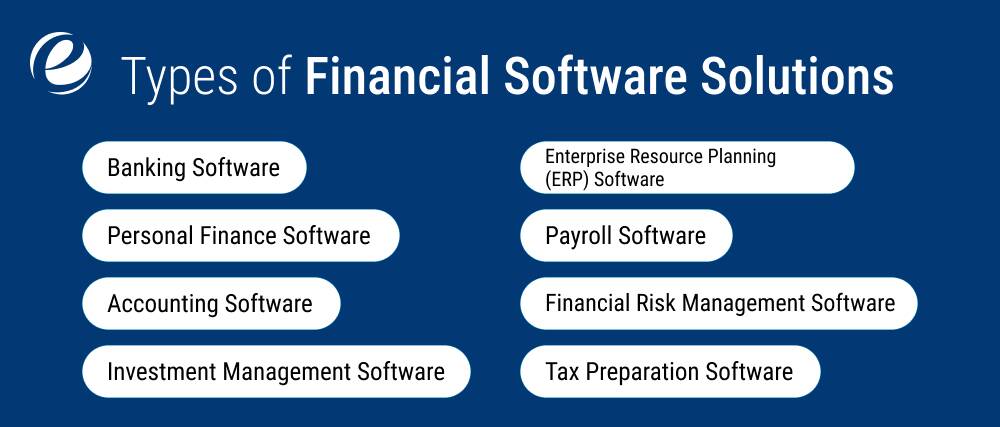
The world of financial software development is vast and diverse, offering a variety of products that meet the needs of businesses of all sizes as well as individuals. As the finance industry continues to evolve, so does the technology behind it, paving the way for more advanced and specialized financial custom software development in the coming years.
In this section, we will explore several types of financial software.
1. Banking Software
Banking software simplifies account management, payment processing, and customer service. The software includes mobile applications that allow customers to check bank balances, transfer funds, and make payments on time. CRM systems and financial management tools help banks stay competitive while ensuring regulatory compliance, security, and customer satisfaction. Banking software has revolutionized the industry, offering a convenient way to enhance service quality for both customers and financial institutions.
2. Personal Finance Software
Personal finance software helps people manage their finances by tracking spending, budgeting, and setting financial goals. It offers features such as planning, forecasting, payment processing, and an overall view of one’s financial state. These tools enable users to make better informed financial decisions, stay organized, and secure their financial future by providing insights and control over their finances.
3. Accounting Software
Accounting software development for financial services helps businesses manage payments, invoices, payroll, and tax compliance. It streamlines bookkeeping processes and financial reporting, saving time and reducing errors. These systems are important for businesses of all sizes, offering efficient financial management, accurate data, and tax compliance. They also provide insightful financial information to support better decision-making.
4. Investment Management Software
Investment management software helps users manage their investment portfolios by tracking performance and making trades more efficient. It offers detailed analytical tools to assist both individuals and companies in making well-informed decisions. This software provides a comprehensive overview of investment options, helping clients maximize returns while ensuring their portfolios align with financial objectives and risk tolerance.
5. Enterprise Resource Planning (ERP) Software
ERP software integrates various functions, including finance, human resources, and supply chain management, into one unified system. It improves data accuracy, boosts efficiency, reduces operational costs, and enhances overall performance. By centralizing business processes, ERP systems help businesses save time and costs while enabling more informed decisions based on the latest data from various departments.
6. Payroll Software
Payroll software automates employee compensation, including wages, taxes, and benefits. It ensures compliance with tax laws and streamlines the payroll process. This software reduces manual errors, speeds up payroll cycles, and ensures compliance with state, local, and federal regulations. Additionally, it provides employees with timely and accurate pay while reducing the administrative burden on the HR department.
7. Financial Risk Management Software
Financial risk management software helps businesses identify, assess, and mitigate financial risks. It offers tools for monitoring market developments, analyzing credit risk, and ensuring regulatory compliance. These tools help businesses proactively manage potential risks, safeguard assets, and reduce liability risks. By analyzing data and predicting risks, companies can make more informed decisions to protect their financial stability.
8. Tax Preparation Software
Tax preparation software simplifies the process of preparing and filing tax returns. It provides tools to maximize deductions, ensure tax compliance, and assist with filing. This software helps reduce the risk of errors and saves time by automating calculations and generating required tax forms. It is especially beneficial for individuals and businesses who want to make tax filing more efficient and avoid costly mistakes.
Technology Stack for Financial Software Development
The technology stack used in financial software development services can vary depending on the specific requirements of the project. In this section, we will examine the key technology stack financial software developers should use when building financial software.
| Development Area | Tech Stack |
| Frontend (User Interface) | HTML, CSS, JavaScript, React, Vue.js |
| Backend (Server-side) | Java, Python, C#, Ruby |
| Database | MySQL, PostgreSQL, MongoDB, Oracle, SQL Server |
| APIs (Data Exchange) | REST, GraphQL, SOAP |
| Security | OAuth, JWT, SSL/TLS, AES Encryption |
| Cloud Hosting | AWS, Azure, Google Cloud, Heroku |
| DevOps & Continuous Integration | Docker, Jenkins, Kubernetes, GitLab CI |
| Payment Integration | Stripe, PayPal, Square, Plaid |
| Data Analytics & Reporting | Power BI, Tableau, Apache Spark, Hadoop |
| Blockchain (if applicable) | Ethereum, Hyperledger, Solidity |
Steps To Develop Financial Software
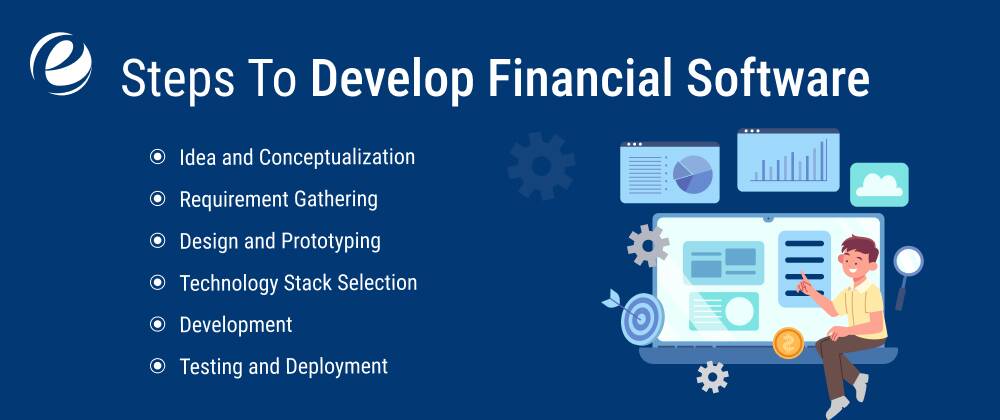
The process of financial software custom development is similar to the development of any other digital product across various sectors. However, the financial software development involves certain peculiarities, which we will explore in this section.
1. Idea and Conceptualization
The initial step is to identify user needs by studying the market. Determine the challenges users face and then develop ideas to address them. Create a plan that not only meets customer needs but also differentiates your product from the competition.
Analyzing business opportunities helps identify growth potential and guides the entire design process. This ensures that the software aligns with user requirements and stands a greater chance of success in the market.
2. Requirement Gathering
At this stage, meet with the customer to discuss their business objectives, target customers, and specific requirements. Understand what the financial software should accomplish. Business analysts will establish the project’s scope, schedule, and deadlines. The information gathered helps create a clear and actionable plan for the development team. The goal is to collect all relevant data necessary to create a product that aligns with the client’s vision.
3. Design and Prototyping
Designers create a simple, easy-to-use interface, focusing on the look and usability of the financial software development. They design wireframes and prototypes to evaluate different concepts. The layout should be straightforward and understandable, even for novice users. Security is also crucial, ensuring sensitive information is properly protected. This step helps refine the design before development begins.
4. Technology Stack Selection
The financial software developer must choose the appropriate technology, tools, and programming languages for the software. The goal is to select technologies that will ensure the software performs efficiently and is built to last. Commonly used technologies include Java, AWS, and Python, depending on the project requirements. Selecting the right technology stack is essential for creating a reliable, scalable, and secure product.
5. Development
The software development financial process begins by creating a base version known as the Minimum Viable Product (MVP). The MVP covers only the essential features needed to test the software’s core functionality. It helps assess whether the application works as intended and whether users find it valuable. Feedback from the MVP will guide improvements and ensure the final product meets user expectations.
6. Testing and Deployment
Once development is complete, thorough testing is required to ensure the software functions correctly. This includes testing for security issues, bugs, and overall performance. After successful testing, the application is deployed in a secure environment for users. Continuous monitoring during deployment is necessary to ensure the software remains secure and operates efficiently. This process helps identify issues quickly and ensures the software stays up-to-date.
Compliance & Regulatory Considerations In Financial Software Development
In this section, we’ll discuss the most important compliance and regulatory issues associated with financial software development. These aspects ensure that the financial software is protected, legally enforceable, and able to safeguard user data, while also meeting industry standards and legal regulations.
1. Understanding Industry Regulations
Financial software must comply with regulations in the financial industry, like GDPR (General Data Protection Regulation) or FINRA (Financial Industry Regulatory Authority). The developers must make sure that the software is compliant with legal regulations regarding the privacy of data, consent from users, as well as reporting.
This safeguards financial data from legal problems. Knowing about these laws at the outset ensures the software is compliant with the required standard and prevents costly failures to comply.
2. Data Security and Privacy
For financial software developers, the security of data is paramount. The regulations require that financial data, such as the details of a bank account or transaction, be encrypted and safely saved. Developers should incorporate robust security features like encryption protocols as well as multi-factor authentication. This helps protect against data breaches and ensures that the user’s personal information is secure and that the software complies with privacy regulations such as GDPR and CCPA.
3. Risk Management and Fraud Prevention
The financial software must have powerful features that identify and stop fraud. Regulators often demand that software developers install tools for the monitoring of transactions and fraud detection techniques, as well as alerts.
Implementing these systems helps reduce threats like money laundering and ensures the software complies with anti-money laundering (AML) rules. A proactive approach to managing risk also builds trust with regulators and users.
4. Audit and Reporting Capabilities
Financial institutions must maintain precise records and carry out periodic audits. The developers must incorporate features into software that allow for simple tracking of balances, transactions, and other user-related activities.
They help financial institutions adhere to reporting standards and allow them to create thorough audit trails for authorities. The use of transparent reporting tools is essential in ensuring compliance as well as the transparency of financial transactions for the highly regulated financial industry.
5. Continuous Compliance Monitoring
Financial software should not just be compliant at the time of launch; however, it must remain in compliance when laws change. The developers must incorporate mechanisms to monitor compliance regulations, which allows software to be able to adjust to the changes in regulation.
It could be as simple as automated updates in response to the latest regulatory developments or periodic audits. Regular monitoring makes sure that the software is updated with the most current legal requirements and prevents sanctions for non-compliance.
Cost of Financial Software Development
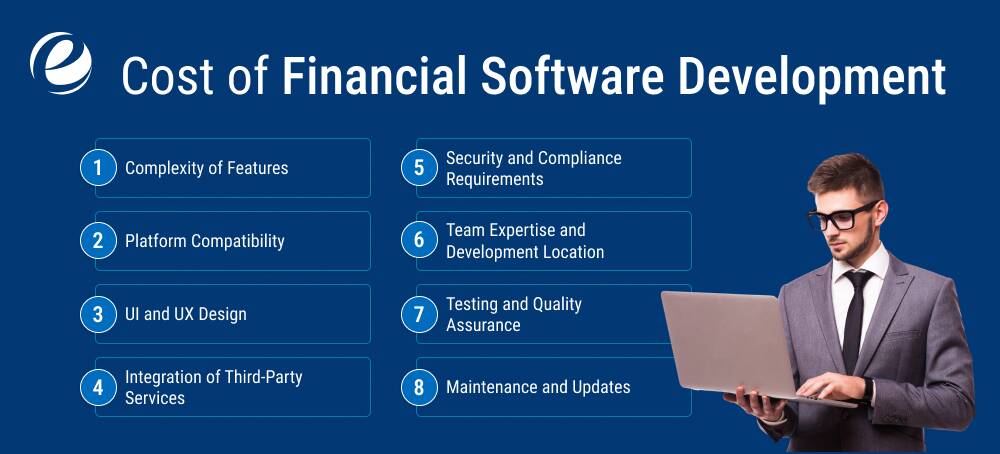
The cost of financial software development can range somewhere between $30,000 and $500,000. The truth is that there’s no clear and fixed answer to the price of developing financial software. Costs vary due to many factors, including the kind of software, the team involved in its development, the complexity of features, and much more.
Let’s take a closer look at some of the major factors that influence the overall cost of developing financial software.
1. Complexity of Features
The more complex the features, the greater the cost for development. Finance software development usually requires complex features like transactions, secure encryption, or even complex analysis of data. Making these capabilities requires experienced developers, testing, and further development as well as integration with other applications, which could increase the cost.
2. Platform Compatibility
The development of financial software that runs on multiple platforms, such as mobile, web desktop, can add to the development costs. Different platforms might require different codes, or a complex and unified system that supports a variety of gadgets. Ensuring that you have the same functionality, speed, as well as security across platforms requires extra effort and energy. This means that costs increase, particularly in the case of several operating systems and devices, such as iOS, Android, or Windows.
3. UI and UX Design
Creating a user-friendly, intuitive, and visually appealing UI/UX is critical when developing financial software. A well-designed interface enhances user satisfaction and engagement. Achieving this requires skilled designers, user testing, and iterative design to meet high standards.
Financial software often requires specialized design and development to ensure clarity, accessibility, ease of use, and smooth interactions, all of which contribute to higher development costs. Poor design, on the other hand, can result in user dissatisfaction and impact software performance.
4. Integration of Third-Party Services
The financial software is often integrated with other third-party providers like banks’ APIs, payment gateways, as well as data providers. Every integration requires additional development, testing, and maintenance regularly.
Costs are higher in the event of integrations with more than one external service, as well as if these services are complex or have custom specifications. In addition, making sure that third-party services are compliant with the security requirements and regulations can increase the overall development expense.
5. Security and Compliance Requirements
As financial software processes sensitive information, making sure the software meets stringent requirements for security and conformity is vital. Ensuring robust encryption, security-based authentication methods, and compliance with regulatory requirements such as PCI-DSS and GDPR will significantly affect the cost of development.
Constant security checks, audits, and security upgrades add to the total cost because developers need to integrate these functions from the beginning and continue to maintain them.
6. Team Expertise and Development Location
Experience and knowledge of a financial software development company play a major role in the cost of financial software development. Professionally skilled specialists, developers, and compliance experts usually charge more.
Furthermore, the place of the team that develops can affect the cost. Developers located in regions that have more expensive living costs,for example, North America or Europe, generally pay higher prices when compared with developers from regions such as Eastern Europe or Southeast Asia.
7. Testing and Quality Assurance
Thorough testing is essential for financial software development to ensure security, accuracy, and reliability. Testing costs can differ based on the complexity of the application, its features, and the types of tests required. The more extensive the testing process, the higher the overall development cost. However, rigorous testing is necessary to ensure the application is secure, bug-free, and reliable.
8. Maintenance and Updates
Development costs do not end when the software is deployed. Financial software must be maintained, bugs and security patches should be provided, and updates rolled out in regular intervals to make it work at all times. It will require dedicated resources and contribute to the cost in the long run. In addition, if additional functions are needed after the release, the software has to be continuously updated, which can require significant work in development work.

Custom Financial Software Development Challenges
One of the most important aspects of financial software development involves forecasting the challenges that lie ahead and preparing for those struggles. This helps in safeguarding your FinTech software as a future-ready solution. Let’s delve into some of the challenges that might occur.
1. App Security
Security of applications is essential for safeguarding sensitive data and stopping the possibility of hacking. Security-first design ensures that the best standards are met, as well as the Data Governance Framework is in place to guard the data.
2. Following Compliances
The compliance with global standards is vital to the financial software development services. Finding pertinent compliance standards and modifying the software to satisfy the requirements of these standards can be difficult, in particularly when business owners or developers don’t know the rules.
3. Data Accuracy
Financial software has to collect relevant, reliable, and trustworthy data from several sources, making data accuracy a challenge. Poor choices may result from erroneous or missing information, hence harming the reputation and credibility of the company. Keeping high-quality data calls for continuous validation and monitoring, which may be difficult and expensive.
4. Legacy System Integration
Incorporating information from outdated systems may be a challenge because these systems might have been dated or worn out. FinTech businesses must spend money on upgrading their systems, or employ special software designed to collect and incorporate data into modern applications.
Why Choose EmizenTech For Financial Software Development?
EmizenTech is a leading financial and banking software development company with years of experience delivering high-quality, reliable fintech software solutions. Our expert team has served a diverse range of clients in accounting, banking, investing, and trading, ensuring we understand the different requirements of each industry.
Whether your venture is small or complex, our expert developers can provide solutions to meet your business goals. We focus on understanding the particular challenges and needs of your business, and we adapt our strategy to design effective solutions. Our team is fully dedicated to helping businesses grow by delivering high-quality financial software that enhances security, performance, and efficiency.
If you’re looking for an experienced partner in financial software development, we’re ready to guide you through the process. Contact us now to discuss your requirements.
Conclusion
The financial industry is increasingly relying on advanced software to boost efficiency and foster innovation. As technologies like big data, cloud computing, blockchain, and artificial intelligence continue to evolve, financial software will become even more powerful. It helps institutions make better decisions, streamline processes, and offer a wider range of services to their customers.
To stay ahead in a fast-changing market, companies in finance need the right tools. The future of the industry depends on smart, data-driven technology, so having reliable software is key to staying competitive and growing in today’s world.
FAQs
How can custom financial software be used in finance?
Custom financial software development helps manage systems by simplifying the administration and record-keeping of financial operations. It also makes complex tasks easier to complete and provides instructions and patterns that allow financial transactions to be completed in just minutes.
What is the typical timeframe to develop financial software?
Considering the various factors and major phases of development, the time required to develop financial software can range from 4-5 months or longer, depending on your project’s requirements.
Can financial software be integrated with other systems?
Yes, the software can be very easily integrated with other systems, such as CRM tools, ERP software, payment gateways, and banking APIs. This enables seamless data exchange and helps automate various processes.
What are the factors to consider when selecting a technology stack?
Security, performance, scalability, and integration are all important factors to consider. A technology stack should be capable of handling large transactions, safeguarding sensitive information, and be adaptable to changing company’s changing needs.



 +1 (989) 535-9295
 info@emizentech.com
 emizentech


