
 Add us as a preferred source on Google
 Software development for startups is really one of those make-or-break foundations when you’re trying to turn an idea into something real in today’s crowded market. For founders, it’s not only about writing code or hiring developers; it’s more about building something that actually works for users, can scale later, and has a clear path to making money.
According to Mordor Intelligence, in 2026, the market for software development globally stands at USD 0.64 trillion, owing to high demand from cloud computing, agile, and digital transformation. This reinforces why startups must choose the right strategy early to stay competitive.
This blog covers what software development for startups is, its features, MVP development, cost & development models. Also, it explores the development and how startups should approach the software development process. So, without any further adieu, read this blog to expand your knowledge!
What Software Development Means for a Startup?
For startup companies, software development is a strategic vehicle that allows market validation and fast scaling. This involves taking more than just simple programming to develop an MVP, which specifically targets one pain point of users.
Through employing Agile methodologies and utilizing up-to-date tech stacks, the development process becomes an endless loop of launching, analyzing, and improving. It is the basis for automation of processes, achievement of product-market fit, and reduction of technical debt. In short, successful development provides founders with the possibility of a quick pivot after analyzing the numbers.
Factors That Impact Startup Software Development Process

The following are the factors that affect the planning, implementation, and management of the software development process for a startup:
Market Validation and Key Idea
- Validation of Idea: The software has to satisfy some practical business requirements rather than assumptions.
- Audience Analysis: Identifying users for the software to focus on developing features that are of value to them.
- Feedback Mechanisms: Feedback loops are key in ensuring quick pivots when necessary.
Strategic and Management Factors
- The “Devil’s Quadrangle”: An ongoing effort to balance quality, scope, cost, and time, wherein any change in one impacts the other three.
- Scope Creep: Addition of unwanted features that result in increasing costs and delays in project completion.
- Methodology Selection: Deciding whether to go for agile for flexibility, lean for speed using the fewest possible resources, or a waterfall approach.
- Time-to-Market: Time when more importance is given to getting to market fast, rather than delivering a perfect solution.
Team and Execution Factors
- Skill Set of Team Members: Bringing on board qualified programmers whose working styles also match the team.
- Implementation Approach: Using in-house or outsourcing methods for application development.
- Decision Paralysis: Delays in decision-making due to a lack of clarity and proper information.
Technical and Product Factors
- Technology: Technology stack and selection of technologies that will be used for software product development.
- Technical Debt: Technical debt caused by certain measures needed to accelerate the release.
- Scalability and Security: Consideration of scalability and security from the early stages of project development.
The Right Starting Point: MVP Development
Building a Minimum Viable Product (MVP) before fully developing a product is a very important step in MVP development for startups that allows a startup to validate its product idea with real users, rather than investing a significant amount of time and money to build a complete product. The primary focus of an MVP is to test the main features of the product with real users to get early feedback, learn from users how to improve the product, and reduce business risk by establishing whether or not there is market demand for the product before scaling the business further.
How MVP Saves Time and Cost
How MVP Saves Time
- Rapid Launch & Iteration: An MVP will be deployed much faster than other software applications that require 6 to 12 months to develop.
- Focused on Core Features: This means that only the essential features will be developed; therefore, there will be no need for long development periods.
- Faster Validation: The MVP can validate itself early by getting user data to know which features work.
How MVP Saves Costs
- Reduced Development Costs: By developing only the key features, development costs will be reduced.
- Evaluating Market Demand Early: The firm will test the product with actual consumers, avoiding unnecessary expenses on developing a full-fledged product that has no market demand.
- Lower Opportunity Cost: In case the product is unsuccessful, the risk will only involve the cost of creating the MVP.
- Resource Utilization: Allocates budget resources on features that are really important to the target audience.
Best Software Development Models for Startup Projects
Here are some popular software development for startup
Agile Model
Agile development utilizes short cycles of development to allow for the building, testing, and improvement of an application or product based on feedback from users. Agile provides flexibility and adaptability throughout the development process. It also assists teams in dealing with evolving demands effectively, thus increasing the quality and user satisfaction with products.
Lean Development Model
If you’re an early-stage startup creating a minimum viable product, then the lean development model is your best bet. This model emphasizes developing essential features that will address the main problem (the MVP) so you can save time and resources and avoid doing unnecessary work.
Rapid Application Development (RAD)
Rapid Application Development (RAD) allows developers to rapidly prototype an application to provide proof of concept and/or validate early versions of an application quickly by prioritising speed of development and delivery of working versions of that application to allow users to validate the use of the concept and to provide feedback on the next iterations of that application.
DevOps Model
The DevOps model is the development and operations (of an organization) working together to create a continuous delivery model by connecting the two large groups (that usually work individually) to allow for an automated testing/deployment process to achieve fast, reliable product releases.
Incremental Model
The incremental model is designed for organizations that want to develop products over time. The incremental model breaks large products down into smaller features and allows you to continuously integrate user feedback throughout product development, so you can improve your product continuously without waiting for the full product.
Prototype Model
Prototyping is a great way for an organization to begin testing its ideas before committing to a complete product. By developing an initial working model through the use of prototyping, you can get valuable feedback on your idea from users and use that feedback to improve the overall product.
How Startups Should Approach Software Development?
Software development for startups has different preferences on how their software should be developed. While some will go for the in-house model because of various reasons, others will outsource their software development because of saving time and costs. Here is a brief description of both models:
In-house Development
The in-house team would include developers, designers, testers, and the technical lead. You will enjoy high levels of ownership and alignment through this mode of software development, which will, however, require considerable time and financial investment.
Pros
- You have complete control of your team. You can manage priorities and make immediate decisions with little or no reliance on outside schedules, as well as change the development direction if need be.
- Internal developers have a deep understanding of your product and users, enabling them to grow their long-term knowledge of these into better continuity and innovation.
- Shared communication channels and daily interaction among team members greatly reduce friction between each other and help speed up the decision-making process.
Cons
- The costs associated with salaries & benefits, workstations, and HR management can significantly add to your budget.
- Finding qualified developers can take an enormous amount of time and subsequently delay the launch date of your products.
- Most small internal teams do not have the breadth of specialization required to affect both speed and technical depth.
Outsourced Development
Outsourcing refers to partnering with a development agency outside your company or even with a remote development team in order to develop some or all of your software. It provides flexibility, expertise, and speed at a lower cost than hiring internally.
Pros
- With no lengthy recruitment period, you’ll be able to connect with a wide variety of specialists in all areas of technology at your disposal.
- Because agencies typically have pre-formed teams and established processes in place, they can get started quickly.
- As you would only be paying for what you need, this will not only save your money but also provide greater flexibility in your overhead and/or long-term commitments.
Cons
- Clear communication & well-defined requirements are necessary to minimize miscommunication or delays.
- A vendor that doesn’t have a reliable partner will see inconsistent quality of the product or will not be able to meet their deadlines.
- Requires proper project management – You should be able to effectively coordinate the external team to maintain alignment and continue to make progress.
Selecting between in-house development and outsourcing depends on your startup’s objectives, financial resources, and timeline. In addition, many companies utilize software development services in order to strike a balance between these factors.
The Startup Software Development Process
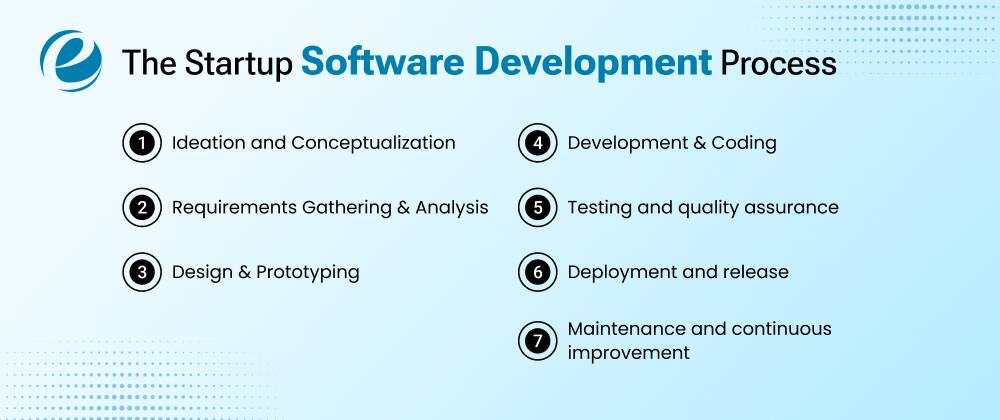
How you run the entire software development process for startups will affect the quality and popularity of your products. It is suggested to cooperate with a startup development agency experienced in app development for startups that follows agile methodologies and has experience collaborating with companies similar to yours. In this section, we’ll explore a development process step-by-step.
Step 1: Ideation and Conceptualization
This is where it all begins. The focus in this step is on shaping the concept, determining the market needs, and defining the problems that need solving. Defining this part is crucial since it becomes the base for further product development.
Step 2: Requirements Gathering & Analysis
This is the step when one conducts research to get a better idea about the users and stakeholders and defines the needs in more detail. Here, you can define such characteristics as MVP features and advanced features.
Step 3: Design & Prototyping
During this stage, the product is designed by designers and architects. Also, a prototype may help in assessing its usability and general user experience.
Step 4: Development & Coding
Here, the development starts for real. Developers work with the project in small pieces, writing down the necessary code.
Step 5: Testing and quality assurance
Testing is extensive to identify errors and ensure that everything works properly before the product is released for consumer use.
Step 6: Deployment and release
When testing is complete, the software is released in a controlled manner so it can be used effectively by customers.
Step 7: Maintenance and continuous improvement
The process does not end there; the product goes through further development and maintenance after its release.
Cost of Software Development for Startups
The cost of custom software development for startups
Typical MVP Development Cost Range
| Application Type | Timeline | Price Ranges | Features |
| Simple MVP | 1 to 2 months | $5,000 – $30,000 | Basic features, one platform, simplistic interface, basic functionality |
| Average MVP | 2 to 4 months | $30,000 – $80,000 | Basic features, smooth user interface/user experience, database connectivity, enhanced user experience |
| Complex MVP | 4+ months | $80,000 – $150,000+ | Custom design, advanced features, integration with artificial intelligence, integration with third parties |
Factors That Affect Cost
- Platform: Creating a development platform for both iOS and Android can approximately double the cost of developing one cross-platform app (Flutter/React Native).
- Development Team Location: Hiring developers in North America is expensive due to hourly wages ($100-$200/hr), while hiring teams in Eastern Europe or Asia will usually mean 30-50% lower costs.
- Development Route: Using freelancers to develop an app will cost anywhere from $5,000 to $30,000, while using an agency is typically $40,000 to $150,000+ (depending on the size of the project).
- Scope & Features: Adding core functionality (e.g., login, payments, and API integrations) will typically add $1,500-$3,750+ per module.
- Design & UX: Custom, high-end user interface design will also add to the cost of your app, but increases competitiveness.
How Emizentech Makes Software Development Simple for Startups
Emizentech makes software development for startups as we provide structured and end-to-end services related to idea consultations, design, development, testing, and deployment. Our experts focus on developing scalable and affordable solutions tailored to the requirements of startups and current market conditions. Being experienced in such domains as mobile app development and web solutions, among others, we aim at helping the startups implement their ideas into life through effective and efficient measures.
Our experts utilize the agile development methodology and promote transparent communication and flexibility throughout the entire software development process. Startups also benefit from MVP-focused execution and ongoing technical support, helping them launch efficiently and grow their products with confidence over time.
Conclusion
Software development for startups is an important step in developing a digital product out of an idea. The selection of the MVP process and the development model will determine the pace, cost, and overall success of the project. Planning will help entrepreneurs minimize risks and develop applications that will meet the market demands.
The emphasis should be placed on the ability of a product to adapt and scale regardless of whether it was developed internally or outsourced. With the right guidance, startup app development becomes more efficient, cost-effective, and growth-driven. Therefore, it is important to develop a proper strategy that will allow the founders of a startup to avoid mistakes and create products according to real market needs.
FAQs
How long does it take to build software for a startup?
Startup software development generally takes 6–16 weeks for an MVP. The timeline really depends on what you’re building; simple products move fast, while complex ones with multiple features or integrations naturally take longer.
How do startups choose the right software development company?
A startup should select a software development company considering its experience, skills, product portfolio, scalability, communication, and transparency of costs.
Why do most startup tech products fail in early stages?
Products of startups fail in the early stages because of a mismatch with the market, misunderstanding the problem statement, inadequate feature prioritization, or over-building the product without any user feedback.
How can a startup decide which features to build first?
The startup can prioritize the features by focusing on user needs, value for the business, and feasibility. A better way would be to concentrate only on the core functionalities needed to solve the user problem.



 +1 (989) 535-9295
 info@emizentech.com
 emizentech


