
 Add us as a preferred source on Google
 Have you ever thought about how banks turn out to be faster, more intelligent, and more personalized than before? Well, this is just possible because of generative AI in banking; it is a revolutionary technology that has changed every aspect of customer service and fraud detection. Generative AI transforms deeply in comparison with old AI, which was only data analysis. It can generate without any limits, such as comical answers to customers’ questions, financial recommendations, or simple reports.
In this era of rapidly developing technology, banks and financial institutions all over the world are searching for new ways of applying generative AI in banking to improve work efficiency, cut down costs, and provide better user experiences. In this article, we will dig into the primary usage of generative AI in banking, its benefits, challenges, and applications.
In case you are a bank executive, fintech startup, or just a tech enthusiast, this guide will be of help to you in figuring out how generative AI in banking is revolutionizing the financial world, how generative AI works, and how you can get ready for the AI-driven future.
Market Stats & Trends (2025–2030)
According to Globe News Wire, Global banking AI is anticipated to experience a five-fold increase, with the AI in the banking market projected to expand from approximately $32.9 billion in 2025 to $75.36 billion by 2030, representing a CAGR of nearly 18%. This trend is indicative of the fact that banks are relying on automation, smarter customer interactions, and the use of fraud detection tools that are powered by AI more than ever before.
On the other hand, the generative AI segment in the financial sector is rising at an even greater rate. From $1.67 billion in 2023, it is expected to grow to approximately $19 billion by 2030, with a CAGR of about 39%. This is a result of the comprehensive acceptance of this technology in banking, payments, wealth management, and compliance. (Source – Fintech Futures)
In 2030, global AI spending (any sector) could hit $1.8 trillion, which represents a CAGR of 36.6% from the period of 2024-2030. Besides, financial services are still the primary source of this growth.
Market Size & Growth
| Region / Segment | 2024/25 Value | 2030 Forecast | Compound Annual Growth Rate (CAGR) |
| Global banking & finance (GenAI) | $1.26 B in 2024, rising to $1.68 B in 2025 | ~$21.8 B by 2034 | ~33% (2024–2034) |
| Banking & finance (GenAI) 2024 baseline | $1.29 B in 2024 | $21.6 B by 2034 | ~31.6% (2024–2034) |
| Overall AI market, including hardware/etc. | $103 B in 2023 | $1,037 B by 2030 | ~39% (2023–2030) |
| Generative AI subset of AI | $2.8 B in 2023 | $75.7 B by 2028 | ~93.7% (2023–2028) |
What is Generative AI in Banking?

Generative AI in banking refers to progressive AI models that have the ability to compose new information, insights, or solutions from examples of past instances. The application of generative AI in banking turns it into a mechanism for generating financial advice, customer service automation, fraudulent behavior detection, and decision-making improvement.
This kind of AI differs from the conventional one in the sense that it mainly performs data analysis, while generative AI in banking carries out the next step, which is the generation of intelligent outputs such as reports, emails, or chatbot responses. It’s radically changing the way banks implement their customer service; the execution of operational processes becomes more accessible and faster.
Generative AI Use Cases in Banking You Should Know
Generative AI is revolutionizing the financial industry so quickly that it is probably best described as an exponential technology. The productive use of generative AI in banking for automating customer service improvement in fraud detection has been the prime accomplishment of financial institutions that have employed AI technology to work smarter, faster, and more securely. It’s not solely about the efficiency of operations anymore.
Banks are by no means only automating tasks; rather, they are combining AI with intelligent solutions, experiences, and data-driven decision-making. We will discuss some of the most impactful use cases of generative AI in banking that are shaping the future of financial services.
Automated Customer Support
Generative AI supports intelligent chatbots and virtual assistants that are able to manage customer issues around the clock. These bots respond to customers in a human-like way; thus, customer satisfaction is improved while fewer support employees are needed, which reduces the cost. As the main application of generative AI in banking, it is aimed at getting a better user experience.
Fraud Detection and Prevention
Generative AI has the capacity to scan through huge sets of transaction data and pick out not only the rule-based anomalies but also those unpredictable ones by recognizing the habits of a consumer and adapting to them. This gives banks the ability to prevent fraud and thus protect customer accounts.
Personalized Financial Advice
Generative AI is capable of producing financial advice just for one person, relying on that person’s spending habits, income, and aims. It initiates customer engagement and helps banks provide higher-value services to customers, all of which amounts to a perfect example of the application of generative AI in banking.
Risk Assessment and Credit Scoring
Banks use generative AI to generate risk profiles and credit scores by analyzing customer data, even from non-traditional sources. This allows lending decisions to be made quickly and correctly, which is in line with financial software development objectives.
Document Generation and Reporting
Generative AI can create loan documents, investment reports, and summaries by extracting information from various sources. This not only frees up time for banking employees but also ensures precision, which makes it an essential tool for banking app development and internal processes.
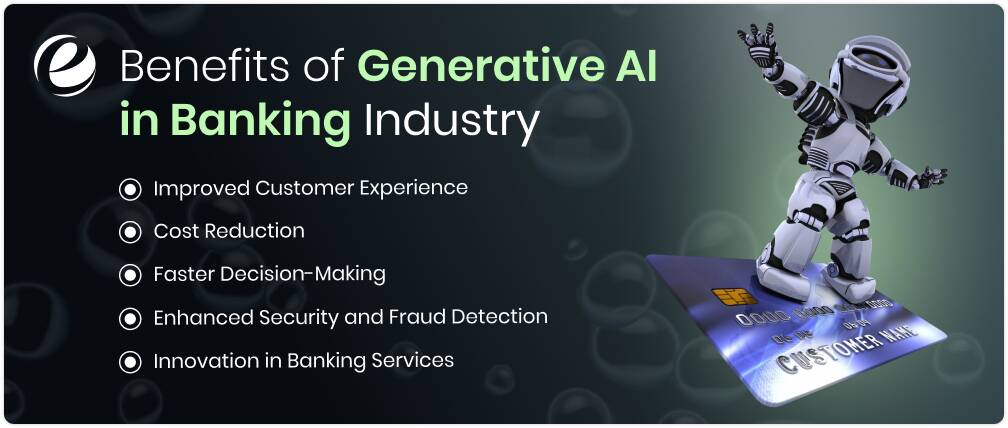
Benefits of Generative AI in Banking Industry
The banking sector has taken a course of digital revolution, and generative AI in banking is the driving force behind it. Banks use AI models that are capable of creating content, making decisions, and learning from the data to carve out new strategies to increase their effectiveness, improve their customer service, and decrease their risks.
Whether it is about making internal operations simpler or providing users with more intelligent financial tools, the employment of generative AI in banking is key to the realization of the power of AI innovation and competitiveness.
Improved Customer Experience
Generative AI enables banks to answer customers’ queries most efficiently by AI-based chatbots and virtual assistants, which provide fast and accurate responses to customer requests. Consequently, a higher level of satisfaction provides more effective service.
Cost Reduction
It therefore follows that banks can significantly decrease operational costs by automating repetitive tasks like data entry, report writing, and answering support queries that are basic in nature. Human staff thus have an opportunity to divert their energy towards those areas that are more valuable.
Faster Decision-Making
AI models have the potential to comb through massive pools of financial data in no time and produce results that are feasible. This not only enables quicker credit approval, the setting up of investment plans, and efficient risk management, but also provides one of financial software development’s key benefits.
Enhanced Security and Fraud Detection
Generative AI can also identify unusual actions and provide continuous notifications that help the fraudsters to be one step behind. This increased protection will enhance customer trust in the company.
Innovation in Banking Services
Banks greatly capitalize on generative AI to inaugurate digital services that are beyond imagination. They implement the technology in various ways, such as employing AI to create a smart assistant for loans, powered by AI investment advice. It also facilitates banking app development by introducing more intelligent and user-friendly features.
Requirements to Implement Generative AI in Banking
Financial institutions must lay the groundwork for successful generative AI adoption in banking, which supports advanced technologies that are essential in the banking sector. This is not merely a matter of connecting an AI tool, but the right data, systems, and strategies, which guarantee security, performance, and compliance, are necessary.
A bank, whether it explores fintech software development or upgrades its services, has to meet some key requirements for the smoothest and most effective AI implementation.
High-Quality Data Infrastructure
Generative AI models need access to refined, accurate, and organized data. Banks should empower the data pipeline and management system to enable AI to learn and perform efficiently.
Robust IT and Cloud Environment
In order to utilize AI models at their best level, banks require powerful computing or cloud-based platforms. An infrastructure that is secure and scalable is indispensable for running and training models.
Data Privacy and Compliance
As banking deals with very sensitive data, it is important to comply with data protection laws such as GDPR and local regulations. Guaranteeing AI systems’ compliance with privacy norms is mandatory.
Skilled Talent and AI Expertise
Banking needs people who have skills in data science, AI engineering, and fintech, whom they respect, and who can bring innovations in technology and banking together. This allows generative AI systems to be properly run, managed, and trained.
Integration with Existing Systems
Generative AI tools are to function without obstacles with the existing core banking systems, apps, and platforms. The smooth integration allows better performance and avoids disruptions that occur in daily banking operations.
Applications of Generative AI in Banking & Finance
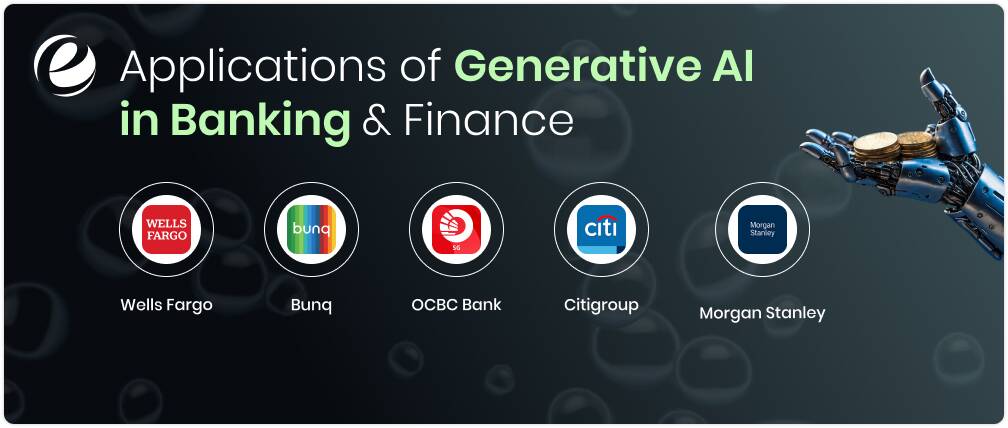
The banking industry is going through a massive transformation using generative AI, which is helping them improve customer service, compliance, investment analysis, and internal automation to boost.
Traditional banks and fintech players who have already embraced the power of generative AI-driven tools are able to not only hold their ground but also lead in a digital-first environment. We are considering the application of generative AI in banking now, that are quite practical, yet they are the most formal illustrations of AI in banking, profusely reshaping the industry.
So, let us find out who the most prominent financial institutions are that are using generative AI and how their platforms are influencing the market.
| Bank/Institution | Launch Year | Platform | App Size | Key Features | AI-Powered Use Case |
| Wells Fargo (Fargo AI Assistant) | 2023 | iOS, Android | ~90 MB | Smart banking assistant, balance checks, and financial tips | AI chatbot for financial guidance and customer service |
| Bunq | 2022 | iOS, Android, Web | ~75 MB | Smart budgeting, expense tracking, and insights | AI-driven money management and financial automation |
| OCBC Bank (AI Chat Advisor) | 2023 | iOS, Android | ~85 MB | Transaction summaries, budget insights, and fraud alerts | AI assistant for financial advice and security monitoring |
| Citigroup (AI Research Tool) | 2024 | Web-based Platform | N/A | AI-generated market research, data visualization, investment reports | Research automation and decision support for clients |
| Morgan Stanley (GPT-4 Advisor Tool) | 2023 | Web, Internal Tool | N/A | Document summarization, investment query handling | Internal knowledge assistant for financial advisors |
Wells Fargo – Fargo AI Assistant
Wells Fargo introduced “Fargo,” a virtual assistant that is also AI-driven, and it can respond to customers’ inquiries about balance, budgeting, or transaction summaries. It harnesses generative AI to create individualized financial advice and support.
Morgan Stanley – GPT-4 Advisor Tool
For its wealth management platform, Morgan Stanley has integrated OpenAI’s GPT-4. The internal tool that the financial advisors are provided with enables them to retrieve, comprehend, and present the research reports’ insights in a concise manner, thereby facilitating decision-making.
Citigroup – AI Research Tool
Citigroup relies on generative AI to conduct market research and financial analysis. Their instrument will come up with investment summaries, data visualization reports, and forecasts, which will make research more efficient for internal teams as well as clients.
Bunq – AI Budgeting & Automation
The digital bank of the Netherlands, Bunq, utilizes generative AI to examine customers’ expenditures, giving customers savings propositions and automating financial tasks. Thus, they practically help themselves become more efficient spenders with minimal inputs.
OCBC Bank – AI-Powered Chat Advisor
OCBC Bank of Singapore has created an AI-based chatbot that allows users to carry out transactions without any conditions, get notifications if any suspicious activity is detected, and also give users spending advice that is generative AI-based.

Challenges and Risks of Using Generative AI in Banking
Even though generative AI in banking definitely brings a lot of good, it also has some difficulties that the banks need to handle very carefully. Everything from privacy issues and regulatory changes to general skepticism in the AI sector necessitates more careful use of technology in the financial sector. Knowing these risks is necessary for trust, security, and utilizing the technology to its fullest.
So, let us delve into the issues and challenges, which are the risks that generative AI brings to the banking sector.
Data Privacy & Security
Customer data forms the basis of generative AI systems. However, if data is not handled responsibly, it can lead to data breaches. Banks must ensure that they comply with privacy-related laws, such as GDPR, in order to avoid any sensitive financial information being disclosed to third parties without the knowledge of the owner.
Regulatory Compliance
Financial institutions are subject to stringent regulations, and they are constantly under the microscope. The use of generative AI should be in line with the laws and regulations that exist nowadays in banking and the compliance standards, which can vary by region and are often unclear for new technologies.
Bias in AI Models
In a case where the AI system provides biased data and thus the decision of the AI is unfair, like in a case of incorrect credit scoring or biased financial advice, it will be the case if the AI is trained on biased data.
Lack of Explainability
Generative AI is predominantly based on deep learning, which is very complex to humans, and thus, AI models may look like a “black box” where banks cannot be sure, and thus, it becomes difficult to explain how a final decision is reached.
In the banking sector, the correlation between the data involved and customer privacy makes information transparency especially vital in the case of lending and regulatory compliance.
Overdependence on Automation
Automation certainly enhances productivity; however, dependence on AI alone without human intervention may result in mistakes or ignored warning signs. Human supervision is not only necessary but indispensable in vital financial matters.
Why is EmizenTech Your Trusted Partner for Generative AI in Banking

At EmizenTech, we leverage our combined industry knowledge and AI capabilities to connect with banks and financial institutions to implement and expand generative AI in banking sector smoothly.
Whether it is that you want to improve the customer experience, automate operations, or create intelligent financial solutions, we are with you all the way. Our professional team is well aware of the peculiar challenges of the banking sector, and they provide secure, scalable, and compliant AI solutions that are just made for you.
- Our developers are experienced in banking app development and are well aware of the compliance, security, and customer service issues that the financial industry faces.
- Our AI engineers produce smart tools that help with decision-making, automate processes, and also provide personalized services.
- We take care of all parts of financial software development, from strategy and design to development and deployment.
- We keep the regulations of data privacy and banking in mind when we create each solution, thus your systems will remain safe and trustworthy.
- We provide continuous support, updates, and improvements for your generative AI systems so that they can develop together with your business instead of going and being left behind after the installation.
Final Words
Generative AI is the main player in reshaping the banking industry to bring smarter, faster, and more solutions. The banking industry of generative AI technology is going to revolutionize the way banks work and provide customer service with the energy of AI applications, such as automating customer support and improving financial decision-making. Nevertheless, it is also necessary to keep in mind that there are many challenges, such as data privacy and regulatory issues with AI.
Financial institutions that comprehend the available generative AI utilization in the banking sector and collaborate with a good technology partner can innovate with confidence. Partnering with those specialists, such as EmizenTech, that are going the same way can help you to be safe, scalable, and innovative when you decide to implement AI in your financial services.
If you want to know more about our help with fintech software development, AI in banking, or banking app development, then let’s connect today.

FAQs
How much does it cost to develop a generative AI solution for banking?
The cost depends completely on the complexity, number of features, integrations, and degree of customization you might need; the cost can vary from $30,000 to $150,000+. The use of powerful AI models and creating a safe infrastructure for the app may cost more.
How much does it cost to develop a generative AI solution for banking?
The cost depends completely on the complexity, number of features, integrations, and degree of customization you might need; the cost can vary from $30,000 to $150,000+. The use of powerful AI models and creating a safe infrastructure for the app may cost more.
What tech stack is used to build generative AI in banking?
A typical tech stack includes: AI Frameworks: TensorFlow, PyTorch, OpenAI GPT Programming Languages: Python, Java, Node.js Cloud Platforms: AWS, Azure, Google Cloud Databases: MongoDB, PostgreSQL, Oracle Security Tools: OAuth, SSL, data encryption libraries
Can generative AI be added to existing banking systems?
Indeed, generative AI can be connected to core banking systems, mobile applications, and customer relationship management systems via APIs and also through custom modules if there are appropriate security and data management protocols in place.
Is it safe to use generative AI in financial services?
Absolutely, if there are proper data protection policies, encryption, and regulatory compliance, such as GDPR or PCI-DSS, generative AI can function securely and reliably in the banking sector.




 +1 (989) 535-9295
 info@emizentech.com
 emizentech


