 Add us as a preferred source on Google
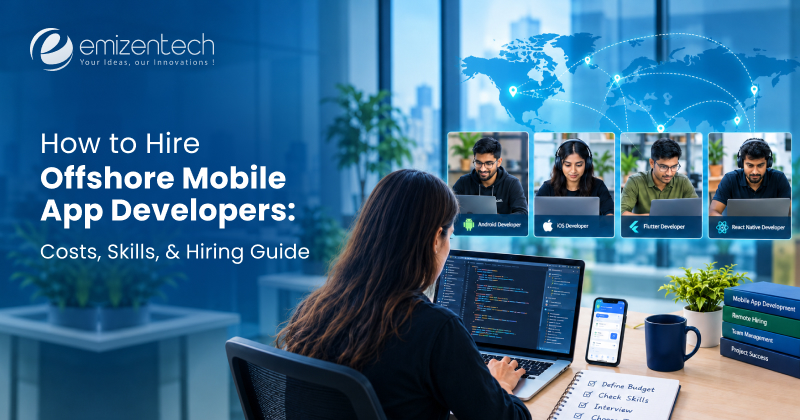
 The global mobile application market is on track to hit $322.6 billion in 2026, according to Grand View Research, and a very small portion of that gets built entirely in-house. Offshore centers already handle close to half of it: an estimated 47% of the world’s IT outsourcing revenue in 2025 went to offshore delivery centers, according to Mordor Intelligence’s latest report on the sector. Hiring offshore mobile app developers stopped being an unusual decision a while back. For most companies building an app right now, this approach is simply the default way they get the work done.
Cost still is an issue. But the bigger issue is skill availability: a founder who can’t find a senior Flutter developer in their own city can usually find five within a week by looking offshore instead. This guide covers what offshore mobile app developers actually do, what hiring one costs in 2026, which skills are worth checking before signing anything, and where offshore projects usually go wrong even when the developer is genuinely good.
Who Are Offshore Mobile App Developers?
Offshore mobile app developers are software professionals based in another country who get hired to develop, test, and maintain a company’s mobile app, usually for less than it would cost to do the same work locally. American, British, and Australian businesses most often work with offshore app developers based in India, Eastern Europe, and parts of Southeast Asia. Before getting into cost or skill, it’s worth being clear on what this role actually looks like day-to-day.
What Does an Offshore App Developer Do?
An offshore app developer does the same basic work as a developer who works in-house: they write code, add features, fix bugs, and test on different devices. On many projects, the role also goes further into UI implementation, API integration, backend setup, and getting the finished app through app store review.
How things are set up around that person is different. Most offshore developers aren’t working solo. They sit inside a team that already has a project manager, a QA tester, and a designer attached to it, which is a big part of what separates hiring an offshore mobile app developer from hiring a freelancer from a marketplace.
Offshore Developer vs Freelance Developer vs Development Company
These three options get lumped together constantly, but they aren’t interchangeable.
| Factor | Offshore Developer | Freelance Developer | Development Company |
| Team structure | Works inside an offshore firm’s team | Works alone | Full team: PM, designers, QA, developers |
| Accountability | Managed by the offshore company | Self-managed | Managed through company processes |
| Best for | Long-term, ongoing app work | Small, one-off tasks | Full app builds from scratch |
| Project management | Usually included | Rarely included | Always included |
| Communication | Structured and scheduled | Informal, ad hoc | Formal reporting and demos |
A freelancer is a good choice for a small task. For anything bigger, something that requires real long-term support, a dedicated offshore development team or a full offshore development company usually holds up better once the project is over.
Why Should Businesses Hire Offshore App Developers?
Cost is the main focus in almost every conversation on this topic, and that’s not entirely wrong. It’s just incomplete. Businesses hire offshore app developers for a number of reasons that have nothing to do with price, and each one solves a different problem.

Access to Global Mobile Development Talent
Local hiring limits a company to whoever’s job searching nearby right now. Go offshore, and the field opens up fast, covering Android, iOS, Flutter, React Native, and specialists. Most local job boards simply don’t have enough to fill a shortlist.
That scale shows up clearly in India’s own numbers. NASSCOM estimated the country’s technology industry at close to $283 billion in FY2025, with about $224 billion of that coming from exports and a workforce of roughly 5.8 million professionals.
That’s why offshore mobile app developers in India and similar markets keep showing up at the top of searches on this topic. The talent consists of specialists, not generalists. It’s built around mobile development specifically, at a scale no single city can match.
Reduce Development Costs
Lower cost of living in most offshore regions means lower hourly rates, and that gap doesn’t automatically mean lower skill. Many businesses hire offshore app developers at a third to half the cost of the same experience level closer to home, without app quality dropping to match.
Over a six-month build, that difference is usually the line between shipping with a marketing budget left over and shipping unfinished.
Scale Your Development Team Faster
Local hiring takes weeks, sometimes months, once you put in job postings, interviews, and notice periods. Offshore development companies skip most of that, since they already keep a bench of vetted developers ready to start within days.
That speed matters most right when a launch date is locked, and someone realizes, three weeks out, that the team needs one more Android developer to fulfill it.
Fill Specialized Skill Gaps
Not every app needs a full-time AR/VR developer or someone who specializes in blockchain integration. Offshore hiring makes that kind of short, specific hire practical in a way a permanent local role usually isn’t.
This scenario is where a majority of companies secretly hire offshore app developers for one specific skill set instead of hiring and finally letting go of a full-time employee for work with a clear end date.
Accelerate Time to Market
Offshore teams working in different time zones can genuinely shorten a build timeline, not only add more tasks to it. A U.S. team that stops at 6 PM can log back on the next morning to actual progress made overnight by an offshore colleague, not a to-do list that looks the same as the day before.
Most companies want a realistic sense of how long each stage of app development actually takes before locking in a budget, and that number shapes the entire offshore hiring timeline from the first phase onward.
Get Long-Term Development Support
An app’s real work starts after launch, not before it. Bug fixes, OS updates, and feature requests keep coming for years, and offshore teams are often structured to handle that ongoing load for less than an in-house hire costs monthly.
Startups especially plan for years of app growth, not a single launch and a walk away, and that’s exactly where ongoing offshore support earns its cost back.
How to Hire Offshore Mobile App Developers? Steps
Understanding why offshore hiring works doesn’t answer the challenging question: what does actually doing it look like, step by step? Here’s the process, in the order it usually plays out.
- Define the app scope and requirements. Features, target platforms (iOS, Android, or both), and a rough timeline: write it all down before contacting anyone. A general brief always gets unclear proposals back.
- Choose an engagement model. Hourly, fixed price, or dedicated team: each one changes both the cost and how much control stays in-house.
- Shortlist offshore companies or developers. Portfolios and client history matter far more than a polished sales page. Reading a few offshore mobile app developer reviews on Clutch or GoodFirms, alongside a look at where to hire mobile app developers directly, usually narrows the list fast.
- Verify technical and communication skills. A short technical interview or a small paid trial task reveals more in two days than a resume does in two pages.
- Check legal and security setup. IP ownership clauses, NDAs, and data protection terms: get these into the contract before a single line of code gets written.
- Start with a smaller pilot project or module. A two- to four-week trial shows real code quality and communication style, with far less risk than committing to the full build-up at the beginning.
- Set up a communication and reporting rhythm. Daily standups, weekly demos, and agreed-on tools: settle these details before the first session starts, not during it.
Offshore Mobile App Development Engagement Models
The model picked at step two above and ends up shaping everything else: cost, communication style, and even how much day-to-day control stays with the business. It’s worth getting the decision right early, since switching models mid-project is more complicated than it seems.

Hourly/Time & Material
Billing follows actual hours worked, which fits projects where requirements are expected to change as development moves forward. Flexible, yes, but it also means someone has to track hours and progress closely enough to catch budget surprises before they turn into a real problem.
Fixed-Price Development
Cost and scope get locked in before work starts, which suits smaller apps with a clear, already-documented feature list. Change something mid-project, and it usually triggers a change order plus extra cost, so this model rewards whoever wrote the original brief carefully.
Dedicated Development Team
A dedicated team works only on one company’s app for a set stretch of time, functioning close to an extended in-house team instead of an outside vendor. This fits long-term products, where developers who actually know the codebase stay valuable longer than a rotating cast of fresh faces would. Some businesses only need one platform covered, which is where it makes sense to hire Android app developers specifically instead of building a full cross-platform team.
Staff Augmentation
Staff augmentation adds individual offshore developers into an existing in-house team to plug specific gaps, like a senior iPhone app developer or a QA engineer, without restructuring the whole team around them. It works best when a company already handles its project management and just needs more developers, not more management.
What Skills Should You Look At Before Hiring Offshore Developers?
The cost and engagement model get decided on paper. Skill mismatch is what actually breaks a project once real work starts, and it usually shows up in one of three places.

Technical Skills
Screening should match the actual platform and framework the app needs: native Android with Kotlin, native iOS with Swift, or something cross-platform like Flutter or React Native. Kotlin specifically carries more weight than most businesses assume going in. Google’s own numbers show over 95% of the top 1,000 Android apps contain Kotlin code, which makes it close to a baseline requirement for Android hiring at this point, not a nice-to-have.
Third-party SDKs are worth asking about too. Apple requires developers to actually understand the data practices of any third-party code included in an app and disclose that accurately, and a developer unfamiliar with that requirement can create App Store approval headaches nobody saw coming. Most of this overlaps with the broader skills a mobile app developer needs regardless of location, though a couple of offshore-specific checks are worth layering on top.
Product Development Skills
Good code isn’t the same thing as a good app. Look for developers who push back with questions about user flow, about performance on lower-end devices, and about app store guidelines, instead of ones who silently build exactly what’s written on the ticket and nothing more.
That kind of pushback is usually the difference between a developer who ships something that works and one who ships something people actually want to keep using.
Communication & Collaboration Skills
Excellent code paired with poor communication is one of the quickest ways to regret hiring an offshore mobile app developer. Check written and spoken English during the trial period, how quickly responses come back, and how clearly technical decisions get explained without turning into jargon.
The same screening questions used to hire any mobile app developer apply here too, offshore or not. Location doesn’t change what effective communication actually looks like.
How Much Does It Cost to Hire Offshore Mobile App Developers in 2026?
In 2026, offshore mobile app developers cost around $18 to $75+ an hour, depending on where they’re based, how senior they are, and which hiring model you pick. A full app build typically lands somewhere between $15,000 for a simple MVP and $250,000+ for an advanced, enterprise-grade product.
Cost by Hiring Model
| Hiring Model | Average 2026 Rate | Best For |
| Freelance developer | $18–$39/hr | Small tasks, single features |
| Offshore development agency | $25–$49/hr+ | Full-cycle app builds |
| Dedicated offshore team | Monthly or resource-based | Long-term products |
| Fixed-price project | Scope-based | Well-defined MVPs |
A freelancer works out cheaper for one specific task. When a project requires UI/UX, backend work, QA, and ongoing support all in one place, an agency or dedicated team quickly recoups its costs.
Cost by Region
| Region | Hourly Range | Why Businesses Pick It |
| India / South Asia | $20–$50/hr | Large talent pool, strong value |
| Southeast Asia | $20–$50/hr | Competitive rates |
| Eastern Europe | $30–$80/hr | Deep engineering expertise |
| Latin America | $30–$75/hr | Time zones close to U.S. hours |
Cost by Experience Level
| Level | Hourly Range |
| Junior | $18–$30/hr |
| Mid-level | $25–$50/hr |
| Senior | $40–$75+/hr |
| Tech lead/architect | $50–$95+/hr |
These are planning numbers, not fixed prices, since specialization and company size shift them either way. For complex builds, the cheapest developer rarely produces the cheapest app. A senior developer avoids the rework, security gaps, and delays that quietly inflate a “budget” hire.
For a full feature-by-feature breakdown instead of hourly averages, the detailed cost guide for hiring an app developer covers exact numbers by app type.
How Offshore App Developers Manage Projects
Nothing of the cost or skill screening matters if day-to-day project management fails once work actually starts. These are the practices that separate offshore teams that deliver on schedule from the ones that quietly slip week after week.
Establish Clear Communication Channels
A single primary channel, usually Slack or Microsoft Teams, should handle daily discussion, with a separate space kept for anything that counts as a real decision, not something hidden in a chat thread nobody can search later.
Set Overlapping U.S. Working Hours
Even two or three overlapping hours a day makes room for live conversation instead of relying only on written updates that lag a full day behind. Many offshore mobile app developers in India adjust part of their schedule specifically to catch U.S. business hours, for exactly this reason.
Use Agile Development
Breaking a big structure into smaller pieces that can be checked along the way works better than one long cycle that ends with a single release and no idea if it’ll work. Small pieces allow the team to catch a mistake early, while it’s still cheap and easy to fix. That’s the whole point.
Set Weekly Sprint Goals
A short weekly checkpoint beats waiting a full month to see what actually got built. It also makes it easy to see quickly if a task is running long, well before that delay slowly eats into the next three sprints.
Conduct Regular Product Demos
A live demo, even a rough five-minute one, shows working features instead of a status report describing them in prose. It also catches usability problems early, while they’re still cheap and fast to fix instead of baked into several more sprints of work.
Maintain Shared Documentation
Requirements, decisions, and design files: all of it belongs in one shared space; both sides can actually search, not scattered across old email threads. This matters even more for offshore teams, since time zone gaps mean that people often ask and answer questions outside of any live conversation.
Use Project Management & Collaboration Tools
The specific tool doesn’t matter much (Jira, Trello, Asana, or something else all work). What matters is keeping tasks, deadlines, and ownership visible to everyone on the project, business side included. Skip a shared tool like this, and it gets easy, fast, for the offshore team and the client to lose track of who actually owns what.
Establish Code Review Standards
Every piece of code should go through review before merging, ideally from a senior developer other than whoever wrote it. NIST’s Secure Software Development Framework backs this up directly, recommending these kinds of checks get built into development from day one instead of bolted on as a final step right before launch.
Track KPIs and Milestones
How much planned work actually gets finished on time, how many bugs pile up, and whether deadlines are being hit: these are simple numbers, but they show clearly how a project is really going. They also make it easier to raise a problem early, instead of finding out about a delay at the worst possible moment.
Common Challenges of Working With Offshore Mobile App Developers
Offshore hiring isn’t always as smooth as it sounds on a company website. These are the challenges that come up most often, along with what actually helps with each one.

Time-Zone Differences
A 10- to 12-hour gap means that people rarely talk to each other in real time. Instead, they send written updates most of the time. When you set even a small daily overlap schedule, as we talked about above, this issue goes away without making everyone work strange hours all the time.
Communication Gaps
Language differences and different communication norms can lead to a feature getting built slightly different from what was actually meant. Clear written requirements, plus a screenshot or short video walkthrough, close that gap better than a phone call alone usually does.
Quality Control
Without anyone reviewing work daily in person, quality problems can go unnoticed until much later in the build. Demos, code reviews, and QA testing built into every sprint, not saved for right before launch, keep quality visible throughout.
Different Development Practices
Offshore teams sometimes follow coding standards or workflows that don’t match what a company’s existing developers already use, leading to difficulties once both teams share a codebase. Agreeing on coding guidelines and documentation formats before development starts heads off most of this before it becomes a problem.
Data Security Concerns
Sensitive user data and business logic pass through offshore hands at some point, and asking tough questions about that is fair, not suspicious. Any offshore development partner should be able to speak clearly about its information security practices and ideally show alignment with a recognized framework like ISO/IEC 27001, which sets requirements for managing information security risk and protecting data confidentiality, integrity, and availability.
Intellectual Property Protection
App ideas, source code, and business logic: all of it counts as intellectual property, and offshore work adds a layer of risk if the contract isn’t specific about who owns what. The World Intellectual Property Organization notes that trade secret protection largely depends on taking reasonable steps to keep information confidential, which in practice means signed confidentiality agreements with every development partner and individual developer on the project.
Scope Creep
New feature requests show up constantly mid-project, and without a clear change process, they quietly stretch both the timeline and the budget. A documented change request process, settled before development starts, keeps every scope change visible and priced instead of silently absorbed into someone’s overtime.
Project Visibility
No daily in-person visibility makes it easy to lose a clear sense of how much progress has actually happened. Shared dashboards, sprint reports, and the scheduled demos we covered earlier restore that visibility without requiring constant check-in calls.
Why Hire Offshore App Developers from EmizenTech?
Anyone can promise quality talent at competitive rates. The real test comes six months into the project, once the early progress settles down and the daily work begins. Here’s what that looks like with EmizenTech.
Experienced Offshore Mobile App Development Team
Twelve years in mobile development means the team has already made most of the common mistakes on many projects. They’ve built Android apps and iOS apps for eCommerce stores, healthcare platforms, fintech products, and on-demand services. So when a new client arrives with a payments difficulty or a healthcare compliance question, it’s likely not the first time we’ve seen it.
End-to-End Mobile App Development Expertise
Design, development, backend work, QA, deployment, and maintenance: one team handles all of it. That’s the full scope of mobile app development, not just the coding part most people picture. It sounds like a small thing until you consider the alternative: dealing with three vendors who each blame the others when something goes wrong. One point of contact, start to finish, is worth more than it sounds on paper.
Dedicated Offshore Mobile App Developers
Pick individual developers or a full team, built around what the project actually needs: iOS, Android, Flutter, React Native, backend, design, or QA. The people stay on the project too. For an app meant to last years, not months, that matters. A team that stays with the project knows the code well. A team that keeps changing has to relearn it every few cycles.
Flexible Engagement Models
Some projects need one developer for a few weeks. Others need a full team for two years. EmizenTech works as an hourly, part-time, dedicated developer, dedicated team, or full offshore development center, whichever actually fits your needs instead of whichever is easiest to sell.
Experience Working With Global Businesses
EmizenTech works with startups, small businesses, and enterprises across different industries and countries. Remote collaboration isn’t something set up specifically for one client. It’s how the team works every day. That matters if the goal is getting mobile expertise without building and managing an in-house team from scratch.
Transparent Communication & Project Management
Jira tracks tasks, Slack handles daily conversation, and GitHub holds the code. A roadmap with real milestones connects it all. Everyone can see where the project actually stands; no need to take a status update on trust.
Security & Intellectual Property Protection
NDAs and IP terms are standard in every dedicated engagement, not an extra. Still, read the actual agreement before signing. Confidentiality and ownership terms should be specific to the project, not a generic clause copied from a template.
Post-Launch Support & Maintenance
Shipping the app isn’t the finish line, even though it can feel that way after months of work. Bugs still show up. Operating systems still update. Users still ask for one more feature. Emizentech stays on for exactly that, so the app keeps getting better instead of slowly falling behind.
Final Takeaway
Offshore mobile app developers give businesses a genuinely practical way to build a full app without the cost or hiring timeline of a local team. The real work is in picking the right engagement model, actually checking skill and communication ability before signing anything, and setting up clear project management from day one, not after the first missed deadline.
Get that part right, and hiring offshore mobile app developers stops being a one-time transaction and turns into a long-term development partnership instead, built around the practices covered throughout this guide.
FAQs
How do I hire offshore mobile app developers?
Start by defining the app's scope, select an engagement model (hourly, fixed price, or dedicated team), shortlist a few companies with genuinely relevant portfolios, and run a small paid trial before committing to the full project. The step-by-step process above covers each stage in more depth.
Where can I find the best offshore mobile app developers?
Most of the time, independent review sites like Clutch and GoodFirms are the best way to find the best offshore mobile app developers. This is because these sites show real client feedback instead of what a company says on its marketing page.
Is India a good choice for offshore mobile app development?
India remains one of the largest offshore mobile app development hubs in the world, with lower hourly rates than the U.S. or Western Europe and no real drop in technical skill for most standard app builds. The scale of India's tech workforce, covered earlier, is a big part of why that reputation holds up beyond cost alone.
How do I verify offshore developer reviews?
Read reviews on third-party platforms instead of testimonials handpicked for a company's own website, and watch for ones that mention actual project details, not vague five-star praise with nothing else behind it. Cross-checking a handful of offshore mobile app developers reviews across two or three platforms usually shows if the pattern holds up or falls apart.
What is the difference between offshore developers and freelancers?
Offshore developers work inside a company structure that already includes project management, QA, and backup coverage if someone leaves mid-project. Freelancers work solo, which can mean a lower cost for something small but real risk once the project gets bigger or takes longer than expected. Choosing to hire an offshore mobile app developer directly instead of a freelancer usually depends on project size and how long the app will need support after it ships.
How do U.S. companies manage offshore mobile developers?
Most manage it through daily or weekly overlapping working hours, shared project management tools, regular demos, and documentation that actually gets updated, instead of relying on email as the single source of truth.
How can I protect my intellectual property when hiring offshore developers?
Get NDAs signed, put clear IP ownership language directly in the contract, and limit system access to a need-to-know basis from day one. These three steps cover most of the real risk, and they're worth confirming before any code gets written, not after.



 +1 (989) 535-9295
 info@emizentech.com
 emizentech


