
 Add us as a preferred source on Google
Putting everything with one vendor feels fine right up until it doesn’t. They have a rough quarter, lose their best engineers, or quietly double the renewal price, and suddenly you realize how little leverage you had. That’s the situation multisourcing is meant to fix. You give different parts of the work to different providers and pick the best one for each piece, instead of settling for one company.
More contracts, more handoffs, and plenty of chances for two vendors to blame each other when something breaks between them. Consider this blog your guide to multisourcing versus single- and sole-sourcing: why companies go this route, where it tends to go wrong, and how to run it without watching your savings disappear into management time.
What is Multisourcing?
Here’s the multisourcing definition.
Multisourcing is when a company contracts several vendors, often alongside its own internal team, to deliver the services or goods it needs. No single provider owns the whole process; each one gets a defined slice. In IT, it might be cloud hosting, app development, and cybersecurity.
In business process outsourcing, it could be a support desk, bookkeeping, and compliance checks. In manufacturing, it usually means buying the same part from more than one supplier so a single factory fire doesn’t shut down your line.
For instance, a retailer keeps product strategy in-house. It hires one agency to build the mobile app, a second firm to handle payments, and a third team to answer customers in several languages. Everyone has a lane; the retailer decides how the lanes connect. Carmakers have done something like this for decades, buying engines, electronics, and interiors from different suppliers rather than trusting one company with everything. There are two ways to do it:
Client-Integrator
This is the do-it-yourself version: you sign separate contracts with each vendor, and your team sits in the middle. If the designers need something from the developers, that request comes through you. You set the schedule, you referee when two vendors disagree, and you’re the one stitching everything together at the end.
Prime Contractor
You get one contact and one party on the hook for the result. When two subcontractors are fighting, that’s the prime’s headache, not yours. It saves your team a ton of effort, which is the whole appeal. But you’re trusting the prime a lot. They choose the subcontractors, so you have less say in who does the work and less visibility into how it’s actually going.
How do you choose
Two questions: do you have people who can really run this, and how much do you care about picking who does the work? Strong team and you want control, go client-integrator. Thin team, or you just want one throat to choke, go prime. And if you go prime, get the details in writing: what they’re responsible for, how subcontractors get approved, and how much you get to see. If you’re new to the idea, here’s a guide on what is outsourcing and how it works.
Multisourcing vs. Single Sourcing vs. Sole Sourcing
The question that arises is how many suppliers you rely on for the same thing, because that determines how exposed you are if one of them lets you down. Single sourcing is when you choose one supplier on purpose, even though plenty of others could do the job. Sole sourcing is different: only one supplier can do it, so the choice is made for you.
Sole Sourcing
It means only one supplier can provide what you need. There’s no alternative, often because of patented technology or very specialized manufacturing. The classic case is advanced semiconductors, where a handful of huge buyers rely on essentially one foundry because nobody else can make a comparable chip. You don’t pick sole sourcing. The market picks it for you.
Single Sourcing
You could use several suppliers, but you go with one because it’s simpler, the pricing is stable, and the relationship is close. Plenty of companies swear by it, and honestly, for standard, stable needs it’s often the sensible call. The catch is that anything that goes wrong at that supplier lands on you.
Multisourcing
You spread the work over several suppliers, either by giving each a different piece or by letting them go head to head on the same job. If one of them has a rough year, folds, or just gets lazy, you’ve got others to fall back on. Suppliers know the work can walk out the door, so they tend to keep prices sensible and stay sharp.
Let’s understand this with a carefully curated comparison table.
| Key Aspects | Sole Sourcing | Single Sourcing | Multisourcing |
| Vendors | One, no choice | One, by choice | Several, by design |
| Who decides | The market | The buyer | The buyer |
| Pros | Access to something unique | Simplicity | Resilience and leverage |
| Cons | No fallback, weak bargaining power | Concentrated risk | More coordination |
| Suitable for | Specialized, hard-to-replace items | Standard, stable needs | Work that splits into clean pieces |
Why Companies Choose Multisourcing?
Companies are multisourcing because no single vendor is good at everything. Spreading the work means better prices, less risk if one partner falls over, and room to swap people out. It’s messier to manage, but teams find the control worth it.
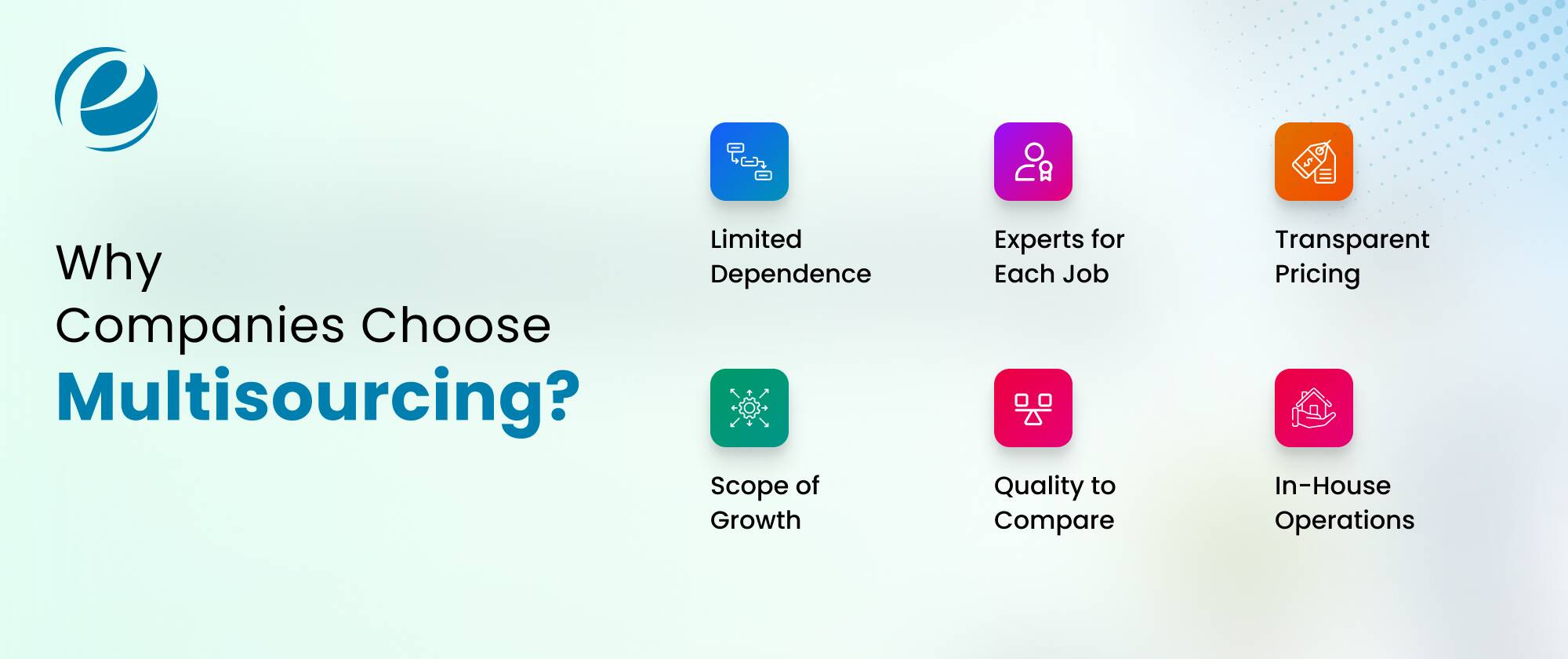
Limited Dependence
If a provider has an outage, loses key people, runs into money trouble, or simply walks away, the rest of your operation keeps going. You’ve removed the single point of failure. Finance and risk teams increasingly treat this as part of enterprise risk management, not just a purchasing preference.
Experts for Each Job
No vendor is brilliant at everything; a firm that’s superb at cloud infrastructure might be mediocre at design. A great support provider might know nothing about security. Splitting the work means you can choose the strongest partner for each piece rather than settling for an average result across the board. That’s especially useful for niche areas like AI and ML consulting, where a specialist will usually outperform a generalist vendor.
Transparent Pricing
When vendors know you can compare them, they tend to behave. You can collect quotes, benchmark delivery, and shift work toward whoever’s doing best. Over time, you also learn what a fair rate and a decent quality bar actually look like, which is worth a lot at renewal time.
Scope of Growth
Need extra hands for a seasonal rush? Bring in another provider for a defined chunk of work. Someone underperforming? Swap them out without rebuilding everything. Many providers will even do a small pilot first, so you’re not signing a long contract blind.
Quality to Compare
You can measure different vendors against the same standard; weak spots show up fast. Vendors also know good results can win them more work, so they have a reason to keep improving.
In-House Operations
Same as ordinary outsourcing: handing off the non-core stuff frees your staff to work on what actually makes your business different. A sensible multi-sourcing strategy keeps the strategic work in-house and sends the rest elsewhere. Another multisourcing example: a bank might use one vendor for compliance, one for security, and a third for customer-facing software. However, businesses should understand In-House vs. Outsourced Development: what’s best for them.
Common Challenges of a Multi sourcing Strategy?
Multisourcing isn’t a free upgrade. Every vendor you add means another contract, another set of handoffs, and another person to keep happy. It helps to understand a few challenges you might run into. These are the problems teams run into most, and they often overlap with the broader risks of IT outsourcing and how to avoid them.
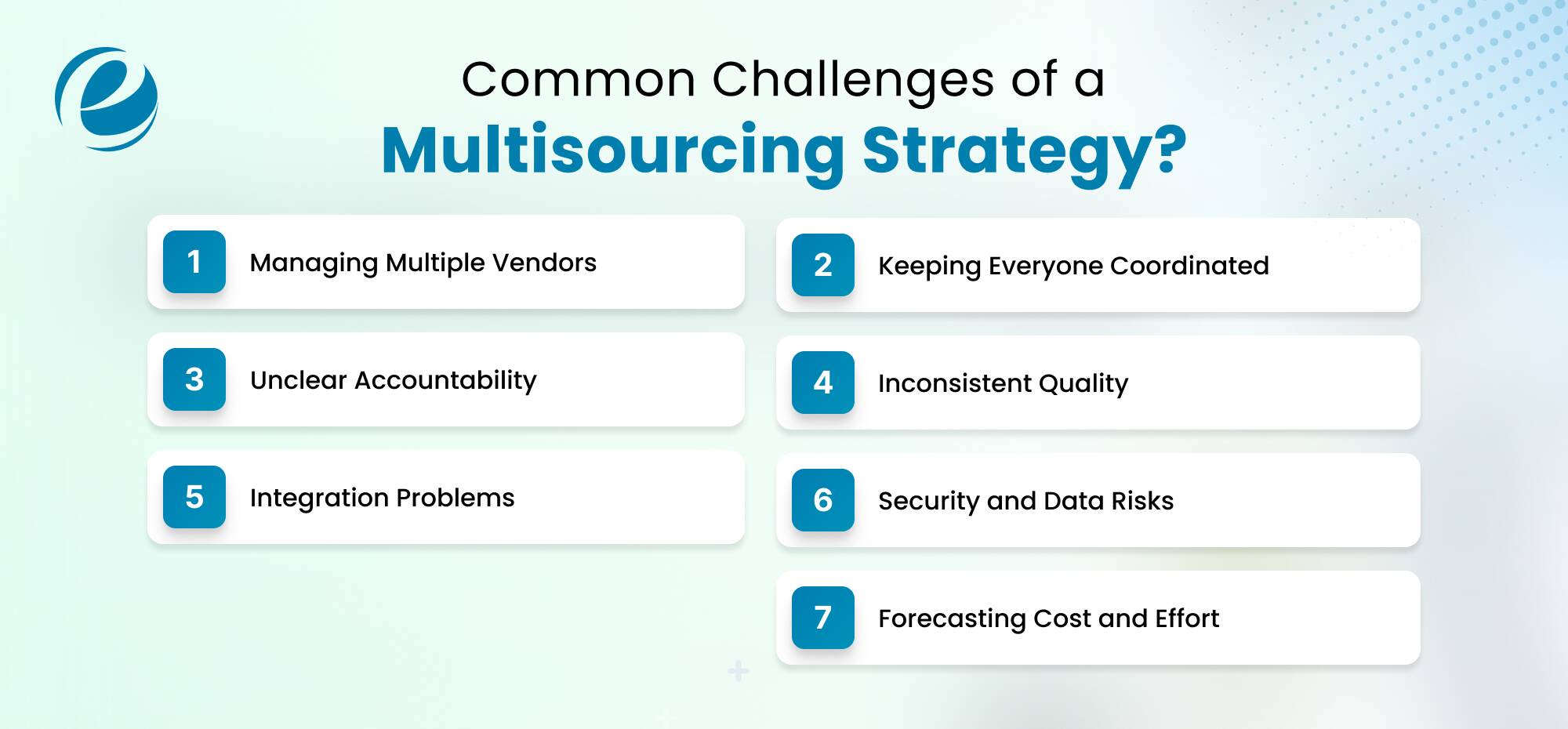
Managing Multiple Vendors
Somebody has to run the contracts, hold the review meetings, track service levels, and settle disputes across all those vendors. A team that was comfortable with one relationship gets stretched thin quickly. Some companies end up hiring extra staff or consultants just to keep up, which eats into the savings.
Keeping Everyone Coordinated
When different vendors build or run different parts of one product, those parts have to connect. Different tools, standards, and habits cause delays and rework. If the back-end and front-end teams assume different things about the same interface, you can lose weeks.
Unclear Accountability
Without a shared structure, vendors work in silos. When something breaks at the point where two providers meet, each can reasonably point at the other. This is where a lot of multi-vendor setups quietly fall apart. Nobody owns the end-to-end result, so nobody fixes it fast.
Inconsistent Quality
Different vendors have different standards, tools, and habits. Keeping quality consistent takes clear metrics, regular checks, and the willingness to speak up when a provider slips. That is why many teams also bring in independent software testing and QA services, so every vendor’s output is checked against the same bar.
Integration Problems
Suppliers who know you’re also working with others may feel less invested in you. They might prioritize their exclusive clients, share less information, or put less effort into understanding your business. Building a real partnership with one vendor is hard enough. Doing it with four is harder.
Security and Data Risks
Splitting work across providers can mean you no longer dictate every platform or tool used in delivery. It also means more people with access to your systems and data, which raises the security and compliance stakes.
Forecasting Cost and Effort
With three or four partners, interdependencies make estimates shakier. And savings from competitive pricing can vanish into management time if nobody tracks total cost. That doesn’t mean you should avoid it. It just means multisourcing needs deliberate management, which brings us to the next section.
How to Successfully Manage a Multi sourcing Strategy?
After the challenges, the next step is to understand what a successful multi sourcing strategy looks like. Companies that get steady results treat it as one connected system they’ve designed, not a pile of separate contracts. Here’s the approach that tends to work.
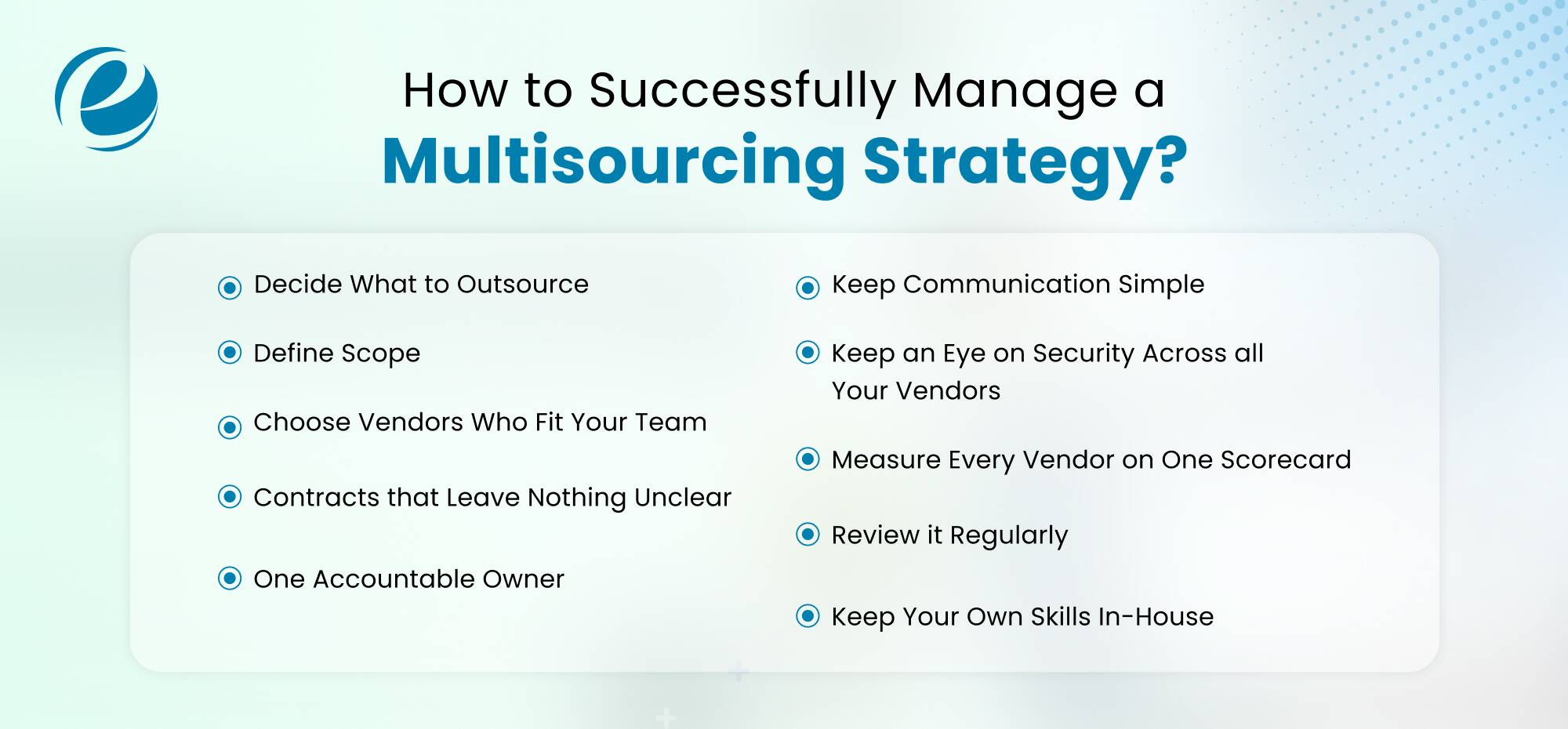
Decide What to Outsource
Sort your work into what can stand alone and what can’t. Self-contained tasks with clear inputs and outputs, like a support queue, monthly bookkeeping, or an independent app module, suit a multi-sourcing strategy well. Tightly connected work usually runs better when you hire dedicated developers or one dedicated team, because there are no handoffs to fail.
Define Scope
Write down what each vendor owns, what it has to deliver, and exactly where its work stops and the next vendor’s starts. Tie every scope to a business goal. Fuzzy boundaries between two vendors are where most problems begin, so spend real time here. It’s boring work. Do it anyway.
Choose Vendors Who Fit Your Team
Look at technical ability, financial health, track record, and references. Location matters too, since time zones, cost, and communication habits differ between onshore and offshore software development. Then add the criterion people forget: will this vendor work well next to the others? Providers with compatible working cultures cooperate more easily. A small pilot project is an affordable way to find out before you sign anything long.
Contracts that Leave Nothing Unclear
Contracts and service level agreements should make clear who’s responsible when something fails at a handoff. Line up the reporting duties, data-handling terms, and security obligations across every agreement. Include a requirement to share data in formats the other vendors can use, and put in exit clauses so one vendor leaving doesn’t leave you stranded.
One Accountable Owner
If you do only one thing from this list, do this. Somebody needs to own end-to-end service levels. That role, often called a service integrator, can sit with an internal vendor management office, with a lead provider, or with a specialist service integration and management (SIAM) function. Tell every vendor the rules for raising and resolving issues so nobody has to guess.
Keep Communication Simple
Vendors shouldn’t have to wonder what the others are doing. Give everyone the same tools, documentation standards, and regular joint meetings. The best setups have partners check and test each other’s work instead of guarding their territory. Iterative methods like agile help, because they force frequent check-ins.
Keep an Eye on Security Across All Your Vendors
More vendors means more doors into your systems. Use role-based access so each partner sees only what it needs, put common security standards into contracts, and monitor compliance all year, not once at renewal.
Measure Every Vendor on One Scorecard
Measure each vendor against agreed service levels, using the same reporting format for all of them. A balanced scorecard covering cost, quality, delivery times, new ideas, and user satisfaction keeps comparisons fair. Useful numbers include cost per unit of work (counting your own management time), how often each vendor hits its targets, and how often work passes between vendors without rework.
Review it Regularly
Look at your vendor mix on a schedule, and again whenever the business changes. Add, replace, or merge vendors based on what you see. A multisourcing setup that never changes has usually stopped fitting the business.
Keep Your Own Skills In-House
Running several vendors needs negotiation, risk management, and clear communication. Most small teams lack some of that, so hire a vendor manager or give the integrator role to a trusted lead provider.
How EmizenTech Can Be Part of Your Multi sourcing Strategy?
Multisourcing rewards companies that know which work to split and who to trust with each piece. If software development or technical delivery is one of your slices, EmizenTech can be one of the specialist partners for outsourcing software development in that mix.
In any workable multi sourcing strategy, each vendor needs a clear role, predictable communication, and a willingness to work with other providers. EmizenTech fits as a focused development partner rather than a vendor trying to own everything. In practice, that looks like:
- Clearly scoped work: defined deliverables, timelines, and handoff points that fit into your wider vendor setup
- Open reporting: shared tools and regular updates so your other providers and internal team always know where things stand
- Flexible team size: the ability to grow or shrink a team as your project changes, which reflects how multisourcing works in real life
- Experience with integration: work built to connect with systems and teams that other parties manage
Final Verdict
To sum this up, multisourcing changes how you think about vendors. You spread the risk, tap specialists, keep pricing competitive, and leave yourself room to adjust. The price is more coordination and a real need for governance. There’s no way around that. The companies that make it work do a few things consistently. They split only what can stand alone, draw the scope and handoffs sharply, choose vendors who can cooperate, and name one owner for the end result.
Then they measure everything against shared standards and revisit the arrangement periodically. If your operations face single-vendor risk, or your needs are too varied for any one provider, a well-planned multi-sourcing strategy deserves a serious look. Our advice is to start small. Two or three partners, clear boundaries, and grow only when your governance can handle it.
Frequently Asked Questions
What is the difference between multisourcing and single sourcing?
Single sourcing means choosing one supplier or vendor for a product or service, even though others are available. Multisourcing means using several, either for the same need or for different parts of one service. Single sourcing is easier to manage but puts all your risk in one place.
Is multisourcing cheaper than full outsourcing?
Competitive pricing and fewer disruptions can lower costs, and you can buy each service from whoever offers the best value. But coordination, contract management, and reporting all grow with every vendor you add. The fair comparison is total cost, including your own management time, not just vendor fees.
What are the main risks of multisourcing?
Management overhead, integration problems between vendors, unclear accountability when something fails at a handoff, uneven quality, weaker vendor loyalty, and a bigger security footprint. Most of these trace back to weak governance. Clear scopes, aligned contracts, and one owner for end-to-end service levels cut most of them down.
Is multisourcing a good idea for my business?
It depends on your work and your capacity. It suits organizations whose work splits into clear modules, who need a range of expertise, and who can't afford to depend on one provider. It's harder for small teams with continuous, tightly connected work and little time to manage vendors.
How do you manage communication between multiple outsourcing vendors?
Set up shared infrastructure first: common project tools, documentation standards, and one reporting format. Hold regular joint meetings so every vendor hears the priorities at the same time, and agree on escalation paths for cross-boundary issues. Write communication and data-sharing duties into each contract, and name one person or function responsible for end-to-end coordination.




 +1 (989) 535-9295
 info@emizentech.com
 emizentech


