 Add us as a preferred source on Google
Nobody wants ten browser tabs open just to plan one holiday. Travel businesses, in particular, are tired of answering the same inquiries by hand day after day.
According to Grand View Research, the online travel agency market is expected to reach about $1,316.8B, growing at a 9.0% CAGR from 2026 to 2033.
As demand grows, travel portal development is shifting from simple booking engines to agentic AI: software that plans, books, changes, and supports a trip on its own, within limits you define.
In this guide, we go through portal types, the problems AI actually solves, features, architecture, process, and cost. If you’re weighing a consumer marketplace or looking at B2B travel portal development for agents and suppliers, you should leave with a workable plan and a list of questions to ask any travel app development company or travel portal software development company before signing.
Types of Travel Portals Businesses Can Develop
Travel portals fall into several categories, each serving a different audience. The table below summarizes each type with a short description to help you decide which best fits your business requirements.
| Portal Type | Primary Users | Revenue Model | Best for |
| B2C | Individual travelers | Markups, commissions, fees | Startups and consumer brands |
| B2B | Agents, tour operators | Net-rate margins, subscriptions | Wholesalers and consolidators |
| B2B2C | Agents and travelers | Commissions, markups, and subscriptions | Established agencies expanding reach |
| Corporate | Employees, travel managers | Service fees | Business travel specialists |
1. B2C Travel Portals (Business-to-Consumer)
A B2C travel portal is an online platform that directly serves end consumers. It is an online travel platform where travelers can search, compare, and book travel services at their convenience. Some popular B2C travel portals widely used by users include MakeMyTrip, Expedia, and Booking.com.
2. B2B Travel Portals (Business-to-Business)
A B2B (Business-to-Business) travel portal facilitates transactions between travel businesses. It’s an online platform where travel businesses sell products and services to each other rather than to end customers. These include travel agents and sub-agents, tour operators and wholesalers, destination management companies (DMCs), and airline consolidators.
3. B2B2C Travel Portal
A B2B2C travel portal, also called a business-to-business-to-consumer portal, connects travel suppliers, resellers, and customers. B2B2C travel marketplace is an e-commerce platform that connects all concerned parties to trade travel products and services. It allows real-time bookings and reservations for hotels, buses, and flights via integrated supplier APIs.
The main task of travel booking software is to automate and streamline key processes in the travel industry supply chain. Building a B2B2C travel portal is also a promising app development idea for the travel industry, helping businesses connect suppliers, resellers, and end customers through a unified booking platform.
4. Corporate Travel Portal
A corporate travel portal is a web-based platform designed for corporate and business travel. It meets the needs of organizations, employees, administrators, travel managers, and finance teams. Employees can search and book travel services under company policies, and administrators can manage traveler profiles, budget approvals, suppliers, and reporting.
A corporate travel portal is more than just a booking interface; it also needs to integrate travel inventory, business rules, payment systems, reporting tools, and user management and administration.
What Problems Do Travelers and Travel Businesses Face, and How Does AI Solve Them?
Traditional portals leave the hard work with people on both sides of the screen. Travelers jump between sites to compare flights, hotels and activities, struggle with fare rules, and wait for help when plans change. Businesses spend hours on manual quotes, support queues across time zones and cancellation paperwork, and they lose margin when replies are slow. An AI agent takes over the repetitive, rules-based steps and hands the rest to a person.
How Does AI Automate the Entire Travel Journey?
The right AI agent works at every stage of the trip, not just at checkout.
- Inspiration: A chat-style search turns your travel vision into a shortlist of destinations and budgets
- Planning: The AI agent drafts a day-by-day itinerary from live availability and what the traveler likes
- Booking: Everything from flights and stays to activities gets booked in one flow
- Before the trip: The agent processes documents and sends check-in reminders, visa notes, and weather alerts.
- During the trip: Monitors flight delays, suggests alternatives, and answers questions by chat or voice
- Afterward: Gathers feedback, sends loyalty offers, and suggests the next trip
How Does an AI Agent Book a Trip End to End?
Behind one request, a well-built AI agent runs the same loop each time:
- Understand the request: Pull out dates, budget, and preferences, and ask a question only if something important is missing
- Search suppliers: Connect with hotel and activity APIs in parallel for live prices and availability
- Rank and assemble: Score the options against the traveler’s constraints and combine them into a few sensible itineraries
- Get approval: Show the options with a clear price breakdown and wait for approval
- Lock and pay: Hold the inventory, take payment through a tokenized gateway, and issue the booking
- Deliver and record: Send tickets and vouchers, then write everything to the CRM and back office
How Does AI Handle Refunds, Cancellations, and Rebooking Automatically?
Cancellations eat up support time on most portals. With an AI agent, the system reads the booking, checks the fare rules and supplier policy, calculates the refund or penalty, and explains it in simple terms. If the traveler agrees, it calls the supplier’s cancellation API and initiates the refund to the original payment method.
When an airline cancels or delays a flight, it can search for replacements, check them against the original constraints, and rebook within limits you’ve approved. Odd cases, like disputed charges or non-refundable exceptions, go to a human with a full summary so the customer doesn’t have to explain everything again.
What are the Key Features to Include in a Travel Agency Website?
AI works best on a solid base. Whether you’re building a consumer site or a B2B portal, make sure these are covered:
- Fast search with filters for price, dates, ratings, and location
- Real-time inventory and pricing from connected suppliers
- Secure multi-currency payments and saved payment methods
- User accounts with booking history, itineraries and e-tickets
- Mobile-responsive design with a clean, short checkout
- Reviews, ratings and rich destination content
- A CMS for deals, banners and SEO pages
- An admin dashboard with reports, commissions and supplier management
- For B2B: agent wallets, markup rules, sub-agent roles and credit limits
How Does AI Chat and Voice Support Work in a Travel Portal?
The language model is only the front door. What makes it useful is access to your data and tools. It pulls booking details, policies, and FAQs through retrieval-augmented generation, and uses function calling to do real things such as changing a date or sending an invoice.
For voice, speech-to-text captures the request, the same agent logic answers, and text-to-speech reads the reply back. Multilingual support is easier to add, which helps if you serve travelers in several regions. Keep a clean handoff to a human, with the conversation attached, for sensitive or complicated cases.

AI-Powered Features to Integrate Into a Modern Travel Portal
Integrating AI-powered features into a travel portal is no longer just about improving the user experience; it’s about making travel operations faster, smarter, and more efficient. Let’s explore the latest features transforming travel portal software development:
| Feature | What It Does | Business Value |
| Agentic trip planner | Builds and books itineraries from a plain-language goal | Higher conversion, less manual quoting |
| Conversational search | Understands queries like “beach trip under budget plces to visit in March” | Lower search abandonment |
| Dynamic packaging | Bundles flights, hotels, and activities in real time | Better margins, larger basket size |
| Personalized recommendations | Ranks options by past behavior and preferences | Repeat bookings, upsell |
| Smart pricing and markups | Adjusts agent markups and offers by demand and margin rules | Protected margins |
| Disruption handling | Detects delays and cancellations, then rebooks | Fewer support tickets |
| Fraud detection | Flags suspicious bookings and payment patterns | Fewer chargebacks |
| Review and feedback analysis | Summarizes reviews and sentiment by property or route | Better supplier decisions |
What Does the Engineering Behind an Agentic Travel Portal Look Like?
Think of an agentic portal as an ordinary booking platform with an AI layer on top. The agent never talks to suppliers directly. It calls a small set of tools (search, price, book, cancel, refund, notify) that wrap your booking engine and supplier APIs, so every action is checked, logged, and can be reversed where supported by the supplier.
| Layer | Typical Technologies | Role |
| Frontend | React or Next.js, React Native or Flutter | Web and mobile experience, chat and voice UI |
| Backend | Node.js, Python (FastAPI), Java | Booking engine, business rules, APIs |
| Data | PostgreSQL, Redis, Elasticsearch or OpenSearch | Bookings, caching, fast search |
| AI layer | LLMs with function calling, vector database for retrieval, orchestration and guardrails | Planning, tool use, support, personalization |
| Integrations | GDS such as Amadeus, Sabre, Travelport; hotel and activity APIs; payment gateways; WhatsApp and email | Inventory, payments, communication |
| Infrastructure | AWS, GCP or Azure, Docker, Kubernetes, CI/CD | Scaling, monitoring, security |
How can I Choose the Best Platform for Building a Travel Website?
You have three realistic routes, and the right one depends on how much control and differentiation you need.
| Approach | Best For | Trade-Off |
| Ready-made SaaS or white-label platform | Fast launch, small budgets | Limited customization, recurring fees, shared roadmap |
| Open-source or template-based build | Standard B2C sites with light tweaks | Heavy rework for B2B logic and AI agents |
| Custom travel portal software development | Unique workflows, B2B rules, agentic AI, long-term ownership | Higher upfront cost and longer timeline |
If AI automation and B2B workflows are central to your model, custom usually pays off. Off-the-shelf platforms may limit customization of the booking logic an agent needs to execute travel-related tasks.
How to Build an AI-Powered Travel Portal: Development Process
A clear process keeps online travel portal development on budget and gives AI features time to be properly tested. A typical path looks like this:
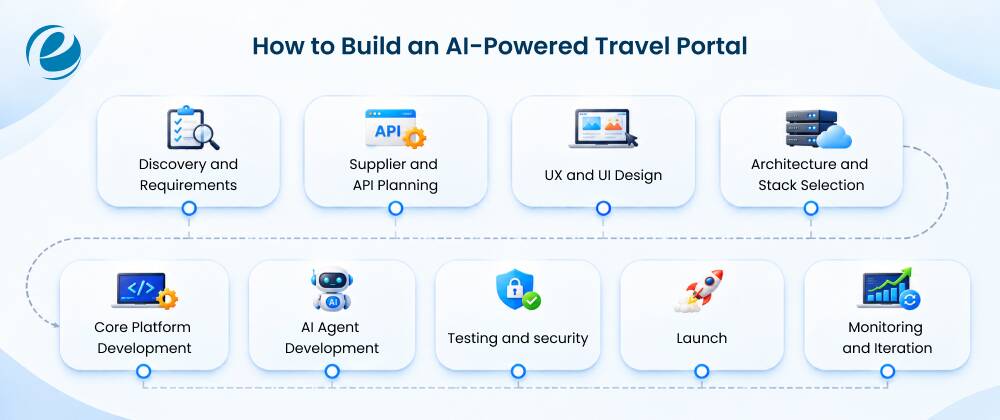
- Discovery and requirements: Define the business model, target users, portal type (B2B, B2C, or both), verticals, and success metrics
- Supplier and API planning: Shortlist GDS, hotel, activity, and payment providers, and confirm commercial terms and API access early, since approvals can take weeks
- UX and UI design: Map the booking journey, agent workflows and chat or voice entry points, then validate with clickable prototypes
- Architecture and stack selection: Decide on the services, data model, hosting, and AI approach
- Core platform development: Build search, booking engine, payments, user and agent accounts, and the admin panel in iterative sprints
- AI agent development: Define the agent’s tools and permissions, connect retrieval over policies and bookings, then test with realistic scenarios and edge cases
- Testing and security: Functional, load, and security testing, payment compliance checks, and agent evaluation for accuracy and safe behavior
- Launch: Release in stages, starting with a pilot group of agents or customers
- Monitoring and iteration: Track conversion, agent success rate, and support deflection, then refine prompts, rules, and features from real usage
How Much Does It Cost to Build a Travel Portal?
Overall travel portal development cost depends on the variety of requirements and the complexity of the features you need. Consider the table below, which shows general ranges:
| Travel Portal | Cost Range |
| Basic Travel Portal | $10,000 – $30,000 USD |
| Mid-Range Travel Portal with More Features | $30,000 – $100,000 USD |
| Complex Travel Portal with Extensive Functionality | $100,000+ USD |
Read More: Travel App Development Cost
Why Choose Emizentech for Custom Travel Portal Development?
Emizentech is a travel portal software development company that builds custom platforms around your business model, rather than squeezing it into a template. We cover the whole cycle: discovery, UX design, frontend and backend engineering, supplier API integration, AI agent development, testing, and support after launch. That makes us one partner for both B2C marketplaces and B2B portals for agents, DMCs, and tour operators.
As a travel portal development company with in-house AI engineering, we design agentic features with guardrails from day one: tool-based booking flows, approval limits, audit trails, and measurable evaluation. We also build in phases, so you can launch an MVP fast and add automation as real usage data comes in. Our travel portal development services include:
- Custom software development services for B2C and B2B portals
- GDS, hotel, activity, and payment API integration
- AI chat and voice assistants, agentic booking and rebooking
- Mobile apps for iOS and Android
- Cloud deployment, security hardening and ongoing maintenance
Conclusion
Agentic AI turns a travel portal from a place people search into a system that plans, books, and manages the trip. Getting there takes solid basics: the right portal type, reliable supplier integrations, a clean architecture, and agents with clear tools and guardrails. Start with a focused MVP, prove value in one workflow, then expand.
Planning a B2C marketplace, or looking for a B2B travel portal development company to build a full agent platform with agentic automation? Talk to the Emizentech team. We’ll help you scope the build, estimate cost and timeline, and get from idea to live portal.
Frequently Asked Questions
What is an agentic AI travel portal?
An agentic AI travel portal is an AI-based travel booking platform that plans, books, and supports a trip on its own. Unlike a standard booking engine that only shows options, an agentic AI completes tasks such as building itineraries, rebooking after delays, and handling cancellations.
How does an AI agent book a trip end to end?
An AI agent extracts all the relevant information for the trip, like dates, budgets, and preferences, then searches supplier APIs in parallel for availability and live prices. Then it ranks the options, shows a clear price breakdown, and waits for approval. The last step is to hold the inventory, take tokenized payments, send tickets and vouchers, and record everything in the CRM.
Can AI handle cancellations, refunds, and rebooking automatically?
Yes, AI can automatically manage cancellations, refunds, and rebooking.
What types of travel portals can a business develop?
There are four types of travel portals a business can develop, which are as follows:
- B2C
- B2B
- B2B2C
- Corporate portals
The right choice depends on your audience and revenue model.
Which AI features add the most value to a travel portal?
The AI features that add the most value to a travel portal are as follows:
- Agentic trip planner
- Conversational search
- Personalized recommendations
- Dynamic packaging
- Smart pricing and markups
- Disruption handling
- Fraud detection
- Review and feedback analysis
What technology stack is used to build an agentic AI travel portal?
A typical stack uses React or Next.js on the frontend and Node.js, Python, or Java on the backend. Data is held in PostgreSQL, Redis, and Elasticsearch. The AI layer uses LLMs with function calling and a vector database. Integrations include GDS providers such as Amadeus, Sabre, and Travelport, and hosting runs on AWS, GCP, or Azure.
How do you keep an AI booking agent safe and reliable?
Set spending caps, require confirmation before payment, and apply rate limits. Log every tool call in an audit trail, and run evaluation tests before launch. High-value or unusual bookings should get human sign-off. The agent should only act through defined tools, never directly on supplier systems.
Should I use a white-label platform, open-source template, or custom development?
- White-label platform: Suitable for fast launches and small budgets but offers limited customization
- Open source templates: Ideal for standard B2C sites
- Custom development: Best when you need to implement B2B rules, agentic AI, and long-term ownership
How much does it cost to build a travel portal?
A basic portal costs roughly $10,000 to $30,000. A mid-range portal with more features costs $30,000 to $100,000. A complex portal with extensive functionality starts at $100,000 and above. The final cost depends on feature complexity, supplier integrations, and the depth of AI automation.
Which APIs are commonly used in travel portal development?
Amadeus, Sabre, and Travelport are some of the most commonly used APIs in travel portal development.
How long does it take to build a travel portal?
A focused MVP usually takes 3-4 months. A mid-scale portal with a B2B module takes 5-8 months, and an enterprise platform with agentic AI can run 8-12 months or longer. What moves the number most: how many supplier integrations you need, how much AI you want, and how fast API access and approvals come through.
What should I consider when choosing a travel portal development company?
Look first at proven travel-domain experience: ask for live portals, case studies, and client references. Check that the team has worked with the GDS, hotel, activity, and payment APIs you need, and that it has in-house AI engineering with guardrails, audit trails, and agent evaluation. Confirm how it handles security and compliance (PCI DSS, GDPR), then compare its delivery process, phased milestones, post-launch support, and code ownership. A reliable travel portal software development company will also give a clear cost and timeline estimate and explain the trade-offs instead of promising everything at once.
How does B2B travel portal software differ from B2C solutions?
B2C solutions are built for individual travelers, so they focus on search, reviews, fast checkout, and marked-up public prices. B2B travel portal software serves travel agents, sub-agents, tour operators, and DMCs, so it adds net-rate pricing, markup rules, agent wallets, credit limits, role-based sub-agent access, commission tracking, and supplier management. In short, B2C focuses on discovery and conversion, while B2B focuses on workflow, margin control, and API connectivity.





 +1 (989) 535-9295
 info@emizentech.com
 emizentech


