
 Add us as a preferred source on Google
 Did you ever think about how businesses can deliver nearly anything to your doorstep in just minutes? It’s all because of pickup and delivery app development, which helps organizations meet the demands and high expectations of their customers for speed, convenience, and real-time updates.
With increasing digitization, the need for pickup and delivery app development is more crucial than ever for startups and big companies aiming to optimize their logistics operations and scale up. In many cases, working with an experienced on-demand app development company becomes vital when businesses want to create scalable and well-structured delivery systems. According to Mordor Intelligence, the online food delivery market is projected to hit USD 284.73 billion by 2026, showing just how deeply people are leaning into delivery-based services. The rapid rise in the industry indicates how much today’s consumers rely on delivery services.
This blog will walk you through what a pickup and delivery app is, must-have features, step-by-step processes to develop it, and pickup and delivery app development cost. Also, it explores tech stacks, monetization models, and how to choose the right one.
What Is a Pickup and Delivery App and How Does It Work?
A pick-up and delivery app is a software application that enables users to connect with businesses and service providers for placing orders, picking up goods or services, and even door-to-door delivery of goods or services.
It eliminates the requirement of manual intervention by enabling the scheduling of orders, monitoring deliveries in real-time, and also making payments through the app. A pickup and delivery app solution is being increasingly adopted by many industries such as food, groceries, laundry, and courier services, among others.
The pick-up and delivery app market is growing at a rapid pace; if you have not thought about developing an app yet, then now is the right time.
How Does It Work?
These apps work based on a three-component ecosystem that brings the consumer, driver, and administrator together:
- Ordering and Scheduling (Customer App) – It will allow customers to quickly browse through our products, add items to a shopping cart, and select an available pickup or delivery time that works for them.
- Dispatch and Routing (Admin Panel)—It provides for the rapid assignment of orders to the closest available driver using intelligent routing methods to ensure that products are delivered timely and efficiently.
- Pickup and Verification (Driver App) – The driver will receive clear order details, pick the items up at the store, and verify that the order is 100% accurate before leaving.
- Real-Time Tracking (Customer App) – Customers may track their products in real-time, receive timely notifications about the status of their orders, and make secure payments through the customer application.
Types & Real-World Use Cases of Pickup and Delivery Apps
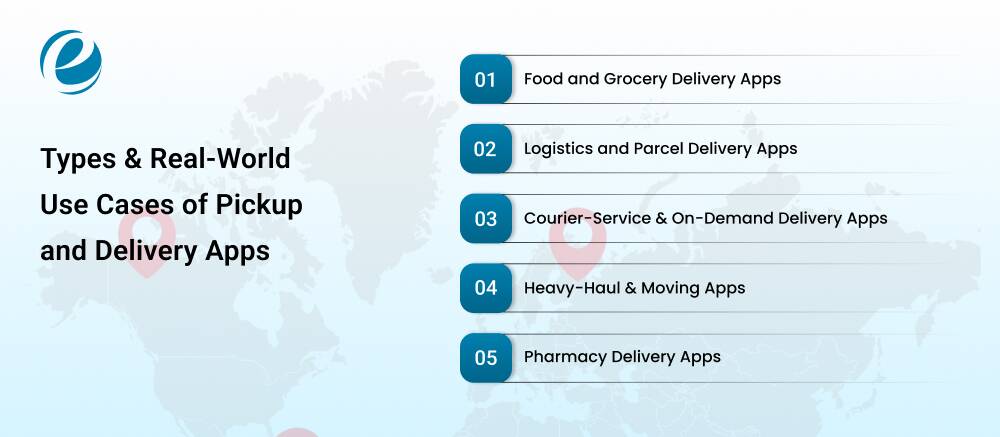
Pickup and delivery app solutions are categorized into diverse categories. Let’s uncover some of them with their real-world use cases:
Food and Grocery Delivery Apps
These services allow users to connect with both restaurants and stores. Some of the largest delivery apps are DoorDash, Uber Eats, Grubhub, Instacart, and Shipt – for delivering food from restaurants and groceries from household stores.
Use case: Ordering dinner on a hectic work day or ordering weekly groceries to avoid having to shop for them at the store.
Logistics and Parcel Delivery Apps
These apps provide a service to move items—not prepared food – from one location to another. Examples include Amazon Flex, Roadie, and FedEx Mobile, which are apps supporting courier services for packages.
Use case: Sending documents or eCommerce orders, or mailing personal packages to another city or country.
Courier-Service & On-Demand Delivery Apps
These services offer on-demand delivery of various things, such as documents and light-weight objects. Dispatch, Reliable Couriers, and Echo Express are a few of the applications providing this service.
Use case: You forgot an important file at home or need to send something urgent across town; these apps handle that kind of situation.
Heavy-Haul & Moving Apps
These applications are designed to move bulky furniture and appliances, such as the Dolly application, which connects users with local truck drivers.
Use case: Moving a sofa, shifting appliances, or dealing with furniture when you’re relocating and don’t want to manage it alone.
Pharmacy Delivery Apps
These are less about convenience and more about necessity. Apps like CVS Pharmacy, Walgreens, and 1mg make it easier to get medicines without stepping out, which can be a big deal in certain situations.
Use case: Ordering regular medication, getting something delivered late at night, or helping someone who can’t easily go to a pharmacy.
Must-Have Features of a Pickup and Delivery App
The pickup and delivery apps play a vital role in the modern-day economy due to the high convenience levels expected by consumers. To gain more insight into the requirements of these apps, you must first understand the key features that make a pickup and delivery app truly effective.
- Easy Registration & Search – Easy login process (email, social media), coupled with intelligent searching capabilities to find nearby stores/services.
- Real-Time Tracking & Notifications – Using GPS location technology provides users with up-to-date and precise ETAs, as well as provides users with notifications on their order status.
- Flexible Scheduling – Users should have the capability to select their preferred time slots for the service needs.
- Multiple Payment Options – All in-app payments should be safe/secure (credit/debit cards, UPI, net banking, or cash).
- Ratings & Reviews- Provides post-delivery ratings of a specific service to ensure high quality in the services delivered.
Tech Stack for Pickup and Delivery App Development
The selection of appropriate technology for the pickup and delivery app development plays a vital role in developing an effective and efficient delivery application. Given below is the technology stack used for the development of such applications:
- Backend & API (Node.js, Python, or Go) – This tech performs most functions related to order management and other backend activities.
- Database Management (PostgreSQL, MongoDB, or Redis) – Used to store vital data about users and orders.
- Real-Time Communication & Sockets (Socket.io or WebSockets) – Provides real-time tracking and updates with the ability for drivers and users to communicate in real-time.
- Cloud Infrastructure & DevOps (AWS, Google Cloud, or Azure) – Provides the ability to scale, be secure, and operate the app effectively.
- External Integrations & APIs (Google Maps, Stripe, Twilio) – Payments, navigation, and notifications will work together and function smoothly.
- Frontend & Mobile App Development (Flutter, React Native, or Native) – Provides a clean interface that is responsive to both Android and iOS devices.
How to Develop a Pickup and Delivery App: Step-by-Step Process
The process of pickup and delivery app development contains diverse steps. If you take all the steps into account, you will end up with an app that works properly.
Validate Market & Identify Niche
Determine your niche: food delivery, grocery delivery, parcels/courier services, laundry, medicine, etc.
Find out your local competitors and their weaknesses.
Selecting a Business Model
- Aggregator Model: User connects with vendor/driver (example, Uber Eats).
- Dedicated or Single Store Model: Stores the inventory and owns the delivery team (example: app for bakery).
- Hybrid Model: Third-party logistics support with in-house employees.
Identify Key Features (MVP Structure)
- Customer Application: There must be a quick sign-up process, browsing/searching capabilities, and the ability to pay effortlessly (Stripe/PayPal can do the job). Real-time tracking via Google Maps is now more or less mandatory, and so are notifications and rating features.
- Driver Application: Maintain an uncomplicated onboarding process. The drivers have to either accept/reject the orders, navigate through GPS, and also know their earnings at all times.
- Admin Panel: An order management dashboard, user and driver management, and a quick insight into the general performance metrics.
Choose Technology Stack
- Cross Platform (Recommend): Flutter or React Native for building an application for iOS and Android.
- Backend – Node.js, Python, and Laravel – whatever works well for your programming team.
- Database – MongoDB and MySQL, depending on how you structure your database.
- APIs – Google Maps for tracking purposes, Stripe for payments, and Twilio for SMS.
Design User Experience (UI/UX)
Make use of Figma or any other software for prototyping the design and creating a wireframe to ensure a smooth user experience. The emphasis should be on reducing the number of steps for ordering and payment.
Develop & Test (MVP)
Create an MVP to release quickly and reduce costs.
Do test properly; payments can fail, drivers might not be available, and users will cancel at the worst times.
Launch & Market the App
Get it live on the Apple App Store and Google Play Store.
Early traction usually comes from small pushes: ASO, social posts, maybe a discount to get people to try it once.
Continuous Improvement
Once people start using it, you’ll see what works and what doesn’t.
Address all the obvious problems and then, slowly but surely, add extra functionality such as better routing and rewards.
Step-by-step building of the pickup and delivery app allows you to concentrate on the essence, that is, users’ needs and application performance.
Pickup and Delivery App Development Cost Breakdown
In 2026, developing a pickup and delivery app usually ranges from $25,000 to $300,000+ based on the degree of complexity and the number of stakeholders (customer, driver, and admin). Let us take a closer look at the pickup and delivery app development cost based on its complexity level.
| Level of Complexity | Estimated Cost | Development Time | Key Features |
| Basic Minimum Viable Product | 24-55K USD | 2-4 Months | Basic Order Placement, Minimal Tracking Ability, Basic Payment |
| Mid-Range App | 60K-120K USD | 5-7 Months | Real Time Tracking Functionality, Review Capability, Create Route That Allows For Multiple Stops |
| Advanced/Enterprise App | 120K USA + 300K | 8-12+ Months | AI Dispatching, Enterprise-level Resource Planning Systems Integrated, High Scalability |
The food delivery app development cost varies based on the complexity of the apps required; however, a strategic investment is sure to make them scalable and perform optimally in the future.
How Delivery Apps Make Money: Monetization Models Explained
Monetizing through delivery apps does not only involve charging customers through delivery fees; there are different ways delivery apps can generate revenue, hence making money. This section examines the various models of monetization employed by delivery apps in order to generate more revenue.
Commission-Based Revenue (15–30%)
Delivery apps use this type of earning model. Restaurants give the delivery app a percentage from every order placed via the app while the app processes the order and coordinates with the delivery person and logistics. This will make it one of the major sources of income.
Consumer Delivery & Service Fees
Customers are charged for delivery, service fees, and other applicable charges, which are based on multiple factors, including the distance of delivery, the size of your order, and the minimum cart value (which varies depending on the merchant). These fees cover the cost of the delivery partners who deliver your order to you and also help provide for efficient last-mile logistics.
Advertising & Promoted Listings
Businesses and restaurants will have to pay for greater visibility within the application. This could mean having better rankings when people search for them or getting featured on the home page. This helps them receive more orders and makes additional money for the platform as well.
Subscription Models
Several applications have subscription-based services where the user receives free delivery or discounts on a monthly basis. Such programs not only help build customer loyalty but also ensure that the company gets regular income.
Surge Pricing
The charges for delivering the meals rise during peak time. This strategy ensures balancing the supply and demand while generating maximum profit for the application and also ensuring that more deliveries are made by the delivery partners.
Restaurant Partnerships & Cloud Kitchens
Delivery platforms can collaborate with cloud kitchens or virtual restaurants that operate only for delivery purposes. They can also offer their partners data analysis and insights, which generate more income streams and improve efficiency.
How to Choose the Right Pickup and Delivery App Development Company?
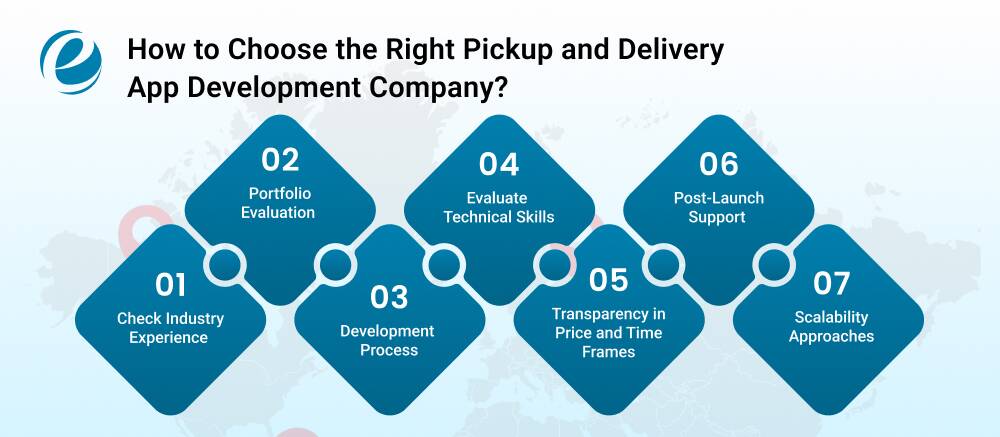
Selecting an appropriate development partner is essential for creating a successful delivery platform. The on-demand pickup and delivery app development company you choose will have a direct impact on your app’s success in the future. Here are some things you need to consider while making your choice.
- Check Industry Experience – Consider working with firms that already have experience with delivery and on-demand apps. Previous industry experience is often indicative of lower chances for errors and higher delivery efficiency.
- Portfolio Evaluation – This will help in understanding their level of expertise regarding design, functionality, and delivery processes.
- Development Process – The development process indicates a systematic approach to managing planning, development, and delivery.
- Evaluate Technical Skills – Ensure that they have the ability to work with modern technology to develop the application effectively.
- Transparency in Price and Time Frames – Do not opt for ambiguous quotes. An experienced company would offer you an estimate right away.
- Post-Launch Support – Apps usually require updates and maintenance even after deployment, so you need to hire an agency that offers such services.
- Scalability Approach – They must consider scalability in mind during the development process for your app.
Selection of the right partner is the basis of any good delivery platform, and by emphasizing knowledge, clarity, and scalability, Emizentech emerges as an outstanding mobile app development company that can develop robust applications.
Final Thoughts
Pickup and delivery app development is revolutionizing how modern businesses provide services to customers in an efficient manner. It encompasses various aspects, including basic functionalities, ways of generating revenue, and scalable technology infrastructure, among others, that must be considered when developing such apps.
The collaboration of businesses with a competent food delivery app development company may facilitate this process even further. The increasing demands in today’s world necessitate investment in pickup and delivery app development as a strategic move towards sustaining digital success.
FAQ’s
How long does it take to build a pickup and delivery app?
The development process usually lasts between 3 to 6 months for the creation of a minimum viable product. The development time of fully functional applications may be increased up to 6 to 12 months.
How do pickup and delivery apps make money?
Some ways that delivery apps make money include through commissions from order delivery, fee hikes, subscription fees, in-app advertisements and collaborations with local eateries
How is AI being used in delivery apps?
AI will revolutionize delivery apps by allowing route optimization, demand predictions, automated dispatching, chatbots, dynamic pricing, and much more, resulting in greatly improved efficiency
Should I build my delivery app on React Native or Flutter?
React Native is quicker at JavaScript coding and has a larger ecosystem, but Flutter has better UI performance and consistency—both depend on cost, team skills, and scalability needs.
What are the benefits of pickup and delivery apps?
The pickup and delivery apps can provide the following advantages: convenience, real-time tracking, faster service, wider reach, lower cost, increased efficiency, and business scalability.


 +1 (989) 535-9295
 info@emizentech.com
 emizentech


