
 Add us as a preferred source on Google
 PunchOut Catalogs are a great link between buying organizations’ procurement systems and suppliers’ online stores. It refers to the ones that allow for the real-time selection of products and pricing, eliminating any need for data entry and thus contributing to the streamlining of the entire procurement workflow. Growing procurement demands and the need for efficient eProcurement solutions are helping fuel the increasing adoption of PunchOut Catalog among suppliers and buyers.
PunchOut Websites are growing in favor amid an ever-growing demand for effective eProcurement solutions. As per the MarketandMarkets report, the catalogue management systems market is anticipated to grow at a rate of 10.6% CAGR during the projection period, reaching a significant market size by 2025. This evolution highlights the increasing importance of digital procurement tools like PunchOut Catalog in modern business operations.
This guide will provide a detailed explanation of PunchOut Catalogs, how they work, and the primary features and benefits they offer businesses. Be it a supplier expecting to support B2B capabilities or a buyer intending to create a strong procurement process, understand why it is essential for competitiveness in the competitive market.
What is a PunchOut Catalog?

A PunchOut Website is an exclusive form of online catalog that ties a buyer’s procurement system (such as SAP, Coupa, or Ariba) directly to the supplier’s website. It takes them to a page, yup, and they can buy from the website, all just from their procurement PunchOut catalog software.
Consider you are shopping online at Amazon, and instead of clicking on a new tab, Amazon opens it within your company’s purchasing system. You are free to view the products, select them and put them in your cart, and when you’re done, your cart is sent back to your procurement system for approval and payment.
This not only makes purchasing easier, but it also makes it faster and more accurate—there is no need to manually enter product details or prices, among other things.
Key Features:
- It keeps the information up-to-date and, at the same time, provides the products and the prices.
- Automatic feeding of data, eliminating errors.
- Your company’s purchasing workflow is considerably lightened by the automated approvals of purchases.
- More control and visibility over spending are among the benefits.
Note: The PunchOut catalog is the company’s well-organized solution to time-saving, error-reducing, and wiser purchasing, empowered by buyers and suppliers through effective collaboration.
How Does a PunchOut Website Work?
PunchOut catalogs are a fantastic concept where the buyer’s system is connected to the supplier’s online store, which makes the purchase process effortless, error-free, automatic, and completely compliant with company rules.
The buyer logs into his/her company’s procurement system (e.g., SAP, Coupa, Ariba contracts), where all the buying activities are controlled.
1. Select the Supplier’s Catalog
In the system, the buyer selects the supplier’s PunchOut Website. As a result, the buyer’s action is opening the supplier’s website, yet it is a secure and special way.
2. Browse and Shop on the Supplier’s Site
The buyer is the “user” of the system, who has logged in to the system, browses the products online, follows the prices, and adds the items to the cart as in typical online shopping. The whole process goes on while a buyer is still “in touch” with the procurement system in the background.
3. Return the Cart to the Procurement System
The buyer performs the shopping, and then the cart is “punched back” into the procurement system (having all the items, prices, and product details on it) once the purchasing stage is over. That is the process by which the data is retransferred automatically; there is no need to fill in any forms manually.
4. Review and Approve the Purchase
The direction of the purchase goes through the inner approval of the company. The subject of the procurement request is still going through the company’s internal approval process.
5. Place the Order with the Supplier
The company’s internal approval process is final, and then the system issues the supplier a purchase order (PO). In turn, the order will be processed, and parcels will be sent by the supplier.
6. Receive Goods and Invoice
The buyer is the recipient of the goods, who follows the supplier’s delivery confirmation and gets the invoice. In addition, the invoice can also be automatically matched in the system, which speeds up the payment process.
Key Features of PunchOut Catalogs
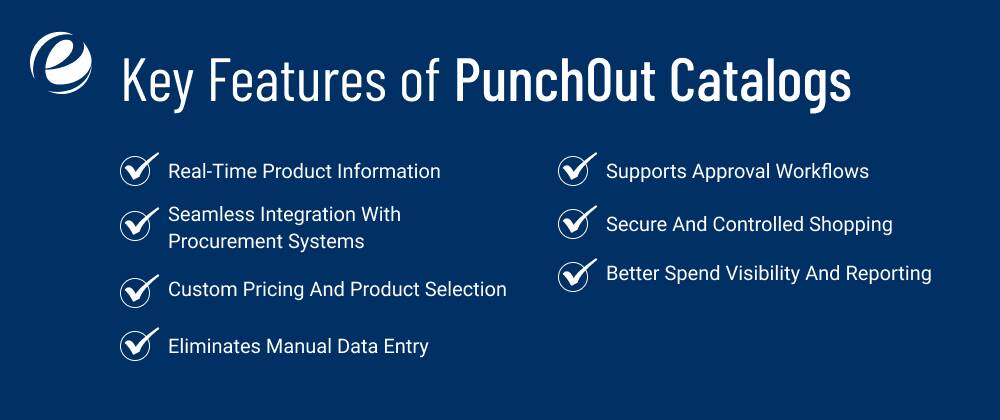
1. Real-Time Product Information
Product details, prices, and stock availability in a PunchOut Website are always the most current data, i.e., the information is directly taken from the seller’s site. Therefore, buyers can be confident that the information upon which they make their purchases is the latest and the truest.
2. Seamless Integration with Procurement Systems
E-procurement applications such as Coupa, SAP, Oracle, and Ariba are easily incorporated with the catalogs. Buyers are hence not compelled to go out of their own system to effect a purchase, thereby ensuring everything remains centralized and managed.
3. Custom Pricing and Product Selection
Suppliers have the possibility of showing certain customers different prices or products. Thanks to this, a company might be granted access to exclusive pricing and products specially made for the supplier and their business relationship.
4. Eliminates Manual Data Entry
As soon as a customer, a quantity, and the price of a product are entered into the e-procurement system, the product details, quantities, and prices are either automatically or manually entered. Manual entry will be quite a mistake-prone and time-consuming.
5. Supports Approval Workflows
When the shopping process is completed, the order is sent through the company’s regular approval channels. The process of permission allows managers to review and sanction a certain purchase before it can happen, which will provide better control and save the business money.
6. Secure and Controlled Shopping
The access to the catalog is strictly for a given group of people, i.e., authorized users. Purchasing is made via the company’s secure system. Hence, the level of spending becomes predictable or at least controlled.
7. Better Spend Visibility and Reporting
The efforts of business owners are tracked through the procurement system. Thus, they are in a better position.
Benefits of Using PunchOut Catalogs
1. Saves Time
Now, buyers can directly purchase from the supplier’s website through their procurement system. This results in a faster process. The whole process can be completed more quickly without switching between platforms or manually entering product details.
2. Reduces Errors
The transmission of all data, such as product characteristics, prices, and article codes, is done in a fully automated mode. This implies that there is very little chance of mistakes that may occur while typing, of wrong orders, or of incorrect pricing.
3. Ensures Compliance with Company Policies
Each purchase has to go through the company’s approval system. Consequently, buying becomes much easier and, at the same time, a reliable way of empowering employees with the help of approved suppliers only.
4. Provides Up-to-Date Information
Buyers can directly get updated prices, inventory, and product information from the supplier’s system; thus, no misinformation and order inaccuracies occur.
5. Improves Spend Visibility
A transparent record of all purchases is present in the procurement system. This enables businesses to know where their money has been spent, thus observing the performance of the supplier and making wiser decisions.
6. Offers Custom Catalog Experience
Suppliers are capable of presenting custom catalogs to the customers with products that are relevant to them, as well as contract-based pricing. The shopping experience becomes both more efficient and personalized.
7. Streamlines Procurement Workflow
All activities in the procurement process, such as browsing, checking out, and approval, go through the same platform. Consequently, the process is much faster as it reduces the possibility of delays and ensures the procurement workflow runs smoothly.
8. Increases Employee Productivity
With the extreme reduction in the number of stages, the consequent simplification, and the great decrease in manual work, the time employees need to spend on purchasing tasks is significantly reduced. Employees can now focus more time on their core responsibilities.
9. Supports Better Supplier Relationships
Automating and ensuring the order is correct leads to less number of disputes, faster processing of requests, and increased communication with suppliers.
Who Should Use PunchOut Catalogs?
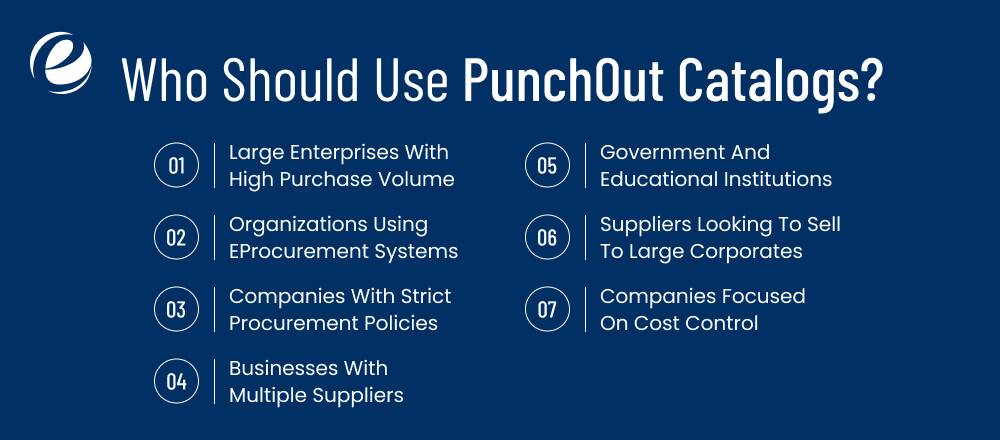
Organizations that are seeking the ability to make the purchase process much easier, with accuracy improved, and still use a spending control method, and at the same time, get a lot of benefits from using PunchOut are the most proposed ones of the many companies in the market that go about their purchasing mechanism.
1. Large Enterprises with High Purchase Volume
There is no question that the most proposed ones are those companies of a large or even a medium size with high purchasing power to simply make the purchases, which are mainly when the case is across units.
From the very start of the selection of the product to the saving of time, PunchOut Websites can really offer the best in terms of innovation, efficiency, accuracy, and time-saving. This ease of use helps to make the purchases less difficult, and at the same time, procurement tasks are almost non-existent.
2. Organizations Using eProcurement Systems
Many companies already using eProcurement (purchase order system) tools, such as SAP, Ariba, Coupa, Oracle, and Jaggarr, already have in place the first step with the catalogs, which is the choice of a complementary system offering an easy B2B PunchOut Websites integration capability. These also make the same effort as the platforms do.
3. Companies with Strict Procurement Policies
PunchOut catalogs provide an excellent way of enforcing the company’s procurement policies even in those cases where the business has set price ranges on each category by making sure that only the products with the required specifications are shopped and the correct pricing is used before any action is taken. The suppliers’ ease of doing business with your purchase function is probably the most significant benefit.
4. Businesses with Multiple Suppliers
The process of managing the suppliers would be time-consuming, overly complex, lossy, and inefficient. If the same buyers used PunchOut Websites to buy products from the suppliers, the suppliers could have had fewer transactions. However, their overall amount of business does not suffer because of the supply chain complications.
5. Government and Educational Institutions
The difficulties faced by the sectors mentioned (government and educational institutions) can be solved using PunchOut catalogs, as they help maintain transparency, accuracy, and audit-ready data.
It helps to simplify the ordering of school supplies, which comes in line with the government’s tone. It is as easy to handle large corporate clients as it is to handle smaller ones if the suppliers have the necessary means to offer them the Catalogs.
6. Suppliers Looking to Sell to Large Corporates
PunchOut catalog manages all of the buyer’s changes (suppliers and products) as the business scale increases and the buyer’s ability to control them diminishes. It makes it easy for the same enterprise buyers to search through all the different suppliers listed and handle the purchasing task just as if they were buying from one vendor only.
Easier confirmation of receipts, accurate audits, analysis of expenses, and monitoring of the total amount spent are some of the benefits that the Public Sector and Educational Industry can enjoy if they use PunchOut Catalog.
7. Companies Focused on Cost Control
PunchOut Website allows more insight into spending, prevents purchases without authorization, and assist in the negotiation of favorable pricing; this makes them particularly apt for firms that focus on cost control.
PunchOut Catalog vs. Hosted Catalog
| Aspect | PunchOut Catalog | Hosted Catalog |
| Definition | A live, interactive catalog hosted on the supplier’s website and accessed via the buyer’s procurement system. | A static catalog file (like Excel or CIF) hosted within the buyer’s procurement system. |
| Product Updates | Real-time updates. Changes made by the supplier are instantly visible to the buyer. | Manual updates. The supplier must send updated files to the buyer periodically. |
| Pricing Accuracy | Always current—reflects latest discounts, contract pricing, and inventory. | May become outdated quickly, especially if prices or stock levels change often. |
| User Experience | Feels like online shopping. Buyers can browse, filter, and search like on a regular e-commerce site. | Basic experience. Limited browsing features and not as user-friendly. |
| Customization | High. Tailored product selection, pricing, and branding for each customer. | Limited. Same catalog is often used for multiple buyers unless customized manually. |
| Integration | Requires setup between supplier’s site and buyer’s procurement system using protocols like cXML. | Simple to set up, just upload the catalog file to the procurement system. |
| Maintenance | Lower long-term effort for buyers. Suppliers maintain their own catalog content. | Higher maintenance for buyers. Must upload and verify updated catalogs regularly. |
| Speed of Deployment | Takes more time to set up initially due to integration. | Faster to set up since it’s just a file upload. |
| Control Over Content | Supplier controls and manages the catalog content and availability. | The buyer controls what is displayed and when. |
| Ideal For | Large enterprises, companies needing dynamic pricing, or frequent product changes. | Smaller businesses or those with limited tech resources and stable pricing. |
| Support for Complex Products | Better suited for configurable products or items with many variations. | Not ideal for complex product selections or real-time configuration. |
| System Requirements | Requires supplier to support PunchOut and integrate with buyer’s eProcurement platform. | Only the buyer’s system needs to support hosted catalogs. |
| Ordering Process | The cart is transferred back to the procurement system for approval after shopping on the supplier’s site. | Buyer selects items directly from within their procurement system. |
- PunchOut Catalogs are best for businesses that want real-time data, dynamic pricing, and a modern shopping experience directly from their suppliers.
- Hosted Catalogs work well for businesses that choose simpler, static catalogs with fewer updates and limited integration requirements.
Top 10 PunchOut Catalogs in 2025
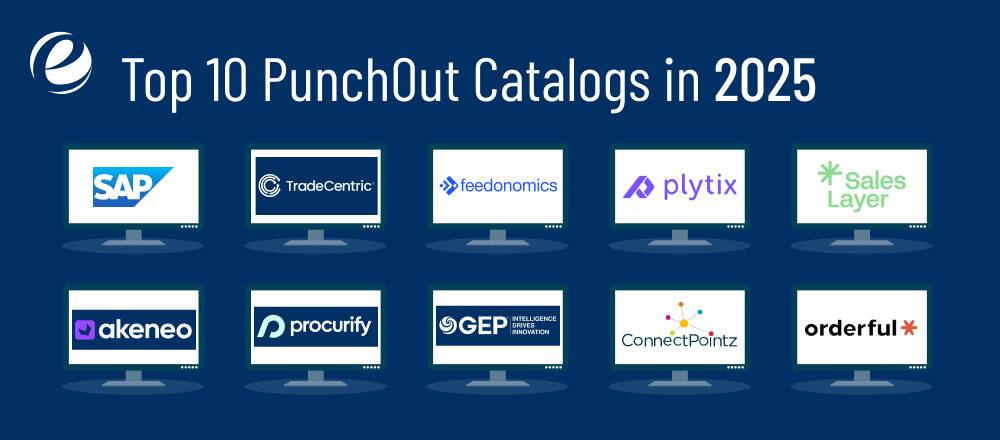
Here is the table which includes all essential details about these popular PunchOut Catalogs. Details like year founded, target users, key features, integration capabilities, and ideal for:
| Platform | Year Founded | Target Users | Key Features | Integrations | Ideal For |
| SAP Ariba | 1996 | Large Enterprises, Procurement Teams | PunchOut catalogs, sourcing, contract management, supplier discovery | ERP (SAP, Oracle), eCommerce, eInvoices | Global enterprises, complex procurement |
| TradeCentric | 2004 | B2B Sellers & Buyers | Catalogs, cXML/OCI, eCommerce-to-eProcurement integrations | SAP Ariba, Coupa, Oracle, Jaggaer, Salesforce, Shopify, Magento | eCommerce-P2P integration for manufacturers |
| Feedonomics | 2014 | Retailers, Brands, Agencies | Product feed optimization, multichannel syndication | Amazon, Walmart, Meta, Google, Shopify, BigCommerce | Retailers wanting to optimize product listings |
| Plytix Cloud PIM & DAM | 2014 | SMBs, eCommerce Teams | Product Information Management, Digital Asset Management | Shopify, WooCommerce, BigCommerce, Amazon, CSV/Excel | Mid-sized eCommerce teams |
| Sales Layer PIM | 2013 | Retail, Manufacturing | Cloud PIM, product syndication, catalog creation | Adobe Commerce, Salesforce Commerce, Amazon, SAP, CSV/Excel | Multichannel retail & manufacturing |
| Akeneo PIM | 2013 | Mid-to-Large Businesses | Open-source & enterprise PIM, data enrichment, catalog management | Magento, Salesforce, Shopify, ERP integrations via API | Businesses needing scalable PIM |
| Procurify | 2012 | SMBs, Finance Teams | Spend management, procurement workflows, approvals | QuickBooks, NetSuite, Slack, ERP systems | SMBs streamlining spend controls |
| GEP SMART | 1999 | Enterprises, Procurement Orgs | Full-suite S2P, spend analysis, contract & supplier management | SAP, Oracle, Microsoft Dynamics, Coupa, JD Edwards | End-to-end enterprise procurement |
| ConnectPointz | 2008 | Distributors, Retailers | Data integration, EDI, PunchOut catalog support | ERP, WMS, eCommerce platforms, custom integrations | Companies needing PunchOut & EDI sync |
| Orderful | 2016 | Enterprises, Tech Teams | Cloud EDI platform, real-time API integration | ERP, WMS, eCommerce, APIs | Developers & teams needing modern EDI |
Technologies Behind PunchOut Integration
Although the concept of PunchOut catalogs is still like a mystery to many, in reality, everything is actually automated through the use of various technologies and protocols that are not even visible on the surface. A buyer’s procurement system sends an immediate signal, paying a virtual visit to a supplier’s eCommerce site, which, in turn, is the essence of such B2B PunchOut catalog integration. Viewers will be able to see the remote exchange only bringing along its all-time companions, i.e., standardized communication protocols, secure connections, and catalog software platforms that are compliant.
Here’s a look at the core technologies that make PunchOut Website work smoothly:

B2B PunchOut Catalog Integration Technology Stack
| Technology/Component | Purpose |
| cXML (Commerce XML) | Data Exchange |
| OCI (Open Catalog Interface) | Alternative Protocol |
| Procurement Platforms | Buyer-side System |
| eCommerce Platform (Supplier-side) | Supplier Catalog Host |
| Middleware or Integration Gateway | Communication Bridge |
| Authentication Protocols | Secure Access |
| Cart Transfer Technology | PunchOut Process Handling |
| Hosted Catalog Backup (optional) | Fallback Catalog |
| Web Services / APIs | Data Exchange (Advanced) |
| Browser and UI Compatibility | User Access |
How to Implement a PunchOut Catalog?
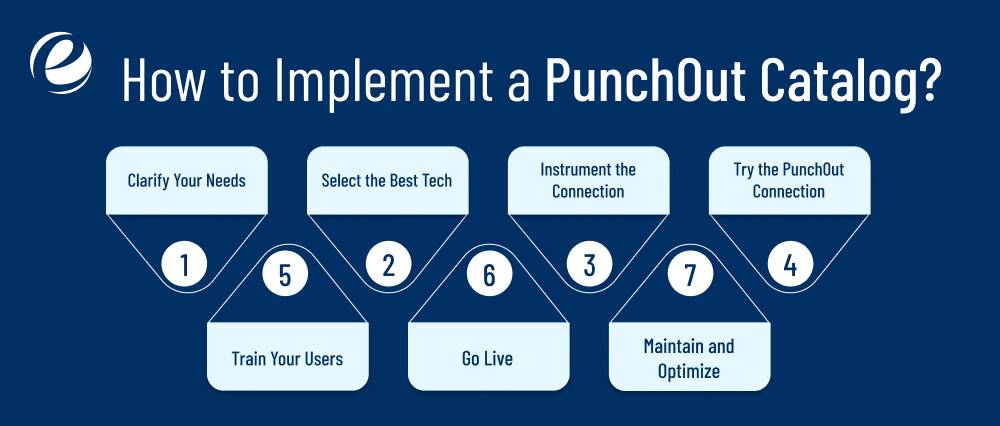
Implementing a PunchOut catalog might look hard, but the correct method offers you the chance to carry out your task in a smooth and efficient manner. Be you the buyer or supplier, the aim is to implement the procurement system with the supplier’s eCommerce site, allowing for real-time and hassle-free purchasing.
In the following article, you will find examples showing you how to proceed if you are the buyer, what you should do if you are the seller, and if you should implement a custom PunchOut Website solution.
Step 1: Clarify Your Needs
- Figure out what items or services will be part of the catalog.
- Determine the method your procurement system uses; is it cXML, OCI, etc?
- Find out if there are any special requests (e.g., contract pricing, user-specific catalogs) that you have to address.
Step 2: Select the Best Tech
- If you are a buyer, know the PunchOut catalog software of your procurement system (SAP Ariba, Coupa, Oracle, etc.) that supports PunchOut.
- If you are a supplier, you should know whether your eCommerce platform (like Magento, Shopify Plus, BigCommerce, etc.) is compatible or if your system is a PunchOut-ready one.
- Ask yourself whether an integration gateway (e.g., PunchOut2Go, Boomi, MuleSoft) can be of great help to you in the process.
- If you want to develop a BigCommerce kind of platform then you need to hire a professional BigCommerce development team which can fulfil your requirements as per your expectations.
Step 3: Instrument the Connection
- Deliver the possible URLs, credentials, and protocol versions of the buyer and supplier teams to each other.
- Prepare cXML or OCI setup to provide guidance through a shopping cart session, user authentication, and cart return.
Step 4: Try the PunchOut Connection
- Complete your testing from the beginning to the end: login from the buyer’s system, search for the products, add them to the cart, and return the cart.
- Check whether information on products, pricing, and the like is passing without hassle through the purchasing system.
Step 5: Train Your Users
- Educate employees or buyers on how to use the PunchOut catalog in the procurement system. Offer them simple directions or brief clips so that the onboarding process will take place smoothly.
Step 6: Go Live
- Once you are sure that you have done all the testing and you have the required resources, the catalog can then be opened to the public. The period after the project’s kickoff should be used to observe the system for any early issues or get feedback.
Step 7: Maintain and Optimize
- Always keep an eye on the catalog’s performance and accuracy. Manufacturers can change prices and tell about product availability and categories if necessary. Purchasers should examine data on usage and supplier performance for betterment as well.
Hire the best IT company to meet your requirements and discuss the implementations with the supplier’s technical team. Effective communication and proper documentation can make the process faster and the likelihood of errors smaller.
Why Choose EmizenTech for PunchOut Catalog Development?
Ensuring that you choose the right partner for PunchOut catalog development is clearly the first step to a successful and smooth implementation. EmizenTech is a reliable tech partner that has been in the business of building personalized eCommerce solutions and integrations for many years.
EmizenTech is the best software development services provider you are looking for to connect your store with large enterprise buyers as a supplier or as a business to streamline procurement; hence, this company is the exact definition of a customer-driven entity. It not only offers technical expertise, reliability, and personalized support but is also keen on performance, scalability, and security. The company guarantees that your PunchOut catalog functions flawlessly with major procurement systems such as SAP Ariba, Coupa, Oracle, and others.
Key Reasons to Choose EmizenTech:
- Experienced Team: Skilled developers with deep experience in B2B catalog integration, cXML, OCI, and procurement systems.
- End-to-End Support: From planning and setup to testing and post-launch maintenance, we handle it all.
- Platform Flexibility: We work with all major eCommerce platforms like Magento, Shopify Plus, BigCommerce,
- Seamless Integration: Smooth connections with procurement systems like SAP Ariba, Coupa, Oracle, and Jaggaer for real-time catalog syncing.
- Custom Solutions: We build catalogs tailored to your business needs—whether it’s customer-specific pricing, custom workflows, or complex product structures.
- Fast Turnaround Time: Agile development ensures quicker go-live without compromising on quality.
Nutshell
PunchOut catalogs are a new opportunity for companies that want to optimize their supply chain. Through a supplier’s catalog that is seamlessly integrated with the procurement system, first of all, the human factor that deals with the speed of the data entry process and the quality of the input is eliminated. Besides, there are also real-time product and pricing offers that the company’s procurement system will receive from the catalog.
Suppliers that have a goal of more corporate buyers, as well as companies that are looking for a better purchasing process, would be smart to adopt a PunchOut catalog. Businesses that have the right technology and the perfect partnership with a reliable provider like Emizentech as their assistant can accomplish more work, save on costs, and hence improve the purchasing process.
FAQs
What are PunchOut catalogs?
PunchOut Website function by reaching the buyer’s buying platform and going to the supplier’s eCommerce system. The product selection made by the buyer is transmitted back as data to the procurement system, where the order can be reviewed, approved, and then processed.
Can PunchOut catalogs be customized?
Sure, with PunchOut Websites, customers can choose the level of customization they need for their products, prices, and corporate branding as per the buyer’s or business requirements.
How long does it take to develop a PunchOut website?
The time to create catalogs can depending on the complexity of the integrated systems. As a rule: 1. It would take approximately 4 to 6 weeks for small businesses. 2. More extended periovary ds say 2-6 months, would be expected for large enterprises or customized solutions that involve testing, integration, and adjustments.
What is the cost of implementing a PunchOut catalog?
Finally! Given that there are many factors included in such a project, such as the complexity of the integration, the number of suppliers, and the size of the business, the prices may vary quite a wide area. Generally, the costs of small to medium size implementations range from $5,000 to $50,000. For further customization or larger setups, the prices may go even further.
What are the key challenges when implementing a PunchOut catalog?
Integrating multiple systems (eProcurement platforms, eCommerce platforms, and suppliers’ systems) can be very challenging. This may lead to the issue of double. 1. Product information, pricing, and availability are always up to date across systems that are involved in the process of data transportation. 2. Customization: Customizing catalogs so that they can be instrumental in the successful completion of various transactions between sell and buy parties could entail complexity in the development process. 3. Utilizer exercising: Educating staff and sellers of the PunchOut Website on how to operate the system in procurement.


 +1 (989) 535-9295
 info@emizentech.com
 emizentech


