 Add us as a preferred source on Google
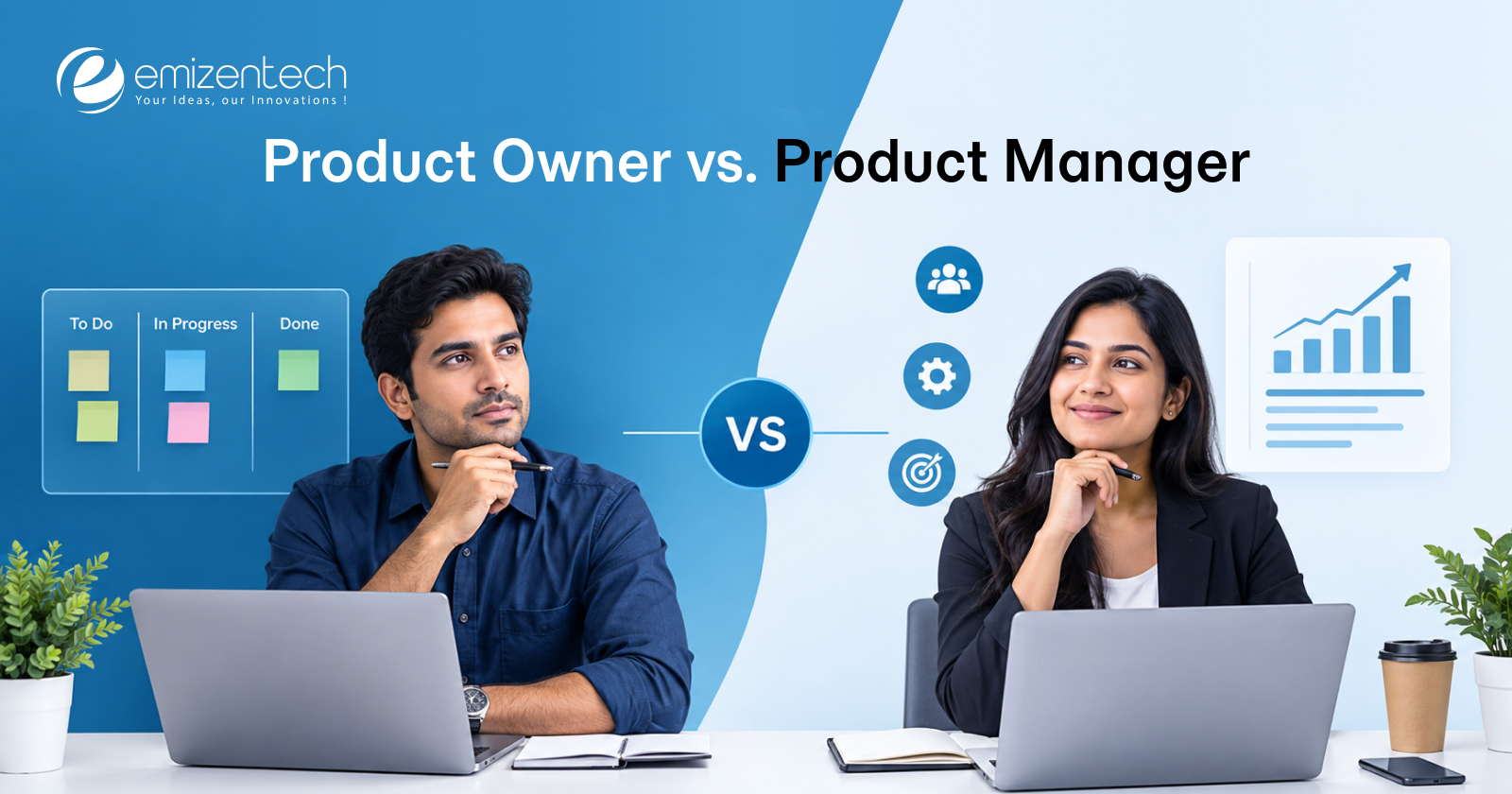
 Many people get confused when they hear the terms “product owner vs product manager.” They sound similar, but they have different jobs in creating a successful product. One role focuses on understanding customer needs and planning the product’s future, while the other works with the development team to make sure the right features are built on time.
Both these roles are crucial and often work together, but their responsibilities are not the same. You should know the difference because it will help businesses build better products, improve teamwork, and choose the right person for the job. In this guide, you will learn what each role does, how they differ, and which one is the right choice for your business.
What is a Product Manager (PM)?
A product manager is responsible for a product’s overall success in the market. They sit somewhere between business, tech, and user experience, and people love calling them the “CEO of the product” not because they manage anyone but because they own whether it works or not.

Core Purpose: A PM’s whole job is making sure the company builds the right product, which sounds obvious until you watch how many companies get it wrong. That means constant validation, talking to users, digging through competitor research, reading support tickets nobody else wants to read, and testing assumptions before a single line of code exists.
Key Responsibilities:
- Defining the product vision and multi-quarter roadmap.
- Running market and competitor research to find real opportunities.
- Setting KPIs and measuring product-market fit after launch.
- Aligning sales, marketing, and leadership around a shared strategy.
- Deciding what problem is worth solving next and why.
- Owning pricing, positioning, and go-to-market decisions alongside marketing.
If you’re weighing product manager vs owner responsibilities, here’s the shortcut: the PM’s work happens mostly before and after a sprint, not during it. They set the direction. Somebody else has to turn that direction into a plan the team can actually execute this week.
What is a Product Owner (PO)?
A product owner is a key member of an Agile or Scrum team responsible for maximizing the value of a product. They act as the bridge between business stakeholders, customers, and the development team by deciding what gets built and in what order.

Core Purpose: A PO’s job is to squeeze the most value out of every single sprint the dev team runs. They own the backlog, and they are the one voice engineering turns to the second a requirement gets fuzzy. A PO keeps the backlog groomed and realistic and keeps developers from ever sitting around waiting on direction.
Key Responsibilities:
- Writing and prioritizing user stories in the product backlog.
- Defining acceptance criteria so developers know when a feature is done.
- Attending daily standups, sprint planning, and sprint reviews.
- Making fast, tactical calls when the team hits a gray area mid-sprint.
- Acting as the customer’s proxy for the immediate one-to-two-week horizon.
- Removing ambiguity from tickets before developers pick them up.
So, these are the differentiations of product owner vs product manager. If you are still facing any issue in understanding these things, you can check out the table given below in the next section.
Product Owner vs. Product Manager: Side-by-Side Comparison
It is understandable that both of these sound similar. With the help of this table you will understand how they are distinct from each other on the basis of some common dimensions:
| Dimension | Product Manager | Product Owner |
| Focus | Strategy and market fit | Backlog and sprint execution |
| Time horizon | Months to years | Days to weeks |
| Reports to | Head of Product / VP Product | Scrum Master or PM (in larger orgs) |
| Primary artifact | Product roadmap | Product backlog |
| Team Interaction | Cross-functional (sales, marketing, execs) | Embedded with one dev/Scrum team |
| Framework dependency | Works in any methodology | Formal role, specific to Scrum |
| Success metric | Revenue, retention, adoption | Sprint velocity, story completion |
| Typical background | Business, MBA, market research | Technical, domain expert, ex-developer |
Even this table narrows down to one thing: the product owner vs manager distinction is really a distinction of altitude. Now’s lets learn something exciting about how these two collaborate in sprints.
Related Blog: Active vs Passive Candidates
How Product Managers and Product Owners Collaborate in Sprints?
In a team that’s actually running Agile well, the PM and PO aren’t competing for the same job; think of it more like a transmission. The PM shows up to sprint planning with a prioritized set of epics pulled from the roadmap. The PO breaks those epics into sprint-sized stories, negotiates over scope with developers, and shields the team from stakeholders trying to sneak in mid-sprint changes.
During the sprint, the PO is the one stuck in daily standups fielding questions the second a developer hits a wall, while the PM is usually a step removed watching adoption numbers from the last release, sketching out next quarter’s roadmap.
This handoff only works when both people understand the underlying development process a PO who doesn’t get the technical dependencies will overpromise every time, and a PM who doesn’t understand the system development life cycle keeps setting roadmap dates that engineering simply can’t hit.
Do You Need a Product Owner, a Product Manager, or Both?
Honestly, the answer depends more on your company’s stage than your budget. Nobody makes this decision off a textbook definition of product owner vs product manager; they make it based on how many products they’re running and how many Scrum teams need someone steering day-to-day.
- Early-Stage Startup: Combine into a “PM/PO Hybrid”: one person wears both hats.
- Mid-Market Company: 1 Product Manager paired with 1–2 Product Owners.
- Scale-Up / Enterprise: Dedicated PMs per product line, with POs included in each dev team.

Scenario A: Early-Stage Startups & MVPs
At this stage, hiring two separate people for these roles is usually overkill, plain and simple. One hybrid owner defines the vision, writes the backlog, and sits in on every standup; the team’s small enough that strategy and execution can comfortably live in one head. This is exactly the environment where startup app development moves fastest, since fewer handoffs mean faster decisions.
Scenario B: Mid-Market & Scaling Tech Companies
Once a company has more than one product line or a growing engineering headcount, the hybrid model starts to crack. The same person genuinely cannot run competitor research and sit in on three daily standups at the same time. A lot of growth-stage teams also drift toward adaptive software development here, since one rigid roadmap stops fitting multiple releases running at once. Expect some friction, too; a newly hired PO and an existing PM often need a few sprints just to figure out where one role’s authority ends and the other’s begins.
Scenario C: Large Enterprises & Multi-Product Platforms
At an enterprise scale, splitting the roles isn’t optional. Every product line gets its own PM, and every Scrum team gets its own embedded PO. To flex capacity without permanently bloating headcount, plenty of enterprises lean on staff augmentation to slot in developers under an existing PO’s backlog. It’s worth budgeting realistically here, too.
So, these are the three scenarios through which you can easily decide whether you need a product manager, a product owner, or both.
Salary & Career Path Comparison: PM vs. PO
If there’s one thing people actually search for by name, it’s product owner vs product manager salary, and the gap is real, though it moves around depending on the source and the region.
Average Salary Benchmarks:
Here is the cost breakdown of both the product owner and the product manager:
- Product Owner: roughly $85,000–$150,000 annually in the US, with a median closer to $110,000–$115,000.
- Product Manager: roughly $101,000–$160,000+ annually, with senior PMs in major tech hubs regularly clearing $180,000+.
The gap exists mostly because PM roles carry broader strategic and business scope, while PO roles stay scoped tightly to what one team delivers.
Progression Pipeline:
A product owner begins by managing the product backlog, defining user stories, and collaborating with development teams to deliver customer value. With experience, they can advance to product manager, taking the responsibility for the product strategy, market research, customer needs, and business goals. Further career progression included roles such as Senior Product Manager, Group Product Manager Director of Product, and Chief Product Officer (CPO), which are leading the product vision, innovation, and organizational growth.
Turning Strategy into Software: Why Your Development Team Matters Most
Here’s the part most product owner vs product manager write-ups skip entirely: neither role ships a single feature without developers who can actually execute against the backlog. A brilliant roadmap and a perfectly groomed sprint plan are still just documents sitting in a tool somewhere until an engineering team turns them into working software.
This is where most internal teams actually hit friction, not in defining the strategy, but in staffing the execution. A PM can have flawless market research. A PO can have flawless user stories. It doesn’t matter if the development bench is thin; both roles end up watching the timeline slip anyway.
That’s the gap companies close when they hire dedicated developers through a partner that already has vetted talent sitting on standby or lean on end-to-end software development services instead of trying to build an internal bench from zero.
How Dedicated Developers Supercharge Product Velocity
A dedicated team removes the single biggest bottleneck in the PM-PO relationship. When developers already know the codebase and are already embedded, a PO can manage a backlog and see working stories, with no ramp-up time, no context-switching between five different clients, and no re-explaining the product from scratch every sprint.
For any team weighing product owner vs product manager priorities against a tight engineering budget, dedicated developers are usually the fastest way to close that execution gap without hiring a whole in-house team.
Read Also: Team Extension Model: How It Works, Benefits & When to Use
Why Tech Leaders Partner with Emizentech to Build Product Squads?
Whether you’re staffing your first PO-led Scrum team or scaling PMs across five product lines, the bottleneck is almost always the same one: finding developers who can actually keep pace with the backlog. Emizentech tackles that from a few different angles.
- Top 3% Pre-Vetted Tech Talent: Every developer goes through a genuinely rigorous technical and communication screening before joining a client squad.
- Agile Integration: The developers slot directly into your existing Scrum ceremonies, standups, and sprint planning.
- 14-Day Risk-Free Trial: You get to validate team fit before committing long-term, which matters most during that early hybrid PM/PO stage when budget flexibility is everything.
- 100% IP Security & ISO Compliance: Product strategy is sensitive by nature, so every engagement comes backed by contractual IP protection and ISO-compliant processes.
If the real bottleneck is capacity, not clarity on product owner vs product manager responsibilities, it’s usually faster to just learn how to hire remote developers than to keep interviewing in an increasingly small local talent pool.
Conclusion
The product owner vs product manager debate was never really about which title sounds more senior. It’s about matching the right kind of ownership to whatever stage your company’s actually in. A PM is responsible for the “why.” A PO protects the “how.” Both roles fall apart without a development team capable of executing the plan.
Get the structure right, staff the execution properly, and the whole thing stops being a debate and starts being a system that really works. Whether it’s a two-person founding team or a scale-up running five product lines, the same rule applies: strategy without execution is just a slide deck, and execution without strategy is just busy work.
FAQs
Can a product manager also act as the product owner?
Yes, especially at startups. One person can hold both titles as long as they can balance long-term strategy with daily backlog grooming, though it gets a lot harder to sustain once the team or product line grows.
Who is senior: the product manager or the product owner
Product Manager: Typically it's the more strategy-focused role, with broader scope and higher average pay. A product owner is often more of a stepping stone toward a PM title.
What is the difference between a product owner and a project manager?
A product owner vs project manager comparison really comes down to focus: the PO owns product value and backlog priority, while a project manager owns timelines, budgets, and cross-team coordination, regardless of what the product actually is.
How do Product Owners work with dedicated offshore developers?
Pretty much the same way, just adjusted for time zones, POs run backlog grooming and sprint planning through shared tools and shift ceremony times to catch overlapping working hours.




 +1 (989) 535-9295
 info@emizentech.com
 emizentech


