
 Add us as a preferred source on Google
Are you curious about how machines like Siri, ChatGPT, or recommendation systems actually “think” and make decisions? The answer lies in AI models, the powerful engines behind today’s smart technologies.
The global AI market will be significant in the period between 2025 and 2030. Referring to the data from ABI Research, the AI software market is targeted to reach the sum of $174.1 billion in 2025 and $467 billion in 2030, hence a 25% CAGR. In a parallel case, Fortune Business Insights sees that the total AI market will increase from $294.16 billion in 2025 to $1,771.62 billion in 2032, with a 29.2% CAGR.
In this blog, we will explore what the best AI models are, how to train an AI model, the different types available, and why they matter for the future of technology and business. Whether you’re a beginner or looking to implement AI solutions, understanding AI models is key to discovering their full potential.
What is an AI model?

An AI model is basically a computer program that is made to mimic human intelligence. It gets knowledge from data, thinks about the characteristics of data, and then makes decisions or predictions based on this data. Just visualize it as the mind behind AI systems; it is the energy of everything from voice assistants and recommendation engines to self-driving cars.
AI models are trained with many data sets, and with every new set of information, they become more capable of understanding and executing tasks. These models are critically important in multiple industries, and furthermore, they are the foundation of advanced technologies such as the AI language model and OpenAI models that are used nowadays.
What’s the Difference Between AI, ML, and DL?
Artificial Intelligence (AI), Machine Learning (ML), and Deep Learning (DL) are a set of concepts that one tends to think of as synonyms, but they are actually different. Well, AI is a high-level definition of machines that are capable of performing tasks resembling human intelligence. Machine Learning is an area of AI that allows us to get data and change it via the data without explicit programming. Deep Learning is a further area of ML, and it uses connectionist systems to mimic human brain function.
Below is the table illustrating the comparison of AI, ML, and DL to help you understand the concepts:
| Aspect | Artificial Intelligence (AI) | Machine Learning (ML) | Deep Learning (DL) |
| Definition | A broader concept where machines mimic human intelligence | A subset of AI that enables machines to learn from data | A subset of ML using neural networks with many layers |
| Goal | To create intelligent systems that can perform human-like tasks | To make machines learn from data to make predictions | To enable machines to learn and make decisions like the human brain |
| Learning Approach | Logic and rules-based, can include ML and DL | Statistical methods and algorithms | Neural networks with layered architecture |
| Data Dependency | Can work with less data | Needs structured data to learn | Requires large volumes of data |
| Examples | Robotics, Chatbots, Self-driving cars | Spam filtering, Recommendation engines | Image recognition, Speech recognition, NLP |
| Complexity | Varies from simple to very complex | Less complex than DL | Highly complex and computationally intensive |
| Human Intervention | Often requires manual input and guidance | Needs human intervention for feature extraction | Minimal human intervention once trained |
| Use in AI Models | Foundation for creating all types of AI models | Used to train many modern AI models | Powers the best AI models for tasks like image and voice recognition |
What are the Types of AI Models?
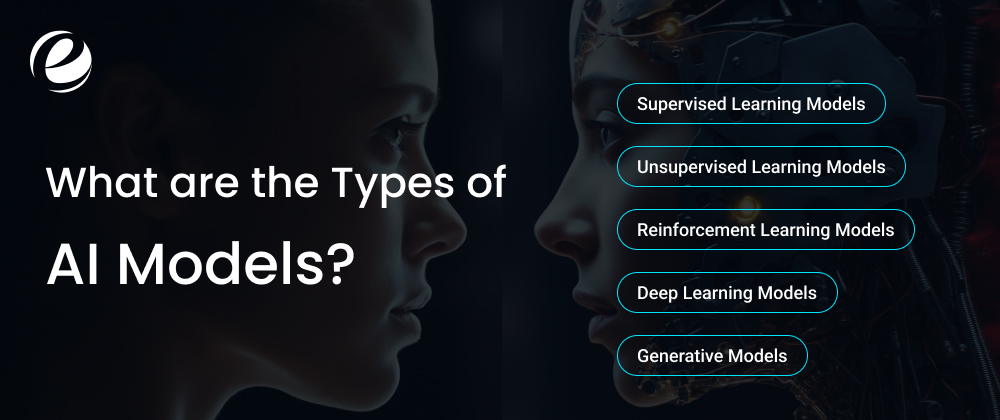
AI systems incorporate various forms; each is specially designed for dealing with particular types of challenges. They include those that aim for number predictions, human language understanding, or making decisions independently without consulting humans. The best AI models vary not only in the manner they learn but also in the way they perform their operations.
Knowing the different AI model types is vital for selecting the most suitable one for the job, whether it is for a chatbot, a recommendation system, or an image recognition tool. Let’s explore the most common types of AI models in simple terms.
Supervised Learning Models
The main concept of these learning models is that they are trained on data with labels, which means the outputs are already known. If we take the example of a machine learning model and show it a large number of pictures of cats and dogs with labels, it will be able to classify new pictures correctly. Examples of supervised learning usage are in the spam detection, fraud detection, and recommendation engine sectors. It is the best AI model if the data is clean and the objectives are well-defined.
Unsupervised Learning Models
On the other hand, unsupervised learning models learn from data that has no labelled answers. The model’s task is to find such patterns, groupings, or trends from the given data. Thus, they are the best for segmenting customers, conducting market research, and detecting anomalies. The latter are examples of tasks where such models do not take any instructions as a guide. Therefore, they become useful for recognizing previously unknown patterns.
Reinforcement Learning Models
These models learn by the trial-and-error method. The AI agents perform certain actions in an environment, get rewards or penalties, and learn over time what the best things to do are. The self-driving cars, robotics, and game-playing AIs like AlphaGo all rely on the same principle to operate. Tasks that require decision-making in complex environments are perfect for such models.
Deep Learning Models
Deep learning models are neural networks with multiple layers that enable them to absorb and extract from various and complex data, such as images, videos, or voice. Such models are inspired by the human brain and are used in facial recognition, self-driving cars, and AI language models like ChatGPT. These are some of the best AI models because of their ability to handle large-scale data with high accuracy.
Generative Models
Generative AI models aim to generate new data that is similar to the original data. They are able to produce images, texts, melodies, and even computer languages. For example, GPT (for text) and DALL·E (for images). This group of models is within the spectrum of OpenAI models, and they find their application in content generation, virtual assistants, and many others.
How to Train an AI Model Step by Step?
Building and training an AI model is the process of going through various steps of data processing that eventually result in the model being able to make intelligent predictions or perform certain actions. The process of developing a chatbot, a recommendation engine, or a visual recognition system generally follows a common workflow. Here are simple steps to build AI Software and train it efficiently.
Define the Concern
The first step is to clearly outline the concern that the AI model should solve. Is it an image classification, a language translation, or a product recommendation? Once you have set the goal, it will be easier to choose the correct model and data.
Collect and Prepare Data
Next, collect data that is relevant. It might be photos, words, figures, or a combination of all. Make sure to clean up the data by deleting errors, duplicates, and irrelevant entries. The condition of your data has a great impact on building correct models.
Choose the Right Model Type
Decide on your problem and data, and accordingly, select the most suitable AI model, like supervised learning, unsupervised learning, or deep learning. You are also able to tap into OpenAI models if you want to go more advanced with text generation or natural language understanding.
Split Data into Training and Testing Sets
Usually, you go with 80/20 and divide your data into training and testing sets. The training set shows the model, while the test set allows it to demonstrate how good it is with unseen data.
Train the Model
This is what real work is all about. Provide the training data to the model, which gives it the opportunity to find the patterns and make predictions. This would be the core of the whole process of learning to train an AI model.
Evaluate and Fine-Tune
Perform a test with your test input and check the results of the evaluation of accuracy, precision, recall, etc. If the change is not good, tune the parameters or even select another model.
Deploy and Monitor
After your model has achieved satisfactory performance, implement it in an actual real-world situation such as a website, a mobile app, or a retail platform. Keep observing how it is performing so you can be sure of its accuracy, and also retrain if there is a need.
7 Major Challenges in Building and Training AI Models

The best AI models are certainly revolutionizing industries, but their construction and training are not always hassle-free. A lot of challenges arise during this journey, like getting the right data and ensuring the model behaves in an ethical and proper manner. Knowing these difficulties enables you to plan more effectively and select a suitable method, tools, or even AI Development Services. Here are seven major challenges in building and training AI models in simple terms.
Lack of Quality Data
Clean and labelled data in large quantities is what AI models request to learn. Low quality or too little data can cause bias in data or result in wrong outcomes. Besides data collection, cleaning is the most time-consuming part of the process, too.
Data Privacy and Security Issues
Privacy issues arise from the need to handle private user data securely. Following the rules (such as GDPR) and ensuring the data is only used for safe purposes during the training of the model are responsibilities that businesses have. This is especially important in sectors such as healthcare and finance.
Choosing the Right Model
Many types of AI models exist, each with characteristics for different tasks. Choosing the wrong one will cause it to perform badly. Scaling the model according to the specific problem you want to solve is the most important.
High Computational Costs
Often, such models as AI language models or deep learning systems require commodities like GPUs or other devices to run for long periods, thus making the whole process expensive. Consequently, it might be unaffordable for small businesses.
Overfitting and Underfitting
When an AI model is trained excessively on the training data (overfitting), it might fail to give good results with the new data. If it selects too little (underfitting), it may not work at all. Achieving a balance is difficult and necessitates precise adjustments.
Lack of Skilled Talent
The best-qualified people for data science, machine learning, and software engineering are needed to create and train the best AI models. Numerous companies have trouble locating well-qualified workers or the appropriate AI chatbot development company.
Continuous Maintenance
AI models have to remain up to date through constant work, such as monitoring and retraining, since only then will their performance be smooth. In case of negligence, the bias might get affected negatively, or even the result might become obsolete over time.

Top Use Cases of AI Models Across Industries
Across many industries, AI models are used to automate processes, improve customer experiences, and make more informed decisions. They can learn from data and change over the course of time. Thus, they make them fitting tools for today’s businesses. Below are the leading and most effective application areas.
Healthcare Diagnosis
By utilizing AI models in medical imaging, lab tests, and patient data analysis, physicians get timely information for deciding on the presence of diseases. Besides, they find their use in cancer detection, designing personalized treatment, and predicting patient risks.
Retail Personalization
Concerning e-commerce, the AI-powered retail software development applies AI models to recommend products. The product recommendations are based on the browsing history, past purchases, and the preferences of the customer, thus creating a better shopping experience and increasing sales.
Financial Fraud Detection
The best AI models are employed by banks and fintech to identify and stop fraudulent operations without any time delay. These models can go through transaction patterns and instantly identify any dishonest behaviour.
Customer Support Chatbots
Natural language processing models are extensively used in AI chatbot creation for the purpose of virtual assistants that comprehend and reply to customers’ questions at any time of the day. They not only uplift the support efficiency but also cut down the costs.
Manufacturing and Predictive Maintenance
AI algorithms foresee the possibilities of breakdown of machines and therefore, determine a downtime-free production period for a manufacturer, thus saving them from unnecessary expenses. These also help in sensing the data generated by the sensors and thus, make the best use of this data to schedule the right maintenance time.
Autonomous Vehicles
By combining the top AI models and deep learning, a self-driving car can comprehend the road situation, identify the objects present, and thus make driving decisions, This will result in the improvement of road safety and car traffic efficiency.
How AI Models Learn: Explained with Real-Life Examples
Have you ever thought about the mechanism behind the learning process of AI models? They essentially mimic human learning by practising; instead of reading and attending classes, they get their knowledge from data. As their data access increases, their capability to spot patterns, solve problems, and take smart actions also grows. Real-life cases that illustrate such a process are given below.
Learning from Labeled Data (Supervised Learning)
Consider the case where an AI shows thousands of images of cats and dogs; these images are labelled correctly without any error. Eventually, the model will develop the ability to recognize various images by exploiting common attributes such as the ear shape or details of fur texture that are the most typical of them.
Learning from Patterns (Unsupervised Learning)
Music streaming platforms such as Spotify organize your most loved songs in a way that they don’t have to learn exactly what you like about them. They apply unsupervised learning to unearth similar music patterns from listening history.
Learning by Trial and Error (Reinforcement Learning)
An autonomous vehicle improves its capability to avoid obstacles by continually deciding and being informed; thus, it can learn. A case in point is that a “reward” is granted if the car stops at a red light; however, if it goes through the red light, a “penalty” will be given.
Understanding Language (AI Language Models)
Imagine that you are having a conversation with a chatbot and it is responding in an understandable manner. The reply is generated by AI language models that use advanced technology like AI. These models are developed by training on vast amounts of data to learn the grammar, tone, and context of the language.
Predicting Outcomes (Predictive Models)
In a scenario where a doctor has to make a decision on which patients are most likely to get a disease, AI can come up with the answers by looking at the medical records. Based on these predictions, the doctors will be able to diagnose and treat the cases at an early stage if necessary.
Creating New Content (Generative Learning)
Open AI models like ChatGPT or DALL·E are aimed at producing human-like text or images. They are going to take an existing corpus and use it to generate new, original creations.
Ethical Considerations When Using AI Models

Technology is evolving fast, and AI models are becoming more powerful and more widely used. This brings with it the necessity of using them responsibly. The ethical obligations that the developer, business, and user have to themselves are summarized below.
Data Privacy
Technological models that use artificial intelligence derive their learning from private information a lot of the time. Data privacy is hence an important issue when it comes to ensuring that personal information about the user is protected, and that data privacy laws such as GDPR are followed. Data abuse or leakage of sensitive information can result in harm to individuals and damage trust.
Bias and Fairness
One of the consequences of the biased nature of training data is that it will become an AI model that is similarly biased; this will lead to unfair results. Take a hypothetical example of a hiring AI; it might incorrectly give preference to one gender over another. Therefore, it is crucial to guarantee the fairness of the model’s outputs.
Transparency
Individuals must be aware that an AI is involved in the interaction and be informed of the decision-making process. A transparent AI not only fosters confidence but also enables users to grasp the logic behind a result provided by a model.
Accountability
If an AI system makes mistakes, who should bear the blame? The parties responsible for the creation of the models and the ventures must take accountability for the usage of the models and ensure that the problem-solving is done clearly.
Misuse and Harm
AI models, being very powerful, like deepfakes or content generators, can be easily exploited to disseminate false information or harmful content. The developers of the AI should, however, have a good understanding of clearly set boundaries and safeguards, in order to be safe from those who want to misuse the AI.
Inclusion and Accessibility
The AI of the future should be something designed for all of us, including people with disabilities and those who live in communities with limited resources. If AI development services are made more accessible to a wider range of people, then it stands to reason that improved and more just solutions will be created.
How Emizentech Helps in Building AI Models?
Emizentech is a reliable technology partner that helps enterprises create intelligent, effective, and scalable AI models that are completely designed specifically for their needs. If you are looking to execute chatbots to automate customer service, customize user experiences, or predict business trends, we are the one that offers the complete range of AI development services.
Our AI experts’ team is responsible for all of this: choosing the correct model and training it with good data, deploying it, and keeping it running in practice. Having experience in AI-based retail software development, AI chatbot development, etc., Emizentech guarantees that your AI solution is correct and trustworthy and will continue to progress with your company.
Conclusion
AI models are the backbone of present-day smart technologies. They’re assisting businesses and individuals to solve problems in a quicker and smarter way in such areas as chatbots, recommendation systems, cars that can drive themselves, and medical diagnosis. If you get the gist of how AI models function, the kinds that exist, and the methods they are trained on, you will have a solid basis for discovering their full capacity.
The industries that are continually going on with AI have a need for trustworthy, ethical, and efficient models, and this demand is going to be higher. If someone is searching for a chatbot to be built, a business process to be automated, or an intelligent app to be developed, knowing AI models is the first step.
To make AI work in your projects, take into consideration professional AI Development Services, AI-powered retail Software Development, and AI Chatbot Development, and learn the Steps to build AI Software that is suitable for you. The future is powered by AI; there is no better time than now to be a part of it.
FAQs
How much does it cost to develop an AI model?
The cost depends on a model's features, the amount of data, and the technologies used. The cost might be from several thousand to millions of dollars for an advanced project.
How long does it take to build and train an AI model?
The time of development depends on the work done to prepare data, the model type, and the complexity of the training. The duration may vary from weeks to several months.
What technology stack is used for AI model development?
Popular tools for the implementation are Python, TensorFlow, PyTorch, sci-kit-learn, and cloud platforms such as AWS or Azure for training and deployment.
Is specialized hardware needed for AI training?
Most of the time, it is true. GPUs and TPUs accelerate the process of training, particularly for deep learning models.
How do I choose the right AI model for my project?
The decision is based on your problem type, the data you have, and the level of performance you require. You may get in touch with experts or AI development companies for help.
What ongoing costs are involved after deployment?
Maintenance, new versions, retraining with additional data, and monitoring are continuous costs that enable the model to be accurate and efficient.




 +1 (989) 535-9295
 info@emizentech.com
 emizentech


