 Add us as a preferred source on Google
You laced up, stepped outside, and ran. But by the time you got home, you had no idea how far you’d actually gone, how fast your pace was, or whether you were even getting better. Sound familiar? Most runners face this challenge at some point. A watch that just tells time isn’t enough anymore, and guessing your progress gets old fast.
That’s where the right running app changes everything. From real-time GPS tracking to heart rate zones, pace alerts, and detailed performance breakdowns, today’s apps turn every run into data you can actually use. Whether you’re training for your first 5K or chasing a marathon PR, this list breaks down the 15 best running apps to help you track smarter, train harder, and run with purpose.
What Makes a Great Running App?
Before getting into the list, it helps to know what you are actually looking for. These are the things that separate useful apps from ones that collect dust on your home screen.
GPS accuracy matters more than most people realize. An app that logs 4.8 miles when you ran 5.2 is not a tracker; it is a liar. Beyond that, the best apps for running do more than measure. They interpret. They tell you whether today’s session was productive or whether you pushed too hard and need a rest day.
A few other things worth checking before downloading:
- Real-time GPS with reliable route mapping (especially off-road)
- Pace, heart rate, cadence, and elevation tracking
- Training plans that adapt based on your actual performance
- Wearable and smartwatch compatibility are relevant if you are building or using fitness tech.
- Offline mode for areas with poor signal
- Audio cues so you are not constantly glancing at your screen
- A social layer, if you are the kind of runner who trains better with competition
Now, you have to know the reason why the best running apps are crucial for your health. Let’s learn about all of them one by one, and after that you can have a quick look at the comparison table to choose the suitable one for yourself.
15 Best Running Apps in 2026
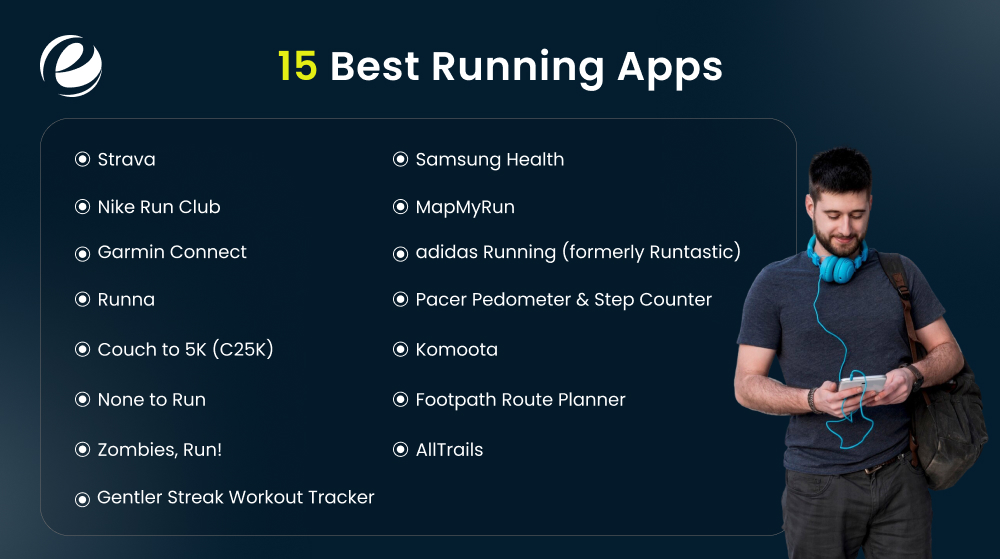
Grouped by use case so you can skip to what applies to you. No filler, no apps that are just rebranded pedometers. Below is a list divided into groups so you can easily find the best running app from it:
Group A: Best Running Apps Overall
These four apps are the ones most serious runners end up using. Strong GPS, solid data, and features that hold up over months of training.
Strava
Strava has been around long enough that calling it the best running app feels almost boring, but it still earns that title. The GPS is solid, the segment system turns familiar roads into mini-competitions, and the social feed keeps you accountable without being annoying about it. The app tracker features here go deeper than most: training load, fitness curves, and relative effort. Paid plan unlocks route planning and advanced analytics.
- Platforms: iOS | Android
- Price: Free / $11.99/month
Nike Run Club
Free. Genuinely free, not “free until you want the useful stuff” free. Nike Run Club gives you guided runs with audio coaching that sounds less like a bot and more like someone who actually runs. The app tracks your pace over time and adjusts its suggestions accordingly. If you are not ready to spend money on a running app, this is where to start. One of the best apps for running at absolutely zero cost.
- Platforms: iOS | Android
- Price: Free
Garmin Connect
If you already own a Garmin watch, this is not really a choice; it is the app. Garmin Connect pulls everything from your device: VO2 max estimates, body battery score, training effect, sleep, and stress. The amount of data can feel overwhelming at first. Stick with it. For anyone who takes the numbers seriously, it is the best run tracking app when paired with Garmin hardware.
- Platforms: iOS | Android
- Price: Free (requires Garmin device)
Runna
Runna is the newest addition to this tier, but it has moved quickly. It builds training plans around your goal race date, your current pace, and how your recent runs actually went, not just what the plan said. The weekly structure shifts based on performance data. Pairs well with smartwatch fitness tracker apps for clean, real-time data sync. Probably the best running training app for anyone preparing for a specific race.
- Platforms: iOS | Android
- Price: Free trial / $14.99/month
Group B: Best Running Apps for Beginners
Starting from scratch is hard enough. These apps remove the guesswork and give new runners a structured path that does not feel overwhelming.
Couch to 5K (C25K)
The name is accurate. Eight weeks, three runs per week, audio prompts that tell you exactly when to run and when to walk. That is it. C25K has been the best running app for beginners for over a decade because the structure works. There is no decision fatigue, no confusing dashboards. Just open the app and do what it says.
- Platforms: iOS | Android
- Price: Free / $4.99 per month
None to Run
None to Run is C25K with a gentler slope. If C25K felt brutal the first time you tried it, this one is worth a go. The 12-week program builds gradually enough that most people make it through without burning out or getting hurt. Video tips on running form are a nice touch that most beginner apps skip. A solid pick for the best running apps for beginners list.
- Platforms: iOS | Android
- Price: Free / $6.99/month
Zombies, Run!
Look, not everyone is motivated by stats. Some people need a story. Zombies, Run! Wraps your run in an audio mission. You are a survivor, picking up supplies and outrunning the horde. Interval training is baked in as “zombie chases.” It sounds gimmicky. Runners who have used it know it works. If accountability apps have not clicked for you, this might.
- Platforms: iOS | Android
- Price: Free / $6.99/month
Gentler Streak Workout Tracker
Most running apps push you to do more. Gentler Streak is different; it actively tells you to rest when your body needs it, pulling data from Apple Health to assess recovery. For beginners who tend to overdo week one and then disappear, this feature is a genuinely useful check. The streak mechanic rewards consistency, not intensity.
- Platforms: iOS
- Price: Free / $7.99/month
Pro Tip: Beginners often switch apps too soon. Stick with one for at least four weeks before judging it; your consistency matters more than the app’s feature list.
Group C: Best Free Running Apps
Free does not mean limited. These four apps cover distance, pace, routes, and community without asking for a credit card.
Samsung Health
Samsung Health does not get talked about enough. For Android users, especially on Samsung devices, the built-in run tracker is genuinely accurate. It logs distance, pace, heart rate, and calories with no subscription required. Not glamorous, but one of the best running apps free options that just works.
- Platforms: iOS | Android
- Price: Free
MapMyRun
Under Armour’s MapMyRun has a large route database and a solid free tier that covers GPS tracking, pace, and nutrition logging. The route community is useful if you are new to an area and do not want to plan from scratch. One of the best running apps free picks if you also do other cardio and want everything in one place.
- Platforms: iOS | Android
- Price: Free / $5.99/month
Adidas Running (formerly Runtastic)
Runtastic got a rebrand when Adidas took over, but the core tracker stayed reliable. Clean design, accurate GPS, and a free tier that covers the basics without the constant “upgrade” nudges some apps throw at you. If you want the best app for run tracking that does not cost anything and stays out of your way, adidas Running is a reasonable choice.
- Platforms: iOS | Android
- Price: Free / $9.99/month
Pacer Pedometer & Step Counter
Pacer starts as a step counter, but its running features are more capable than the name suggests. The group challenge feature is what makes it stand out from other free options; it adds team accountability that most free apps do not bother with. Good for runners who want a social nudge without paying for Strava.
- Platforms: iOS | Android
- Price: Free / $3.99/month
Group D: Best Run Tracking Apps for Routes and Trails
Road GPS apps often fall apart on trails. These three are built for terrain, elevation, and explorers who want to go somewhere new.
Komoota
Komoot is better for route planning than almost any running app. It knows the difference between a gravel path and asphalt, gives accurate elevation profiles, and works offline once you download the region. The community route library is large and well-rated. The best run-tracking app for anyone whose runs involve hills, trails, or terrain that Google Maps would label as “not a road.”
- Platforms: iOS | Android
- Price: Free / $3.99/month
Footpath Route Planner
Footpath does one thing: it lets you draw a running route on a map and tells you exactly how far it is. That sounds simple. It is. But if you plan routes rather than running freehand, the clean drawing interface saves a lot of time compared to other apps. One of the quieter, best-run tracking apps that runners tend to keep long-term.
- Platforms: iOS | Android
- Price: Free / $4/month
AllTrails
AllTrails has over 400,000 mapped trails with community reviews, difficulty ratings, and offline map support. For trail runners, it is the most useful discovery tool available. The app’s integration with emerging AI in sports technology is starting to show in smarter route recommendations based on your fitness data. The best app for running discovery on anything that is not a pavement.
- Platforms: iOS | Android
- Price: Free / $35.99/year
Quick Comparison Table of Best Running Apps
Still can’t decide what to choose? You can scan the table below. It covers the 15 best running apps side-by-side across the features that actually matter.
| App | Best For | Training Plans | Free Tier | Starting Prices |
| Strava | Overall / Social | Yes (paid) | Yes | $11.99/month |
| Nike Run Club | Free Coaching | Yes | Yes | Free |
| Garmin Connect | Data / Hardware | Yes | Yes | Free |
| Runna | Training Plans | Yes | Trial | $14.99/month |
| C25K | Beginners | Yes | Yes | $4.99/month |
| None to Run | Beginners | Yes | Yes | $6.99/month |
| Zombies, Run! | Motivation | Partial | Limited | $6.99/month |
| Gentler Streak | Recovery | No | Yes | $7.99/month |
| Samsung Health | Free / Android | No | Yes | Free |
| MapMyRun | Routes | Limited | Yes | $5.99/month |
| Adidas Running | All-round free | Paid | Yes | $9.99/month |
| Pacer Pedometer & Step Counter | Steps + Running | No | Yes | $3.99/month |
| Komoot | Trail / Routes | No | Yes | $3.99/month |
| Footpath | Route Planning | No | Yes | $4/month |
| AllTrails | Trail Running | No | Yes | $35.99/year |
So, with this table, you can easily select the suitable app on the basis of your critical needs and requirements.
How to Choose the Best Running App?
There is no universal answer. The right app depends on what your runs actually look like and what you are trying to fix. These are a few honest shortcuts:
- Want a structured plan with weekly targets? Runna or C25K. Pick based on whether you have a race in mind.
- Care most about data? Strava for community and segments. Garmin Connect if you own the watch.
- Need free, full-featured, and reliable? Nike Run Club. No caveats.
- Running trails or new terrain? Skip the road apps. Go straight to Komoot or AllTrails.
- Just getting started and not sure what you need? C25K. Start there. Upgrade later.
The best running app for beginners is rarely the most sophisticated one. It is the one with the smallest gap between downloading it and actually going outside.
Pro Tip: Enable auto-pause on your app from day one. It keeps your average pace accurate on routes with traffic lights, crossings, or hills where you naturally slow down.
Thinking About Building Your Own Running App?
The running app market is growing, and there is genuine space for niche products that serve specific runners better than the big platforms do. According to Business Research Insights, the market is valued at $1.32 billion in 2026 and projected to hit $5.5 billion by 2035.
That kind of growth attracts competition but also creates room for focused products and apps built for ultramarathon training, running clubs, rehab runners, or specific geographies. If you are a startup or sports brand thinking about this, sports application development is worth exploring to understand what building in this space actually involves.
How to Develop a Running App: Steps and Cost
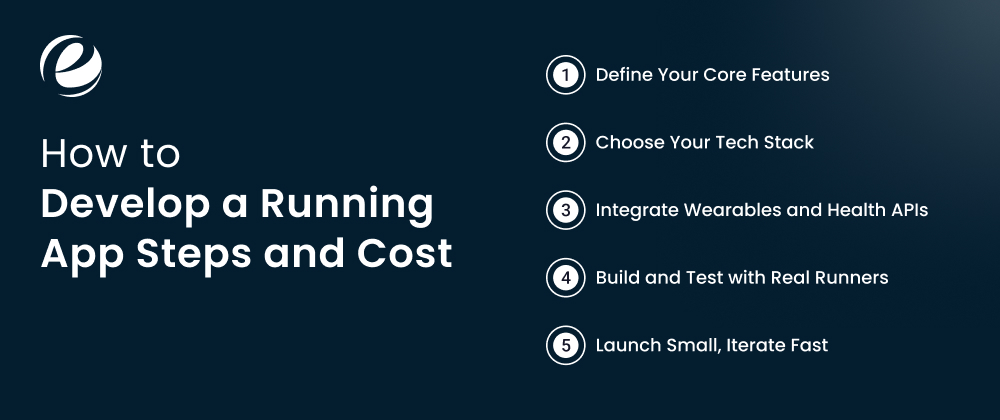
Building the best running app takes more than GPS and a nice UI. Below you will learn the development process step by step to develop a fully featured app:
Step 1: Define Your Core Features
Start narrower than you think you need to. GPS tracking, user profiles, run history, and performance stats cover 90% of what runners actually use. Decide on iOS, Android, or both before anything else; that choice shapes the entire build.
Step 2: Choose Your Tech Stack
React Native or Flutter handles cross-platform builds well. Backend infrastructure for user data and run storage, plus a map SDK like Mapbox or Google Maps for route visualization. Nothing exotic here, the complexity comes in the details.
Step 3: Integrate Wearables and Health APIs
Apple HealthKit, Google Fit, and Garmin APIs are where the real-time data comes from. Getting these right takes time and careful testing. Understanding wearable app development before you scope this out saves weeks of back-and-forth later.
Step 4: Build and Test with Real Runners
GPS drift, battery drain, and background tracking failures are the three things that kill running apps in reviews. Test outside, on actual routes, with actual runners, not just in a simulator.
Step 5: Launch Small, Iterate Fast
A soft launch with a few hundred users gives you real feedback without the pressure of a public rollout. Fix the things that matter. Ship updates regularly. The first version will not be perfect.
Here is the general development cost of the running apps based on the complexity:
- Basic MVP (core tracking, single platform): $15,000 – $30,000
- Mid-range app (cross-platform, training plans, wearable sync): $40,000 – $80,000
- Full-featured platform (coaching, social, marketplace): $100,000+
How to Monetize a Running App in 2026?
The apps that stick around have figured out how to make money without making the product worse. Here is what works.
- Freemium subscriptions: Give runners enough in the free tier to trust the product, then charge for advanced analytics and coaching. Strava and Runna both do this well.
- One-time unlocks: Works for feature-specific apps. Komoot’s regional map purchase model is a clean example: buy once, use forever.
- Brand partnerships: Co-branded challenges with gear companies, sponsored race prep plans. Works best once you have an engaged user base.
- Coaching marketplaces: Let certified coaches sell plans through your app. Look at how women’s health tracking apps have built revenue around personalized guidance; the model translates well to running.
- Aggregated data licensing: Anonymized run data has real value to sports science teams and gear brands. A longer-term play but viable at scale.
So, these are some of the models that you can choose to monetize your app to generate a good revenue from it.
Why Choose EmizenTech for Running App Development?
Good ideas need good execution. EmizenTech brings the technical depth to turn a running app concept into something runners actually use.
EmizenTech is a full-cycle mobile app development company with experience across fitness, health, and sports tech. The team covers everything from initial scoping to post-launch support, including GPS integration, real-time analytics, AI coaching features, and wearable connectivity.
- 10+ years building mobile products across iOS and Android
- Hands-on experience with health, fitness, and sports applications
- Full-stack capability: frontend, backend, API, and infrastructure
- Wearable and IoT integration handled in-house
Whether you are building a consumer app or a tool for a professional training team, you can hire mobile app developers from EmizenTech who have experience in this area and understand the challenges involved in the projects.
Conclusion
The best running apps in 2026 have moved well past simple distance logging. The good ones coach. They plan. They tell you when to back off. Whether you need the simple running app for a structured training block or the best run tracking app built for trails and terrain, something in this list fits. Pick the one that matches where you actually are right now. Not where you plan to be in three months.
FAQs
Is Strava Premium worth paying for?
The free tier of Strava is good for most runners who simply want to track distance and time. With the help of premium features, users get route building, deep segment leaderboards, and advanced fitness analytics.
Do I need multiple running apps?
There are many runners that use a combination of 2 to 3 apps: one for GPS and tracking and an optional one for structured training or entertainment that keeps them engaged.
What are the best apps for Apple Watch running?
Strava, Nike Run Club, and Runna all feature highly optimized, standalone Apple Watch apps that track your heart rate and location without needing to carry an iPhone.
What are the best running apps for beginners?
The highly recommended options for starting out are Couch to 5K and Nike Run Club because they provide highly favored, built-in guided coaching for free.



 +1 (989) 535-9295
 info@emizentech.com
 emizentech


