
 Add us as a preferred source on Google
 Following regulations keeps you safe from unnecessary burdens and fines that you can easily avoid. According to Grand View Research, the Compliance Software Market is expected to grow to 78.9 billion by 2033. These facts clearly show the value of following rules and regulations and ensuring your organization is legitimate in every aspect. There is no doubt it helps build trust among users.
But as regulations become more complex and require greater clarity and transparency, the best option is to deploy compliance management software. This software solution ensures your company knows and follows current policies, helps mitigate risks, and optimizes business operations. Read this guide to gain an in-depth understanding of how this software works, its key benefits, and how you can choose the right solution that aligns with your business goals.
What is Compliance Management Software?
Compliance management software is an integrated system that businesses use to meet regulatory requirements, internal policies, and industry standards. Using effective compliance managing software helps you and your organization understand the repercussions of non-adherence to rules and regulations and focus on achieving regulatory compliance.
Why Do Businesses Need Compliance Management Software?
To answer your question of why businesses often require compliance management software, let’s have a look at its implications. What can happen if you choose not to deploy a software solution like this?
The Ability to Avoid Errors and Mistakes
The best compliance management software records and tracks your business activities or tasks consistently. Maintaining and updating all your records in a spreadsheet is considerably difficult. Storing information via email, documents, or spreadsheets carries a high risk of data loss or theft.
Furthermore, you cannot expect 100% transparency in your work or draw measurable conclusions. That’s why people prefer adopting compliance risk management software that not only mitigates risk but also helps prevent avoidable errors and mistakes.
Reporting Ability
Manual reporting processes are time-consuming. Drafting manual compliance reports, imparting training to employees, due diligence, and assessment – everything eats up a lot of your time. Merely integrating a standard tool and saying you have automated the work. You may not, when a senior person asks for the relevant impact made, which may be beyond the tool’s capacity. Reporting gets even tougher when a new product launches, a new regulation is introduced, you expand into a new market, or the board makes a new request, and you have to start everything from scratch.
It’s not only tiring but exhausting too. In these scenarios, compliance management software is often the best investment and a strategic business move. It structures your company’s compliance tasks and generates data on compliance efforts. This helps you assess risk more clearly and reliably.
After assessing all these points, you will never be confused about the question: why do businesses need compliance risk management software? It’s a necessity, and avoiding it can impact your business’s scalability in the long run.
Core Benefits of Compliance Software and Risks Involved
Now that you understand the importance of this software solution, let’s move on to its core benefits and the risks involved.
Benefits
Handle and Minimize Risk
If you are working with the best compliance management software tools, you will notice they sweep away flaws in the workflows and processes you are working to manage and reduce risks. Such compliance software is also used to build organizational charts and entity diagrams to visualize the entire structure, highlight potential issues, and file reports directly with regulatory bodies.
The notification and dashboard tabs help you identify concerns early, before they become high-risk issues for your organization. It also serves as a single source of truth, reduces data duplication, and supports informed decision-making.
Boost Efficiency
We all know accuracy drives efficiency. Transparency in decision-making leads to accurate results, improving productivity and helping you identify areas that need attention. If you are opting for cloud-based compliance management software, the best way to boost efficiency is to collaborate with third parties and stakeholders by carefully managing user permissions.
To simplify signatory duties, e-signatures are now trending, saving you from unnecessary delays. Furthermore, by leveraging automation, company secretaries can focus on more strategic decisions, as it handles the day-to-day work.
Cost-Efficient
Cost-efficiency is directly related to your organization’s efficiency. The higher the efficiency, the lower the costs, and the more efficient your business will be, and vice versa. The software for compliance management is known for reducing outlays because everything is managed digitally, saving you significantly on office and storage space costs.
Increased Flexibility
Compliance management software serves as a centralized platform that gives organizations and business owners greater flexibility and supports strategic thinking and decision-making. It means you can keep everything organized in one place, with clear visibility into how things are working, current growth levels, and more. The more agile your compliance and operational systems are, the better and more effective your planning can be.
Improved Performance
The math is simple: collaboration + efficiency + flexibility = improved performance for your organization. If your teams use compliance systems, they can address silos across finance, accounting, healthcare, and administration. For healthcare needs, you can consider deploying healthcare compliance management software. This will help you gain the right analytical information and organizational insights to drive growth and performance.
Now that you are well aware of the benefits of using the best compliance software, let’s assess the risks associated with it.
Risks Involved
Adoption Challenges
Once you become accustomed to a technology, a new invention can disrupt it and require a shift. As humans, we love comfort, whether it’s using existing software or being in our own place. But to achieve the best results possible, you need to step out of your comfort zone. Similarly, you may face difficulties when connecting a new CMS to existing ones, which can sometimes lead to data silos.
Heavy Reliance on Automation
Don’t run toward automation unthinkingly, as it can lead to human oversight and unnecessary nuances. You may often face algorithmic bias issues, such as third-party vulnerabilities. Therefore, it’s advisable to avoid over-automation, as it can disrupt your existing organizational frameworks and hamper overall growth.
Incomplete Visibility
You cannot determine the true level of transparency or growth if you are operating in Shadow IT. If your organization uses on-premises or cloud-based development models, you may face similar risks. As a result, there will always be a gap in compliance tracking, leaving blind spots, especially in audit trails.
Key Features to Look For in Compliance Software
If you are planning to opt for the best compliance software, look for the key features that are mentioned below:
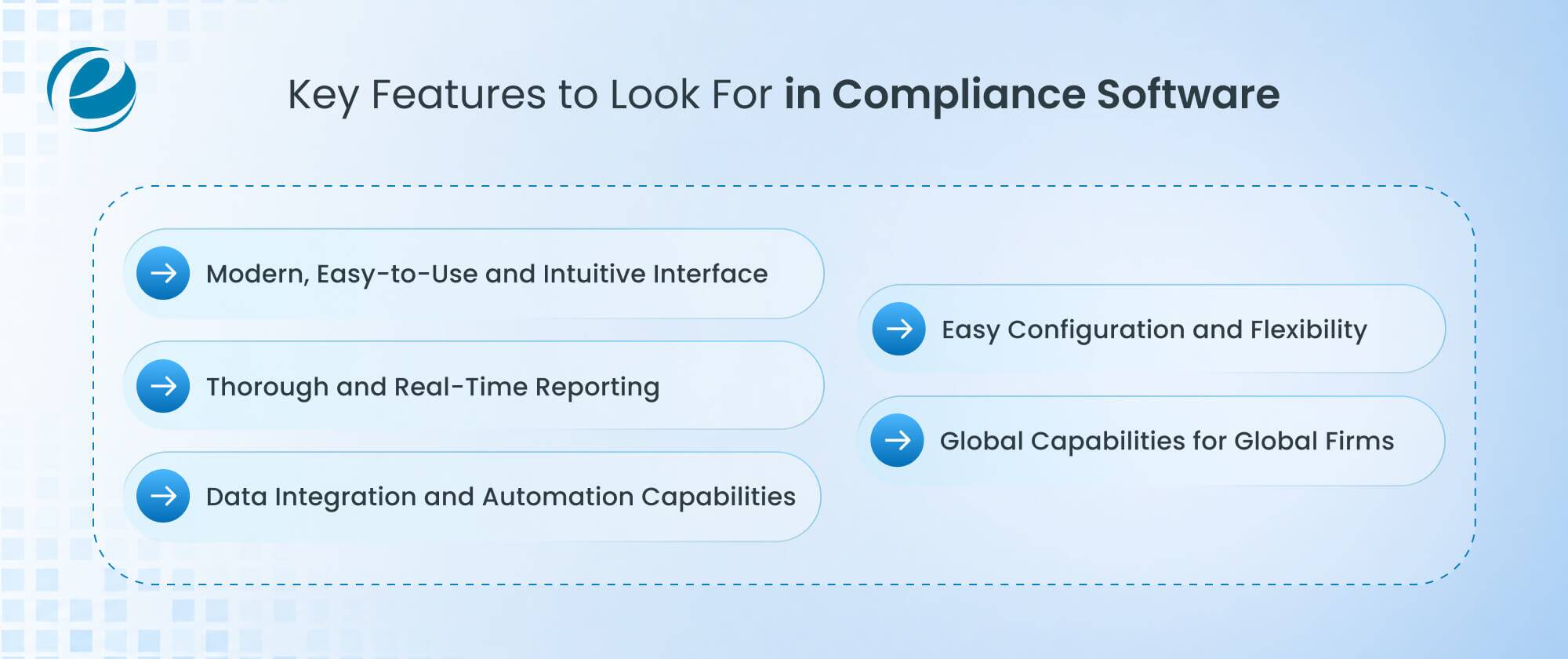
Modern, Easy-to-Use and Intuitive Interface
We live in a technological era where everyone prefers simplicity, and apps like Instagram and Twitter (X) have raised the bar with clean, easy-to-navigate designs. So, if you are looking for compliance management software, choose one that promises a simple, clear, easy-to-navigate, intuitive design.
This reduces the mental load for compliance managers by cutting down on questions. No employee or business owner will be interested in a bulky app. A smooth design will also increase the app’s longevity.
Thorough and Real-Time Reporting
With the right software for compliance management, efficiency can increase threefold, especially for compliance managers, who can report directly to senior management on the company’s market goodwill and help avoid penalties and the risks of non-compliance. The best tools help compliance teams proactively identify risk and go a long way toward accomplishing this very high-value activity.
Look for software development services with the widest range of reporting tools, especially those that can automatically generate and deliver management information showing activity, trends, and resolutions.
Data Integration and Automation Capabilities
In simpler terms, if you want to understand what automation is, you can say it is an alternative to repetitive tasks and manual, mundane work. Companies prefer to implement automation and data integration capabilities to shift their workforce’s focus towards higher-value functions that create a visible impact on the company’s growth and performance and help improve overall productivity.
If you associate it with compliance, it means having more flexibility and time for tasks such as policy creation, employee training, compliance strategy development, and regulatory reviews.
Easy Configuration and Flexibility
Whether it’s compliance risk management software or standard compliance programs, the best options offer built-in configurations without hidden charges or added costs. When it comes to flexibility, installed compliance platforms and systems should not feel like a burden, requiring extensive employee training to fully understand the software and a costly process of adjusting policies through committee and board meetings and legal reviews.
The best compliance management software quickly adapts to your existing work environment without creating chaos.
Global Capabilities for Global Firms
Compliance risk management software is highly useful when your business operates globally. The best system ensures it handles national and international boundaries and covers every conceivable situation.
For example, employees in different jurisdictions as well as regions often have different regulatory requirements, and a strong system supports multiple currencies, time zones, and languages. Global capabilities for global firms become much easier when compliance software is designed so regional compliance officers see only the data for the employees they monitor and users see only the functions relevant to them.
Types of Compliance Management Software
The growing number of strict data privacy norms and regulations makes it cumbersome for organizations to manage everything manually. That’s why individuals or companies prefer to deploy the best compliance management software to stay ahead in the market and gain a competitive edge.
You need a brief understanding of the types of such software available to integrate privacy compliance and risk management into your day-to-day business operations.
1. Regulatory Compliance Software
Regulatory compliance software helps organizations and professional entities follow laws and regulations specific to their industry or region. With this software solution, you can track regulations applicable to your company, identify potential gaps, and generate documentation to prove compliance during audits or inspections.
Its sub-areas involve:
- Financial compliance: If you run a financial company, compliance will involve internal controls testing, financial reporting workflows, and segregation-of-duties tracking.
- Healthcare Compliance: Healthcare apps are built around HIPAA and EHR integrations that help track valuable information like access logs, breach notifications, and business associate agreements.
- Data privacy compliance: Here, you follow and address GDPR (EU), CCPA (California), and similar laws. It also includes consent management, handling data subject requests, and data mapping (knowing where personal data lives).
Useful For: Regulated industries like banks, hospitals, insurers, manufacturers.
2. IT and Cybersecurity Compliance Software
These software solutions are highly targeted at organizations that prioritize information security frameworks over general business regulation. IT & Cybersecurity Compliance Software helps in mapping security controls to frameworks, automates evidence collection for audits, and continuously monitors for control failures (like a misconfigured server or expired access credentials).
Key Characteristics:
- Automation for evidence collection (screenshots, logs, configs pulled directly from cloud environments)
- Constant control monitoring
- Vendor security questionnaires
- Cloud platform integrations with AWS, Azure, GCP
Best suited for: Tech companies, SaaS vendors, and organizations managing sensitive data.
3. GRC Platforms (Governance, Risk & Compliance)
A governance, risk, and compliance platform, also referred to as an enterprise approach. Organizations often prefer GRC platforms because they eliminate the need to buy separate tools for risk, policy, and compliance.
How it works:
- Governance: Tells who is accountable for what and how decisions are made.
- Risk: Identifies, scores, and tracks risks across the organization.
- Compliance: Links it back to specific regulatory or policy requirements.
Ideal For: Large enterprises with complex and multi-jurisdictional compliance needs.
Steps to Build Custom Compliance Management Software
Off-the-shelf tools force your processes to fit their design. Custom software development helps flip that, but only if the project is run with discipline. Here’s the sequence that experienced teams follow.
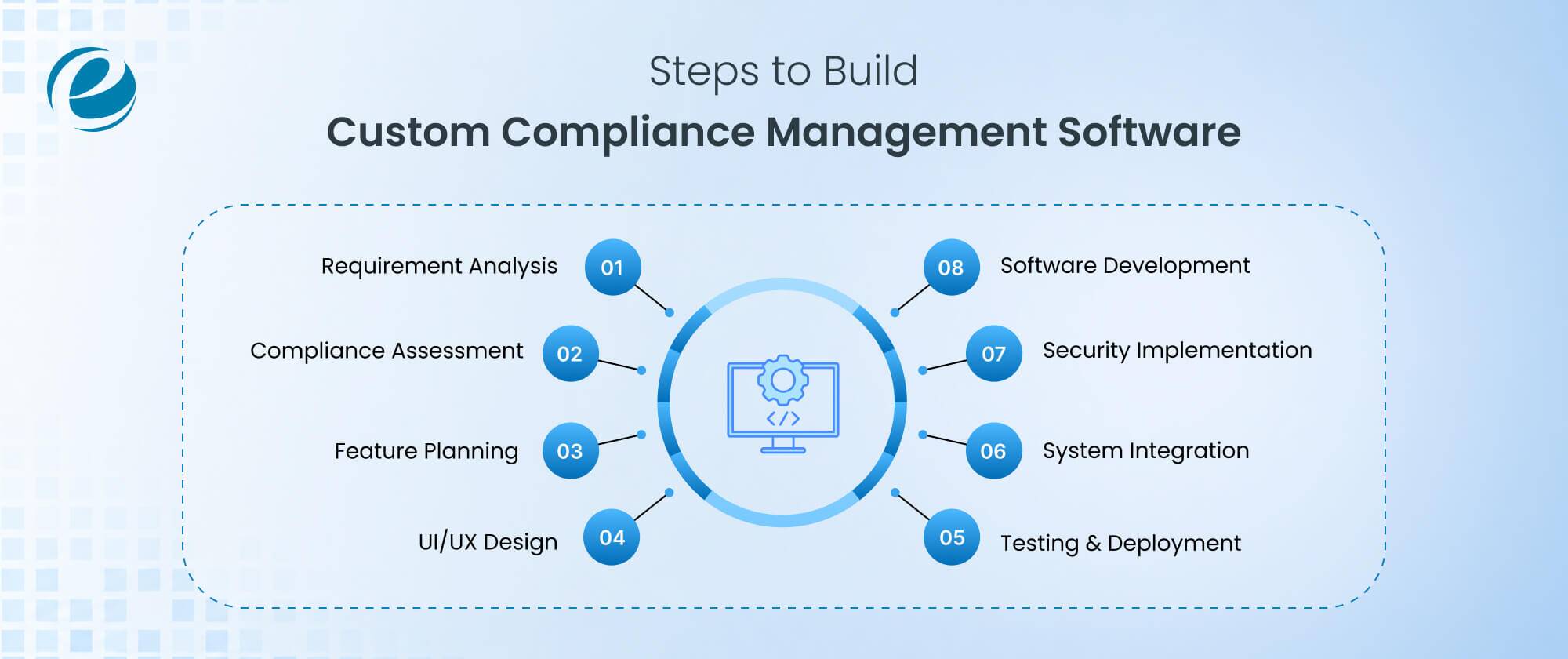
Requirement Analysis
Start by mapping how compliance actually works in your organization today, not how the org chart says it works. Interview the compliance team, sure, but also talk to the department managers who file incident reports and the IT staff who pull evidence during audits. The gaps between official process and daily reality are where your requirements hide.
Document current pain points with specifics:
- How many hours audit prep consumes
- Where data gets re-entered manually
- Which deadlines have been missed and why
These numbers become your success metrics later. A vague goal like “improve compliance” can’t be measured; instead, aim for “cut audit preparation from six weeks to two,” if you can.
Compliance Assessment
Next, catalog every regulation, standard, and contractual obligation the software must support. This list drives architecture decisions, so it has to be complete before design starts.
A company handling European customer data needs GDPR-compliant data handling baked into the foundation. One processing card payments needs PCI DSS controls. Healthcare providers need HIPAA-compliant apps that safeguard any record that touches patient information. Also consider what’s coming. If expansion into a new market or product line is on the two-year roadmap, the regulatory load that comes with it belongs in this assessment now.
Feature Planning
With requirements and obligations documented, translate them into a prioritized feature list. Resist the urge to build everything at once. A focused first release, typically covering policy management, incident tracking, and basic reporting, delivers value in months. In contrast, a build-everything approach delivers nothing for a year and then arrives bloated.
Rank features by a simple test:
Does the feature reduce regulatory exposure, save measurable staff time, or unblock something the business needs?
Features that pass none of the three criteria go to the backlog. This is also the stage where you define the data model, because the way you structure risks, controls, policies, and evidence determines how flexible the system will be over the next decade.
UI/UX Design
Compliance tools fail most often for a mundane reason: people avoid using them. If filing an incident report requires 12 clicks across 3 confusing screens, employees will report incidents by email instead, and your carefully designed system will end up with incomplete data.
Design for the busiest, least technical user in the workflow.
Forms should be short, statuses should be obvious, and the next required action should never be a mystery.
Prototype the core flows and test them with real future users before development begins; a week of usability testing at this stage can prevent months of adoption problems later.
If your in-house team is stretched thin, this is a sensible point to hire web developers with UI-heavy product experience rather than treating interface design as an afterthought.
Software Development
Now the build. Agile sprints work well for compliance platforms because requirements sharpen as stakeholders see working screens. Release internally in increments, gather feedback from the compliance team every sprint, and adjust before misunderstandings harden into finished code.
Technology choices should favor boring reliability over novelty. Compliance systems run for years and must be maintainable by whoever inherits them. Clean architecture, thorough documentation, and automated test coverage are non-negotiable here in a way they might not be for a marketing site.
Many organizations without a large internal engineering bench choose to hire web developers from an established team for this phase, keeping product ownership in-house while outsourcing the build itself.
Security Implementation
A compliance platform that gets breached is an irony nobody wants to explain to a regulator. Security work runs parallel to development, not after it.
The baseline: encryption for data at rest and in transit, multi-factor authentication, granular access controls, secure session handling, and comprehensive logging of administrative actions. Beyond the baseline, schedule penetration testing before launch and code reviews focused specifically on the OWASP Top 10.
If the system will store regulated data categories, verify that storage locations and backup routines meet the residency and retention rules identified back in the compliance assessment.
System Integration
Connect the new platform to the systems it must exchange data with: HRIS (human resource information systems) for employee records and offboarding triggers; document management for evidence storage; email and chat tools for notifications; and, if applicable, ERP or CRM systems, depending on your workflows.
Build integrations defensively. External systems go down, APIs change, and data arrives malformed. Each connector needs error handling, retry logic, and alerting so a silent sync failure doesn’t quietly corrupt your compliance records for weeks. Test each integration with production-scale data volumes, because a sync that works with 50 test records can choke on 50,000 real ones.
Testing & Deployment
Testing a compliance platform goes beyond checking that buttons work. Verify that the audit trail captures every action accurately. Confirm that role permissions block anything unnecessary or spammy. Run the reporting engine against known data and check the numbers match. Simulate a mock end-to-end audit and see whether the evidence the system produces would actually satisfy an auditor.
For deployment, run the new system alongside existing processes for one full compliance cycle before cutting over. This parallel period catches gaps while the old safety net remains in place. Pair the rollout with role-specific training, short sessions focused on each group’s specific tasks, and appoint internal champions in each department to answer day-one questions.
After launch, the work shifts to maintenance: regulatory updates, security patches, and feature refinements driven by user feedback. The best compliance management software, whether bought or built, is never really finished, because the rules it enforces never stop moving. Budget for ongoing development from the start, and the platform will keep earning its place for years.
How Much Does Compliance Management Software Cost
| Business Tier | Estimated Annual Cost | Best For | Typical Features Included |
| Budget / AI-Driven | $3,000 – $8,000 | Startups, micro-teams | 1 framework, lightweight AI policy syncing, basic dashboard |
| Mid-Market | $10,000 – $35,000 | Growing SaaS & tech firms | 1–3 frameworks (e.g., SOC 2, ISO 27001), automated evidence collection |
| Enterprise / Full GRC | $50,000 – $150,000+ | Highly regulated industries | Cross-framework mapping, continuous monitoring, third-party vendor risk |
How to Choose The Right Compliance Management Software
If you’re planning to choose the right compliance management software, you may have lots of considerations and no idea where to start. Don’t worry; ask these questions to determine which software best fits your needs.
Question 1: Does the compliance software have all the right features?
Ans: Emphasizing digital landscapes is even better with a product that has all the necessary features relevant to your business. To name a few:
- Smart Dashboards: Intuitive and navigable dashboards that are easy to use and are color-coded with drill-down capabilities.
- Native Mobile Applications: iOS and Android-based mobile applications that will help you manage your compliance.
- Agile Workflows: Easy-to-configure workflows that can be adapted to your business processes.
- Legal Notifications: Receive timely updates to stay in the loop.
- SaaS-Based Models: These models are easy to adapt without requiring additional IT infrastructure or licenses.
Question 2: Are the software solutions easy to use?
Ans: Software development trends keep coming and going, but the best ones sustain. If you are also confused about whether the solutions are easy to use, it depends on whether your employees feel comfortable using the software. Everyone demands a user-friendly interface.
Question 3: Can they scale with you?
Ans: Mid – and large-sized businesses are growing rapidly in the USA. The higher the revenue growth, the higher your digital footprint will be across the globe. It directly indicates an exponential increase in your compliance obligations.
Why Choose Emizentech to Build Your Compliance Platform?
Choose Emizentech if you are planning to build software for compliance management. The reason is that, in today’s world, compliance is a necessity, not an option. Especially when users around the globe prefer partnering with a trusted, reliable, and compliant company. Affordability and budgets take a back seat in long-term projects, and clients prefer trust above all.
Emizentech has earned ratings from Clutch and GoodFirms, helping it stand out from other agencies in the market. Over time, they have also amassed numerous positive client testimonials in eCommerce, web, software, and mobile app development, making them a preferred choice for many users. The dedicated developers believe in delivering quality work that helps you see results from day one. If you have an idea for such software, our experts are here to help.
Final Verdict
Compliance management software will not just simplify your daily routine tasks but also save you time wasted on mundane work. With such software, you can develop projections for your business, support analytical decision-making, and more. As tech evolves, the need for compliance will continue to grow. So if you’re still deciding when to integrate compliance management tools, what’s required is execution and implementation. There is no right time; the right time comes only when you deploy the compliance tool.
FAQs
1. What is the best compliance management software?
There is no single best software. The thing that is best for you may be of no use to others. Therefore, selecting the best compliance management software means identifying your specific regulatory requirements and then choosing software that matches your needs.
2. How much does compliance management software cost?
Software for compliance management costs vary by business size, industry, and the frameworks you manage.
- For entry-level startups, it will cost between $20 and $500 per month
- For mid-market automation, it will range between $8,000 and $35,000 per year
- For enterprise GRC, it will lie between $50,000 and $100,000+
3. Is compliance management software required by law?
No, specifically, software for compliance handling is not explicitly required by law.
4. What is the ROI of compliance management software?
Well, if you ask about the ROI of compliance management software, it comes from:
- Administrative time savings
- Reduced labor costs
- Financial avoidance of regulatory penalties and legal fees
5. How long does it take to build custom compliance management software?
If you plan to build custom compliance management software, it typically takes 3 to 12 months from inception to completion.



 +1 (989) 535-9295
 info@emizentech.com
 emizentech


