
 Add us as a preferred source on Google
 TL;DR:
- Agile methodologies are Scrum, Kanban, Scrumban, XP, lean software development, feature-driven development, DSD, adaptive software development, Crystal, and the Scaled Agile Framework.
- The Agile SDLC includes concept, inception, iteration, release, maintenance, and retirement.
- The benefits of Agile SDLC are faster time to market, reduced risk, better visibility, and higher quality.
- The challenges of Agile SDLC are scope creep, cost and timeline uncertainty, insufficient documentation, and team burnout.
- The cost of developing custom software using Agile methodology starts at $25,000 and can go up to $300,000.
Agile software development is a method for creating a product in short sprints. It aims to deliver working software faster, adapt to changing requirements, and reduce the risk of building the wrong thing.
But Agile isn’t a single approach. It has different frameworks, like Scrum, Kanban, and Extreme Programming. Each framework sets its own roles, meetings, and speed of work. This variety means you can choose a framework that fits your team size and how your project needs to move.
This is how most software development teams now work. According to Digital.ai’s 18th State of Agile Report, companies now use hybrid and Agile-based delivery models regularly.
Choosing the right framework still depends on a few factors. Team size, how often requirements change, and project complexity all affect which setup works. For the best results, it helps to work with experts who have used these frameworks on real projects.
With more than 12 years of experience creating software for clients in different industries, we have set up Agile many times and know what works and what does not. At EmizenTech, we help teams choose and run an Agile setup that fits their actual project.
What is Agile Software Development Methodology?
Agile software development methodology is an approach to building software in short cycles, called sprints. It is not about planning the entire product upfront. Each cycle produces a working piece of the product. Clients see it and give feedback, and the team uses that feedback to plan the next cycle.
The main idea behind agile software development methodology is simple. You build a small piece, test it with real feedback, adjust, and repeat. It is less of a rigid rulebook. It stays flexible, keeps the client involved, and does not wait until the end to find out something is wrong.
Agile is not limited to software anymore. Many teams, like marketing and product development teams, also use Agile principles. But it started in software development, and that is still where most people use it.
How Does the Agile Process Work?
Agile is not one rigid process, but most teams follow a similar rhythm. Let’s have a look at its workflow.
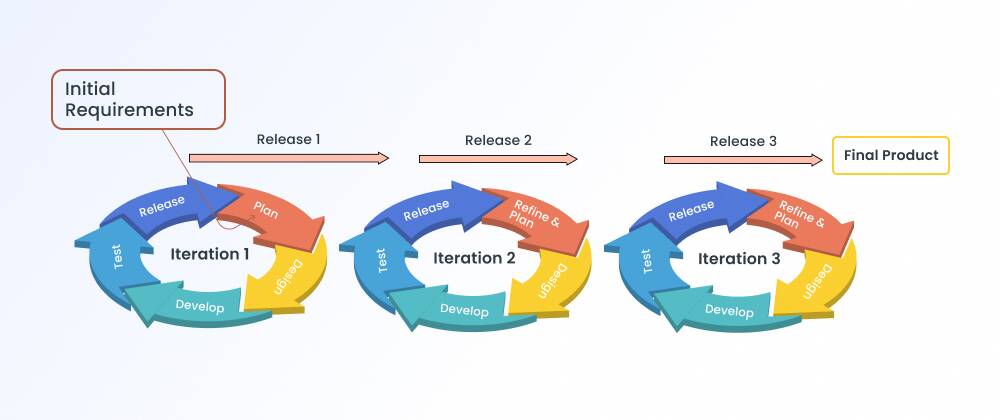
1. Build a Backlog
The team lists everything the product might need, like features, bug fixes, and requirements. This list is never final. It grows and changes as the team learns more.
2. Plan a Sprint
At the start of the project, the dedicated development team first chooses the high-priority tasks from the backlog to complete in one sprint. It usually lasts two weeks.
3. Build and Test
Now developers write code, testers test it, and designers design, all working from the same short list of sprint goals.
4. Daily Meetups
Team members hold a daily meeting, usually 15-20 minutes, to discuss what they did yesterday, what they will do, and any roadblocks they face.
5. Testing and Review
Testers regularly test features built to ensure high quality. At the end of the sprint, the team shows what it created to the clients and gets real feedback.
6. Reflect and Repeat
Lastly, the team looks back at what worked and what did not. They update the backlog and start the next sprint.
A Brief History: Where Agile Came From
In 2001, seventeen software developers met in Utah and wrote down 4 values and 12 principles. They called it the Manifesto for Agile Software Development. It was not a company initiative but a group of developers tired of watching projects fail because of too much upfront planning and too little flexibility.
Four Core Values of the Agile Manifesto
- Individuals and Interactions Over Processes and Tools
People solve problems. Communicate with your team instead of just following a rigid workflow.
- Working Software Over Comprehensive Documentation
A working feature matters more than a 40-page specification document nobody reads.
- Customer Collaboration Over Contract Negotiation
You can keep communicating with clients throughout the project, not just at the start and end.
- Responding to Change Over Following a Plan
If the market changes or the client learns something new, change the plan. Do not force reality to fit an old document.
None of these values say that documentation or planning is useless. They just say do not allow those things to get in the way of building something that works.
The 12 Principles of the Agile Approach
Instead of listing all twelve Agile approaches in detail, here are the pointers you must consider:
- Delivering software early that has real business value increases customer satisfaction.
- Responding quickly to changing needs, even when the development stage is already far along.
- Facilitating frequent software delivery.
- Establishing close cooperation between the development team and clients.
- Including motivated specialists in project teams and creating a proper work environment.
- Setting up real-time communication within the project team.
- Considering working software as the primary measure of progress.
- Maintaining a sustainable development pace.
- Paying continuous attention to technical excellence and sleek design.
- Minimizing unnecessary work.
- Encouraging team self-organization.
- Promoting regular reviews and adjustments of the team’s work to improve effectiveness.
Agile vs. Waterfall: What is the Real Difference
Agile and Waterfall are two different approaches for managing collaborative projects. Waterfall is a traditional approach for developing software. You plan the entire project first, including requirements, design, development, testing, and deployment. Agile is a modern approach built to address Waterfall’s drawbacks. Agile is the best software development approach for startups. The table below shows an in-depth comparison between Agile and Waterfall.
| Aspects | Waterfall Methodology | Agile Methodology |
| Project flow | Step by Step You complete one stage before moving to the next one. | Cycle by Cycle The project is divided into sprints. You develop and improve it. |
| Changes and flexibility | Hard to change. | Easy to change |
| Customer involvement | Concentrated at the start of requirements and at the end (review). | Customers are frequently involved throughout the project. |
| Documentation | It is very extensive. Detailed specifications and plans are created before the work begins. | It is lean. Just enough documentation to support the work |
| Risk handling | Plan in advance. The team tries to anticipate every risk during planning. | It is ongoing. Risks surface and get addressed sprint by sprint. |
| Delivery | One complete product at the very end of the timeline | Working, usable increments delivered every few weeks |
| Team structure | Hierarchical, with defined roles and top-down direction | Cross-functional and self-organizing with shared ownership |
| Best fit | Project with fixed and well-understood requirements | Project where requirements are likely to change |
Types of Agile Methodologies and Frameworks
Agile is a philosophy. These are the frameworks teams actually use to put it into practice. Choosing one that does not match your team size or project type is a common reason Agile fails, so fit matters more than the name. So, let’s discuss different types of agile software development methodologies.
1. Scrum
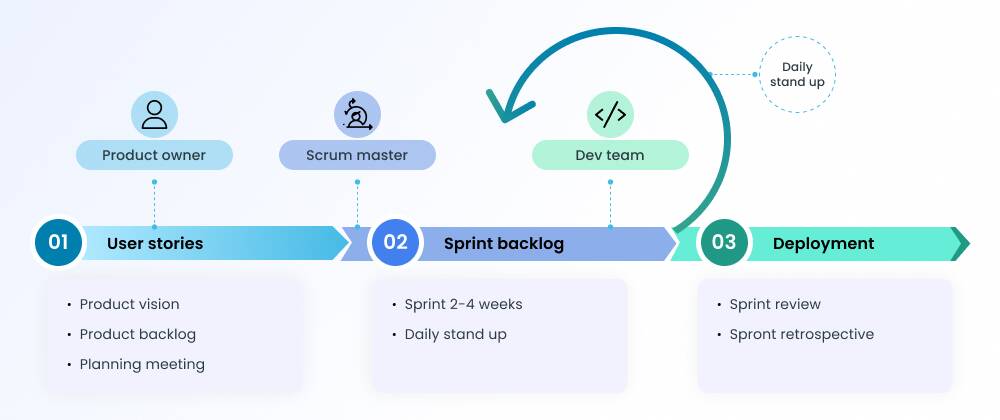
Scrum is the most used Agile framework. In this methodology, the software development process begins with a short planning phase. Basically, agile software development with Scrum works in fixed sprints that usually last 2 to 4 weeks. At the end of each sprint, the team reviews the achievements and plans for the next sprint.
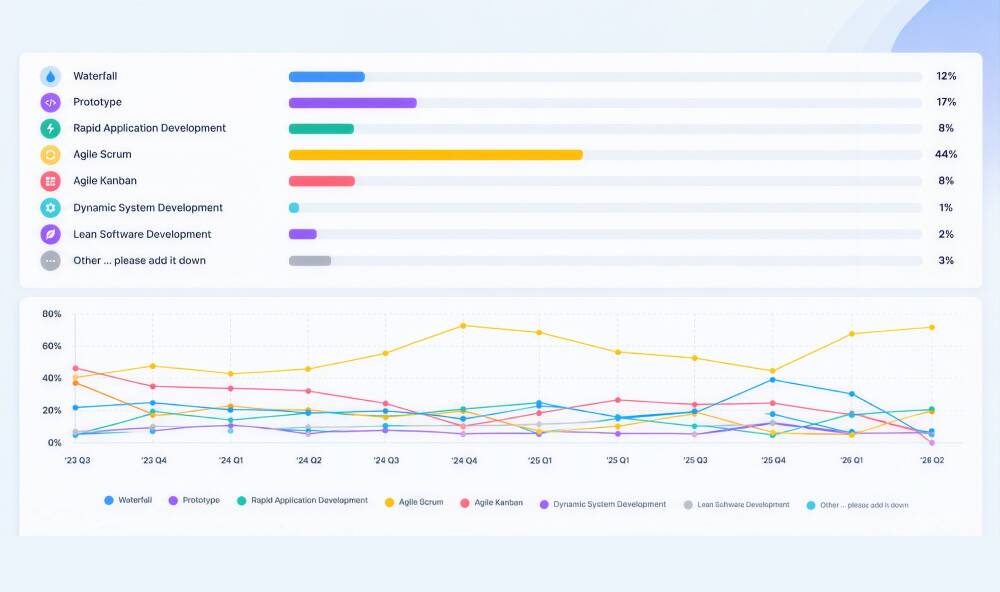
There are three defined roles:
- A product owner who owns priorities.
- A scrum master who removes blockers and keeps the process running.
- The development team that builds the work.
Every sprint follows the same loop: plan, build, review, and reflect.
Best for: A single team building a product where priorities shift regularly.
2. Kanban
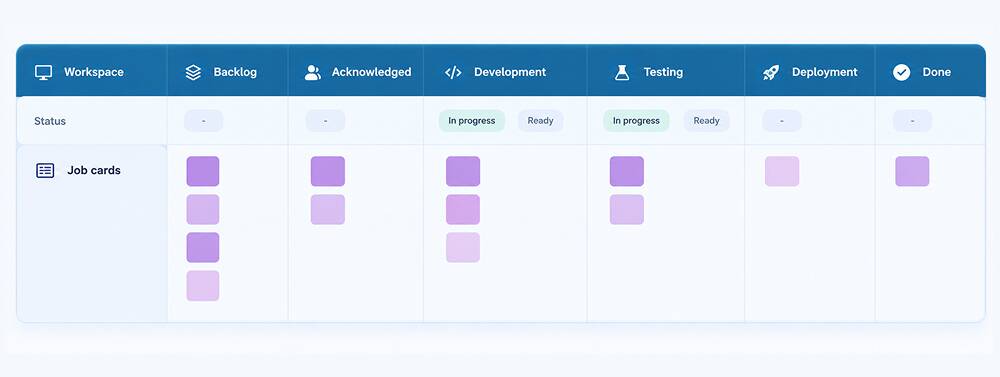
Kanban is simple and less structured than Scrum. The work items move on a visual board. It usually has columns like To Do, In Progress, and Completed. There are no fixed sprints. Instead, teams limit how much work can be in progress at once, which keeps focus tight and prevents obstacles.
In Kanban, neither a Scrum Master nor a Product Manager role is required. Anyone on a team can add or reprioritize a card. That’s why Kanban suits support and operations work better than product development with a fixed roadmap.
Best for: It is ideal for support and maintenance projects or projects with changing requirements.
3. Scrumban
Scrumban is an Agile method for software development. It is just a mix of Scrum’s structure and Kanban’s flow. The software development team keeps some Scrum habits, such as short planning sessions and retrospectives.
But they drop fixed sprints in favor of continuous delivery. They integrate the best features of Scrum and Kanban into a hybrid project management framework.
Best for: Companies handling migration from Scrum to Kanban or projects that mix new feature work with ongoing support tickets.
4. Extreme Programming (XP)
XP is a set of engineering practices, not just a project management style. It pushes practices like pair programming, where two developers work on the same code together. But with frequent small releases and continuous testing.
Pair programming can feel slow at first. In this, two people write code that one person could write alone. But it catches mistakes in real time, so no single developer becomes the only one who understands a critical piece of the system.
Best for: Teams building financial or medical software sometimes lean on XP practices even inside a Scrum setup. If you are planning healthcare software development, Extreme Programming is the best approach.
5. Lean Software Development
Lean focuses on cutting anything that does not add value, unnecessary meetings, excess documentation, and features nobody asked for. Decisions get made on real data, not assumptions. The team is trusted to make calls without waiting for sign-off at every step.
Best for: Small companies building an MVP on a tight budget and timeline where every extra process increases costs.
6. Feature-Driven Development (FDD)
The feature-driven development model works around a list of specific features. Each feature goes through its own short design-and-development cycle. Each feature lasts two weeks before moving to the next. The team tracks the progress feature by feature.
Best for: Larger teams that need a clear, feature-by-feature way to track progress.
7. Dynamic Systems Development Method
DSDM is an agile framework. It was formerly used as a software development approach. It is based on the idea that you cannot get all of the requirements right at the start.
So, it mainly focuses on creating the most crucial 80% of a product well. It uses fixed time boxes and a prioritization method to decide what actually makes the cut.
Best for: Projects with a tight deadline where on-time delivery matters more. It is very common in time-boxed government or event-driven projects.
8. Adaptive Software Development
Adaptive software development is an Agile framework that treats project plans as flexible guides rather than rigid rules. It helps software development teams develop complex software by expecting and welcoming continuous change instead of resisting it.
It mainly focuses on continuous learning, adaptation, and collaboration to manage complex and rapidly changing project requirements.
Best for: High complexity, highly uncertain projects where requirements keep changing very frequently.
9. Crystal
Crystal is actually a family of methods, scaled based on team size and project risk. A small, low-risk project uses a lighter version with minimal ceremony.
A large, higher-risk one uses a more structured version with more checkpoints. It helps businesses deliver faster and with fewer errors.
Best for: Teams that want to use agile principles without being tied to a single rigid framework. Also for teams comfortable adjusting process weight as the project’s risk level changes.
10. Scaled Agile Framework (SAFe)
SAFe is built for large companies running multiple Agile teams on the same product or platform. A 10-person startup does not need SAFe. A company with 15 development teams working on the same enterprise software probably does. SAFe applies Agile principles across many teams working on the same large project.
Best for: Large enterprises running multiple agile teams on a single product, where the coordination problem itself, not the coding, is the most challenging part.
Which framework fits your Agile SDLC project?
- Small team, clear product goal, fixed sprint cadence → Scrum
- Ongoing support or maintenance with unpredictable incoming tasks → Kanban
- High-stakes code quality, financial or medical software → XP practices layered on Scrum
- Cutting waste, moving fast with a lean team → Lean
- Large enterprise, multiple teams, one product → SAFe
8 Stages of the Software Development Process with Agile
What is the Agile software development process? The Agile in software development process has eight sequential stages. They are conceptualization, planning and sprint setup, design, development, testing, deployment, and maintenance. Let’s check out the process in detail.

Phase 1: Concept and Requirement Gathering
The conceptualization phase sets up the goals and requirements of the Agile software development project. The team and the client outline the overall vision. What problem this solves, who it is for, and what success looks like. The team fills in details sprint by sprint.
The development team can use generative AI research and coding tools. These tools can help them understand project requirements or experiment with new features.
Phase 2: Planning and Sprint Setup
In the planning and sprint setup phase, the development team emphasizes turning project objectives into sprint plans and in-depth task lists. The backlog gets prioritized.
The team decides what to build first, usually whatever gives the most value in advance. They set the sprint length to one, two, or four weeks, which is typical. Estimation in Agile is not exact.
Let’s say the team is working on a fintech software development project. They will set up the sprint first and create a task list. Now they often use story points, which are a rough measure of effort and complexity. This avoids the false precision of promising a feature will take exactly 14 hours when nobody really knows yet.
Phase 3: Design
The design phase includes the software project’s architecture. For example, core steps cover outlining the navigation, designing the database, creating the UI, and so on.
For the features planned in this sprint, the team works out the UI, UX, and technical architecture. This happens continuously, sprint after sprint, rather than as one big design phase at the start.
A designer might prototype the checkout screen while developers are still developing the product listing page from the previous sprint. The design phase work is gathered in an SDD, a software design document. It then passes to the development team as a roadmap or blueprint for coding.
Phase 4: Development
The coding starts here. Developers work in short cycles, often with quick daily meetings to identify roadblocks. It is usually 10 to 15 minutes, where each person answers three questions: what did I do yesterday, what am I doing today, and what’s blocking me.
It’s not a status report for management. It is a quick sync so the team can solve problems fast. The goal of each sprint is a working, demoable piece of software, not a half-finished feature.
This coding phase also covers developing additional APIs, such as REST APIs, which are important for the product to work properly.
Phase 5: Testing
Testing does not wait until the whole software is developed. QA checks each feature as it is completed, inside the same sprint. The Agile software development team also runs automated tests often; every time new code is added, it catches errors immediately instead of days later.
However, manual testing still happens for anything automated tests cannot catch. For example, how a feature actually feels to use. Testing is a mandatory part of the Agile process. Without testing, the next sprint does not begin.
Phase 6: Deployment
Once a software feature passes testing, it can go live, sometimes at the end of every sprint, sometimes on a slightly longer schedule. Some development teams deploy small updates multiple times a week.
Others release less often but still far more frequently than a Waterfall project. In the Waterfall model, the feature might not go live until the entire software is finished. It can sometimes take a year or more.
Phase 7: Review and Feedback
At the end of each sprint, the Agile team reviews the work. It shows what was built. Besides, it also includes a brief history and discusses what went well and what did not. The feedback from the client and real users feeds directly into the backlog.
In this stage, the scope gets adjusted. If feedback shows a planned feature is not required, the team removes or reprioritizes it.
Phase 8: Maintenance
The Agile process does not end here. Based on user feedback and real usage data, the backlog gets updated, and the team plans the next sprint. The software requires changes based on what users actually do.
Each Agile software development lifecycle phase repeats, sprint after sprint, for the life of the project. That is the real difference from Waterfall. The life cycle is not a line you walk once. It’s a loop you run continuously.
What Are the 6 Phases of the Agile Software Development Life Cycle?
Concept, inception, iteration, release, maintenance, and retirement are the six phases of the Agile software development life cycle. Each of these phases has different sprints, and it works in a loop. Let’s discuss each phase in detail.
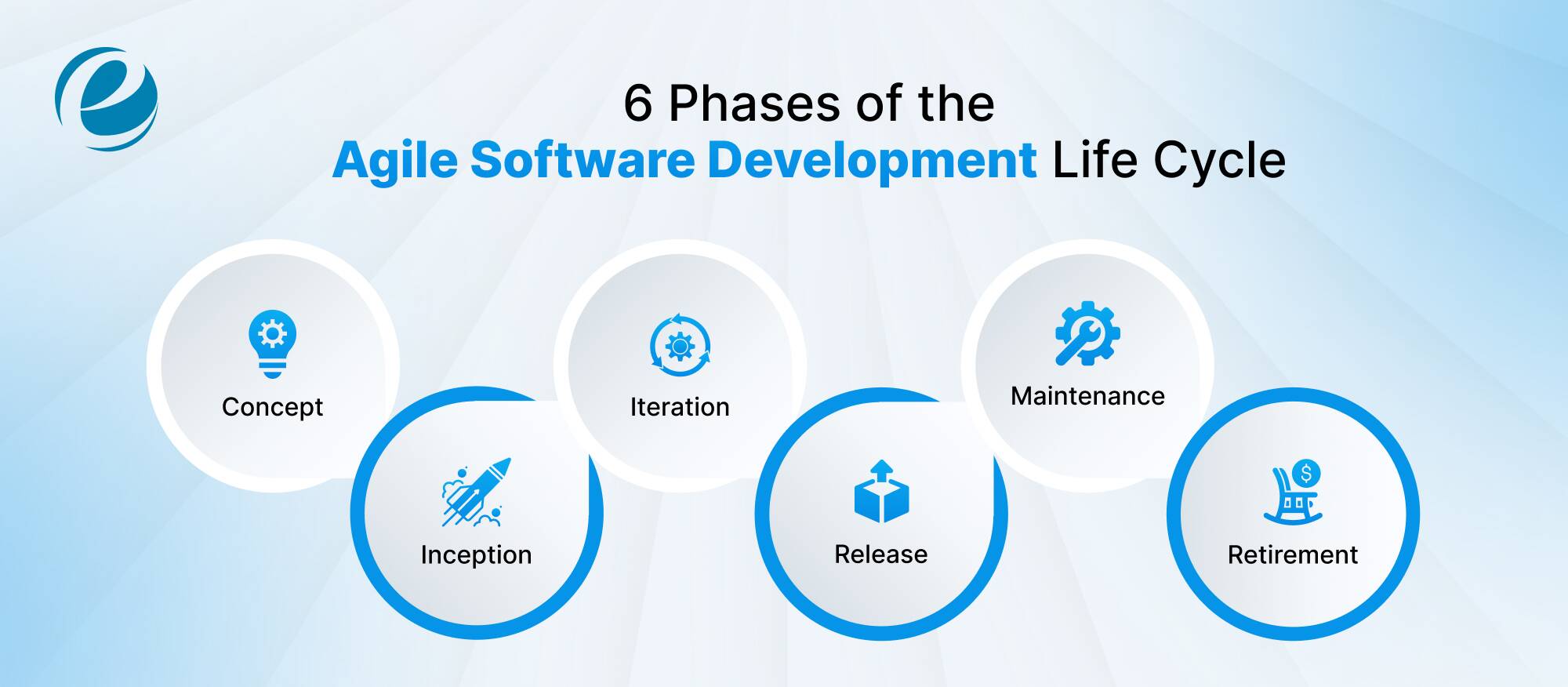
1. Concept
Firstly, the client understands the project scope. The product owner discusses the major requirements with the client and creates documentation to outline them. It is vital to set minimum requirements for the project. You can add them in later phases.
Additionally, the product owner gives a rough estimate of the project’s time and budget. This thorough analysis helps them decide if a project is possible before they start working on it.
2. Inception
After sketching out the idea, it’s time to form a software development team. The product owner first checks if they are available. They choose experienced ones and make sure they have all the resources they need.
After that, they can begin the design work. The software development team creates a UI mock-up and develops the architecture. Stakeholders provide more information so that a diagram can fully capture the requirements and define the product’s functions.
3. Iteration
Now comes the iteration, or development, phase. It is one of the longest phases because it carries out all the work. Software developers and UX designers will work together to meet all software development Agile requirements and customer feedback.
The goal is to finish the first sprint with the product’s core features built. Developers can add additional features in the next sprint. This iteration phase allows software developers to develop software faster and make changes that satisfy the client.
4. Release
In the release phase, the software is ready to launch. But first, the testers will do some tests to check if the software is properly functioning. They also check that the code is clean and error-free. If the software has bugs or errors, the developers will fix them right away.
User training also takes place in this stage, which will require more documentation. Once it is finished, the final sprint of the product can be sent into production.
5. Maintenance
The software will now be launched, and customers can use it. After that, the maintenance phase will start. The software development team will provide maintenance services so that the software runs smoothly.
Additionally, they will also resolve bugs or errors found in the software after deployment. Over time, new sprints will start to refresh the software with updates and additional features.
6. Retirement
There are two major reasons why the software goes into the retirement phase. Either new software is installed to replace it, or it stops working with the company over time. The team will inform users that the software is no longer being supported.
If a replacement is needed, users will migrate to the new system. Lastly, developers complete any last-minute tasks related to end-of-life support and stop working on the software.
What Are the Benefits of Agile Software Development?
The benefits of software development Agile includes:
- Faster time to market
- Reduced risk
- Better visibility
- Higher quality
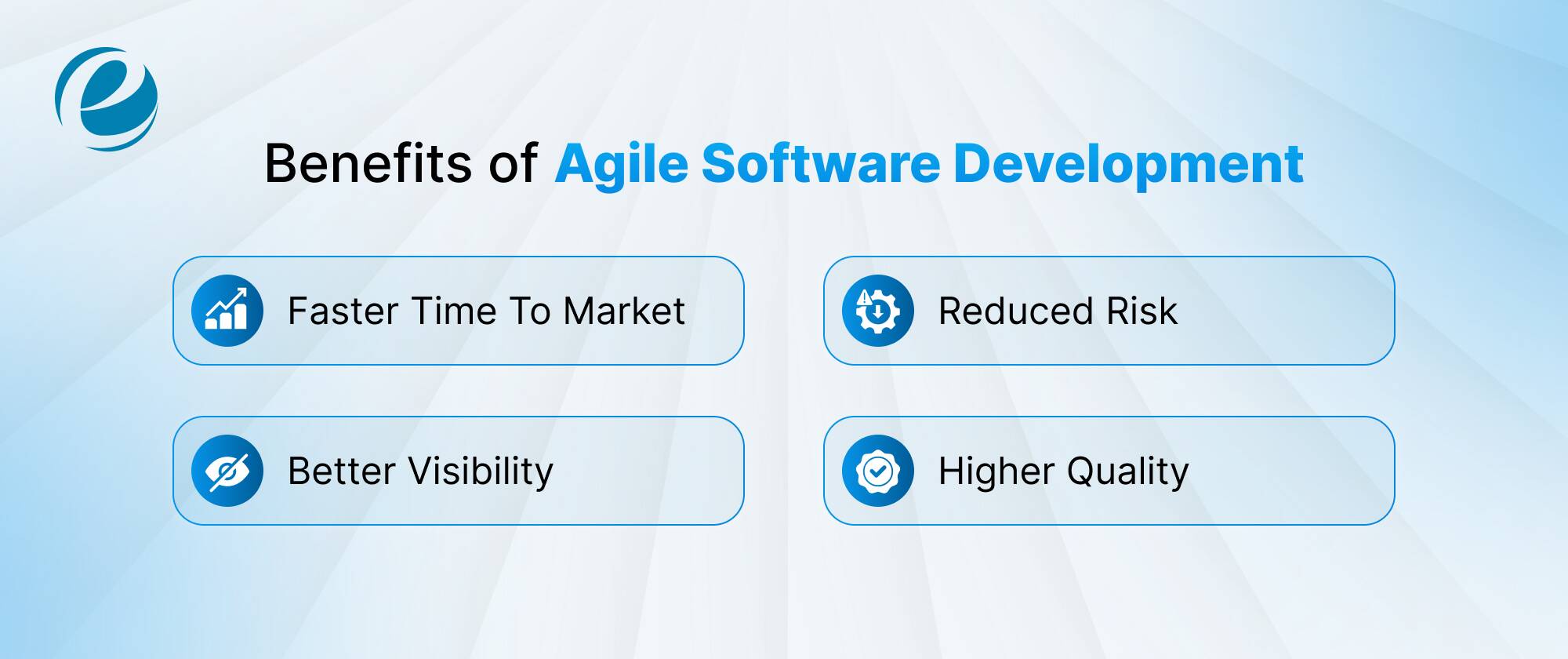
1. Faster Time to Market
Since Agile ships in small sprints, you get a usable or at least testable product much sooner than waiting for the one big release. By releasing working features in small chunks, the team lets users get value faster instead of waiting for the whole thing to be finished.
2. Reduced Risk
Another benefit of agile software development is reduced risk. Feedback every few weeks means you find out in advance if you are off track or doing something wrong. This way, you avoid discovering after a year of work that nobody wants the finished product.
3. Better Visibility
Sprint reviews give business stakeholders a real look at working software, not a status report that’s simple to spin. The agile SDLC breaks work into short cycles, or sprints, and uses clear tracking tools so everyone can monitor progress.
4. Higher Quality
Agile methods use an iterative approach to project management. This means processes improve each time an interval is repeated. One of the core principles behind Agile is that you should always be working to improve and check the quality of your work. This Agile project management approach helps you make better products.
Common Agile Challenges and How to Actually Fix Them
Here are some common challenges that could make it difficult to complete an Agile project successfully. They are:
- Scope Creep
- Cost & Timeline Uncertainty
- Insufficient Documentation
- Agile in Name Only
- Lack of Customer Engagement
- Team Burnout
Solving these challenges is mandatory for a successful project. We have jotted down the challenges and how to fix them.
1. Scope Creep
The project scope keeps creeping because Agile welcomes change. Some development teams treat every stakeholder’s request as an automatic yes. That backlog list keeps getting longer, and nothing ever gets completed.
Solution:
You have to give the product owner real authority to say no. If a new request is worth more than what it would push out, it will go into a sprint. Otherwise, it goes into the backlog and is ranked lower.
2. Cost and Timeline Uncertainty
Estimating cost and timeline is quite challenging. With work planned sprint by sprint, it is harder to hand a client one fixed number before any work starts, the way Waterfall can.
Solution:
You should estimate in ranges, based on velocity. It means how much the team can complete per sprint, and you update the estimate as real data comes in. In this case, a time-and-materials contract with a not-to-exceed cap is better than a fixed bid.
3. Insufficient Documentation
When development teams are in a hurry, they do not always write things down and provide insufficient documentation. That hurts later, when new people join the project or when the software needs to pass a compliance audit.
Solution:
You have to keep the documentation lightweight but deliberate. Add documentation directly into your Definition of Done (DoD). Also, you should decide upfront what must be documented, like architecture decisions and compliance-relevant logic, and do not skip that, even under sprint pressure.
4. Agile in Name Only (Fake Agile)
A development team adds daily standups and calls itself agile, but management still demands fixed scope, a fixed deadline, and zero surprises. This is one of the most common complaints from developers, and it is not the framework’s fault.
Solution:
Agile only works if leadership actually accepts that scope or timeline may shift. If neither can move, the project is not a suitable candidate for Agile in the first place. It’s better to say so upfront than to force the Agile label onto a Waterfall project.
5. Lack of Customer Engagement
Agile depends on regular client feedback. If they are unreachable for weeks at a stretch, sprints stop or deliver the wrong thing.
Solution:
You must set a fixed weekly check-in with the client from day one and treat it as non-negotiable. Besides, you can also record a short video of working features after every sprint if live meetings are impossible.
6. Team Burnout
The development teams often burn out from constant sprints. It can become boring to do back-to-back sprints with no breaks, especially if problems are brought up every time they are looked at but never fixed.
Solution:
You should protect a sustainable speed on purpose. If velocity keeps dropping, that’s a signal to address workload or process issues, not a reason to demand the team work longer hours.
Which Industries Use Agile the Most?
Agile fits best where requirements change often and speed matters. That is why it is the default in software, but its use has spread well beyond that. Let’s check out the industries using Agile.

1. Ecommerce
Agile is widely used in e-commerce and retail software development projects due to frequent feature releases, seasonal demand swings, and constant A/B testing.
2. Healthcare
In the healthcare industry, Agile methodology is very common. The main reason is that it supports iterative development along with strict compliance checkpoints. Also, it manages complex environments, speeds up innovation, and improves patient outcomes through flexible, iterative cycles.
3. Fintech
For financial software development projects, companies choose the Agile approach. It suits projects with evolving regulations, a need for iterative security testing, and competitive pressure to release features quickly.
4. SaaS
In B2B SaaS projects, Agile is the preferred methodology. This is because continuous delivery is the whole business model. Most companies rarely use pure Scrum or Kanban as their agile software development methodology. Instead, they adopt hybrid models that align with business-to-business demands.
Even outside software, the marketing, HR, and product teams have started borrowing Agile practices, sprints, backlogs, and daily standups for their own work.
How to Know If Agile is Right for Your Project?
Agile is a Good Fit for Your Project When:
- You are creating an MVP where requirements are not fixed. It can change once the users start interacting with the product.
- You want to launch a product early and improve it with real user feedback.
- Startups or mid-size businesses testing an idea in a competitive, fast-changing market.
- The end goal or features are not fully defined at the start and will evolve through learning. Products are expected to change after launch based on user behavior.
- The client can stay involved throughout the project and not just at the start.
Agile is a Poor Fit for Your Project When:
- The scope, budget, and timeline are fixed and will not change. It is common in some government or hardware-dependent projects.
- Clients who need an exact fixed price and can’t tolerate scope discussions mid-project.
- The client cannot commit to regular meetings or involvement.
- Heavy, fixed compliance documentation has to be finalized before any code is written.
Most software projects lean toward the first list. If you are unsure, a short two-week discovery phase that combines agile planning with some upfront scoping clarifies the decision. That discovery sprint produces a rough backlog, a first cost estimate, and a clearer sense of how much the requirements are likely to shift, which is enough to resolve the question.
How Much Does It Cost to Build Software with Agile Methodology?
The cost to develop custom software with Agile methodology starts at $25,000 for an MVP and goes up to $300,000 for an enterprise solution. It varies based on team composition, integrations, compliance needs, location of the development team, and number of sprints.
Let’s have a look at the table of rough cost ranges for agile engagements:
| Project Size | Typical Team | Approx. Timeline | Approx. Cost Range |
| MVP version | 3-5 people: PM, 2 developers, 1 QA, part-time designer | 8-12 weeks | $25,000 – $60,000 |
| Mid-size product | 5-8 people, full cross-functional team | 4-6 months | $60,000 – $200,000 |
| Enterprise-scale platform | 8+ people across multiple squads | 9+ months, ongoing | $300,000+ |
These are just directional and not a quote for your specific project. The actual agile software development cost depends on:
1. Team Composition
More specialists in security, DevOps, UI/UX increase the hourly rate but often lower the total cost by avoiding rework later.
2. Integrations
Adding integrations like payment gateways, ERPs, third-party APIs, or CRM software development can increase the sprint time and cost.
3. Compliance Needs
Fintech and healthtech projects need extra QA and security sprints. Strict rules like HIPAA or GDPR require specialized security steps.
4. Development Team’s Location
US-based teams typically bill $100-200+ an hour; offshore and nearshore teams often run $25-40 an hour for comparable skill, which is why many US and EU companies build with distributed agile teams.
5. Number of Sprints
Two projects with the same deadline can cost very differently if one needs twice the sprints to reach a usable product. This is why an accurate estimate needs a rough backlog first, not just a target launch date.
Why Choose EmizenTech to Build Your Software with Agile?
EmizenTech is a trusted ERP software development services provider that runs every project on a Scrum-based agile process, with sprints, transparent reporting, and a working demo at the end of every cycle. This way, you always know what has been built and what’s coming next.
Spring has ranked us as one of the Top 50 Professional Firms for 2026 based on surface-level metrics like client retention, project outcomes, and responsiveness.
- Specialization in E-commerce: Our experts have a deep understanding of payment flows, inventory systems, and the compliance requirements that are common to these industries. We do not use these sprints to cover the basics.
- No black-box development: You get visibility into the backlog, the sprint plan, and progress at every stage, not just at final delivery.
- Flexible team scaling: You can add or reduce developers as the project’s needs change, without renegotiating a fixed contract from scratch.
Additionally, we have run agile delivery across e-commerce platforms, fintech products, and custom SaaS development for clients who needed to move fast without losing control of scope or budget.
Whether you can see the backlog, the sprint plan is shown to you before it starts, or the demo at the end of each sprint is a real, working piece of the product rather than a set of screenshots. That’s the standard we hold our delivery process to, and it’s a fair standard to hold any vendor to before signing a contract.
Thus, if you are evaluating agile development for an e-commerce, fintech, SaaS, or any other product, get in touch with our team for a free project consultation to scope your first few sprints.
Conclusion
Agile software development is not a trend. It is a practical way to build custom software when you do not have every answer on day one, which describes most real projects.
Agile alone won’t fix a badly run project, and it’s not the right fit for every situation, but it is for most software, like e-commerce and fintech. It beats trying to plan everything perfectly before the developers write code.
If you are planning to develop custom software and want a software development services provider that runs agile as it should, EmizenTech is the one-stop destination.
No matter if you already have a detailed specification or just a rough idea, we can turn it into a working backlog and a realistic sprint plan within the first couple of weeks. Book a free consultation now.
FAQs
Is Scrum the same as Agile?
No, Scrum and Agile are not the same. Agile is the underlying philosophy. Scrum is one of the specific frameworks for putting that philosophy into practice. It is the most popular one. Kanban, XP, and Lean are also frameworks that do not use Scrum’s specific roles and sprint structure.
What is a Sprint in Agile?
A sprint is a small, fixed time period that lasts 2-4 weeks. In each sprint, a team commits to completing a particular set of work. At the end, they review it and then plan for the next sprint.
Can Agile be used for projects outside software?
Yes, Agile can be used for different fields like marketing, HR, and product teams. They use Agile practices, sprints, backlogs, and daily meetings for non-software tasks. Its core idea is small sprints with regular feedback.
How much does it cost to build software with Agile?
The cost of building software with the Agile methodology starts at $25,000 for an MVP version and can go up to $250,000 for enterprise development. However, this cost is not fixed. It varies depending on project size and team composition.
Is Agile always faster than Waterfall?
No, Agile is not always faster than Waterfall. But it usually fails less often. Standish Group and PMI data both show Agile projects succeed and fail at noticeably better rates than Waterfall projects. This is mainly because problems surface every sprint instead of at the very end.
Do I need to pick just one Agile methodology?
No, you do not need to pick just one agile software development methodology. Most real teams blend two, commonly Scrum's sprint structure with Kanban's flow or Scrum's process with XP's engineering practices.
What happens if my requirements are already fixed?
If your scope, budget, and deadline are not fixed, a Waterfall or hybrid approach may serve you better. Agile's value comes from the flexibility to change direction, and that value disappears if change is not actually allowed.



 +1 (989) 535-9295
 info@emizentech.com
 emizentech


