
 Add us as a preferred source on Google
 The growth of a construction company isn’t measured solely based on the number of structures it has built. If anything, that’s just a starter. The metrics of growth span relationships, approaches to complex operations, communication flow, and efficiency. That’s where CRM for construction industry can be the game-changer. The largest software market, CRM, caters to the multi-layered needs of contractors, real estate businesses, builders, and project managers.
Businesses relying on cluttered reports, operating in silos, or working with outdated software can swap various challenges for a diverse range of benefits this tool offers. The global construction market is set to reach $17.1 billion by the end of 2031. While this pace is fueled by heavy infrastructure investments, it is also accelerated by tech innovations. This article explores what role construction CRM can play here.
What is Construction CRM Software?
Construction CRM software is a tool designed to manage and help carry out various tasks involved in customer lifecycle management. It is a specialized tool with tailored offerings like documentation, coordination, payment tracking, and more to simplify construction project handling on one platform. From civil engineering to EPC to real estate, a range of operations becomes easier to manage with the right CRM for construction.
Generic CRM Software vs. Construction CRM: What’s the Difference?
CRM tools are a widely used solution across industries, and thus, they are not necessarily the same. While a generic CRM platform caters to a wide range of industries, the one for construction is a rather purpose-built platform for handling unique operations. Below are the key differences between the two.
| Feature/Aspect | Generic CRM | Construction CRM |
| Industry | Serves the purpose for an array of industries | Built for construction and contracting |
| Project Management | Limited or needs integrations | Integrates with project management tools |
| Communication | Standard email and contact management | Built-in portals |
| Integrations | Integrates with marketing and sales tools. | Integrates with a wide range of tools, like ERP, accounting, and project management, based on unique business requirements. |
| Mobile Accessibility | Yes, but it may lack optimization for the network | Built for on-field teams and real-time collaboration |
| Customization | Some tools are flexible, but on a larger level, may lack industry-specific functions. | Pre-built templates |
While a generic CRM is a fantastic tool for businesses looking for a sales-focused solution, a construction CRM is the ideal platform for those aiming to streamline sales and lead management and various other operations specific to the industry.
How Construction Companies Use CRM Software
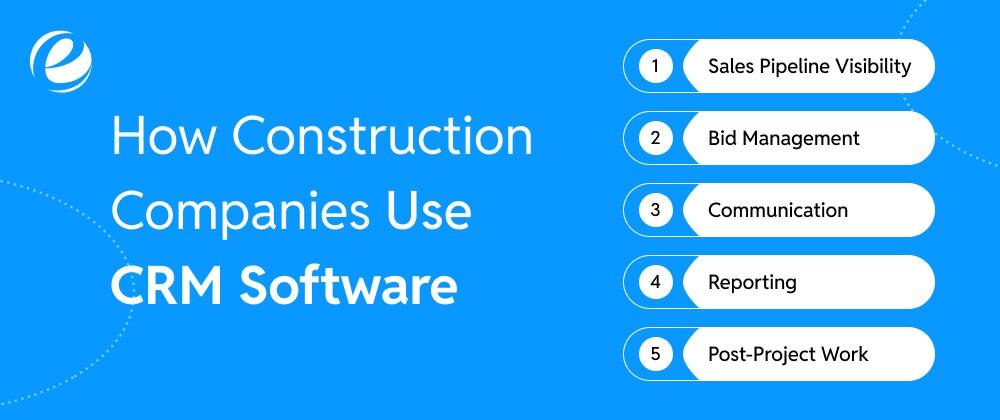
The right CRM platform can speed up both workflows and growth for construction firms’ operations at different scales. Here are some examples of its usage across various businesses.
Sales Pipeline Visibility
One of the main use cases of the tool in the construction industry is access to every stage of a deal in the most organized way. Sales teams can track everything from the awareness phase to signing. They can even prioritize opportunities with automated follow-ups, lead scoring, and conversion tracking.
Bid Management
Construction CRMs let companies enhance efficiency in bid management tasks with automation. They can generate, submit, monitor, and revise bids for different projects, all with one tool. Do they receive new RFQs or RFPs? Whenever they receive one, the tool automatically assigns it to the concerned team. That’s not all; it also stores documents, sets deadlines, and ensures no scope of growth goes unnoticed.
Communication
Since projects and collaborations are both a long process in the industry, CRMs act as a handy platform for stakeholders to communicate with each other. It keeps logs of correspondence, call records, site visit notes, and more in one place.
Reporting
Performance tracking is just as crucial a function in construction as lead generation. With CRM, leaders get a clear picture of who’s handling what and how well. They can get real-time information on performance, project allocation, resource management, and revenue. These insights are particularly useful during strategy calls.
Post-Project Work
The tool facilitates a platform to raise requests, schedule calls, and log resolutions. When clients reach out to businesses for project support post-wrap-up, they receive prompt assistance, be it for warranty or upgrades.
10 Benefits of CRM in Construction Industry
Here is a roundup of the benefits of construction CRM software that companies can use in many ways:
Streamlined Communication
From clients and vendors to architects and on-site teams, there are many people involved in the construction projects. Problem? Communication. Solution? CRM! The tool serves as a unified platform where all sorts of communication regarding multiple projects can be logged, tracked, and shared. The real-time accessibility keeps interactions flowing. And as a final result, businesses break free from confusion, silos, and lack of synchronization, be it in terms of client feedback or a project update.
Improved Client Relationship
Long sales cycles and post-completion support often accompany construction projects. With construction CRM software, companies can nurture long-term relationships in the meantime by personalizing experiences. All they have to do is track calls, meetings, follow-ups, and grievances to curate communications and offers accordingly. This practice helps enhance retention and referrals.
Automation in Action
One of the key benefits of CRM for the construction industry is that it automates routine tasks. This includes everyday work, like sending follow-up emails, scheduling site visits, and generating reports. Automation not only saves time but also eliminates a major risk from the scene: manual errors. This results in improved efficiency and hassle-free client relationship management.
Enhanced Lead Tracking
From REPs to site visits to RFQs, there are multiple touchpoints in a construction sales pipeline, which often complicates it to even comprehend, let alone handle. CRM for the construction industry simplifies lead management, relieving everyone of the hassle. Features like lead scoring and automated reminders further ensure that no opportunity goes unnoticed. This boosts conversion rates and brings order to how things are done.
Smarter Business Planning
With feature-rich, well-built construction CRM software, capturing sales data, client behavior, project win/loss trends, and more such tasks becomes hassle-free. And here’s what it means for construction companies: They can leverage the insights to anticipate demands and trends, take calculated risks, set achievable targets, strategize smartly, and make decisions backed by numbers, not just ‘gut feeling.’ Data also enhances resource planning and allocation, further saving time and money.
All Documents, One Hub
Juggling blueprints, contracts, project files, and more such crucial documents can be worrisome at times (imagine that constant risk of losing an important document). CRM software facilitates a cloud-based repository where you can store all the documents. That’s not all; you can tag and share them in just a few seconds. The ease of access eliminates frustrating and time-consuming back-and-forth.
Smooth Collaboration
With the best construction CRM software, breaking down the silos between departments becomes way easier. From sales to marketing to customer service to procurement, all departments handle tasks with ease, and all stakeholders can access real-time information on projects and more, thanks to dashboards. This enhances the way cross-functional collaboration works, speeding up various tasks and ensuring up-to-date data.
Client-Focused Customization
CRM for the construction industry benefits businesses with the ease of customizing communication templates, pricing models, workflows, and follow-ups, all based on the preferences and ultimate goals of different clients. This flexibility is barely an option nowadays, given that it renders better service and reinforces the sense of confidence in the brand. That said, by investing in construction CRM software development, you can win clients’ trust for your attention to detail and project handling capacity.
Efficient Subcontractor and Vendor Management
Think of managing different groups of stakeholders as a challenge? You can eliminate the hassle (and barriers) with a custom CRM in construction processes. Manage communications with all stakeholders, including plumbers, contractors, electricians, and logistics personnel, through a seamless tracking system. The software allows you to monitor individual performances, contract statuses, subcontract availability, and more from a single platform. This creates a sense of accountability and improves relations.
Improved Customer Support
And all the benefits of CRM for construction boil down to this: You will have a family of happy, loyal clients. That’s not it. The software also helps you manage tasks post-project completion. These may include maintenance, upgrades, and warranty assistance. Moreover, a CRM system maintains a complete record of all the post-sale communications, including service requests. The constant support keeps you on top as their go-to partner for simplifying the work.

Key Features to Look in CRM for Construction Industry
Let’s discuss the features that make a construction-focused CRM tool a go-to for businesses.
Project Lifecycle Management
Be it inquiry, final handover, or follow-up, the top construction CRM software lets you keep complete track of the project lifecycle. You not only set milestones and allocate resources but also track progress and make tweaks, all effectively. If any critical delay occurs or a process seems to be deviating, you get instant alerts. This comprehensive solution reduces overruns, helping you manage time and deliverables smartly.
Lead Management
You take full control of why, when, and how different leads are managed with the advanced lead management capabilities of construction CRM software. The tool lets you capture leads across channels, from campaigns to referrals to forms. Functions like automated lead scoring and customizable sales pipelines make segmenting the most valuable opportunities easy. This is super helpful for ensuring high-quality lead conversion and improved resource allocation.
Proposal and Bid Generation
CRM’s construction unlocks access to a range of templates and tools to facilitate automated proposals.
Whether you want to generate RFPs or get detailed cost estimates in just a few clicks, add to that the option to monitor the bid status and refine strategies to enhance proposal success rates in the future.
Document Manager
Have you considered the benefits of storing your documents digitally in one place instead of relying on traditional storage practices? The built-in document management module in CRM keeps all your files secure and intact. From contracts to drawings to compliance, you can manage everything while editing, assigning access, and retrieving it.
Role-Based Permissions
Tailored platforms often have customizable dashboards, where you can decide who can access what. From sales and executives to PMs and supervisors, everyone gets the permission to see information that’s relevant to their role. The most viable way to ensure data security is to enhance usability across teams.
Offline Access
Construction operations involve on-field work on a larger level. This makes accessibility to data and uninterrupted collaboration a must-have aspect of CRM software. The tool with mobile access and, not to mention, offline mode, helps keep things moving in the right order. Whether someone wants to access a file immediately or update a number, they can do it right away.
Integrations
When investing in a CRM, look for one with seamless integrations with project management tools.
This aspect lets all your teams work in a collaborative manner, with a spot-on sync between sales data, cost plans, and timelines. Moreover, it enhances real-time visibility and reduces the risk of double entries or mismatches.
Top CRM Software for Construction Industry
Whether it is to ensure security, smooth collaboration, or simply streamlined workflows, it is highly important to explore the available options before you choose or build the best CRM software for the construction business. Below are the top names in the lineup.
| Name | Features | Platform | Pricing |
| Buildertrend | Offers a mix of CRM and project management functions, budgeting, scheduling, and client communication. | Web, iOS, Android | Starts at $99/month |
| Procore | Comprehensive construction management capabilities, CRM features integrated with project operations. | Web, iOS, Android | Custom |
| CoConstruct | Ideal for custom builders: Client communication, budgeting, and scheduling tools. | Web, iOS, Android | Starts at $99/month |
| JobNimbus | Cloud-based CRM and project management features, invoicing, real-time updates, and reporting tools. | Web, iOS, Android | Pricing upon request |
| FollowUp CRM | Seamless sales and lead management, user-friendly interface. | Web | Starts at $55/user/month |
| SalesRabbit | Mobile-first app, seamless routing, lead tracking, ideal for employees in the field | iOS, Android | Starts at $25/user/month |
| HubSpot CRM | Generic CRM with customization options | Web, iOS, Android | Free; Paid plans start at $50/month |
| AccuLynx | Ideal for roofing contractors, CRM and project management capabilities, cost estimate tool | Web, iOS, Android | Pricing upon request |
| Zoho CRM | Customization and scalability; integrates with various third-party applications. | Web, iOS, Android | Starts at $14/user/month |
| JobTread | Tracking, file management, and budget tracking; suitable for small to mid-sized firms. | Web, iOS, Android | Starts at $99/month |
How to Build CRM for Construction: A Step-by-Step Process
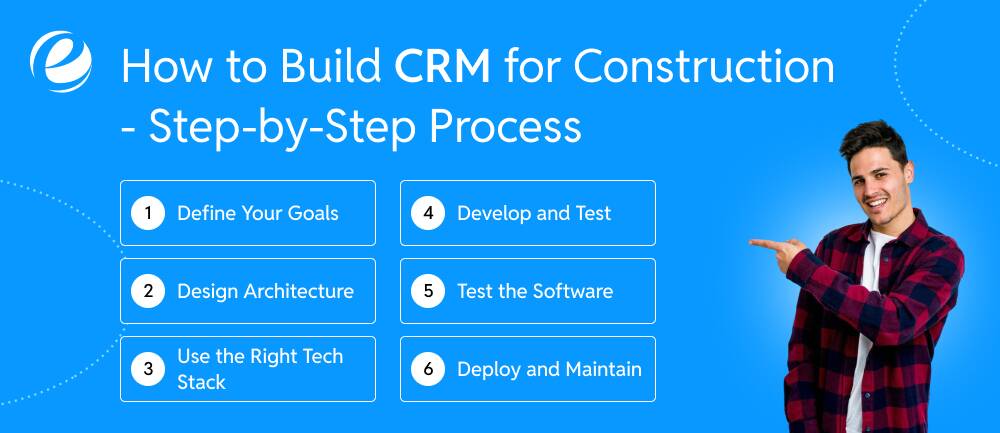
Here’s what the process of developing illustration apps like Procreate looks like:
Define Your Goals
As you may know, the process begins with having a clear understanding of specific goals. Here’s what you must define before investing in the process.
Why do you need CRM software for your construction business?
What are the core goals you are looking to achieve?
What are the features (basic and advanced) that you think would benefit your business?
These are just the basics. Dig further into the purpose of the software development process by gathering inputs from key stakeholders across departments. Such input will help you understand different challenges that need to be addressed with CRM. This phase is also crucial for analyzing the existing tools and the market from a defined vantage point.
Design Architecture
Once the requirement has been identified, here’s the next stage that comes into action: designing the overall architecture of your custom construction CRM platform. Here, the CRM developers will define front-end interfaces, backend systems, data workflows, and, not to skip, integrations with third-party tools, legacy tools, and more. This stage also focuses sharply on module finalization, meaning the features that would form the foundation of the system.
Use the Right Tech Stack
The technology stack you pick will determine the performance, security, and scalability of the CRM. That said, this stage is one of the most important phases of the overall process, where you can consult a reliable CRM software development company for finalizing the right stack. This stage could involve AWS for cloud hosting. QuickBooks for integrations and more.
Develop and test.
We’ve now made the key decisions. It’s time to get into building the best CRM software for construction. This process encompasses the most valuable modules, such as lead management, contact databases, and user login. With time, complex modules like automation and integrations come into the picture too.
Test the software.
The QA team tests the developed software. This phase includes unit testing, security checks, real-world usability, integrations, and overall performance. One of the most important steps to building construction CRM software is testing, which ensures that the tool is ready for use across all teams and functions.
Deploy and maintain.
The final leg of the project, the deployment phase, covers the installation of the tool on clients’ cloud or non-premises environments. Your development team shares training modules, onboarding support, and role-specific demos. This stage ensures seamless adoption among teams. We must monitor the tool’s performance and keep it updated to meet the evolving market needs.
How Much Does It Cost to Build a Construction CRM?
Depending on varying business needs and goals, there are several factors that may affect the cost of developing CRM software for construction. The overall development of a basic platform with features, like contact management, reporting, and sales tracking, costs between $20,000 and $40,000. On the other hand, adding advanced features to the same platform spikes the budget to $75,000-$140,000.
When determining the budget, it is important to look at the post-launch front. Processes like updates, maintenance, support, and bug fixes usually form about 15% of the overall build cost. Integrations, hosting preferences, and security aspects are also crucial factors deciding the range.
Why Partner with Emizentech for Construction CRM Software Development?
Construction CRM tools are specialized solutions and are best built with an attention-to-detail approach. Every feature it offers should add value to your business workflows, be it directly or indirectly. Plus, it is just as important to ensure that the tool you invest in aligns with the fast-paced market and evolving trends.
At Emizentech, a trusted software development company, we assist you in creating a robust platform that not only handles the ongoing tasks but also keeps you a step ahead of the upcoming shifts. We help you rest assured about profitability, efficiency, and collaboration with our end-to-end services, focusing on:
- Custom CRM for real estate developers, EPC companies, and contractors
- Integration with AutoCAD, ERP, HRMS, and more such existing tools within the ecosystem
- Mobile integration
- BI dashboards
- Automated workflows
Whether you are getting started with a construction business or are already operating on a large scale, connect with our expert CRM software developers to create a solution that fits your goals perfectly.
Final Thoughts
In the construction industry, every minute counts. What we’d otherwise call a minor delay can convert into a loss worth millions and strained client trust in this space. So, merely relying on fragmented systems might not make the cut to long-term success. A custom-built CRM for construction industry that can set an evolving business apart from the stagnant one. Whether you plan to boost client retention or unlock new levels of precision in every project, do it all in one place, with a smart, automated system.
FAQs
What is CRM software in construction?
CRM in construction helps manage client relationships, streamline communications across teams, track and manage leads, and schedule follow-ups.
What is the best CRM for construction companies?
Procore, JobNimbus, and Buildertrend are some of the best options when it comes to top CRM software for construction businesses.
Can you build your own CRM system?
Yes, you can opt for a custom CRM system that’s tailored for your unique business requirements. It’s advisable to consult a reliable CRM software development company to ensure expertise and a full-fledged solution that actually serves the purpose.


 +1 (989) 535-9295
 info@emizentech.com
 emizentech


