
 Add us as a preferred source on Google
 When implementing an all-new CRM platform in the system, everything seems to be getting on track, until it might not. While an off-the-shelf tool for customer relationship management practices can handle a share of the operations, it also comes with challenges, such as integration issues, feature overload, or other problems. That’s why custom CRM development services are on the rise, promising exactly the features that a business needs and powering the purpose that they plan to achieve. In short, no excess and no spending money on what you are not going to use.
65% of the businesses start using CRM, the fastest-growing tool in digital marketing, within the first 5 years. If you are planning to adopt one too, continue reading to learn why and how to implement a custom solution.
Understanding Custom CRM Software Development
As the name itself suggests, Custom CRM development refers to building a tailored CRM system specifically designed to meet unique business goals (both short-term and long-term), to strategize more effectively, and to tackle various challenges that hinder business growth.
The primary purpose of building custom solutions from scratch is to ensure the implementation of technologies and functions that can help businesses execute their plans by blending well with unique workflows, team structures, and, not to mention, the customer lifecycle. Today, CRM is the largest.
Here’s a roundup of what custom development for CRM means:
- Automation across various operations
- Sales and lead pipeline tracking
- Personalization in customer interactions
- Integrations with the overall ecosystem
When you invest in building CRM software, the results are supposed to unlock access to flexibility, unlike off-the-shelf tools that have their own set of limitations.
Top Industries Leveraging Benefits of Custom CRM Development
First, every business can unlock various benefits with CRM. These could include automating specific tasks, maintaining data organization, or other similar tasks. A study highlights that 91% of businesses with 10 or more employees use a CRM platform. However, some industries gain a unique edge by implementing the right CRM in their system. These are the sectors with rigid operational flows and high-volume data. Let’s understand how they use a tool to simplify things:
Healthcare
Tracking patient history, scheduling appointments, maintaining compliance, and following up are some everyday healthcare tasks that occur behind the scenes. By investing in specialized CRM solutions for healthcare industry, organizations can access benefits such as automated, personalized follow-up reminders, symptom tracking, and HIPAA-compliant data storage.
Real Estate
There are hundreds of thousands of property listings, documents, buyers, and sellers that real estate businesses must deal with. Implementing an end-to-end CRM software in real estate industry makes managing these tasks easier. The tool tracks lead interactions, automates site visit alerts, and streamlines property management. That’s not all, it can present the best listings for buyers. And if document integration comes into play, even signing and module handling become seamless.
Financial Services
A scalable CRM solution is a valuable asset for banks, insurance firms, and other financial institutions. It simplifies tasks ranging from managing sensitive data to tracking long sales cycles. With a custom platform, banks and insurance companies can automate processes such as Know Your Customer (KYC) verification and provide EMI payment alerts.
Ecommerce
This market is crowded, with a world of brands competing fiercely. And the scope for customer dissatisfaction? It’s zero. With the right CRM solution, ecommerce businesses can segment audiences based on different factors (preferences, historical interactions, etc.), track purchase and search history, trigger personalized communications (offers, discounts, etc.), and so much more from one screen. This results in increased retention and revenue.
Education
Companies in the educational and EdTech sectors can leverage CRM development services to streamline their day-to-day operations, whether on a small or large scale. The tool helps tackle tasks such as managing student records, admissions, parental interactions, and courses. That’s not all, a feature-rich CRM can also be used for automated payment tracking, personalized learning methods, timely updates, and so much more.
Travel and Hospitality
Whether a hotel or a travel agent, maintaining good relationships with guests is a non-negotiable rule for everyone in the travel and hospitality industry. With custom CRM software development, businesses in the sector can handle post-booking work, curate loyalty benefits, automate itinerary management, and store traveler preferences. The platform can also be used for chat and booking analytics.
Benefits of CRM Software Development Services
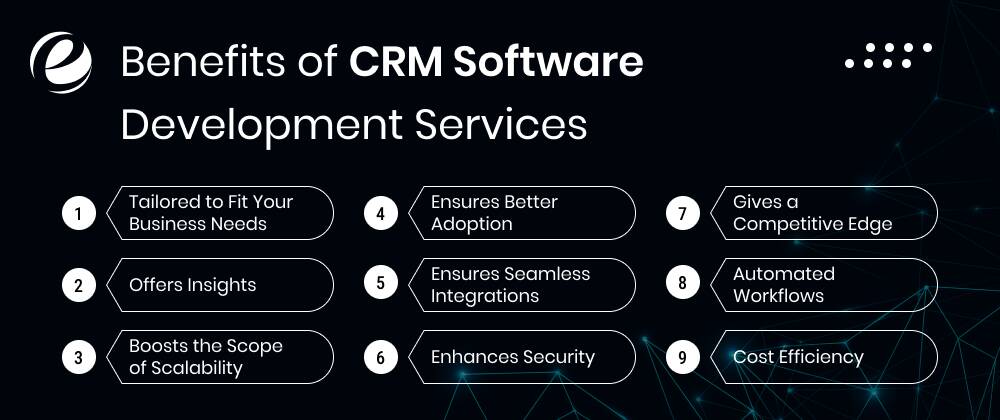
Investing in custom CRM development services is not just about getting a tool in return. The right platform can have a significant impact on an organization on a broader level, from facilitating collaboration between departments to enhancing decision-making. This shift also unlocks new doors to innovation.
Let’s discuss the benefits of CRM software development further in this roundup.
Tailored to Fit Your Business Needs
Off-the-shelf CRMs require that your processes fit their templates, even if it means molding the workflows. But the picture is entirely different with a custom solution. In this case, you decide how a CRM should work. You can implement automation pipelines, create dashboards, and do more, ensuring the tool is in sync with your operational structures.
Offers Insights
Tailored intelligence is barely a choice now. It is the much-needed ingredient for ensuring a competitive advantage in the cutthroat competition. But here’s the thing: A standard CRM would not help you make smart and calculated moves like a custom solution. The latter unlocks access to actionable insights, such as service performance, customer preferences, customer behavior, conversion patterns, and challenges. It features analytics dashboards that monitor key metrics across various departments, including marketing, sales, and customer lifecycles. It shows everyone the right direction for targeted actions and customer engagement.
Boosts the Scope of Scalability
With custom CRM, you not only streamline the ongoing work but also set the stage for future growth possibilities. It keeps growing with your business. Whether you need to track additional KPIs or plan to hire a new team, consider everything taken care of. Custom CRM software development services leverage you to scale modules, features, technologies, and overall capabilities, the way you want. And this level of flexibility is the need of the hour.
Ensures Better Adoption
User resistance, despite its initial underestimation, is a significant hurdle to implementing CRMs. An off-the-shelf platform is often packed with features and rules that no one or no team in the organization needs. It only clutters the interface. On the other hand, a custom tool features an intuitive interface and facilitates role-specific functions. From sales and marketing to support and product, everyone receives tools and dashboards tailored to their unique needs.
Ensures Seamless Integrations
This is one of the biggest perks of custom CRM software development services, especially if you already use email marketing, accounting, or ERP tools. When introducing a new tool, ensure it doesn’t create data silos. With custom solutions, you can rest assured that the CRM will integrate smoothly with the existing systems within your organization. Therefore, everything works in synergy, and data flows smoothly with no challenges.
Enhances Security
Data is an asset, the most valuable asset, which needs to be protected in the best way possible. Off-the-shelf systems have protocols that may or may not align with your business’s industry-specific compliance requirements. Here’s the good part: You can use custom CRM development to implement top-notch security (like role-based permissions, encryption, etc.) and keep up with internal and regulatory demands.
Gives a Competitive Edge
To create a recall, businesses must do something better than the rest. A custom CRM tool can help you gain that advantage smartly. Want to automate a workflow specific to your industry? Launch a niche loyalty program? Put your tool to work and come up with unique strategies that set your brand apart from the crowd.
Automated Workflows
Here’s one of the easiest ways to benefit from CRM software development: Automate your workflows. By automating everyday tasks, the tool saves you a great deal of time and energy. Sending follow-up emails? Done. Updating the status of a lead? Check, check. From triggering alerts to updating details, this one tool can free up time on your hands, taking productivity to a new level.
Cost Efficiency
If reading the perks mentioned above made you feel that it is budget-heavy work, take a pause. While a custom solution may seem expensive initially, it ultimately proves to be the most cost-effective approach for running operations in the future. You don’t have to pay for features you don’t need, third-party add-ons that you won’t use, and subscription fees. To top that all, reduced errors, improved efficiency, and fewer operational bottlenecks will also directly and indirectly impact savings in the long run.
Features to Consider for CRM Software Development
When you opt for end-to-end software development services, you have the freedom and flexibility to implement functionality that best fits your business needs, goal to goal and team to team. The list below discusses 15 key features of CRM software that you must consider investing in.
Intuitive Dashboards
Real-time dashboards tailored to different teams and roles allow everyone access to track and analyze metrics. While support teams can monitor the ticket resolution process and status, sales teams can check deal pipelines. These dashboards retrieve information from CRM modules and present it in clear, easy-to-understand graphs, charts, and other formats. A visually appealing, customizable interface makes it extremely easy for everyone to stay up-to-date on data.
Workflow Automation
Automation makes management a lot easier. From follow-ups to invoice creation to customer feedback requests, automating a range of tasks can unlock all-new levels of efficiency for teams. With a custom-built automation engine, you can leverage these perks seamlessly by setting up actions, triggers, and conditions as per your business needs. Bottom line: You cut back on manual workloads, prevent errors, save time, and boost productivity
Lead Tracking
Why rely on cluttered notes and spreadsheets when you can customize your CRM to track leads in a rather sophisticated system? Customization enables seamless tracking functionality, allowing leads to be auto-fetched from emails, forms, social media, and other sources. You can also create unique deal stages, follow-up cadences, and scoring mechanisms to tailor your approach to each customer’s specific needs. This feature enables the sales team to be on the same page and have clarity on the action to take.
Multi-Channel Communication
No one sticks to just writing emails or SMS for reaching out to brands anymore. In a hyper-digital world, it has become pretty standard for customers to expect interactions with brands to be as seamless as chatting on Instagram. Custom CRM solutions enable your teams to track all previous interactions and seamlessly pick up where they left off on another channel. They can also leverage personalized responses, automate messaging, and ensure every chat is on track with the relevant context.
Third-Party Integrations
CRM software development can be a game-changer for business operations, but hang on, is it enough? Not exactly. Integrating it with other tools, such as account management software, email marketing platforms, or ERPs, is crucial for maintaining harmony and efficiency. The benefit of a custom solution is that you can implement these integrations seamlessly and set up a connected tech stack that powers uninterrupted data flow and collaboration among teams.
Role-Based Access Controls
While relevance and speed are paramount, security is equally important in ensuring customer loyalty. One of the non-negotiable features of CRM software is role-based access controls, which ensure that each employee has access only to the data relevant to their role. For instance, a sales team does not need to access HR data, nor does the marketing team need to edit a lead report. You can define who can view, edit, or delete what, based on their team, role, or hierarchy.
Advanced Analytics
Why continue juggling with bundles of cluttered reports when you can swap them for cleaner, precise numbers? One of the most valuable features of CRM software custom solutions is that they let you design reports based precisely on your KPIs. Want to track deal closure time? Check. Or catch up on customer satisfaction scores? Check, check. From data visualization to predictive analytics, a single custom tool can significantly improve the standards of decision-making and issue resolution practices.
Customer Segmentation
Staying organized shouldn’t be a task. By investing in a customized CRM platform with built-in calendars and task managers, you can achieve order across all operations. These must-have tools can schedule product demos, assign tasks, create timelines, add follow-ups to the calendar, and do more. The interesting thing is that they can be synced with Outlook and Google, which only doubles the ease.
Multi-Language and Currency
An excellent feature for businesses operating across regions, multi-language and currency support powers global workflows and ensures consistent customer service on all levels. By building a custom solution, you decide the number of languages and currencies that the tool should support. This aspect, as underrated as it may seem initially, is crucial for keeping operations going smoothly, especially for businesses in ecommerce, logistics, and SaaS.
Feedback Analysis
With feedback modules integrated in your custom CRM, you can know precisely how satisfied the customers are with your product/service. These modules include star ratings, post-chat and call forms, and more. The responses are automatically categorized, interpreted, and assigned to specific teams.
AI-Powered Recommendations
AI in CRM can take the purpose of the tool beyond lead handling, all the way to a predictive approach to almost every aspect of customer management. AI-powered CRMs analyze customer interactions on multiple levels, ultimately identifying the risk of churn and recommending products or services to up-sell or cross-sell accordingly. This feature accelerates the process of decision-making, strategizing, and taking action to mitigate risks.
Task Management
This feature simplifies the whole process of segmenting customers with built-in tools. Every business has its own tags for customers, along with unique life cycles. A custom solution enables you to group them based on various factors, including engagement, behavior, interaction, purchase history, demographics, and other relevant criteria. This isn’t just amazing but essential for tailored marketing campaigns and spot-on targeting.
The Role of AI In CRM Software Development
AI is everywhere, more as a necessity than a high-end concept. The integration of AI technologies into CRM powers up decision-making, customer experience, operational efficiency, and ultimately, cost efficiency. As a result, more and more businesses are approaching customer management operations from a fresh angle. The global AI in CRM market size is expected to reach $28.01 billion by 2029.
Here are some examples of what and how AI transforms customer relationship management:
- Forecasts sales
- Automates lead scoring and prioritization
- Predicts behaviors, trends, demands, and risks
- Personalizes communications
- Analyzes customer sentiment across various channels
Moreover, AI-powered customer service agents in CRM can also be embedded into your custom CRM for lightning-fast query handling and resolutions. Simply put, it can not only simplify lead tracking but also predict what’s next, while providing up-sell and cross-sell recommendations. This leads to increased customer engagement and retention.
Top 10 Industry-Leading CRM Platforms
Here are the top CRM solutions that have set the benchmark for building custom platforms:
| CRM | Features | Pricing |
| Salesforce | Lead and scope management, automation, AI insights with Einstein, AppExchange | $25/user/month |
| HubSpot CRM | Contact management, email tracking, sales pipeline, marketing automation | Free (Basic), Paid from $20/user/month |
| Freshsales | Built-in phone/email, visual sales pipeline, AI-based lead scoring | $12/user/month |
| Zoho CRM | Workflow automation, omnichannel support, analytics, and AI assistant (Zia) | $10/user/month |
| Pipedrive | Visual pipeline, activity reminders, customizable reports | $14/user/month |
| Nimble | Social CRM, contact insights, group messaging | $24.90/user/month |
| Monday Sales CRM | Customizable workflows, dashboards, and integration with Monday.com | $10/seat/month (billed annually) |
| Insightly | Project management, workflow automation, and relationship linking | $29/user/month |
| Keap | Sales & marketing automation, invoicing, and appointment scheduling | $159/month (up to 1,500 contacts) |
| Bitrix | Free plan, project management, team collaboration, call center | Free (Basic), Paid from $39/month (up to 5 users) |
Custom CRM Software Development Process
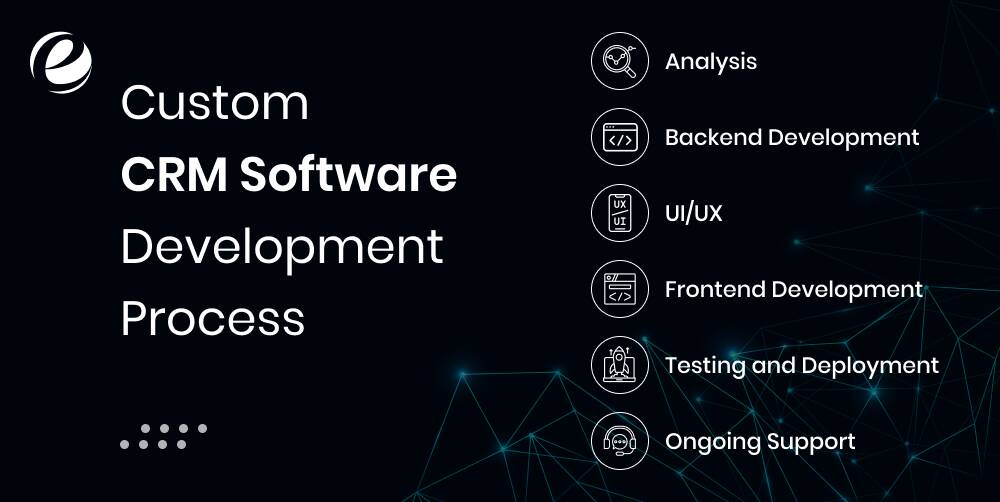
Building a custom CRM is a process that strikes a balance between detailed strategy, innovative approach, and domain expertise. Below are the steps that form the most crucial stages of the project.
Analysis
In order to create a solution, you first need to define why and how you will do that. This means studying the market and listing out the purposes that off-the-shelf CRMs are not solving for you. At this stage, you should also partner with the top CRM software development company to ensure that your project is under an expert watch. Ultimately, you should have a clear view of customer touchpoints, pain points, goals, and must-have features that will soon evolve into a robust tool.
Backend Development
This stage of the custom CRM software development process focuses on building custom modules according to the requirements. It essentially involves designing database schemas, installing role-based access controls, and creating data models. The goal of this phase is to ensure that the system operates efficiently on the front end.
UI/UX
Interactive prototypes are non-negotiable for visualizing user journeys, interface logic, and dashboard layouts. At this stage, the team ensures that your CRM tool is both seamlessly functional and user-friendly, with a visually responsive interface.
Frontend Development
This is the stage where the fronted team comes to the forefront. They create intuitive forms, clutter-free navigation routes, and highly responsive dashboards. The primary focus is to ensure that all these functions are tailored to specific use cases, just the way they need to be. Ultimately, the tool should be accessible and easy to use.
Testing and Deployment
The CRM software doesn’t hit the launch date just like that. The development and QA teams work closely to make sure that the tool is one hundred percent ready to be unveiled. This heads up comes only after the CRM has been thoroughly tested for user accessibility, unit functionality, and integrations. There is also a focus on ensuring that it is secure and bug-free.
Ongoing Support
The best CRM software is one that is always in pace with the market. And that’s why this phase remains constant. Even after the launch, the tool should be monitored for any updates or upgrades that may be required to enhance its functionality. Moreover, consistent maintenance also helps keep you vigilant about risks, such as security breaches and fraudulent activities.
Why Choose Emizentech for Custom CRM Development Services?
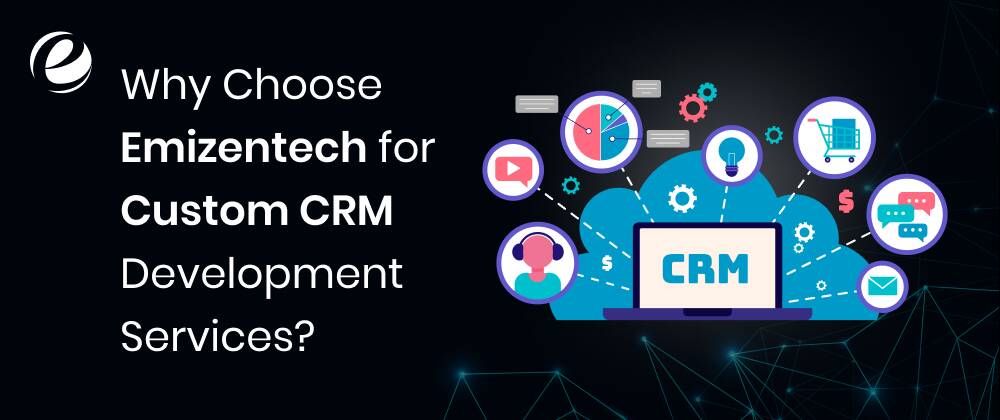
A custom-built CRM that simplifies every aspect of your customer management processes, like it is a cakewalk, sounds like the best solution. But developing a tool from scratch may seem like a hassle. We make sure it doesn’t.
As a leading CRM software development services provider, we take up the entire process of crafting the exact platform that aligns with your business. With years of experience in building custom solutions across industries and domain expertise, our end-to-end services include:
- Tailored customer relationship management solutions
- UI and UX
- Al-powered automation
- Integrations and migration
- Post-development support
And while our experts are at it, we keep the process completely transparent, ensuring that your vision and our interpretation of it are aligned.
Power Up Customer Experience with Custom CRM Development
The global CRM software market is expected to grow at a compound annual growth rate (CAGR) of 14.6% between 2025 and 2030. While organized customer management processes are the primary goal behind its adoption, custom CRM software development services are also gaining popularity due to their AI-powered capabilities and social media integrations. By investing in them today, you can cut back on operational costs in the years to come, while engaging existing customers and driving more leads. The best part is that you will accomplish everything effortlessly.
FAQs
What is CRM software development process?
CRM software development process is focused on defining the functions of the customer relationship management platform, creating a roadmap, building a secure architecture, designing UI/UX, and testing the platform before launching it for use.
Is CRM software development worth it?
Implementing a robust, feature-rich CRM in the infrastructure can streamline a significant share of workflows, automate operations, boost productivity, enhance the customer experience, and, in the long run, help improve cost efficiency as well.
What is the primary goal of CRM?
CRM primarily focuses on automating, organizing, and segmenting sales data to streamline processes and enhance efficiency. It also helps create or fine-tune strategies based on unique customer data.
Who benefits from a CRM system?
Customer service teams, marketing teams, sales teams, and business leaders all benefit from the CRM in terms of efficiency, valuable insights, and decision-making.



 +1 (989) 535-9295
 info@emizentech.com
 emizentech


