
 Add us as a preferred source on Google
Is your business still hesitant to bring on remote developers because of these old fears that keep getting recycled? The global remote work software market is projected to move up to $97.5 billion by 2032, at almost a 14% CAGR, while fully remote job postings are expected to sit around 14 to 16% of all listings by 2027, and the digital nomad crowd might reach 35 million by 2028. Source: Electroiq.
Those figures show remote hiring is a long-term shift, not a short-lived fad. This blog focuses on debunking remote work myths with real facts so you can make hiring choices with evidence instead of depending on outdated systems or office-first instincts that quietly strangle business growth.
12 Remote Developer Myths Businesses Need to Stop Believing
Remote hiring myths hold companies back from reaching skilled talent worldwide. So before you hire dedicated developers, here are 12 points that split outdated assumptions from the actual, data-backed truth behind remote software teams.
Myth 1: Remote Developers Are Less Productive Than In-Office Teams
Ground Reality: Research suggests remote engineers frequently produce more code and fewer defects since there are fewer workplace distractions, and longer, uninterrupted focus periods help build deeper concentration and steadier, consistent delivery.
Myth 2: Communication Breaks Down Without a Physical Office
Ground Reality: Modern teamwork tools like Slack, Jira, and video calls keep remote teams aligned in real time, so they can even improve documentation habits, which helps reduce miscommunication that you get in crowded offices where everything is moving fast.
Myth 3: Hiring Remote Developers Costs the Same as In-House Staff
Ground Reality: Companies that hire developers remotely often cut down on office space, equipment, and extra overhead, so remote talent ends up a more cost-effective option without sacrificing expertise or delivery pace.
Myth 4: Remote Teams Can’t Handle Complex, Long-Term Projects
Ground Reality: Dedicated remote teams routinely run large-scale enterprise software and multi-year product roadmaps, so the real issue is process and competence, not the absence of office walls or location.
Myth 5: You Can’t Trust Remote Developers With Sensitive Data
Ground Reality: Credible remote teams use tight NDAs, secure VPNs, and access controls, so they provide the same, or sometimes better, data protection than many traditional in-house development setups today.
Myth 6: Time Zone Differences Make Remote Collaboration Impossible
Ground Reality: With structured overlap hours, async updates, and shared project boards, distributed teams can seamlessly hand off work, turning time zone differences into 24/7 development coverage and faster project delivery.
Myth 7: Remote Hiring Limits You to a Smaller Talent Pool
Ground Reality: Remote hiring expands your talent pool, giving businesses access to specialised developers worldwide rather than only local candidates, and that difference is bigger than most people expect at first glance.
Myth 8: Remote Developers Lack Loyalty and Leave Quickly
Ground Reality: When remote professionals are given flexibility, opportunities for advancement, and meaningful work, they tend to stay longer. Long-term developer retention and loyalty are driven primarily by job satisfaction rather than office presence.
Myth 9: In-House Teams Are Always Easier to Manage
Ground Reality: Remote teams can be just as easy to manage as in-house staff with structured sprints, daily check-ins, and clear ownership, making it beneficial to hire remote developers for steady, predictable delivery.
Myth 10: Remote Work Reduces Code Quality and Testing Standards
Ground Reality: Distributed teams that use CI/CD pipelines, proper code reviews, and automated testing keep the same strict quality habits as any development team sitting in the same building. Location doesn’t automatically change standards.
Myth 11: You Lose Control Over Project Progress Remotely
Ground Reality: Cloud-based dashboards and sprint tracking tools, plus regular demos, give businesses full visibility into project progress. Remote work often offers greater transparency than traditional office environments because every task is logged and visible.
Myth 12: Remote Teams Can’t Build a Strong Company Culture
Ground Reality: Virtual team-building on a regular basis, shared goals, and transparent communication help remote teams establish a strong culture and alignment. Company culture is not simply about physical proximity; it takes intentional effort.
Quick Comparison: Remote Developer Myths vs Reality
To make it clear, here’s a quick side-by-side view of common remote developer myths versus what businesses actually see once they move past those outdated assumptions and start using modern hiring practices.
| Aspect | Common Myth | Actual Reality |
| Productivity | Remote developers slack off without supervision | Fewer distractions lead to higher output and fewer bugs |
| Communication | Teams fall apart without a shared office | Modern tools keep distributed teams aligned in real time |
| Cost | Remote hiring costs the same as in-house staff | Businesses save significantly on overhead and infrastructure |
| Project Complexity | Remote teams can’t manage large, complex builds | Dedicated remote teams run enterprise-scale projects successfully |
| Data Security | Sensitive data is unsafe with remote developers | NDAs, VPNs, and access controls ensure strong protection |
| Time Zones | Time differences make collaboration impossible | Overlapping hours and async workflows enable smooth delivery |
| Talent Pool | Hiring limits access to good talent remotely | Remote hiring opens access to specialized global talent |
| Management | In-house teams are always easier to manage | Sprints and check-ins make remote teams equally manageable |
| Code Quality | Remote work lowers coding and testing standards | CI/CD and code reviews maintain consistent quality |
| Visibility | Businesses lose control over remote project progress | Dashboards and demos offer full, real-time visibility |
| Retention | Remote developers leave jobs quickly | Flexibility and growth paths support long-term retention |
| Sustainability | Remote hiring isn’t viable long-term | Clear contracts support lasting, multi-year partnerships |
Beyond the Myths: A Practical Framework for Hiring Remote Developers
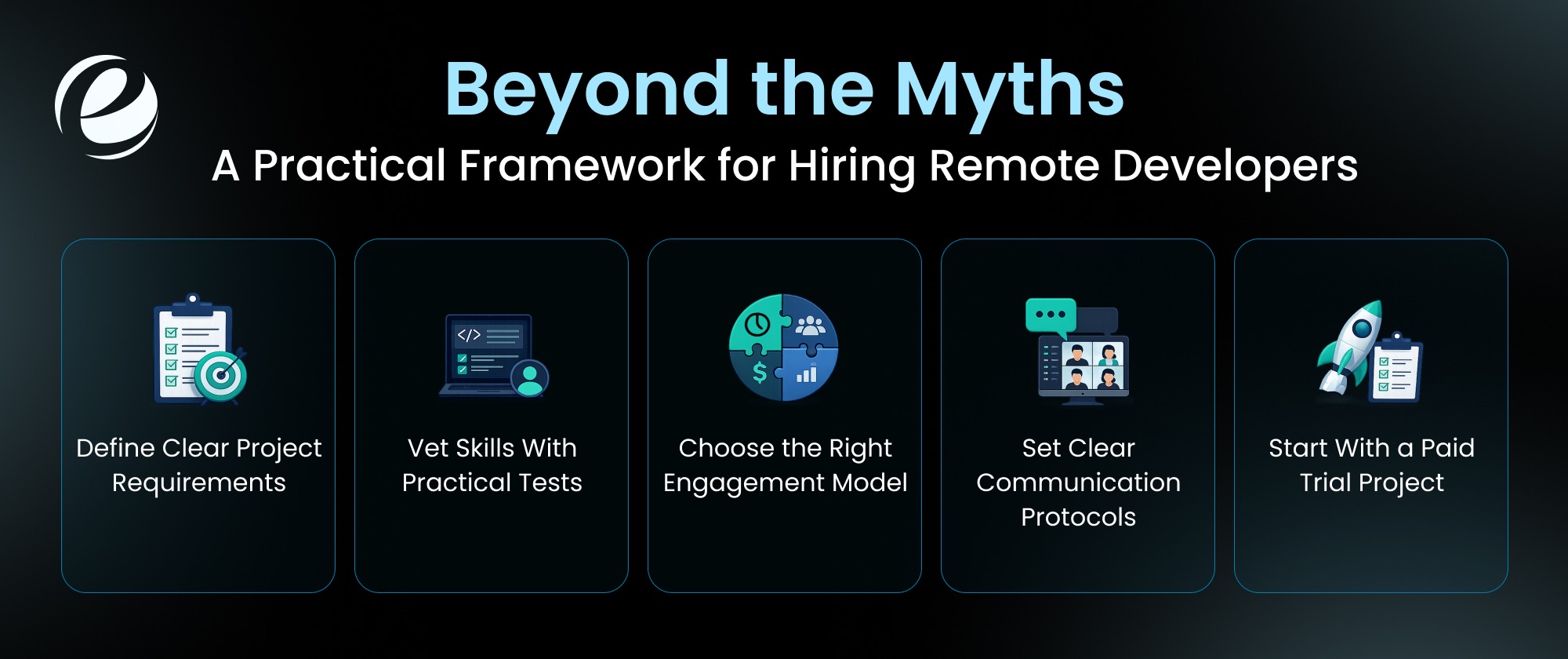
After debunking remote work myths, businesses still require a clear strategy for hiring remote talent the right way. Here’s a five-step framework for successfully hiring remote developers.
Define Clear Project Requirements
Before you hire anyone, map out your project scope, the tech stack, a realistic timeline, and the budget, because well-defined requirements draw in the right remote developers and also stop expensive misunderstandings later in the project.
Vet Skills With Practical Tests
Conduct coding assessments, review portfolios, and do technical interviews so you evaluate actual ability, not the resume sparkle, because you want to be sure the person can handle your technical project needs and demands.
Choose the Right Engagement Model
Choose whether you need a freelancer or want to hire a dedicated app development team. That decision depends on how large the work is, how complex it gets, and how much ongoing support your business requires.
Set Clear Communication Protocols
Set fixed check-ins, agree on shared tools, and require documentation standards from the start so distributed teams remain in sync, and in a way it makes debunking remote work myths an ongoing habit, not only a one-time idea.
Start With a Paid Trial Project
Before signing a long-term commitment, try a small paid trial project to test collaboration, code quality, and overall performance. This approach helps reduce hiring risk while confirming the skills and capabilities are real and that the person is a good fit.
The Final Words
Remote hiring is not a gamble. It’s a proven way to build better software teams. And if you dig a little deeper, the whole notion that working remotely is “just worse” falls apart. Because really, productivity, security, and quality are about the process, not the physical location. Companies that move beyond outdated assumptions tend to unlock skilled global talent, deliver faster, and get a bit more flexibility too.
Before you begin, make sure you understand the real costs to hire an app developer remotely so you can make a smart budget and not just guess. Just make sure you know what you need and vet people properly, and the level of communication and remote development can match or even beat in-house results.
FAQs
Is it safe to hire remote developers?
Yes, when you hire developers through vetted agencies and you have signed NDAs, secure access controls, and contracts that are actually clear, remote hiring ends up being as safe as in-house development.
What is the cost difference between remote and in-house developers?
Remote developers often cost less because the overhead is lower. Still, the real cost to hire an app developer depends a lot on the region, the experience level, and the project complexity involved.
How do you evaluate a remote developer's skills before hiring?
Use technical tests, code reviews, portfolio checks, and even a small paid trial project. That way you validate not just coding ability but also the way they communicate and how reliable they are before moving into a long-term contract.
How do you handle time zone differences with remote engineering teams?
Set overlapping working hours and use asynchronous updates. Use shared project management boards and collaboration tools to keep workflows organised, allowing teams to work efficiently despite time zone differences and global locations.
How do you protect intellectual property (IP) when hiring offshore developers?
Sign strong NDAs, use secure code repositories, limit data access, and choose agencies that include clear IP ownership clauses inside every signed contract.





 +1 (989) 535-9295
 info@emizentech.com
 emizentech


