 Add us as a preferred source on Google
 You have to understand early on that building and managing an offshore team can help your business save money, work with skilled developers, and complete projects faster. The reason behind these benefits is that an offshore team is based in another country and works closely with your in-house team to achieve the same goals.
However, making this setup work takes clear communication, defined responsibilities, and good project management. Building a supportive working relationship can lead to better results over time. In this blog you will learn about the right approach to build and manage an offshore development team and its costs by region and some common challenges to avoid.
Why Build an Offshore Development Team?
The offshore software development market sits above $204 billion in 2026 and is on track to hit nearly $348 billion by 2030, roughly 14% growth a year, according to a recent market report from Research and Markets. That kind of growth isn’t a trend people are chasing. It’s the math and the talent access, both holding up under actual scrutiny, year after year.
Three reasons tend to come up when leadership explains the decision:
- Cost Efficiency: It lowers average salary rates and reduces overhead for office space in regions like Eastern Europe or India.
- Access to Specialized Skills: AI/ML engineers, blockchain developers, and DevOps specialists are easier to find abroad due to larger tech talent pools, while the local markets may have limited availability.
- Speed and Scale: A full team can come together in weeks, not months, so you can staff up for a launch and scale back down once things settle.
There’s a resilience angle too, one that doesn’t get talked about enough. Spread engineering across time zones, and work keeps moving after your local team clocks out. Releases get shorter without anyone pulling extra hours to make it happen. That’s pushed many product teams to rethink how much of the roadmap really needs to live in one office.
Some companies want more than a project team. They want an offshore dedicated development team that stays with them from sprint to sprint instead of rotating between clients. Companies that have outgrown local hiring or want a full offshore development center instead of a handful of contractors usually land here first.
Offshore Development Team vs. Other Engagement Models
Not every project needs a full offshore build; some just need an extra pair of hands for six weeks. Here’s how the model stacks up against the other common ways to staff a project:
| Model | Cost | Control | Talent Access | Best For |
| Offshore Development Team | Low–Medium | High (dedicated team) | Very high | Long-term products, ongoing development |
| Onshore Team | High | Highest | Limited by local market | Regulated industries, in-person needs |
| Nearshore Team | Medium | High | Moderate | Time-zone-sensitive collaboration |
| Freelancers | Low | Low | High but inconsistent | Small, short-term tasks |
| Staff Augmentation | Medium | Medium | High | Filling specific skill gaps temporarily |
| Project-Based Outsourcing | Medium | Low | High | Fixed-scope, one-time builds |
Offshore wins on cost and talent breadth, but it asks for more upfront work on process and communication than hiring down the street would. It’s not free; it’s just cheaper in a different currency.
Offshore Development Team Costs by Region
Rates for an offshore software development team swing a lot depending on where the developers actually sit. Here’s a rough 2026 snapshot for a mid-to-senior developer, per hour:
- India: $20 – $45
- Eastern Europe (Ukraine, Poland, Romania): $35 – $65
- Latin America (Brazil, Mexico, Argentina): $30 – $60
- Southeast Asia (Vietnam, Philippines): $18 – $40
- Africa (Nigeria, Kenya, Egypt): $15 – $35
Those numbers move around based on tech stack, seniority, and how good the vendor’s reputation actually is. An architect-heavy senior team will always cost more than a junior support pod, and that’s fair. Fixed-price contracts, hourly billing, and monthly retainers each change the math again, so it’s worth pushing any vendor to break their rate card down by role instead of accepting one blended number for the whole engagement.
The comparison most companies end up running is offshore developers vs onshore hires, and the gap usually isn’t small. US rates for the same seniority level often run two to four times higher. If you’re still weighing that trade-off, this breakdown of onshore vs. offshore software development is worth a read before you commit a budget.
How to Build a Dedicated Offshore Development Team in 5 Steps
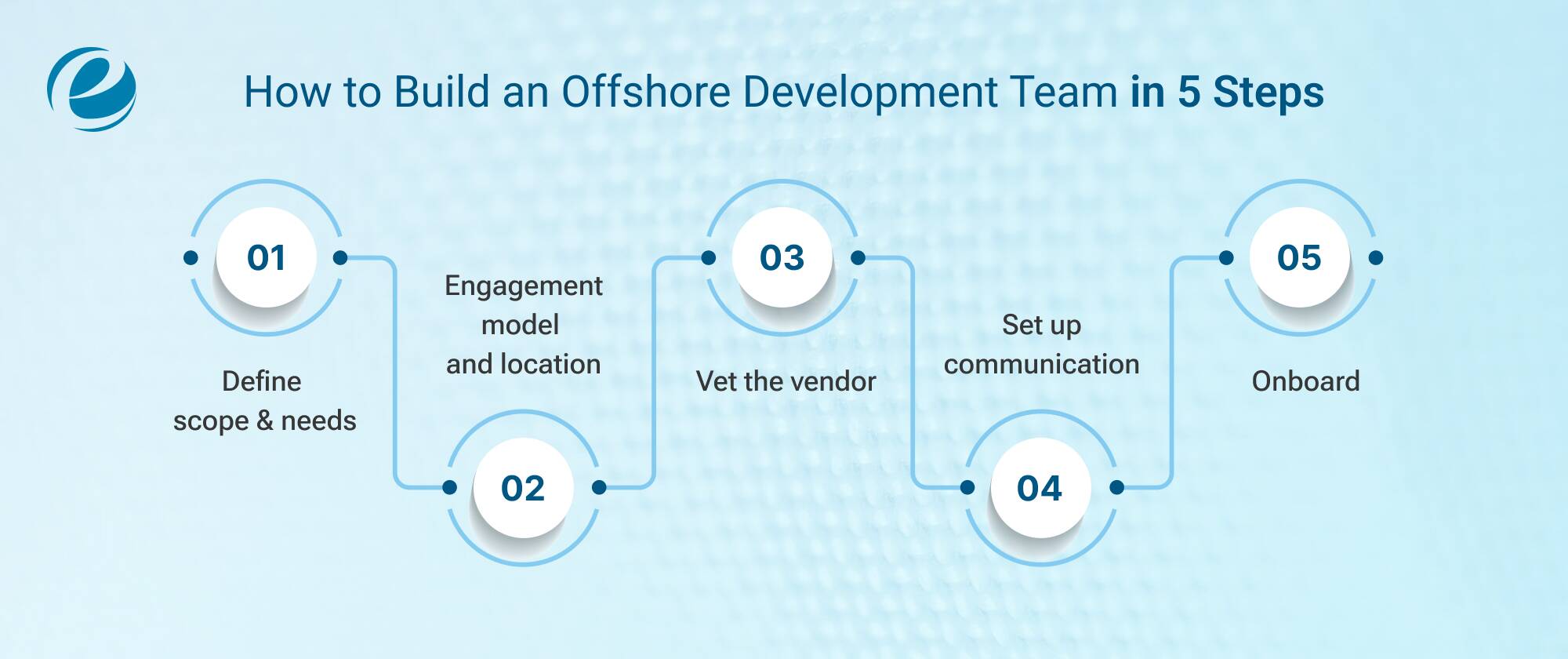
Skip a step here, and it usually shows up later as a missed deadline, a mismatched vendor, or a team that never quite gels. Here’s the short version of what actually matters, step by step.
Define Scope
Write down the tech stack, timeline, and exact roles you need for backend, mobile, QA, and DevOps before you talk to a single vendor. Vague requirements are the number one reason offshore engagements stall, usually months after the contract is already signed.
Engagement Model and Location
A fully dedicated build, staff augmentation, or something narrower like an offshore hybrid mobile development team that blends in-house product owners with engineers abroad; the choice depends on budget, required overlap hours, and language needs, not just the hourly rate.
Vet the Vendor
Interview the actual developers who will work on your project, not just the sales rep. Check references, and run a small paid trial task if the engagement is high-stakes. With this, you can easily select the expert offshore developers.
Set Up Communication
Standardize on tools Slack, Jira, and GitHub; agree on overlapping working hours; and lock in a recurring standup cadence before day one of development actually starts, not after the first missed deadline forces the conversation nobody wanted to have.
Onboard
Give the offshore side the same documentation, same access, and same context you’d give a local hire. Teams treated as a genuine extension of the company, not a vendor kept at arm’s length, ship better work and stick around longer.
So with the help of this process, you can easily build a team of offshore developers, those who are professionals in your field and understand your goals clearly.
Common Challenges of Managing Offshore Developers
Offshore teams bring real advantages, but they also create friction that in-house hiring rarely does. Here are the five most common challenges and the fixes that actually work day to day.
Time Zone Gaps:
A 10-hour difference turns a five-minute question into a 24-hour wait if nobody plans for it.
Solution: Build a 2-3 hour daily overlap into contracts and lean on async updates, recorded stand-ups, and written PR notes for everything outside that window.
Communication and Language Friction:
Misread requirements are usually a documentation problem, not a competence one.
Solution: Standardize written documentation over verbal handoffs, and pick vendors with real English fluency across the whole bench, not just the project manager.
Security and IP Concerns:
Handing external developers broad system access is one of the more common early mistakes and an easy one to avoid.
Solution: signed NDAs, role-based access control, and repositories your company owns outright rather than ones sitting on the vendor’s infrastructure.
Cultural and Working-style Differences:
Different markets have different defaults for how bluntly feedback gets delivered, and that alone causes more friction than any actual skill gap.
Solution: A short onboarding on how your company gives feedback and makes decisions can help a lot.
These are some challenges you face managing offshore developers, but you can easily overcome them with the solutions.
Advice for Working on a Team with Offshore Staff Augmentation
Working with a dedicated offshore development team can be a great way to fill skill gaps and speed up your projects. If you want to make the partnership successful, keep the communication simple and regular so everyone stays updated. To do this, you can set clear goals early, explain tasks clearly, and use collaboration tools to track progress.
It is also helpful to respect different time zones and encourage open discussions whenever questions come up. If your business needs a larger development team or end-to-end project support, you can also explore outsourcing software development services to find the approach that best fits your goals.
Why the Dedicated Developer Model Delivers the Best Offshore ROI
Of all the ways to structure an offshore engagement, the dedicated model tends to win on returns, and it’s not particularly close. Instead of paying per project or per task, you get engineers who work exclusively on your product, learn the codebase properly, and stay long enough for that knowledge to actually compound.
The ROI shows up in three places: fewer onboarding cycles because the team isn’t rotating between clients, better architectural consistency because the same people keep making the calls, and lower management overhead because the whole thing behaves like an in-house unit instead of a revolving door of contractors.
There’s a compounding effect on top of that. A team that’s shipped three releases with you already knows your edge cases, your users, and why certain calls got made, and that shows up as fewer regressions and shorter QA cycles the longer the relationship runs.
Why Tech Leaders Partner with Emizentech for Offshore Development Teams
Emizentech has spent over a decade building mobile and software products for clients in fintech, healthcare, retail, and logistics. A few reasons tech leaders keep coming back:
- Full-stack and mobile depth: Native, cross-platform, and hybrid setups for companies building across iOS, Android, and web at once.
- Transparent engagement models: The dedicated teams, staff augmentation, or fixed-scope projects focus on what the client actually needs instead of a one-size-fits-all package.
- A track record that holds up: There are hundreds of shipped products across industries, with client relationships that stretch across multiple releases, not just one.
- Real access to senior talent: No unqualified junior swaps mid-project and no surprise handoffs to a different bench nobody agreed to.
If you want to hire dedicated developers without building a recruiting pipeline from scratch, you usually start with a short scoping call to match team size and skills to the roadmap our developers are actually working from.
Conclusion
Building a strong offshore development team isn’t about chasing the cheapest rate card. It’s about finding a model that lets you scale engineering without scaling the management headache that usually comes with it. The companies that get this right treat their offshore partners as a real extension of the team, get communication sorted early, and choose a dedicated engagement model over ad hoc outsourcing once the product is past MVP.
If you’re ready to hire an offshore dedicated development team that fits your roadmap and budget, start with a clear scope, vet the people behind the portfolio, and build the process before you build the product.
FAQs
What is an offshore development team?
It is a group of developers based in another country who work as a dedicated extension of your company that handles design, coding, testing, and maintenance the same way an in-house unit would.
How do I maintain the security when working with an offshore development team?
You can use signed NDAs, role-based access controls, and repositories your company owns directly. You have to limit vendor access to task needs and check access logs on a regular basis to catch anything unusual early.
How much does it cost to hire an offshore development team?
The costs depend on the region and seniority, and are $15 to $65 an hour in 2026. India and Southeast Asia sit on the lower end, while Eastern Europe and Latin America run higher thanks to stronger time-zone overlap.
How quickly can Emizentech build an offshore development team for my project?
Emizentech puts a full team together within two to four weeks, which depends on the skill set and headcount, following a scoping call to nail down roles and technical needs upfront.
What are the differences between staff augmentation and a dedicated offshore team?
Staff augmentation fills specific skill gaps temporarily within your existing team, while a dedicated offshore setup works as a long-term unit that is focused on your product from planning through delivery.



 +1 (989) 535-9295
 info@emizentech.com
 emizentech


