 Add us as a preferred source on Google
 You’ve got a product to ship, a budget that doesn’t stretch to full-time hires, and two very different models in front of you, each offering a solution. Choosing between outstaffing vs outsourcing doesn’t just cost money; it costs months of delivery time that you won’t get back.
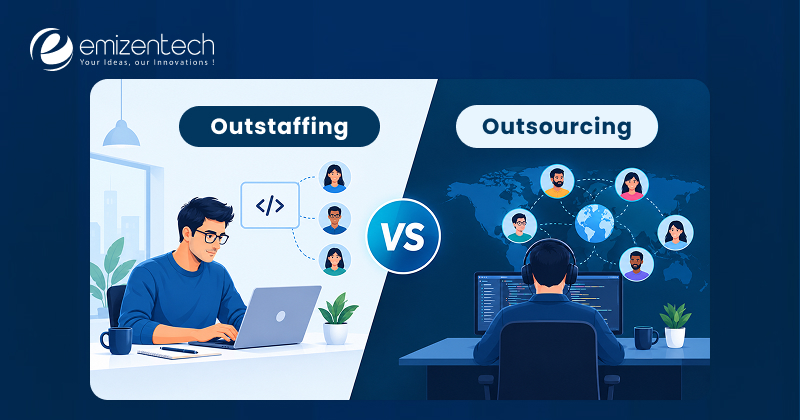
Outstaffing gives you remote talent you manage directly, while outsourcing hands the entire delivery to an external vendor. According to Deloitte’s Global Outsourcing Survey, 42% of businesses now cite access to specialized talent as their top driver for external workforce models, rather than short-term cost reduction. This post breaks down exactly how both models work, where each wins, and which suits your situation.
What is Outstaffing?
Outstaffing is a business practice where you hire a remote tech professional or team through a third-party vendor, but manage them directly as if they were internal employees.
Think of it like hiring an employee, but instead of you handling their payroll and providing their office space, another company does that while the employee works exclusively for you and takes daily direction from you. It is a popular form of staff augmentation that many companies frequently use in software development and IT.
What is Outsourcing?
Outsourcing is when you hire an outside team, or a third-party vendor to do a job instead of doing it yourself. Instead of using your own employees, your company pays an external business to handle specific tasks, projects or entire departments.
For example, you hire a marketing agency to run the website of your clothing brand. Instead of spending weeks trying to learn about accounting & web design or hiring expensive, full time professionals; you outsource and hire an overseas agency to redesign your website.
Outstaffing vs. Outsourcing: Key Differences at a Glance
| Features | Outstaffing | Outsourcing |
| Definition | Hiring remote staff via an agency to join your team | Contracting an entire project or process to an outside provider |
| Control & Management | You manage daily tasks, goals, and performance directly. | The external vendor manages the team workflow, and delivery. |
| Accountability | You are responsible for the final product quality, and success. | The vendor is responsible for delivering the final result. |
| Costings | Flat monthly or hourly rate per individual worker. | Fixed project or scope pricing; includes vendor management fees. |
| HR & Payroll | Handled by the third-party agency | Handled entirely by the external vendor. |
| Primary Focus | Team augmentation and long-term product work. | Bounded deliverables and turnkey project execution. |
| Cons | High internal management time and risk of information leaks. | Higher overall cost, and low visibility into daily tasks. |
| Best Suited For | Extending existing teams with specific tech skills | Complete products with clearly defined scopes |
Advantages and Disadvantages of Outstaffing
Outstaffing is a business practice where you hire remote employees through a third-party agency to work directly for your company. The agency handles their payroll, taxes, and legal employment, but you manage their daily tasks just like your internal team.
Now that you have learned the major difference between outstaffing vs outsourcing in the above section, here is a breakdown of the advantages and disadvantages of outstaffing:
Advantages of Outstaffing
- Lower costs: Hiring local employees is expensive due to high salaries, office space, hardware and benefits. Outstaffing lets you hire dedicated developers and other talent from regions with a lower cost of living, which helps you to save significant money.
- Access to global talent: If you cannot find specialized experts, such as specific software developers in your local city, outstaffing opens up the entire world, and you can find the exact skills you need without geographical limits
- No HR admin hassle: The outstaffing agency takes care of all the repetetive documentation where they handle local labor laws, employment contracts, payroll, taxes as well as vacation tracking, so you don’t have to.
- Full control over the team: Unlike traditional outsourcing (where you hand a project to another company and hope for the best), outstaffed employees report directly to you, and you choose how they work & what they focus on every day.
- Easy to scale up or down: If your business suddenly grows, you can quickly add more outstaffed workers through the agency. If business slows down, ending the contract through the agency is much easier than laying off full-time staff.
Disadvantages of Outstaffing
- Communication barriers: Working with people in different countries can lead to language barriers. Misunderstandings can happen easily if project goals or instructions are not written down clearly.
- Time zone differences: If your outstaffed team is 8 hours ahead, or behind you, finding a time to meet can be tough. It can delay your project if a worker has to wait until the next day to get an answer, to a simple question.
- Cultural and workstyle differences: Different countries have different workplace cultures, holiday schedules and styles of feedback. It takes extra effort to make sure that remote workers align with your company’s standard values.
- High management effort: Since you are managing these workers directly, your current managers will have to spend a lot of time organizing tasks, checking code, or work quality, and keeping remote employees motivated.
- Security risks: Sharing internal company data, customer information or source code with remote workers outside your network creates data privacy risks. You have to invest heavily in secure software, and strict access controls.
Advantages and Disadvantages of Outsourcing
Outsourcing is when a company hires an outside team or business to handle an entire project or service from start to finish. Instead of using your own employees, you hand the responsibility over to a third party. For ex. a restaurant might hire an outside accounting firm to handle all its calculation and taxes so the owner can focus entirely on service & management.
While discussing the difference between outsourcing vs outstaffing, outsourcing is a powerful business strategy, it comes with a distinct set of pros & cons.
Advantages of Outsourcing
- Saves money: You do not have to pay for full-time salaries, employee benefits, office space or even expensive equipments; you only pay for the specific work done.
- Instant expert help: You can get access to specialized experts from the start. You do not have to spend months trying to find, interview and train new employees. When comparing staff augmentation vs outsourcing, normal outsourcing is much better when you do not want to manage the experts yourself.
- Focus on core goals: By handling off extra tasks like payroll or tech support to the outsourcing agency, then your core team can spend 100% of their energy on growing your main business.
- Easy to scale: You can quickly hire more help from outsourcing software development company during your busy seasons and easily cut back when business slows down and that too without the need to fire anyone.
Disadvantages of Outsourcing
- Less control: You cannot watch over the day to day work. You have to trust that the outside company is doing things correctly, and following your standards.
- Communication blocks: Hiring a team from another country can introduces time zone gaps, cultural misunderstanding, and language difference that cause project delays.
- Hidden costs: It may be cheaper in the short term, but you may have to pay extra for legal setups, contract changes, or fixing work that wasn’t done right.
- Security risks: Data leaks are more likely to happen if you share your business data, customer information or software code with someone outside your company.
Cost Comparison: Outstaffing vs Outsourcing
When looking purely at the invoices; the hourly billing rates are where outstaffing saves you roughly 20-40% in direct hourly costs compared to outsourcing.
However, looking at the exact amount of differences between outstaffing vs outsourcing requires looking past the base rate. To break down the true outsourcing outstaffing difference, you have to balance the price you pay the agency against the cost of your own internal management time.
Estimated Hourly Rate Breakdown
When you work with an outstaffing agency, you are renting an employee’s time, and in contrast when you choose an outsourcing, you are buying a complete as well as managed results. Between outsource vs outstaff, the outsourcing vendor has to pay for the project managers, quality assurance and organizational risks, they charge a higher markup.
Here is how the average hourly rates break down if you hire a dedicated development team from a popular nearshore region like, Eastern Europe or Latin America:
| Role | Outstaffing Rate (Per Hour) | Outsourcing Rate (Per Hour) | The Cost Difference |
| Customer Service Rep | $12 – $18 | $18 – $25 | Outsourcing costs ~35% more |
| Marketing Specialist | $25 – $40 | $45 – $65 | Outsourcing costs ~45% more |
| Software Engineer | $35 – $55 | $55 – $85 | Outsourcing costs ~40% more |
An outstaffing agency saves $2,400 monthly per seat, but you must watch out for the hidden financial risks of IT outsourcing models. First, the empty bench expense means you pay for full-time hours even if your project stalls and workers sit idle. Second, outstaffing transfers daily management to you. Without a highly skilled internal tech leader to oversee the work, non-technical managers will cause costly project delays that completely wipe out your monthly savings.
Can You Use Both Models Together?
Yes, you can absolutely use both outsourcing vs outstaffing models together which is called hybrid model. Combining them allows you to hire hybrid developers to handle different tasks that helps in creating a highly flexible tech team.
When looking at outsourcing outstaffing difference
- Outsourcing: You hand over an entire project to an external agency. Their project manager oversees the timeline, budget and final delivery which requires very minimal direct involvement and management from you.
- Outstaffing: You add remote engineers directly into your existing setup which is also similar to team extension model. Your internal managers guide their daily tasks and makes them feel like temporary yet full time employee.
Why Mix Them?
Using both gives you the ultimate balance of control and speed. For instance, you can outsource a brand-new mobile app build to an external agency to save your internal team time. Simultaneously you can use outstaffing to bring in a specialized cybersecurity expert to work alongside your standard team. This hybrid approach optimizes your budget, while scaling your capabilities.
How EmizenTech Helps You Build the Right Team
Choosing between outsourcing vs outstaffing is one thing and that is finding a partner who can actually deliver on either model is a completely different challenge. With 12+ years of experience and a track record spanning 30+ industries, EmizenTech gives businesses the flexibility to build their team exactly the way their project demands.
Here’s what working with us looks like in practice:
- You can hire offshore development team members who slot directly into your existing workflow, managed by you, and handled administratively by them
- Flexible engagement structures, whether you need a single specialist or an entire dedicated unit built around your stack
- Access to full-stack software development services covering web, mobile, ecommerce, CRM, ERP, and more
For international clients who want to test before committing, our “Try & Buy Model” offers a 7-day risk-free engagement so you can evaluate real output, real communication, and real delivery quality before signing anything long-term. It’s a low-pressure way to answer the outsource vs outstaff question with actual evidence rather than just a sales pitch.
Conclusion
There’s no universal winner in the outsourcing outstaffing difference debate as the right model depends entirely on how much control you want, how defined your project scope is, and how fast you need to move. Outsourcing is best when you want results delivered to you, while outstaffing is best when you want the talent on your team and under your direction. Get clear on that distinction first, and the decision becomes straightforward.
FAQs
What is the difference between outstaffing and outsourcing?
With outstaffing, you manage remote staff directly, while a third-party agency handles their employment. Whereas, with outsourcing, an external vendor manages the team, and delivers the final result independently with minimal involvement from you.
Is outstaffing the same as staff augmentation?
They're closely related as outstaffing is a specific form of staff augmentation, where a third-party agency employs the worker legally but you control their daily tasks, priorities and overall direction just like an internal employee.
Is outstaffing cheaper than outsourcing?
On a direct hourly basis, yes outstaffing typically costs 20–40% less per hour. However, since you manage the team yourself, hidden costs, like internal management time can reduce, or offset those savings significantly.
Which is better for a startup - outstaffing or outsourcing?
Outsourcing usually suits early-stage startups better since it delivers a managed result without requiring internal tech leadership. Outstaffing makes more sense once you have a product owner or CTO who can direct a remote team effectively.



 +1 (989) 535-9295
 info@emizentech.com
 emizentech


