
 Add us as a preferred source on Google
 In today’s dynamic manufacturing world, it’s not just about producing goods; it’s about managing customer relationships, dealer networks, sales pipelines, and after-sales service efficiently. A CRM for manufacturing industry certainly helps in managing everything effectively. Well, customer relationship management in manufacturing differs from that in other sectors, as it is primarily designed to support manufacturers. Significant advantages are experienced in the transformation of business processes and the integration of various functions.
From tracking orders to enhancing customer satisfaction and predicting demand, CRM software for the manufacturing industry enables companies to stay competitive and organized. In this blog, we’ll learn about the key features of a manufacturing CRM, its operational parameters, the benefits it brings, some uses, and companies like Emizentech that are getting custom CRM solutions made for manufacturers to grow.
Global CRM Market Overview (2025–2030)
- According to Grand View Research, the global CRM market was valued at $73.4 billion in 2024 and is expected to reach $163.16 billion by 2030. It’s also likely to have a compound annual growth rate (CAGR) of 14.6% from 2025 to 2030.
- Expected to be the region with the fastest growth rate of 16.3%, wherein China and India lead the increasing demand for innovative CRM solutions.
- The CRM market in India was valued at $2.09 billion in 2023 and is projected to reach $6.68 billion by 2030, with a compound annual growth rate (CAGR) of 18.1%.
CRM in Manufacturing Sector
- According to Verified Market Reports, the manufacturing CRM software market was estimated to be worth $5.2 billion in 2022 and is foreseen to rise to $9.8 billion by 2030, with a CAGR of 8.4% from 2024 to 2030.
- The trend in the manufacturing industry is to utilize CRM software to obtain quick feedback and better connect with customers, while also achieving more efficient operations.
- The subject of the CRM system being equipped with the most advanced technologies is the key to the emergence of a personalized consumer experience and the improvement of the decision-making process.
Cloud CRM Market
- In 2025, the cloud CRM industry is projected to be worth $127.5 billion, while by 2030, it is expected to reach $252.72 billion, representing a compound annual growth rate (CAGR) of 14.68%.
- The characteristics of cloud-based CRM solutions include scalability and flexibility, ensuring these systems are accessible to manufacturers of all sizes.
- The primary drivers of the increased adoption of cloud CRM are the reduced infrastructure costs and the ease of system maintenance.
SaaS CRM Market
- According to Mordor Intelligence, the SaaS CRM market is valued at $54.98 billion in 2025 and is projected to be worth $139.73 billion by 2030, at a compound annual growth rate (CAGR) of 20.51%.
- The reasons behind the growth of small to medium-sized enterprises adopting SaaS CRM solutions are that they have lower upfront costs and are easy to implement in the manufacturing sector.
- The improvement of customer insights and the automation of routine tasks are among the positive implications of integrating artificial intelligence into SaaS CRM systems.
Meaning and Role of CRM in Manufacturing
CRM means Customer Relationship Management – the software of the manufacturing industry that describes the necessary tools to manage the interactions not only with the customer but also with the distributor and the supplier. A CRM designed explicitly for the manufacturing industry streamlines sales processes, enhances customer service, and fosters long-term relationships with clients and partners.
The CRM in manufacturing sector is an ideal software that deals with the manufacturing portion, such as tracking product specifications, managing sales tasks, coordinating dealers and service teams, etc. The use of a manufacturing CRM not only helps firms manage their time and respond to the market more quickly but also enables them to make informed decisions that benefit the company.
Key Benefits of CRM for Manufacturing Industry
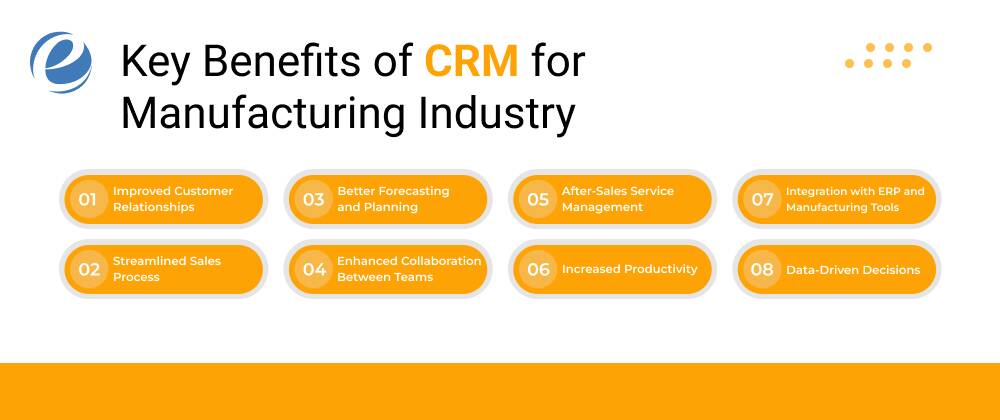
Today’s era of competition demands that manufacturers go beyond product quality and begin the work of building relations that are as strong as the product. Thus, CRM has emerged as a crucial instrument in the manufacturing industry. It not only optimizes the manufacturing process but also increases sales and service levels. Let’s talk about the incredible advantages of employing CRM in manufacturing sector:
Improved Customer Relationships
A manufacturing CRM helps store all customer data, including contact info, communication history, and preferences, in one place. This makes it easier for sales and service teams to offer personalized support and build long-term trust.
Streamlined Sales Process
With the help of CRM software for the manufacturing industry, manufacturers’ sales teams can track leads, follow up on quotes, and close deals more efficiently. This software keeps the entire sales pipeline organized and improves conversion rates.
Better Forecasting and Planning
Manufacturers’ CRM enables you to study buying power, customer behavior, and order history, allowing the business to forecast demand and plan production accordingly.
Enhanced Collaboration Between Teams
With CRM software, sales, production, and service departments can be linked. This often means that data will be easily accessible, leading to improved communication, faster decision-making, and, consequently, increased productivity.
After-Sales Service Management
The post-sale aspect of product support is a critical failure point for most manufacturers. A CRM in the manufacturing industry platform is a great help in cases where not only service requests and warranties, but also maintenance schedules, are effectively managed.
Increased Productivity
In the manufacturing industry, CRM software with automated workflows and reminders eliminates repetitive work. This essentially frees up a significant amount of time, allowing people to focus on higher-level tasks and strategic issues.
Integration with ERP and Manufacturing Tools
Modern Salesforce production solutions enable seamless and rapid integration with ERP and production tools. In turn, this guarantees enhanced visibility and end-to-end automation of the processes.
Data-Driven Decisions
The manufacturing sector’s CRM is a source of data analytics and dashboards that display performance. The decision-makers, being able to stay on top of facts and trends, can clearly recognize the trends and make educated data-based decisions.
Another benefit of a robust CRM software built for the manufacturing world by enterprises is the realization of operational proficiency, in addition to staying ahead of the competition. For businesses considering building customized CRMs, spending on CRM Software Development or employing full-scale Manufacturing Software can be a key determinant of long-term satisfaction.
5 Best Platforms for CRM in Manufacturing
The decision of which CRM is most effective for the manufacturing industry is never a plain and simple one, obviously because of the variety of choices. This is the primary reason we have compiled a list of the five best CRM platforms most suitable for the manufacturing sector.
These top CRM platforms are not only the choice of global renown but also those that have made their manufacturing-specific features known. The pros of using these brands range from product inquiry tracking to post-sales services.
It does not matter whether you are a manufacturer, regardless of your size; this CRM software for the manufacturing industry will still be a good fit for your company. Hence, it can be used to automate not only operational parts but also to improve customer relationships.
| CRM Platform | Launch Year | Global User Base | Platform Size | Key Features for Manufacturing | Notable Clients |
| Salesforce Manufacturing Cloud | 2019 | Part of Salesforce’s 150,000+ customers globally | Comprehensive CRM with modules for sales, service, and manufacturing operations | Sales agreements, demand forecasting, and integration with ERP systems | Caterpillar, Honeywell, Hitachi |
| Microsoft Dynamics 365 | 2016 | Over 500,000 organizations, including 97% of Fortune 500 companies | Unified platform combining CRM and ERP capabilities | Supply chain management, production planning, and IoT integration | Toyota, Coca-Cola, HP |
| Zoho CRM | 2005 | Over 100 million users across 700,000+ businesses in 150+ countries | Suite of 55+ integrated business applications | Inventory management, order tracking, customizable workflows | Amazon, Netflix, Bose |
| HubSpot CRM | 2014 | Over 248,000 customers across 135+ countries | All-in-one platform for marketing, sales, and service | Lead tracking, email automation, and customer segmentation | Atlassian, Suzuki, Trello |
| SAP Customer Experience (formerly SAP CRM) | 2000 | Used by thousands of enterprises worldwide | Integrated with SAP’s ERP solutions | Advanced analytics, customer insights, omnichannel engagement | Siemens, 3M, Airbus |
How is CRM Used in the Manufacturing Sector?
The CRM in manufacturing sector extends to operations that go beyond customer interaction and plays a crucial role in managing business operations. A CRM for manufacturing industry is the central point where significant steps and information flow through, including sales and service to production planning. What CRM can cover and how it’s done in manufacturing:
Managing Customer Orders and Inquiries
A manufacturing customer relationship management keeps a record of all customer orders received, quote inquiries, and product inquiries. It also makes it possible for the teams.
Supporting Dealer and Distributor Networks
A CRM in manufacturing is a performance tracking tool that facilitates the management of these relationships, ensuring that no leads are left unattended.
Sales Pipeline and Lead Tracking
By using CRM software, sales teams can effectively manage manufacturing industry leads, opportunities, and conversions. As a result, it contributes to their attention to potential deals, allowing them to align with the meeting calendar and, consequently, sell at a faster rate.
Coordinating with Production Teams
By sharing customer demand and order details, CRM software enables the production team to prioritize their schedule. This way, it can cut delays and boost the accuracy of deliveries.
Handling After-Sales Services
Whether it be an installation process, warranty support, or repairs, a CRM application in the industrial sector is the best tool to help a service team with after-sales activities and, hence, keep the customers satisfied.
Forecasting and Inventory Planning
CRM systems for the manufacturing industry provide sales data that could be useful for predicting future demand. This will result in some inventory being separated for wiser utilization and fewer excess quantities or stockouts.
Marketing Campaign Management
As the production or marketing department of the manufacturing unit starts sending out numerous emails, promotions, and product launch communications, CRM software comes to the rescue by matching all of that to the target audience, which naturally leads to big sales and engagement.
Integration with Salesforce and ERP Tools
The successful implementation of CRM systems in the manufacturing sector, such as Salesforce, facilitates the tracking of sales and enables easy interaction with customers by integrating ERP tools, for example, production planning, which simplifies the decision-making process.
Upon their effective utilization, manufacturers who already have a CRM system in place to manage their sector will increase the effectiveness of their staff, streamline communication, and enhance customer satisfaction with their service delivery. If the program needs to meet their specific requirements, the company might consider implementing CRM Software Development or a significant project, such as manufacturing software development.
How Emizentech Helped Build CRM Software for Manufacturing Industry?
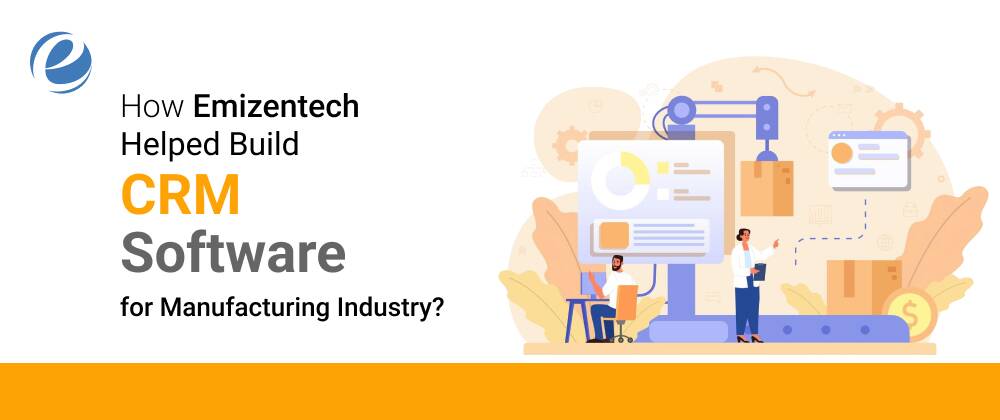
At Emizentech, we know the importance of CRM in manufacturing sector. Our team of experts has already supported numerous manufacturing companies in optimizing their operations by creating CRM software for the manufacturing industry, which is robust and specifically designed to meet their unique needs. We want to design software that is intelligent and integrates sales, service, production, and customer support under a consolidated CRM platform.
- We developed CRM software that can be scaled and customized to fit each customer’s unique workflows. We also equipped the software with modules that addressed the major pains in the CRM for the manufacturing industry, such as those related to order tracking and dealer management.
- Our team ensured that the CRM system was successfully integrated with the existing ERP solutions and the Salesforce manufacturing tools. This gave the manufacturers an opportunity to get a comprehensive view of their operations and also made the process of data flow between departments automatic.
- We designed dashboards that display sales, customer behavior, and production status. Through the use of CRM in manufacturing, our customers were able to make faster and more informed business decisions.
- Our team developed an automated CRM solution that eliminated the need for time-consuming tasks, such as sending price quotes, scheduling follow-ups, and generating invoices. This reduced the time and increased the overall efficiency.
- We developed features that optimized the processes of managing dealer performance, product delivery, and distributor communications for our clients, a requisite in CRM for manufacturing.
- We made it simple for our clients to utilize the service modules to manage warranties, maintenance schedules, and customer complaints, enabling better customer after-sales service and, consequently, long-term customer satisfaction.
Our mission at Emizentech is to provide manufacturers with top-of-the-line CRM solutions that best suit their requirements. If you’re aiming to develop a new system or construct a complete CRM from scratch, our CRM Software Development teams are waiting for you to join them in your progress journey.
Conclusion
A well-established CRM for the manufacturing industry is not simply a sales tool; it is a comprehensive system that enables the team to work more effectively, strengthens customer relationships, and enhances the overall efficiency of manufacturing companies. Taking care of leads and after-sales services, the right CRM in the manufacturing industry helps companies stay a few steps ahead in an aggressive market.
Whether you are a small manufacturer or a large-scale enterprise, the right CRM software for manufacturing industry is a game-changer for your business. By combining the right features and intelligent automation, the manufacturing CRM approach streamlines work and fosters long-term growth.
If you are in the position of building a fully customised CRM solution, our company, Emizentech, is the best partner to offer you professional CRM Software Development and Manufacturing Software Development services. We have expertise in managing programs like Salesforce manufacturing, which directly impacts business efficiency and customer satisfaction. Our solutions drive your business needs.
Make your business grow with custom CRM software made for your industry.
FAQs
Can CRM software be integrated with ERP systems?
Manufacturers need CRM software to track leads, manage customer orders, improve after-sales service, and streamline communication between teams.
Why do manufacturers need CRM software?
Manufacturers need CRM software to track leads, manage customer orders, improve after-sales service, and streamline communication between teams.
How much does it cost to develop CRM software for manufacturing industry?
The cost of building a custom manufacturing CRM depends on features and complexity. On average, the price may start at $15,000 and increase based on your specific needs.
How long does it take to develop a CRM for manufacturing industry?
The development time typically ranges from 3 to 6 months, depending on the project size and the required custom features.
What technologies are used to develop CRM software for the manufacturing industry?
Technologies such as React, Angular, Node.js, .NET, Python, and Salesforce are used to develop CRM software for the manufacturing industry. Databases include MySQL or MongoDB, and cloud hosting is often done via AWS or Azure.




 +1 (989) 535-9295
 info@emizentech.com
 emizentech


