
 Add us as a preferred source on Google
A senior engineer passed four video interviews and a full background check before a US cybersecurity firm hired him as a remote software developer in 2024. He got his company laptop, logged in for his first day, and twenty-five minutes later, security alerts started going off. Malware was loading onto the company’s systems in real time. He wasn’t who he said he was. He was a North Korean operative working off a stolen American identity.
That story is precisely why hire remote software developers in 2026 can’t work the way it did five years ago. A resume, a video call, and a quick reference check used to feel like enough. Not anymore. Companies now need to confirm a candidate is who they claim to be, prove they can actually do the work, pick a hiring model that matches the risk they’re willing to take on, and lock down expectations before anyone touches production code.
That’s a lot to get right, and most hiring guides only cover half of it. This one walks through where to find remote software developers, how to test their skills, what different hiring models actually cost, and how to onboard someone securely. There’s also a section on working with dedicated development teams for companies that would prefer to assign the process to a partner.
What Does Hiring Remote Developers Mean?
Before looking at where to find developers or what each hiring model costs, it’s helpful to clarify the basics first. Remote hiring gets passed around like it means one specific thing, but it actually covers a handful of different setups.
Hiring remote software developers just means bringing engineering talent onto your team without needing them in your office. That person might be based in your city, across the country, or on another continent. It depends on your project needs and which arrangement works best.
The common arrangements companies use look something like this:
- A full-time employee in your own country who works from home
- An independent contractor, based in your country or somewhere else entirely
- A nearshore developer working in a similar time zone
- An offshore developer based in another country or region
- An international employee brought on through an Employer of Record
- A developer supplied through staff augmentation or a dedicated team
The real difference is that the developer isn’t sitting in your office. Everything else about running a team still applies. You still need to set working hours, decide how the team communicates, define the technical requirements, nail down contract or employment terms, and figure out what systems this person can access.
Which model you pick affects your costs, your legal responsibilities, how much control you have, and how closely that developer ends up working with your existing team.
How to Hire a Remote Software Developer: 7 Steps
Hiring a remote software developer requires more than just identifying a candidate with a strong resume and sending them an offer. There’s a role to define, a decision on where and how to hire, candidates who need real evaluation, and clear terms to lock in before that developer touches a single line of code.
These seven steps lay out a structured process that helps you avoid the problems that usually creep up during recruitment and onboarding.
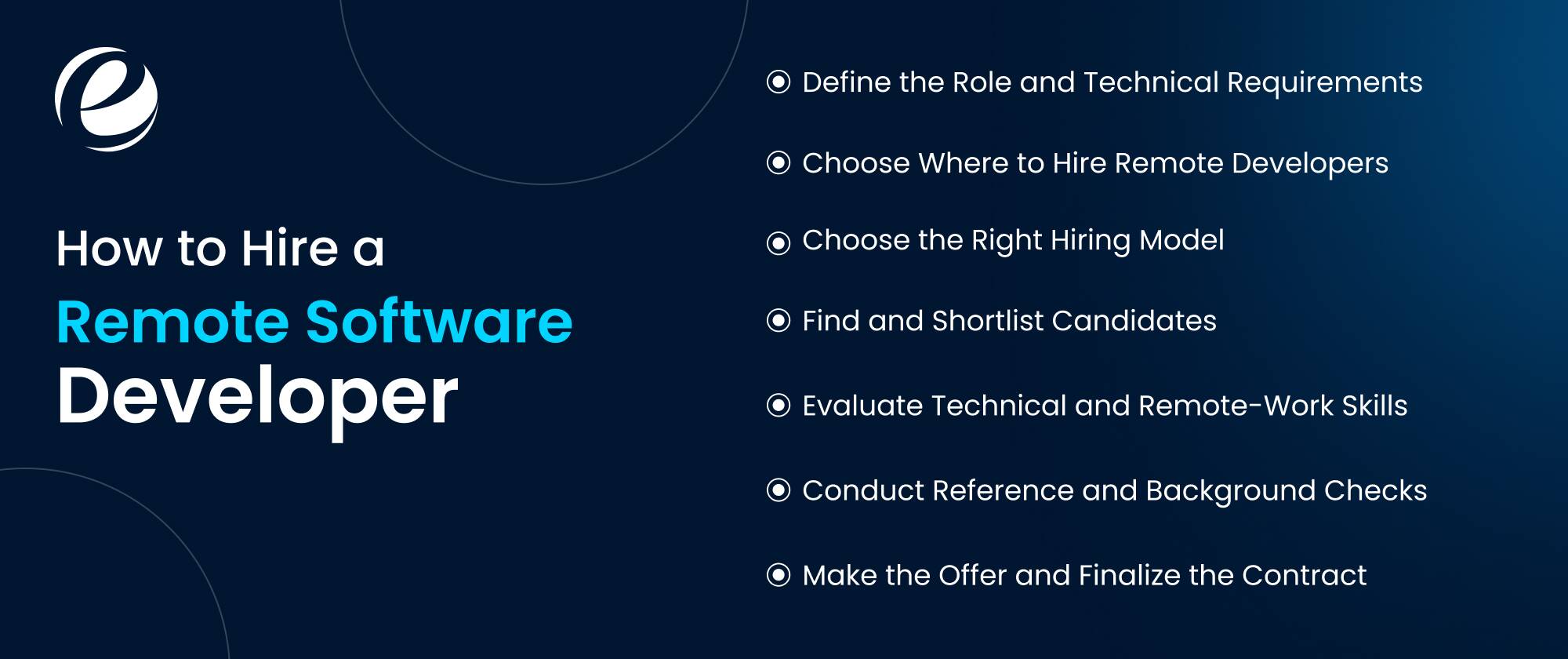
Define the Role and Technical Requirements
Turn the profile from the previous section into a written brief. Include the technologies with versions, the seniority band, the first ninety days of expected output, and the working hours you need covered. Share it internally first, because addressing issues now is cheaper than after an offer goes out.
Choose Where to Hire Remote Developers
Geography is really a question about overlap hours and what you’re willing to pay for them. Latin America gives US companies genuine same-day working time at roughly half of American rates. Eastern Europe does the same for Western European companies.
India and Southeast Asia are even cheaper, but they require careful scheduling because India is typically 9.5 to 10.5 hours ahead of U.S. Eastern Time, depending on daylight saving time. Companies considering that route can look at how to build a remote development team in India and what the working rhythm looks like day to day.
Choose the Right Hiring Model
Freelancing, staff augmentation, dedicated developers, dedicated teams, managed delivery, and Build-Operate-Transfer are options to consider. Each model has different costs, management responsibilities, and levels of control.
Short or exploratory work can suit freelancing. Staff augmentation can help you add specific skills to an existing team. For sustained product work, you can consider a dedicated developer or dedicated development team. For companies planning to build an offshore operation and gradually bring it in-house, the Build-Operate-Transfer model can be an option.
Find and Shortlist Candidates
Match the channel to the role. Verified marketplaces pre-screen candidates for you and charge accordingly. Open marketplaces offer more volume but leave the screening work to you; if that’s the direction you want to go, this comparison of platforms to find freelance developers is a useful place to start.
Job boards work best for direct full-time hires. GitHub and the monthly Hacker News “Who’s Hiring” threads are quieter channels that often surface stronger candidates, simply because fewer companies bother looking there.
Evaluate Technical and Remote-Work Skills
Run a structured interview with the same questions for every candidate, scored against a set of criteria. Add a short work sample drawn from your real backlog. Test written communication separately, because remote work runs on writing and a strong coder who can’t write a clear update will frustrate everyone around them.
Conduct Reference and Background Checks
Call previous employers directly rather than trusting the contact details on a resume. Verify education with the school. Require video with the camera on. This step used to be a formality, and it isn’t one anymore, for reasons covered further down.
Make the Offer and Finalize the Contract
Move quickly once you’ve decided, because good candidates have other conversations running. The contract needs intellectual property assignment specified clearly, an NDA signed before any system access, named-developer placement if you’re going through an agency, a replacement guarantee with a written response time, and notice periods on both sides.
What Type of Remote Developer Should You Hire?
The seven steps above assume you already know which kind of working relationship you want. Most companies don’t know what kind of working relationship they want, and they only figure it out halfway through interviews, which is too late. Three arrangements cover the majority of situations, and they suit genuinely different needs.

Full-Time Remote Developers
This arrangement is best for core product work you plan to invest in for years. You get continuity, established context, and someone whose incentives line up with the product’s long-term health. The cost is real: payroll, benefits, employment taxes, and the admin that comes with all of it.
Hiring a full-time employee in another country requires either a local legal entity or an Employer of Record, which is a service that employs the person on your behalf while you direct the work. Platform fees for that service run from a few hundred dollars per employee each month, but that fee is the smaller part of the total bill. Salary plus employer taxes and statutory benefits add another 13 to 40 percent depending on the country.
Contract Remote Developers
Best for defined pieces of work with a clear finish line, or for a specialist skill you need for three months rather than three years. Contractors cost less in total because you’re not carrying benefits or employment requirements. What you give up is continuity. A contractor who takes a full-time job mid-project is a normal event, not a betrayal, and the contract should assume it.
Dedicated Remote Development Teams
Best for sustained product work where requirements are constantly changing. A vendor supplies an exclusive team on a monthly retainer, handles recruitment and replacement, and manages the turnover risk. In India, this model runs roughly 2,500 to 14,000 dollars per month depending on team size and seniority.
Staff augmentation sits nearby: the vendor supplies vetted developers, around 22 dollars per hour for mid-level and 35 and up for senior, all-inclusive, but you still direct the work yourself. Specialist needs often route this way too, since teams shipping to phones usually want to hire mobile app developers who’ve taken products through both app stores rather than generalists learning on your budget.
How Much Does It Cost to Hire a Remote Software Developer?
Nearly every guide avoids this question with something like “costs vary depending on your requirements.” True and useless. Real numbers exist; they’re published, and knowing them before a sales conversation beats learning them during one.
Remote Developer Costs by Location
The table below shows mixed agency and estimated contract rates, drawn from rate guides published across 2025 and 2026.
| Region | Hourly range | By seniority |
| United States | $60 to $150 | Senior: commonly $100 to $150 |
| Eastern Europe (Poland, Ukraine, Romania) | $45 to $90 | Poland: $45 to $70, Ukraine: around $49 |
| Latin America | $23 to $90 | Junior: $29 to $44, mid: $50 to $60, senior: $60 to $74 |
| India | $20 to $50 | Junior: $10 to $20, mid: $20 to $27, senior: $30 to $50 |
| Southeast Asia (Vietnam, Philippines) | $15 to $30 | Junior at the lower end |
| Africa | $10 to $60 | North Africa and South Africa: $25 to $99 |
For a US baseline, the Bureau of Labor Statistics put the median annual wage for software developers at $133,080 in May 2024. That’s base wage, which matters, because you’ll see much higher numbers quoted elsewhere that include equity and bonuses and skew toward large technology employers.
One honest note. Published sources disagree with each other; one guide might put senior Eastern European developers at $50 to $90 per hour, while another caps the same group at $45 to $70. Anyone quoting a single precise number for an entire region is either guessing or selling something. There’s a detailed explanation of what it costs to hire dedicated developers by team size if you need to model it properly.
How to Evaluate a Remote Software Developer
This is where the last three years changed everything and where most hiring processes are quietly out of date. Two separate problems arrived at roughly the same time. AI assistants can now complete most take-home tests, and some candidates aren’t who they say they are. Both require responses, but the nature of those responses varies.
Assess Technical Skills and Experience
Start with production evidence rather than resume keywords. What has this person shipped, who used it, and what broke? Look at GitHub activity, code review comments, and how they describe past architectural decisions.
Someone who can explain why they chose one approach over another, including what it cost them, is showing you something no assistant can fake. For web-focused roles, framework-specific production experience matters more than years, which is worth remembering if you’re looking to hire web developers for an existing codebase.
The World Economic Forum’s Future of Jobs Report 2025 found that 39 percent of workers’ core skills will change or become outdated by 2030 and that 63 percent of employers already name skills gaps as their biggest barrier to business transformation. That’s a strong argument for hiring adaptability rather than a summary of what somebody knows this quarter.
Use Practical Technical Assessments
Consistent, structured interviews predict on-the-job performance better than free-flowing conversation, though most companies do the opposite and call it culture fit.
Pair that with a work sample. Keep it short, two to four hours, drawn from your actual backlog, and let the candidate document the decisions they made; pay for it. Good developers with options don’t work for free, and unpaid trials sort out the exact people you want.
Evaluate Communication and Remote-Work Skills
Remote work leaves less room for quick conversations across a desk, so clear communication matters. But asking someone, “Are you a good communicator?” won’t tell you much.
Try a real scenario instead. Give the candidate a scenario like this: “A production API is showing temporary latency after yesterday’s deployment.” Then look at how they communicate. Is the update clear? Ask them to write the Slack update they would send to the team and outline their first three investigation steps.
Then look at how they communicate. Is the update clear? Do they separate what they know from what they are assuming? Do they prioritize the right issues? Do they ask useful questions before jumping to a solution?
Ask Effective Remote Developer Interview Questions
Ask candidates the same core questions every time; it’s the only fair way to compare their answers side by side. Then push toward questions that show how someone actually handles a real, difficult situation, not the refined answers people rehearse before every interview.
For example:
- Tell me about a production issue you had to solve. What happened, and what did you learn from it?
- What do you do when a requirement is unclear and nobody is immediately available to answer?
- Tell me about a technical decision you made that required careful judgment.
- How do you communicate when you’re blocked on a task?
- How do you review or verify code generated with AI tools?
A short work sample can follow the interview. Keep it to two to four hours, use a realistic problem, and ask the candidate to explain the decisions they made. If you’re asking for several hours of actual work, pay for it. Good developers have options, and unpaid trials can quickly turn them away.
Common Mistakes When Hiring Remote Software Developers
Most of these look reasonable in the moment, which is what makes them expensive. They also show up in a predictable order, usually starting with budget pressure and ending with a contract nobody read closely. There’s a fuller treatment of the common challenges of hiring dedicated developers if you want the longer version.
- Hiring based only on cost: The cheapest hourly rate rarely produces the cheapest project. Management, knowledge transfer, coordination, rework, and the cost of replacing someone who doesn’t work out can increase the true project cost. Calculate the total cost before comparing quotes.
- Focusing only on technical skills: A developer who codes well but can’t write a clear status update will slow down everyone around them. Remote work runs on writing. Test it directly rather than hoping.
- Ignoring time-zone differences: Deciding overlap after choosing a candidate means discovering the problem during the first sprint. Define required hours before sourcing, and put them in the job description.
- Using an overly long hiring process: Every extra interview round creates another opportunity to lose strong candidates who are considering other offers. Keep the process focused and limit it to three or four stages for most roles.
- Overlooking contracts and IP ownership: Paying for code does not automatically make you its owner, especially across borders. Without a written assignment clause, the rights may stay with the contractor. Classification is the related gap. If someone works fixed hours, exclusively for you, under your direction, the arrangement looks like employment, whatever the paperwork says, so check with a lawyer for your situation.
- Failing to define performance expectations: “Do good work” isn’t a standard. Write down what should exist after thirty days, how quality gets judged, and what response time looks like across time zones. False expectations produce disappointing results, and neither side sees it coming.
How to Successfully Onboard a Remote Software Developer
Onboarding a remote software developer properly means giving them access to every tool, system, and person they need from day one. A clear process helps them understand the project, talk to the team without confusion, and start contributing fast.
Prepare Before the Developer’s First Day
Have accounts, repository access, and tooling ready before they log in. A developer spending three days waiting on permissions learns that things move slowly here, and that lesson remains. Provide the hardware early enough to arrive before the start date.
Security deserves an update too. VPNs, strong passwords, and two-factor authentication are all still worth having, and none of them are enough on their own now. Current practice covers zero-trust access, device management on company hardware, endpoint detection software, and least-privilege permissions. The security firm mentioned at the start of this guide caught its intrusion through endpoint detection on a company laptop, not through any password policy.
Set Clear Communication and Collaboration Expectations
Assign one named person as the first point of contact, not the whole team, which means nobody. Agree on which questions require an immediate message, which wait for standup, and what response time looks like across time zones. Write architecture decisions down, including the reason that the odd workaround exists in the payments module. Documentation is the only real assurance against turnover, and it pays for itself the second time somebody joins.
Establish 30-Day Performance Goals
Set a 30-60-90-day plan with something shippable in the first fortnight, even if it’s something small. Early delivery builds confidence on both sides faster than any amount of reading time. Review at thirty days against what you wrote down, not against a general impression. Longer-term rhythm is covered in this guide on how to manage a dedicated software team.
What You Get When You Hire Remote Developers From Emizentech
Many companies work through the sequence above and decide they’d rather not run recruitment themselves. That’s a reasonable call, particularly for a first or second offshore hire where the cost of learning by trial is high.
Emizentech has been building web, mobile, and eCommerce products since 2013, with more than 1,200 projects delivered across 30+ industries and a bench of 100+ vetted developers. The company reports a 98% client retention rate and works with clients across the US, UK, UAE, Australia, and India. Ratings sit at 4.9 on Clutch and 5.0 on GoodFirms.
Engagements can be structured as a dedicated full-time developer, part-time or hourly support, a full dedicated team, or a Build-Operate-Transfer model for companies planning an expected in-house change. Every hire is backed by an NDA and IP-assignment protections built into the contract, and every engagement starts with a 14-day money-back guarantee, so you can evaluate the suitability before committing further.
If the shape of your work points toward a sustained build rather than a short project, it’s worth a conversation about scope before you commit to anything. You can hire remote developers from EmizenTech with vetting, contracts, and a risk-free trial period already handled.
Conclusion
Hiring remote software developers in 2026 isn’t harder than it was five years ago, but it is different. Rates are known, and platforms are numerous. What changed is that evaluation methods built for a pre-AI world no longer measure what they claim to, and checking that a candidate is a real person became an actual task rather than a formality.
The companies that get this right aren’t the ones who found the cheapest hourly rate. They matched the engagement model to the shape of the work, tested candidates on something real before committing, wrote down who owns the code, and took the first month as seriously as the interview.
Work the sequence, and most of the expensive mistakes go away. If it would help to talk through where your project fits, book a free consultation before spending anything.
FAQs
How do I hire a remote software developer?
Define the role, select your location and engagement model, source through the right channel, run a structured interview plus a paid work sample, verify identity directly, and then contract with IP assignment written in.
How much does it cost to hire a remote software developer?
Rates run from $15 to $50 an hour in India, $23 to $90 in Latin America, $45 to $90 in Eastern Europe, and $60 to $150 in the United States.
Where is the best place to hire remote developers?
Latin America and Eastern Europe are the best options for most teams, with real-time collaboration costing about half of US rates. India and Southeast Asia can save even more, just by budgeting extra time for coordinating across bigger time zone gaps.
Is it better to hire remote developers directly or through an agency?
Direct hiring makes sense once you've got real recruiting skills in-house, but if you don't, an agency will hand you vetted candidates faster and eat the replacement risk themselves. Whatever you pick, get the replacement guarantee in writing before signing.
What should I look for when hiring a remote software developer?
Skip the resume keywords and look at real production experience instead. The best remote hires work independently, write clearly, and stay steady when requirements are messy. Look for someone who reviews AI-generated code rather than shipping it blind.




 +1 (989) 535-9295
 info@emizentech.com
 emizentech


