
 Add us as a preferred source on Google
 Most logistics companies are managing billion-dollar freight relationships in spreadsheets. Sales reps are copy-pasting tracking numbers into emails, quoting rates from a tab that’s three months out of date, and “following up” means searching through their inbox for the last time they talked to a customer. A logistics CRM fixes that. But not in the vague, everything-is-better way software companies promise in very specific, operational ways that people who actually work in freight will recognize immediately.
So what is CRM in logistics? At its core, it’s a Customer Relationship Management system built around how freight businesses actually work. Not how a software product manager imagined a business works, but how it actually works. That means rate cards, lane history, carrier compliance docs, spot freight, load margins, shipper credit terms, and the hundred other things that make logistics genuinely different from selling SaaS subscriptions or managing a marketing agency.
Why Generic CRMs Fail Logistics & Transportation Companies
In a typical CRM use case, a “customer” has a stable profile. A “deal” moves through a pipeline from prospect to closed. Revenue is relatively predictable. Those assumptions are baked into every part of how these tools work.
Rate management doesn’t exist
Generic CRMs store contacts and deals. They don’t store lane-specific rate cards, fuel surcharge schedules, or accessorial charge tables. So reps end up keeping a separate spreadsheet that is immediately out of date and that nobody else can see.
There’s no connection to how freight actually moves
A salesperson talking to a shipper about a late delivery has no idea what’s happening unless they open the TMS separately. That context gap costs real money, in both time and customer trust.
Carrier management isn’t a thing
If you’re a freight broker, you manage two relationships for every load: the shipper and the carrier. Generic CRM doesn’t model that. You end up hacking workarounds or keeping carrier records somewhere else entirely.
The metrics are wrong
Freight businesses care about margin per load, margin per lane, gross revenue, and load count. Generic CRM reports on pipeline value and closed deals. Those things aren’t the same, and the gap means leadership is looking at numbers that don’t tell the real story.
Document management is an afterthought
Invoices, carrier certificates of insurance, proof of delivery these are operational necessities in freight. Generic CRMs treat them as file attachments. That’s not good enough when a COI expires, and you don’t notice until a load is already on the road. Understanding what CRM software actually is makes it easier to see why logistics needs its own version.
9 Must-Have Features of a High-Performing Logistics CRM

A high-performing logistics CRM goes beyond standard contact and pipeline management to address the industry’s core challenge: connecting customer relationships with real-time shipment and operational data.
A sales pipeline built for freight cycles
Freight sales don’t move in a straight line. A shipper might go from “interested” to “running a trial lane” to “gone quiet” to “back and wanting volume pricing” in the span of a quarter. Your pipeline needs stages that reflect how freight relationships actually develop, including quoting stages, credit approval, carrier onboarding for the first load, and the critical first 90 days of a new account.
Rate management inside the CRM
If your reps are switching tabs to quote freight, you have a problem. Rate cards, lane-specific pricing, spot versus contract logic, and fuel surcharges should live inside the CRM and be surfaced automatically when a rep is building a quote. The goal is fewer tabs, faster quotes, and consistent pricing.
TMS, WMS, and ERP integration
This is probably the most important thing on the list. A logistics CRM that doesn’t connect to your Transport Management System is just a fancy contact database. When a shipper calls about a delayed shipment, your sales or customer success rep should be able to see exactly where that load is without switching systems. That CRM-to-TMS connection is what turns the software from a sales tool into an operational one.
AI-powered insights
Your CRM should be able to tell you which accounts are at risk of spinning based on declining shipment frequency. It should surface which shippers are strong candidates for volume pricing conversations. It should flag when a lane that used to do 20 loads a month has dropped to 8 without anyone noticing. That’s what an AI-powered CRM does that’s actually useful: it catches things humans miss because they’re busy.
Carrier management module
For freight brokers especially, this is non-negotiable. Your carrier relationships are as valuable as your shipper relationships. A freight broker CRM needs to track carrier capacity commitments, on-time performance scores, insurance compliance and expiry dates, preferred lanes, and communication history, just as it tracks shippers.
Client self-service portal
Shippers increasingly expect to request a quote, check shipment status, pull an invoice, and submit a support request without having to call anyone. A self-service portal reduces inbound volume on your ops team and makes your company easier to work with. Both things matter.
Document and compliance management
It’s critically important, Carrier COIs expire. BOLs go missing. Contracts need to be accessible during disputes. A logistics CRM should manage these as first-class objects, with automatic expiry alerts and clear audit trails, not as email attachments buried in someone’s inbox.
Revenue and margin analytics
Gross revenue is a vanity metric in freight. Margin per load, margin per lane, margin per customer those are the numbers that tell you whether a relationship is actually valuable. Your CRM’s analytics layer should be built around freight economics, not generic sales metrics.
Mobile access that actually works
Sales reps are at shipper facilities. Carrier reps are on the road. Ops managers are at the dock. The CRM needs to be genuinely usable on a phone, not just technically accessible, but actually functional for the way people in logistics work. See how similar principles apply when CRM is deployed in manufacturing; the integration logic transfers almost directly.
Logistics CRM Architecture: Unifying Front-Office and Back-Office Systems
Most clients don’t want to call dispatch to find out where their shipment is. Give them a portal instead. That one change alone takes a huge chunk of routine requests, quotes, tracking, status checks, and routes them straight into the CRM instead of into someone’s inbox.
Self-Service Client Portal
Nobody wants to call dispatch just to ask where their truck is. A portal fixes that. Quotes, tracking, status checks, all of it moves into the CRM on its own, and dispatch stops fielding the same question fifteen times a day.
Logistics CRM Central Hub
This is the part that actually holds everything together. Leads come in here, quotes get built automatically instead of by hand, and every call or email with a client sits in one history instead of scattered across someone’s notes. One place, not five.
TMS Integration for Shipment Dispatch
The TMS is what actually picks the carrier and gets the load moving. Since it feeds back into the CRM, a rep can pull up shipment status without walking over to operations and asking.
WMS Integration for Inventory Sync
Inventory stays current because the WMS is syncing in real time, not overnight. That matters more than it sounds like, because quoting against stock that already shipped is one of the fastest ways to annoy a client.
ERP Integration for Invoicing and P&L
Billing and P&L live in the ERP, and since it ties back to the same shipment record, finance isn’t stuck guessing or emailing ops for numbers. Everybody’s pulling from the same source, which honestly should’ve been the case all along.
Key Benefits & ROI of Implementing a Logistics CRM
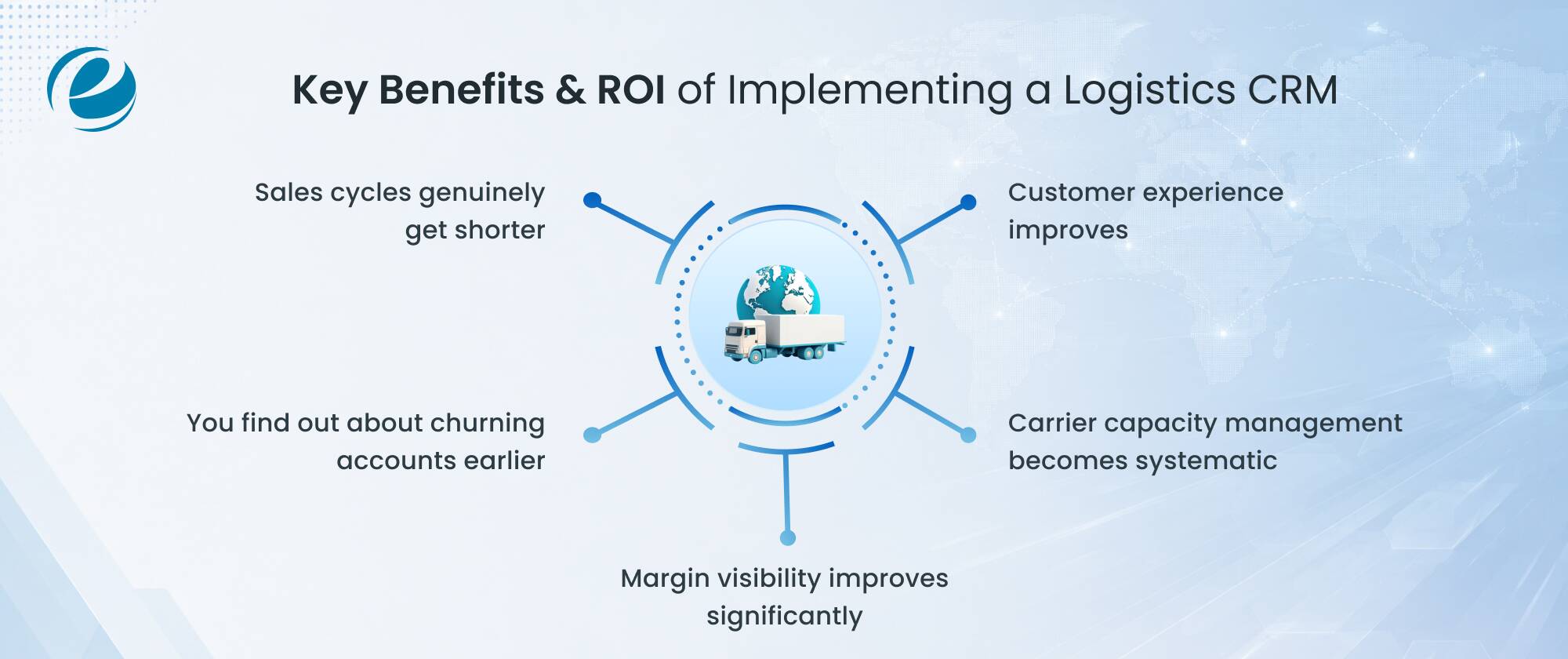
Here’s what actually changes when a freight company properly implements a logistics CRM, as opposed to what the brochure says will change:
Sales cycles genuinely get shorter
When rate quoting is automated, and proposals are generated from templates with pre-populated lane data, reps quote faster. When they quote faster, they win more bids, particularly on time-sensitive spot freight where the shipper is calling three brokers simultaneously.
You find out about churning accounts earlier
This one is underrated. The cost of losing an established shipper account is enormous, not just the revenue, but the replacement cost. A CRM that tracks shipment frequency trends and surfaces declining accounts gives your team a real chance to intervene. Without it, you find out a customer left when they stop calling.
Margin visibility improves significantly
When the CRM is connected to the ERP, leadership can see margin by lane, customer, rep, and region in near real time. That changes the strategic conversations from “we’re growing revenue” to “we’re growing margin on these specific lanes, and losing it here, and here’s why.”
Carrier capacity management becomes systematic
For freight brokers, the ability to see which carrier relationships are performing, which are underutilized, and which have compliance issues, all from the same platform where shipper relationships are managed, is genuinely valuable. Right now, most brokerages are doing this manually.
Customer experience improves
When a shipper calls and whoever answers has their full history, current shipment status, and any open issues in front of them, the call goes better. Every time. That adds up to a meaningful difference in customer satisfaction over time.
Off-the-Shelf vs. Custom Logistics CRM Development
Off-the-shelf logistics CRM software, whether that’s a configured Salesforce instance, a vertical product like Zoho for logistics, or a freight-specific tool, gets you started faster. Lower upfront cost. Faster deployment. Known quantities. If you’re a growing brokerage that needs to get organized and doesn’t have time for an 18-month build, there’s a legitimate argument for starting here. Custom crm for logistics development flips that equation. Higher upfront investment, longer build time, but you own the platform, you control the roadmap, and the system is built around your specific workflows rather than a generic template.
Your data model reflects how your freight operation actually works. Your integrations are built directly to your TMS and ERP, not routed through a third-party connector. And as you scale, the cost structure improves rather than worsens. The question is when, and whether it’s cheaper to build custom from the beginning or after you’ve maxed out what a packaged product can do. For context on how these decisions play out with specific platforms, the Salesforce cost breakdown and what Salesforce actually does are worth reading before making the call.
| Key Aspects | Off-the-Shelf | Custom Build |
| Time to deploy | Weeks–months | 3 to 9 months |
| Upfront cost | Lower | Higher |
| Ongoing licensing | Per-seat, compounding | Infrastructure only |
| Logistics workflow fit | Requires heavy config | Built for your operation |
| TMS integration | Third-party middleware | Direct API |
| Data ownership | Vendor | You |
| Competitive edge | Same as competitors | Proprietary |
How to Implement a Custom Logistics CRM
Implementing a custom crm for logistics starts with mapping core workflows such as quoting, dispatch, tracking, and billing before any development begins. From there, teams define the data model around shipments and accounts, integrate with TMS, WMS, and ERP systems, and build role-based dashboards for sales, operations, and support.
Map what actually happens in your business
Before anyone writes a line of code, you need a clear picture of every customer-facing workflow: how leads come in, how quotes get built and sent, how new shippers are onboarded, how your ops team manages active accounts, how billing works, and how renewals happen. This isn’t documentation for its own sake; it’s the specification that determines whether what gets built actually fits your operation. This phase also surfaces the integration requirements: which TMS, which ERP, which load board feeds, and what data needs to flow where.
Design the data model and integration architecture
How does a shipper account relate to a lane? How does a lane relate to a load? How does a rate card attach to a contract? These aren’t abstract questions; getting the data model right determines whether the CRM actually reflects how freight works or forces people to work around it. For logistics software development, this is the phase that separates good implementations from expensive ones.
Build in freight-focused sprints
Two-week development sprints, with actual freight operations staff reviewing the output at each cycle. Start with the lead-to-quote workflow, the thing your sales team will use from Day 1. Then add TMS integration, carrier management, the client portal, and analytics in subsequent phases. The sequencing matters: if you try to build everything simultaneously, nothing is usable when you need it. Decisions about whether to use onshore, nearshore, or offshore development teams will significantly affect how you structure sprint reviews and communication cadence.
Test against real freight scenarios
Not synthetic test cases; actual freight scenarios your ops team deals with every week. What happens when a carrier’s COI expires mid-shipment? What happens when a rate card needs to be updated across 40 active accounts simultaneously? What happens when a shipper disputes an invoice? Run the system through those situations before go-live. Also run parallel operations: keep the old system running alongside the new one for four to six weeks so the team has a fallback if something breaks in a way testing didn’t catch.
Train by role, not by feature
The biggest implementation failure mode is training that covers what the system can do rather than how each specific role uses it. A sales rep, an ops manager, and a customer success specialist are each using a different part of the same system. Train them separately, on their workflows, with their actual data. And build a feedback loop from Day 1; the first three months after go-live will surface gaps that couldn’t have been anticipated in design. Those gaps need somewhere to go. Partnering with the right outsourced software development team means that feedback loop actually results in improvements.
Why Logistics Companies Partner with EmizenTech for CRM Engineering
Emizentech has built custom CRM platforms and logistics software for freight brokers, 3PLs, asset-based carriers, and shippers. We have pre-built integration connectors for the major TMS platforms that reduce the most time-consuming part of the build. We embed machine learning models trained on logistics-specific signals, not generic ML frameworks applied to freight data. And we architect every system with the security and access control requirements that enterprise shippers and publicly traded carriers actually require.
Our engagements are structured around your constraints. And we don’t disappear at go-live; post-launch support, feature development, and integration maintenance are part of how we work. The same integration depth that we bring to complex CRM environments, including verticals like automotive, as covered in our piece on Salesforce Automotive Cloud, applies directly to freight.
Final Verdict
To sum this up, the logistics industry has been slow to adopt purpose-built CRM. Part of that is inertia: freight businesses are operationally intense, and there’s always a more urgent fire than “let’s improve our CRM.” Part of it is that the off-the-shelf options never quite fit, so companies tried them, got frustrated, and went back to spreadsheets and email. That’s changing.
The freight market has gotten competitive enough that customer retention is a genuine strategic priority, not just a nice-to-have. Shippers have more choices and higher expectations. Carrier capacity is volatile enough that carrier relationship management is actually a differentiator. And the margin environment means that operational efficiency every hour saved, every at-risk account caught early, every missed renewal flagged in advance compounds in ways that show up on the bottom line.
Frequently Asked Questions
What is CRM in logistics?
A crm for logistics is a Customer Relationship Management platform built specifically for freight and transportation businesses. Unlike a generic CRM, it includes native features for freight rate management, carrier relationship tracking, TMS and WMS integration, and shipment status visibility.
What is the difference between a TMS and a Logistics CRM?
The Transport Management System handles load planning, carrier assignment, dispatch, tracking, and proof of delivery for operational execution. The CRM handles leads, quotes, contracts, customer communication, and business development on the commercial side.
How much does it cost to build a custom Logistics CRM?
It depends heavily on scope and team structure, but as a rough guide: a foundational logistics CRM with core pipeline management, basic TMS integration, and a client portal typically falls in the $80,000 to $200,000 range.
Can a custom CRM integrate with my existing TMS and accounting software?
Yes, and this is one of the primary reasons companies choose custom development over off-the-shelf. A custom-built logistics CRM can be connected directly via API to virtually any TMS platform, including McLeod, TMW, MercuryGate, and Oracle TMS.
What is a logistics CRM used for?
A logistics CRM unifies six core functions business development, quoting, customer success, carrier management, operational coordination, and revenue intelligence into a single system of record.


 +1 (989) 535-9295
 info@emizentech.com
 emizentech


