
 Add us as a preferred source on Google
 The world of e-commerce is changing fast. Gone are the days when one-size-fits-all solutions were enough. Today’s customers expect more personalized experiences, smooth interactions, and brands that truly understand them. That’s where machine learning (ML) steps in. E-commerce was one of the first industries to truly embrace machine learning, and for good reason. From personalized recommendations and dynamic pricing to fraud detection and customer service chatbots, machine learning in e-commerce is powering almost every part of the online shopping experience.
Machine learning is giving online businesses a major edge in the competitive digital space. By analyzing huge amounts of customer data, ML helps predict what shoppers want, when they want it, and even how they prefer to shop. This means smarter product suggestions, better inventory management, and marketing that speaks directly to each customer’s needs.
But it’s not just about making processes faster or easier. Machine learning helps brands build stronger relationships with their customers by making each interaction feel personal and relevant. It turns raw data into insights and insights into action. As we move deeper into the digital era, implementing machine learning in e-commerce is a necessity. It’s not only shaping the future of e-commerce but also driving every smarter, more personalized decision along the way.
In this blog, we will explore in detail about the benefits and applications of machine learning in ecommerce
Market Statistics For Machine Learning in ecommerce
In this section, we’ll explore key machine learning market statistics in e-commerce to help you understand its growing impact, adoption trends, and why it’s reshaping the online retail landscape.
- The global Machine Learning (ML) market value was $35.32 billion in 2024. This market is expected to expand to $47.99 billion by 2025 and to $309.68 billion by 2032. This reflects an increase of 30.5% over the timeframe.
- The machine learning market within e-commerce has experienced massive growth. It is forecasted to reach $98.9 billion by 2034, rising from $4.4 billion in 2024.
- The global recommendation engine market was valued at $3.92 billion as of 2023. It is expected to grow at a rate of 36.3% from 2024 through 2030, with e-commerce and retail being the primary drivers.
- 73% of business leaders believe that machine learning can improve their efficiency.
Quick Look At Machine Learning and Its Work In E-commerce
Machine learning (ML) refers to a technology that enables computers to learn from valuable data and then make decisions or predictions without being manually programmed for every task. It is transforming e-commerce by creating a more responsive and adaptive shopping experience.
It allows systems to understand customer needs, anticipate their requirements instantly, and seamlessly integrate personalized experiences into every interaction. By continuously learning from the user behavior and data, machine learning models adapt to changing trends, providing clear and relevant suggestions that enhance the overall shopping experience.
In e-commerce, machine learning helps improve customer satisfaction and boosts business performance. Supervised learning uses labeled data, such as past purchases, to recommend products. Unsupervised learning detects patterns in unlabeled data, helps group customers by behavior, and identifies fraud. These techniques enhance personalization, security, and marketing.
Reinforcement learning teaches models to make better decisions over time by rewarding positive outcomes such as increased sales or customer engagement. It’s especially useful for long-term goals like marketing and pricing strategies.
Together, these techniques make e-commerce more effective and responsive. They help businesses understand their customers, make informed decisions, and quickly adapt to changes creating a more user-centric online shopping experience.

Business Benefits of Machine Learning in E-commerce
Machine Learning in ecommerce
1. Personalized Customer Experience
By analyzing what people browse, buy, and search for, machine learning can provide unique buying experiences. Machine learning suggests items suited to each customer’s particular preferences. It makes customers feel appreciated and more likely to return. This also increases customer sales and satisfaction by offering appropriate and relevant product suggestions that result in a better overall buying experience.
2. Increased Conversions
Machine learning in e-commerce can increase conversion rates by optimizing on-site search engine results and providing unbiased product recommendations for e-commerce sites. Using AI creates “smarter” results that align better with the way users think and behave. Natural language processing more accurately identifies what people are searching for. Product recommendations can adjust based on the customer’s purchase journey, helping them find what they need quickly.
3. Better Inventory Management
Predictive analytics based on machine learning, past sales data, seasonality, and market trends to predict demand and optimise stock levels. This function ensures inventory levels match projected and current needs, helping to avoid overstock and shortages. A well-organized inventory system reduces carrying costs, minimizes waste, and enhances overall supply chain performance, increasing product availability and saving money.
4. Improved Customer Service
Both chatbots and virtual assistants powered by machine learning provide rapid, accurate assistance for clients, handling a wide range of issues and questions without human involvement. These tools can independently respond to requests, manage routine inquiries, and offer round-the-clock support. By reducing response times and improving customer interactions, businesses enhance overall satisfaction and free up human staff for more complex tasks.
5. Improve In-House Operational Efficiencies
Machine learning ecommerce companies operate more efficiently by automating tasks like stock management and order tracking. It can monitor real-time inventory levels and predict future demand. This reduces errors, saves time, and makes sure that your business maintains the right stock. As a result, processes become faster and more efficient, improving both performance and customer satisfaction.
6. Automated Marketing
By analyzing data on customer reactions, engagement, and campaign performance, machine learning enhances marketing strategies. By automating adjustments to strategies based on this data, companies ensure their campaigns are targeted and effective. Since major marketing campaigns are tailored to specific customer segments’ needs and preferences, engagement and conversion rates rise, boosting the ROI on marketing efforts.
7. Customer Segmentation
Using parameters like engagement levels, demographics, and purchasing behavior, ML-powered customer segmentation divides clients into distinct groups. Businesses can create customized promotions and strategies based on each group’s specific needs and preferences. By offering relevant discounts and information, companies increase customer loyalty, improve engagement, and make marketing efforts more effective.
8. Making Informed Decisions
Machine learning in e-commerce supports better decision-making by quickly and accurately analyzing large volumes of data. It identifies patterns that may be difficult for humans to detect. This helps businesses understand customer behavior, improve marketing and pricing strategies, and plan more effectively. Data-driven decisions reduce guesswork and increase the likelihood of success across all business operations.
9. Enhanced Fraud Detection
Machine learning identifies suspicious activity, such as fraud or unusual purchasing behavior, by detecting patterns in your data. It learns over time, becoming more accurate in spotting fraud. This keeps your e-commerce website secure, protects sensitive customer information, and reduces financial losses from fraudulent activity, building greater trust with your customers.
10. Dynamic Pricing
Machine learning enables dynamic pricing by analyzing real-time data on competitors’ prices, demand, and inventory levels. This allows businesses to stay competitive, maximize revenue, and adjust prices automatically in response to market shifts. ML algorithms can lower prices during low-demand periods or raise them during high demand, helping businesses optimize profits while remaining attractive to customers.
11. Enhanced Search Functionality
Machine learning in e-commerce improves search functionality by understanding the meaning and context behind users’ queries. It enhances search algorithms by analyzing previous searches, user behavior, and product attributes to deliver more relevant results. This makes the search experience faster and easier, helping users find what they need with minimal effort, improving satisfaction and conversion efficiency.
12. Trend Analysis
Machine learning analyzes vast amounts of data to detect new trends and shifts in customer preferences. ML models can extract key insights by processing data from sources like surveys, social media, and sales. Businesses can use this information to refine their product offerings, adjust marketing strategies, and manage inventory to stay ahead of market changes and seize new opportunities.
13. Efficient Customer Support
By using machine learning in e-commerce, businesses will be able to provide faster and better customer service. AI bots are able to answer queries or track orders and assist with difficulties at any time of the day. They are able to learn from previous conversations and become more efficient with time. This helps reduce the load for your support staff and makes sure that customers receive fast, timely services.
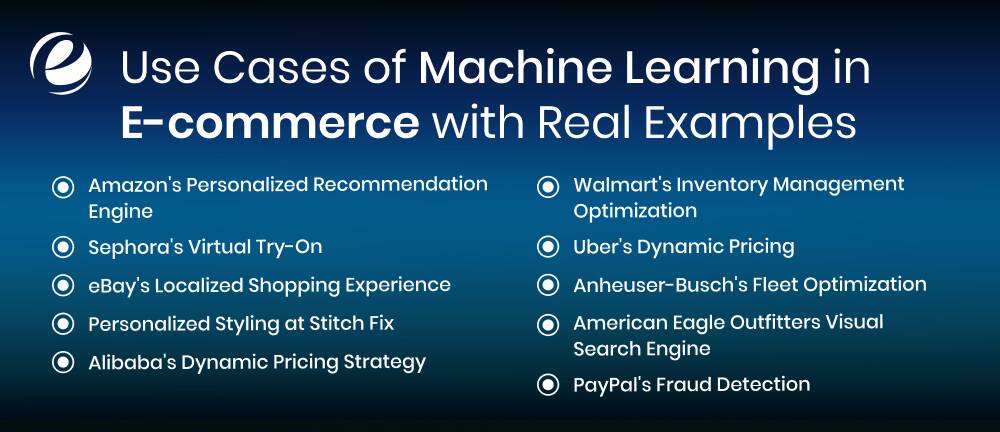
Use Cases of Machine Learning in E-commerce with Real Examples
Machine learning is a powerful tool that enhances the online shopping experience for both customers and businesses. From product selection and inventory management to security, machine learning for e-commerce
Let’s explore how leading companies use machine learning to drive innovation and improve customer experiences.
1. Amazon’s Personalized Recommendation Engine
Amazon’s recommendation engine, powered by Amazon Personalize, uses sophisticated machine learning techniques to provide highly personalized product suggestions. It analyzes previous interactions, such as browsing history, search activity, and past purchases, to gain insights into customer behavior and preferences. Thanks to AWS’s scalable infrastructure, Personalize processes and analyses vast amounts of data to provide relevant and timely recommendations.
The system enhances user engagement by presenting tailored content that evolves with individual preferences. Its scalability ensures that Amazon Personalize can efficiently handle data for businesses of all sizes, ultimately increasing conversion rates and customer satisfaction by offering a more relevant and customized shopping experience.
2. Sephora’s Virtual Try-On
Sephora’s online try-on service allows shoppers to test makeup products before making a purchase. This feature enables shoppers to see how different colors and products look on their skin, making online shopping more personalized and realistic. It easily bridges the gap between in-store and online shopping by providing an experience similar to trying products in person.
As a result, consumers feel more confident about their purchases. This feature also reduces returns since customers can better visualize the product before buying. Additionally, it boosts sales because customers are more likely to purchase when they have a clear idea of how the product will look. Ultimately, Sephora’s virtual try-on feature enhances both customer experience and company performance.
3. eBay’s Localized Shopping Experience
eBay transforms search results with advanced machine learning technologies that improve both accuracy and relevance. Initially it was applied in Russia but now expanding to France, Italy, and Spain also, eBay uses automatic machine translation to offer customers with a localized shopping experience. By translating search terms and inventory items across multiple languages, eBay ensures its customers receive relevant results regardless of their location.
The main app, Best Match, utilizes these algorithmic techniques to evaluate factors like item popularity, price, quality, and return policies, showing only the most relevant offers. As it advances machine learning technology, eBay is leveraging open-source libraries and cutting-edge technology to rapidly refine its search models, marking a significant leap in personalizing and enhancing the user experience.
4. Personalized Styling at Stitch Fix
Stitch Fix uses artificial intelligence and machine learning to provide customized styling options for every client. By analyzing an individual’s style preferences, body measurements, and fashion history, AI recommends clothing that perfectly matches their personal style and body shape. This allows users to find clothing they enjoy without extensive research. The AI learns from each purchase and feedback, continually improving its recommendations over time.
As a result, consumers enjoy a personalized shopping experience that is both tailored and convenient. The outcome is greater customer satisfaction, stronger loyalty, and a higher lifetime value. Satisfied customers are typically more likely to return, leading to continued growth for Stitch Fix. Offering personalized services at a large scale demonstrates how AI and ML can enhance eCommerce businesses and improve customer retention.
5. Alibaba’s Dynamic Pricing Strategy
Alibaba Cloud utilises machine learning to enhance its cloud services, customer support, cloud infrastructure, and data analytics capabilities. Alibaba uses machine learning to create innovative pricing strategies that easily adapt to market trends and competitor analysis, allowing the business to increase revenue and remain at the forefront of its industry.
The technology analyzes vast amounts of data, such as competitor pricing and customer behavior, to adjust prices that attract consumers and maximize profit margins. By continuously adjusting pricing, Alibaba ensures it offers the most competitive prices, even as market conditions change. This flexible approach helps Alibaba maintain its competitive edge in the fast-paced world of eCommerce.
6. Walmart’s Inventory Management Optimization
Walmart makes use of machine learning in its eCommerce strategies to simplify its inventory management as well as optimize its logistics in the supply chain. Through the analysis of sales data as well as market trends, Walmart can dynamically adjust its inventory levels to make sure that the availability of products while also avoiding stock-out situations. The predictive analysis based on machine learning helps to predict demand and increase inventory levels, decreasing the risk of overstocked stocks.
To improve its AI capabilities, Walmart has created the Element platform, which simplifies the implementation process of both AI and machine learning at any scale. The platform equips engineers, data scientists, and developers with the tools needed to efficiently create and deploy machine learning algorithms. Element provides Walmart with valuable insights into competitor pricing, product selection, and marketing strategies, helping the company make more informed decisions.
7. Uber’s Dynamic Pricing
Machine learning plays a vital role in helping Uber adjust ride prices in real time based on factors like traffic, demand, weather, and even the time of day. For instance, if there is a surge in passengers, such as during rush hour or in poor weather, Uber activates “surge pricing,” which increases the fare to incentivize more drivers to offer their services.
The dynamic pricing system ensures that the number of available rides is higher during times of high demand, while also balancing the number of drivers on the road. Uber’s machine learning algorithms analyze recent trends and historical data to predict when and where demand will rise. This ensures that both users and drivers get the most out of Uber’s services during peak times, leading to greater efficiency and satisfaction for both sides.
8. Anheuser-Busch’s Fleet Optimization
To improve its e-commerce logistics and manage its growing customer base, Anheuser-Busch, the world’s largest brewery, is implementing a machine learning-driven fleet optimization system for its last-mile delivery services. This system uses historical data, such as transportation patterns, parking availability, and weather conditions, to find out the most efficient and cost-effective delivery routes. The system then provides the latest navigational and docking information to dispatchers and drivers via a specialized app.
Since adopting this advanced technology, Anheuser-Busch has achieved an impressive 80% reduction in late deliveries. The improved route optimization system not only reduces delays but also lowers operating costs, highlighting the impact of machine learning in modernizing logistics and enhancing delivery efficiency.
9. American Eagle Outfitters Visual Search Engine
American Eagle Outfitters, a well-known clothing retailer, has partnered with Slyce, an innovative company specializing in image recognition, to make shopping more enjoyable for customers. Together, they developed an image search function within the American Eagle mobile app. This feature allows users to snap a picture of any item they want to buy, whether it’s from a physical store, social media, or even a magazine, and search for similar items in American Eagle’s catalog.
Slyce’s technology detects the clothing in the photo and searches American Eagle’s catalog for similar merchandise. This simplifies and enhances the shopping experience, especially for those influenced by what they see in their everyday surroundings. The app also helps American Eagle connect with tech-savvy customers who prefer fast, visual ways of exploring styles. Ultimately, it’s a great step towards making shopping more engaging and efficient.
10. PayPal’s Fraud Detection
PayPal makes use of machine learning to detect and prevent fraud by analysing large amounts of payment data. These algorithms monitor customer behavior patterns and identify any suspicious activity that differs from normal behavior. For example, if a person typically makes small purchases locally but suddenly initiates a large transaction from an overseas location, PayPal’s system flags it as suspicious.
Machine learning algorithms continuously analyze both legitimate and fraudulent transactions, improving their ability to detect fraud over time. Real-time detection minimizes the impact on consumers by blocking fraudulent transactions before they are processed. This means PayPal’s machine learning algorithms provide enhanced security for users, ensuring safer online payments and reducing the risk of financial losses.
How to Adopt Machine Learning in Your E-commerce Business
Machine learning can help your online business in various ways, from providing more efficient customer service to preventing fraudulent transactions and ensuring product authenticity. If you’re eager to stay ahead of your competition, now is the perfect time to implement machine learning in e-commerce.
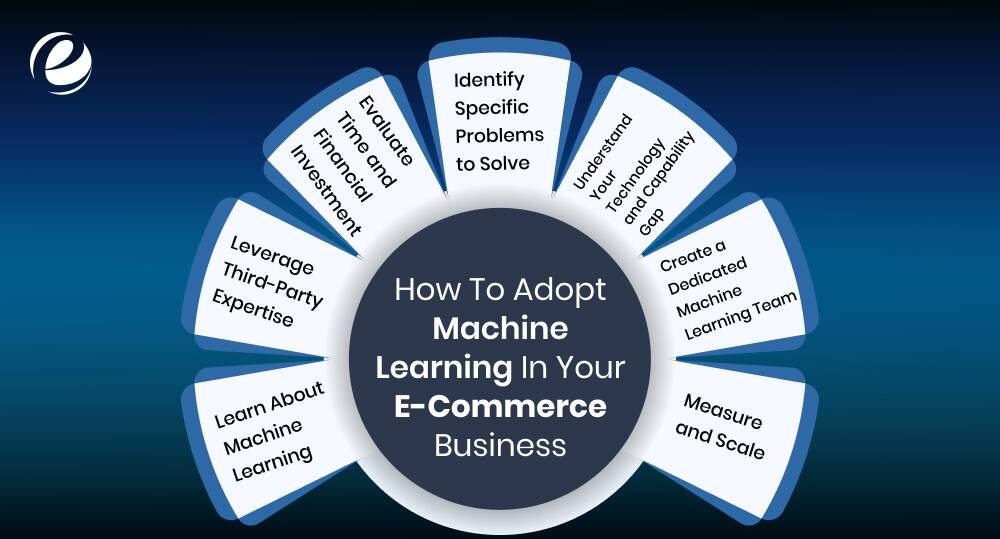
1. Learn About Machine Learning
To successfully implement e-commerce machine learning
2. Leverage Third-Party Expertise
In case your company does not have machine learning professionals available, you can hire professionals working externally. This work can be done by consultants or new employees competent in machine learning. The second option is to hire machine learning experts who will guide your business in the adoption process and help you leverage it while aligning with your business needs, maximising the potential/impact.
3. Evaluate Time and Financial Investment
Before diving into machine learning, consider the time and financial investment required for implementation. The more you invest in research, development, and testing, the quicker you’ll see results. Plan a realistic budget for the necessary tools, resources, as well as the expertise to ensure the success of your project.
4. Identify Specific Problems to Solve
Machine learning is most effective by focusing on specific achievable goals. Instead of vague goals such as “increase sales,” identify specific issues that should to be addressed. As an example, concentrate on increasing the retention rates of customers who are first-time buyers or reducing the abandonment rate of your cart. The identification of a specific issue allows machine learning to provide accurate, precise results.
5. Understand Your Technology and Capability Gap
When you are setting the goals for machine learning, you should evaluate the current technology you have and your staff’s abilities. Make sure your company has the infrastructure and the resources. Do not set objectives that go beyond the capabilities of your technology. It is crucial to match machine learning strategies with the strengths of your business as well as its weaknesses.
6. Create a Dedicated Machine Learning Team
A successful machine learning implementation needs an experienced team. Create a team with the appropriate combination of researchers, data scientists, as well as project manager. The team should guide the process of adoption and make sure that machine learning technologies can be seamlessly integrated in your daily business processes that will yield effective results.
7. Measure and Scale
Begin by experimenting with machine learning in a narrow area of your company’s activities. Analyze its performance through data-driven analysis. After initial efforts produce positive results, you can gradually increase the size of the project in other areas of your company. Monitoring your progress continuously ensures your business grows and evolves effectively.

Challenges of Implementing Machine Learning in E-commerce
It is not simple to integrate Machine Learning in E-commerce. Let’s take a look at some of these challenges and their solutions.
1. Integration into Existing Systems
The integration of machine learning models to the existing platforms for eCommerce can be difficult and could be disruptive. Partner with knowledgeable experts or developers to ensure seamless integration. Use APIs and modular methods to integrate ML models into existing systems effortlessly.
2. Scalability Issues
When your business expands in size, scaling your ML models to cope with the increasing volume of traffic and data can be difficult. Choose scalable machine learning tools and cloud-based solutions that can be expanded to meet your requirements. Make sure you regularly review and modify your model to deal with greater amounts of data and more complicated tasks effectively.
3. Model Accuracy and Bias
Making sure that ML models are reliable and free of bias is essential, since biases in models could harm customers’ experience and result in improper methods of doing business. Always monitor and analyze the performance of your model. Make use of diverse and relevant data sets for your training as well as employ methods to identify the sources of bias and minimize it in your models.
4. Privacy and Compliance
Managing personal data and ensuring compliance with privacy regulations is a major concern. Implement robust measures to safeguard your data and ensure compliance with all the regulations. Use anonymization techniques and secure storage practices to safeguard customer data and comply with privacy guidelines.
How EmizenTech ML Expertise Will Help You to Improve Your E-commerce Business
EmizenTech is a trusted e-commerce app development company that helps your business grow using advanced AI and machine learning (ML). Our team of expeerts creates custom ML solutions designed specifically for your business needs. Whether it’s improving product recommendations, adjusting prices, or forecasting demand, we make sure our ML models are accurate and work smoothly with your existing systems.
We have experience with all major e-commerce platforms, including BigCommerce, Magento, Shopify, and others. No matter which platform you use, our team can easily integrate these ML solutions into your business to make it more efficient and profitable.
With our support, you’ll stay ahead of the competition in the fast-evolving e-commerce world. We guide you through every stage, from planning to execution, making sure your business can fully benefit from the power of machine learning.
Partner with EmizenTech today to successfully implement ML services and boost your e-commerce business.
Final Words
E-commerce is a fast-growing industry where machine learning plays a vital role in enhancing customer service and driving business growth. By using machine learning in e-commerce, every part of an e-commerce business, from marketing to inventory to customer support, can see real benefits. These technologies help businesses make smarter decisions based on data, improve efficiency, and create more personalized experiences for customers.
In recent years, both artificial intelligence and machine learning have become powerful tools for digital transformation in retail. As online shopping continues to grow, these tools help businesses manage large amounts of data, automate processes, and meet customer needs more effectively.
The future of e-commerce will rely even more on machine learning. From product recommendations to fraud detection and chatbots, many applications are already in use or being developed. It’s clear that machine learning is becoming a key part of staying competitive and successful in the online retail world.
FAQs
Why to use machine learning in ecommerce business?
Machine learning is becoming increasingly widespread in e-commerce, with major players already fully adopting it. Not implementing this technology could pose a risk and negatively impact your e-commerce sales.
How can machine learning help the e-commerce industry increase revenue?
Machine learning in e-commerce enables online stores to reach customers more effectively by analyzing data to determine what has worked in the past. It uses that data to create similar customer profiles through retargeting. ML examines the profiles of millions, analyzing behaviors and outcomes to identify the most likely consumer conversions.
What’s the difference between AI and machine learning?
AI refers to a computer's ability to mimic human thinking and perform tasks in real-world scenarios. Machine learning is basically refers to a subset of AI that uses data to improve systems and identify the root causes of problems.
How long does it take to implement machine learning in e-commerce?
It depends. A simple feature like product suggestions could take a couple of weeks. Larger systems might take several months. It also depends on the size of the e-commerce store and the volume of data it handles.




 +1 (989) 535-9295
 info@emizentech.com
 emizentech


