
 Add us as a preferred source on Google
- Offshore outsourcing is when you hire a company based in another country to build or maintain your software and reduce hiring time and costs at the same time.
- The offshore engagement models are dedicated development team, staff augmentation, fixed-price project outsourcing, and time-and-materials.
- The best approach to hire an offshore software development company is to define the project scope, choose an engagement model, shortlist vendors, vet them properly, lock down the contract, and run a paid trial before committing long-term.
- The cost of hiring an offshore software development team starts at $3000/month per developer or $20/hour per developer.
- Red flags to avoid when choosing a vendor: no verifiable portfolio, vague pricing, unwillingness to sign an NDA, and no project management tool.
Hire the wrong offshore development company, and you do not just lose the project budget. You lose the months it takes to find out something was wrong, then rebuild it.
That is exactly why most businesses that are searching for how to hire an offshore outsourcing software development company have already planned for offshore. What they really want is a process to separate a vendor who delivers from one who does not.
The pressure to get this right is only growing. The Gartner report predicts that global IT spending will reach $6.37 trillion, with 14.2% growth from 2025.
At that pace, in-house teams cannot scale fast enough on their own. Offshore outsourcing exists to close that gap, but it only works for companies that vet a vendor properly before signing a contract.
So if you are reading this guide, you are probably one of a few people. A startup founder or CTO trying to decide between building in-house or going offshore. Or a mid-size business owner who needs custom software development.
What is Offshore Software Development Outsourcing?
Offshore software development outsourcing means hiring a company based in a different country to develop software. They are not part of your team but work remotely.
For example, a U.S. tech company hires an external vendor to work on its software development project from scratch to deployment. They are very cost-effective.
Additionally, they help startups and established businesses reduce costs, access expert talent, and develop faster. The services of an offshore development team are not limited to development, but they also offer other services like quality assurance, UI/UX design, and project management.
However, the following three types of outsourcing often get mixed up, so it is vital to separate them clearly. Let’s have a look at the table of Onshore vs. Offshore vs. Nearshore software development.
| Factor | Offshore | Nearshore | Onshore |
| Definition | Team located in a different country | Team located in a nearby country | Team located in the same country |
| Time zone gap | Often significant | Usually small | Minimal or none |
| Cost | Lowest | Moderate | Highest |
| Communication | May need more coordination | Generally easier | Easiest |
| Cultural alignment | May need adaptation | Usually strong | Strongest |
| Talent pool | Access to global talent | Access to regional talent | Limited to the domestic market |
| Project control | Needs strong processes | Relatively easy | Highest level of direct control |
| Best suited for | Cost-sensitive and scalable projects | Balancing cost and collaboration | High-touch, complex, or sensitive projects |
If you hire an offshore outsourcing software development company, you will get a large, well-trained talent pool. Finding someone with a particular skill set is much faster with offshore outsourcing.
Why Do Companies Outsource Offshore Software Development?
Companies outsource offshore software development to find skilled developers, reduce hiring time, and control costs that are not available in their local market. Let’s understand the advantages of outsourcing in detail.
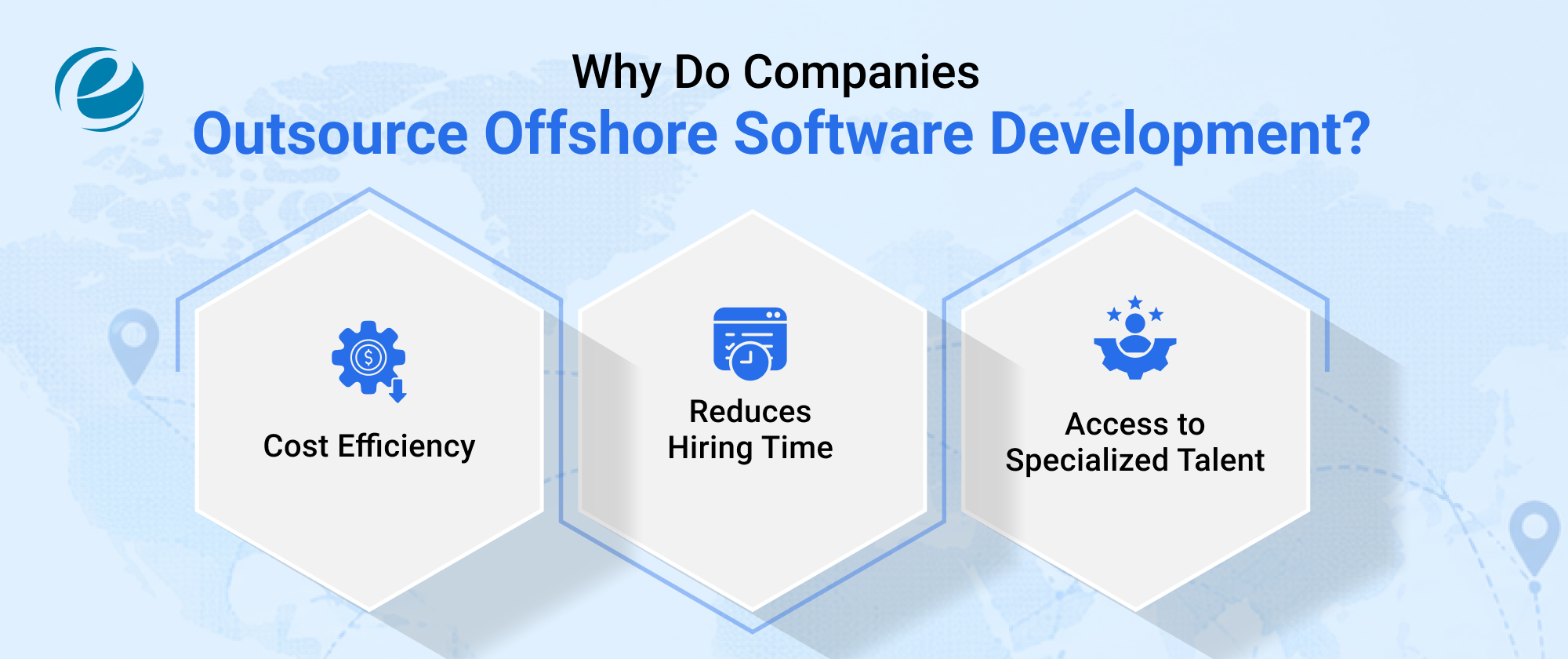
1. Cost Efficiency
One of the major reasons businesses outsource offshore software development is the cost. According to Deloitte’s Global Outsourcing Survey, around 72% of companies have outsourced their software development. This directly reduces costs.
However, it is not only about the outsourced engineers. You can also reduce costs on hiring, infrastructure, perks, etc. It’s one of the best ways to improve cost efficiency.
2. Reduces Hiring Time
Hiring one senior developer in the US can take nearly 2-3 months, right from job posting to signed offer. Sometimes, it also takes more time to find specialized roles.
If you hire an established offshore outsourcing software development company, they can provide you with qualified developers who can start within 1 or 2 weeks. They have vetted people on the bench, so they do not start a search from zero. This can reduce your hiring time.
3. Access to Specialized Talent
Another driving factor is the specialized global talent. According to ManpowerGroup’s latest Talent Shortage Survey 2026, 71% of organizations are facing challenges in hiring people with the right skills.
This is the single most important reason why businesses are moving towards outsourcing. It gives you access to specialized and expert developers from different parts of the world.
Types of Offshore Engagement Models
The outsourcing engagement models are dedicated development teams, fixed-price project outsourcing, staff augmentation, and time-and-materials contracts. But before you contact a single vendor, decide how you want to structure the work. This choice decides everything that follows.

Dedicated Development Team
You get a dedicated development team that has developers, designers, a QA person, and project managers. They work as an extension of your team, just employed by the vendor rather than by you directly.
This model is best for long-term products where the roadmap continuously changes, and you need a consistent team that develops real familiarity with your codebase over time.
You have to decide based on your requirements whether you need to outsource a dedicated development team or another engagement model.
Fixed Price Project Outsourcing
In this type of engagement model, you decide the full scope upfront and get a quote on a full project. The fixed budget, exact work, features, and deadlines are set before you sign the agreement.
The fixed-price project outsourcing model works best for small or well-defined work where requirements are fixed. It does not work well where requirements change. Every change request triggers a new negotiation, so it can slow the project down
Staff Augmentation
The next one is the staff augmentation model. It enables you to hire external professionals who collaborate directly with your internal team on a temporary basis.
For example, if you manage your project in-house but need a CTO for technical guidance and strategic consultation for a short period, this model is the best.
Did you know that you can hire a fractional CTO right here at EmizenTech?
Our CTO, Amit Samsukha, provides strategic guidance, technical consultation, and leadership support tailored to your project requirements.
Time and Material Contracts
The time and material contracts model allows you to pay for actual hours worked at an agreed rate. It gives you the flexibility to change direction as the project develops. Because of this, it can be difficult to immediately see the full cost. You need effective tracking and reporting to keep it under control.
How to Hire an Offshore Outsourcing Software Development Company: Step-by-Step Process
To hire an offshore software development company for outsourcing, follow the process below. This process is for outsourcing software development and helps you see if the hire works out. Let’s check these steps out in detail.

Define Project Scope and Requirements
First, write down the project scope and requirements. For example, what the product does, what tech stack you prefer, your rough timeline, and the team size you think you need.
The document does not have to be a full technical specification. But it should have enough detail for a vendor to give you a real quote. If you don’t include all your needs, the vendor has to price them based on what they don’t know. This results in vague, high quotes.
Besides, you should also add any constraints that matter too. For example, changing existing systems with integration and compliance requirements. If vendors know these requirements at the start, they can quote and assign projects differently.
Choose the Engagement Model
Now, once you know what kind of project you need, the next step is to choose the right engagement model. You can choose from a few options like a dedicated team, staff augmentation, fixed price, or time and materials.
If you need a team for a longer period, then you can hire dedicated developers as a team. But if you have an in-house team and need some expert support or guidance, staff augmentation is the best option.
So, you must choose the engagement model that best fits your project scope, level of control, and budget. Once you decide, you can choose the same model when comparing different vendors. However, we have clearly broken down engagement models in the section above.
Shortlist Offshore Vendors Via Right Channels
There are a few channels to shortlist offshore vendors. You can go to Clutch or GoodFirms. They list verified companies with different client reviews. Then you can filter companies by industry, location, hourly rate ranges, and project size.
Additionally, you can also ask for referrals from other founders or technical leaders who have outsourced before. They are the strongest leads because they can tell you the truth about what happened.
Apart from this, LinkedIn can help you find the companies that specialize in your exact tech stack. You must shortlist five to eight companies before you start scheduling calls. That’s enough to compare properly without spending weeks on it.
Vet Their Technical Expertise and Portfolio
To vet a vendor’s technical expertise and portfolio, you must review their real project samples or client testimonials. You can ask them for case studies that are close to your project, in the same industry, and the same tech stack. You can ask them a few questions.
- What technical decisions did you make along the way and why?
- Can you share a case study where you built a system with similar scale and security compliance to ours?
- What is your standard code review process?
A vendor that can explain tradeoffs from a past project understands the work at a real level. It is vital to make sure that the developers who will work on your project have sample code or a portfolio.
Besides, you can also bring your own technical people onto these calls. They can help you find whether a vendor’s technical explanations are correct or not.
Check Reviews and Verify Legitimacy
To check reviews and verify a vendor’s legitimacy, look for verified purchase tags. The Clutch and GoodFirms reviews are credible because they are tied to verified and completed projects.
You can read a few of the negative reviews. The vendor’s response to criticism tells you many things about how they will handle problems on your project. Do not simply rely on written testimonials alone. If possible, ask for 1 or 2 direct client references and verify them.
Also, you must confirm their basic legitimacy.
- Does the company have a registered business address you can find?
- Does their LinkedIn page show real employees rather than fake numbers?
- Have they been operating for at least a couple of years with a visible project history?
Evaluate Communication and Time Zone Overlap
The more effective your conversation with offshore teams, the more successful your project will be. So, ask them directly how many hours of overlap you will get with your working day.
When there is zero overlap, everyone is waiting for written messages, which slows down projects more than most people expect. Two to three hours is enough for daily updates and quick decisions.
Additionally, you can also test their English proficiency on a live call. It is important because a lot of day-to-day coordination happens by voice or video calls. Most importantly, ask them what project management tool they use and whether you will get direct access to it.
Discuss Pricing and Get a Detailed Quote
Once you evaluate the communication, you can ask the offshore outsourcing software development company for a full cost breakdown. You can ask them a few questions.
- What is included in the hourly rate or monthly cost?
- Is project management billed separately or together?
- Are there setup or onboarding fees you have not been told about yet?
- What happens to pricing if we need to scale the team up or down mid-project?
If a vendor gives you one flat number with no cost breakdown, it is much harder to hold them accountable later if costs increase without explanation. It is vital to discuss pricing with them before hiring them and get a detailed quote.
Review the Contract, NDA, and IP Ownership Terms
This is the most important step to hire a company for offshore software development outsourcing. Before any detailed technical discussions begin, tell them to sign an NDA first. This is a standard practice, and any legitimate vendor will sign this non-disclosure agreement without any delay.
The contract should have a clear IP clause stating that once you pay, you own all the code, designs, and documentation. If you do not have a proper written IP agreement, the vendor can legally keep the copyright to the custom software code.
Also, if your software processes user data, review the data protection provisions. For example, if your software development team is located overseas, GDPR and CCPA compliance become a concern.
What happens if an offshore vendor does not deliver?
You can build in a clause that covers what happens if the vendor fails to deliver. This should include a defined service level agreement or SLA, a clear escalation process, and a termination clause that allows you to exit.
Run a Paid Trial Project Before Committing Long-Term
Before you sign a long contract, you must run a small paid trial project first on a real but limited piece of work. This can help you analyze their work. It tells you more than any interview or portfolio review will.
You can see their actual code quality, how the team manages a real deadline, and whether communication holds up under real pressure. If a software development vendor entirely refuses to do a trial, treat that as useful information.
Running a paid trial project can help you minimize costly hiring errors and give mutual clarity between you and the vendor. Finally, you can hire an offshore outsourcing software development company that fulfills all of your requirements.
How to Manage an Offshore Development Team Successfully?
Hiring the team is half the job. Managing it well is what actually decides whether the project succeeds. So, here are the ways you can manage an offshore development team successfully.
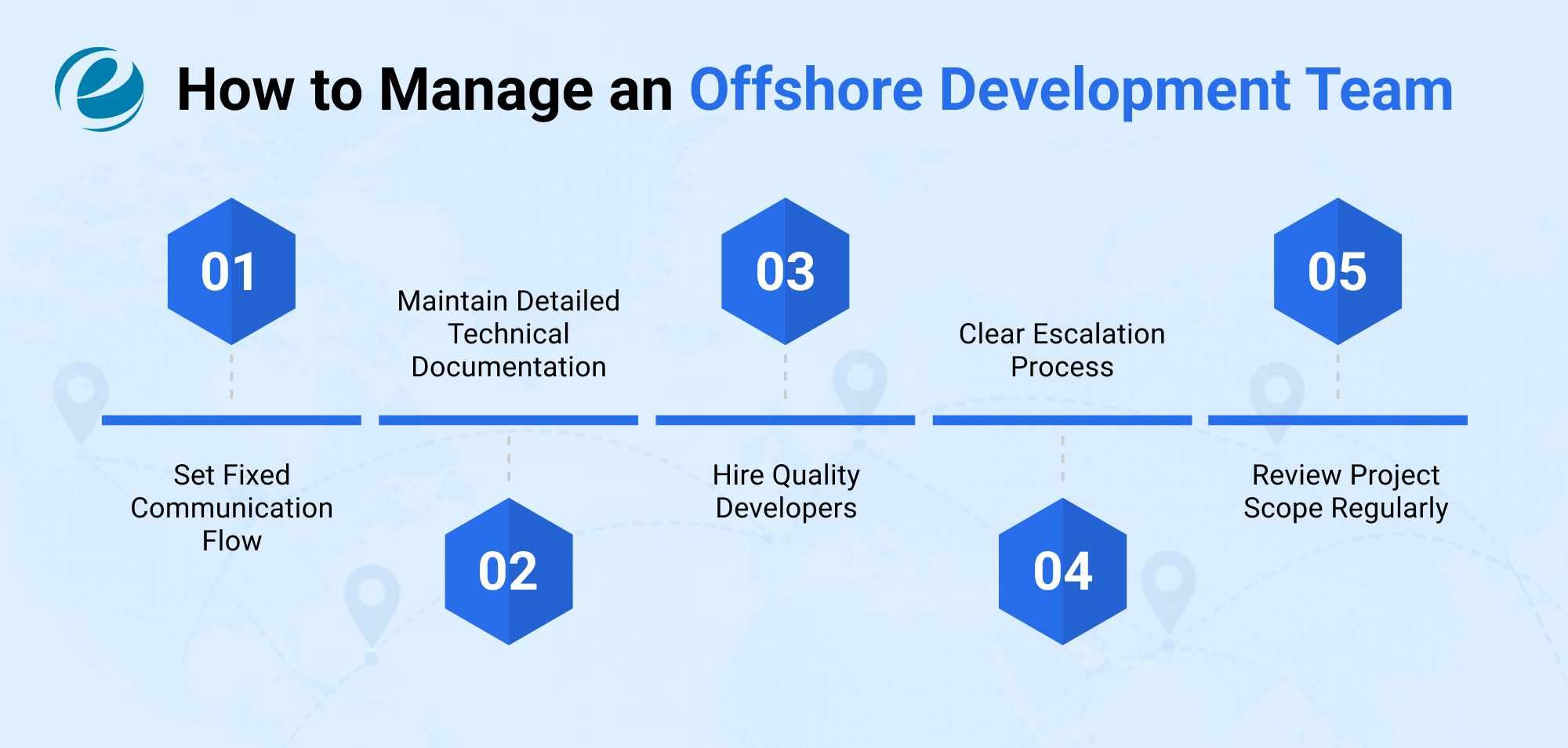
Set Fixed Communication Flow
To manage an offshore development team, you have to set a fixed communication cadence and stick to it. For example, you might have a short daily async update and one call a week. This can cover most needs of a small or mid-size team.
Basically, there should be a structured process for smooth communication. Do not rely on a specific message alone, since details get lost that way, and questions sit unanswered longer than they should. You can choose a particular project management tool like Jira, Wrike, Asana, etc.
Maintain Detailed Technical Documentation
You should create detailed technical documentation or, in simple words, document decisions at every stage. If a technical direction changes partway through the project, it is vital to write down why it changed and who approved it.
Documenting everything really matters more with an offshore team than an in-house one because you miss out on the spontaneous conversations that naturally keep everyone on the same page when people have an office.
Hire Quality Developers
The success of your offshore software development depends on specialized professionals. You should hire remote developers from an offshore outsourcing software development company who are skilled and have expertise.
But before that, you must thoroughly check their remote collaboration experience and specialized knowledge. Also, check their prior work, like client testimonials or portfolios, and you can take a short trial project session to know their real-time collaboration.
Clear Escalation Process
Now, it is crucial to set a clear escalation process from the start. Everyone should know who to call and how soon to call them if something clearly goes wrong or slows down the process. It is not necessary to wait two days for a response to a blocking issue if the right structure is in place before it is needed.
Review Project Scope Regularly
To properly manage an offshore outsourcing software development team, you have to regularly review the original scope. Offshore projects tend to drift when nobody checks in until a deadline is close.
A small misunderstanding about a feature can turn into a much bigger gap between what you expected and what gets built. So, it is vital to do a short weekly review that can help you catch these issues in advance.
What Questions Should I Ask an Offshore Software Development Company Before Hiring?
You have to keep a short list of questions ready for every IT outsourcing company call. These are the most important questions you should ask. We have jotted down some of them.
- Can you share two or three references from clients in our industry?
- What happens if a developer assigned to our project leaves mid-engagement?
- Who owns the code and IP once the project or contract ends?
- What is included in your hourly rate or monthly cost, and what gets billed separately?
- How many hours of overlap will we get with our working day?
- What project management tool do you use, and will we have direct access to it?
- Can we run a paid trial project before signing a long-term contract?
- What does your code review and quality assurance process look like?
- Will you sign an NDA before we share project requirements with you?
- How do you manage scope changes once the project is already underway?
- Can we speak directly with the developers who would work on our project?
- What is your replacement policy if a core developer leaves the project?
You have to keep answers to these questions during the vendor meeting. If a vendor cannot answer most of them, particularly within a few minutes, that alone says something.
How Much Does It Cost to Hire an Offshore Software Development Company: Region-Wise Cost
The cost to hire an offshore software development team ranges from $2,000 to $20,000 per month per developer. However, rates vary by region and experience level.
The table mentioned below shows the rough ranges as of 2026, based on published industry cost data. You must treat them as a starting point for budgeting, not a quote. The actual cost to hire dedicated developers depends on your particular project requirements, tech stack, and the vendor you choose. Take a look:
|
Region |
Average Hourly Rate |
Average Monthly Rate Per Developer |
| Asia | $20-$30/hr | $3,000-7000 |
| USA | $70-$130/hr | $12,000-$20,000+ |
| Africa | $18-$45/hr | $2,500-$7,000 |
| Latin America | $30-$60 | $5,000-$9,500 |
| Western Europe | $60-$110 | $10,000-$18,000 |
| Eastern Europe | $35-$70 | $6,000-$10,000 |
These offshore development costs by country may change with market demand and currency movement, so confirm current rates directly with vendors during your evaluation. Do not depend on any published table alone, including this one.
Red Flags to Avoid When Hiring an Offshore Development Company
The major red flags to avoid are no verifiable portfolio, vague pricing, unwillingness to sign an NDA, all junior team pitched as senior, and no project management structure. You should check these during vendor evaluation. If you find any one of them, it is best to pause it right away. Below are some red flags you must consider.
No Verifiable Portfolio
- The warning sign: If a vendor cannot point you to real, checkable past work with client names you can confirm, treat it as a serious gap. Screenshots with no context, projects with the client name blacked out, or a portfolio page that never changes are all signs of work not being reliable.
- Why it matters: A portfolio is proof. It shows the vendor has actually delivered software, not just talked about it on a sales call. Without it, you are trusting claims you cannot test. If the work turns out weaker than promised. You find out after you have already paid and lost weeks.
- What good looks like: A trusted vendor shares named case studies with real outcomes. They give you contracts or reviews you can independently verify and links to live software you can actually use. They are comfortable with you checking their claims because they are true.
Vague Pricing
- The warning sign: You can look at quotes that are not specific. You get some phrases like “It depends” or “Let’s discuss on a call,” with no follow-up numbers. A billing model that is never explicitly stated as a fixed price/hourly. One lump sum proposal with no explanation of coverage.
- Why it matters: Vague pricing today means surprise invoices later. Without a clear scope and a rate card, the small requests can turn into billable extras. Your spending goes over budget, and you do not realize it until your project has been started.
- What good looks like: The right vendor gives you a written quote. They tell you upfront whether you are paying hourly, at a fixed price, or on a retainer, and they explain how change requests get priced.
Unwillingness to Sign an NDA
- The warning sign: If a vendor delays, gives excuses, or refuses to sign an NDA before discussing your idea in detail, that is a clear warning sign. Some vendors will provide you with a weaker version that will protect them more than it protects you.
- Why it matters: Whenever you share your idea, code, or any user data, it needs legal protection like an NDA. Without a signed NDA, there’s a high chance your details or idea could be leaked. This is not just paperwork. It is the only thing that can protect your idea.
- What good looks like: A professional offshore outsourcing software development services provider has a standard NDA ready and signs it before the first conversation about your project. Besides, they can explain who on their team will have access to your data and code and why.
All-Junior Team Pitched as Senior
- The warning sign: In the sales meeting, they tell you they have all senior professionals. But once the work starts, the actual delivery team is mostly junior developers with 1 or 2 years of experience. You ask for resumes or LinkedIn profiles but get delays or generic bios with no verifiable history.
- Why it matters: Seniority affects the quality of decisions made for your project. Junior developers make more mistakes in architecture. These issues may show up later as bugs, errors, or missed deadlines. If you pay senior rates for a junior developer team, it can be hard to find the problem until the code is already written.
- What good looks like: A trusted vendor will give you the full details of the people who will work on your project before you sign anything. They allow you to interview developers and tell you that a senior will check juniors’ work rather than hiding.
No Project Management Structure
- The warning sign: You can check if the project manager is not assigned. Also, you can get random updates through scattered emails or chat messages. Nobody can tell you what the progress is.
- Why it matters: Without proper structure, a small misunderstanding can cause features to be built incorrectly. Deadlines would not be met because nobody owns the schedule. There is no clear person answerable if anything goes wrong. You end up chasing updates.
- What good looks like: A well-run vendor assigns you a dedicated project manager. He will be the main point of contact. You get regular updates on a set schedule and visibility into progress through project management tools. Plus, you have a clear way to raise issues that need immediate attention.
In-House vs. Offshore Outsourcing: Which is Right for You?
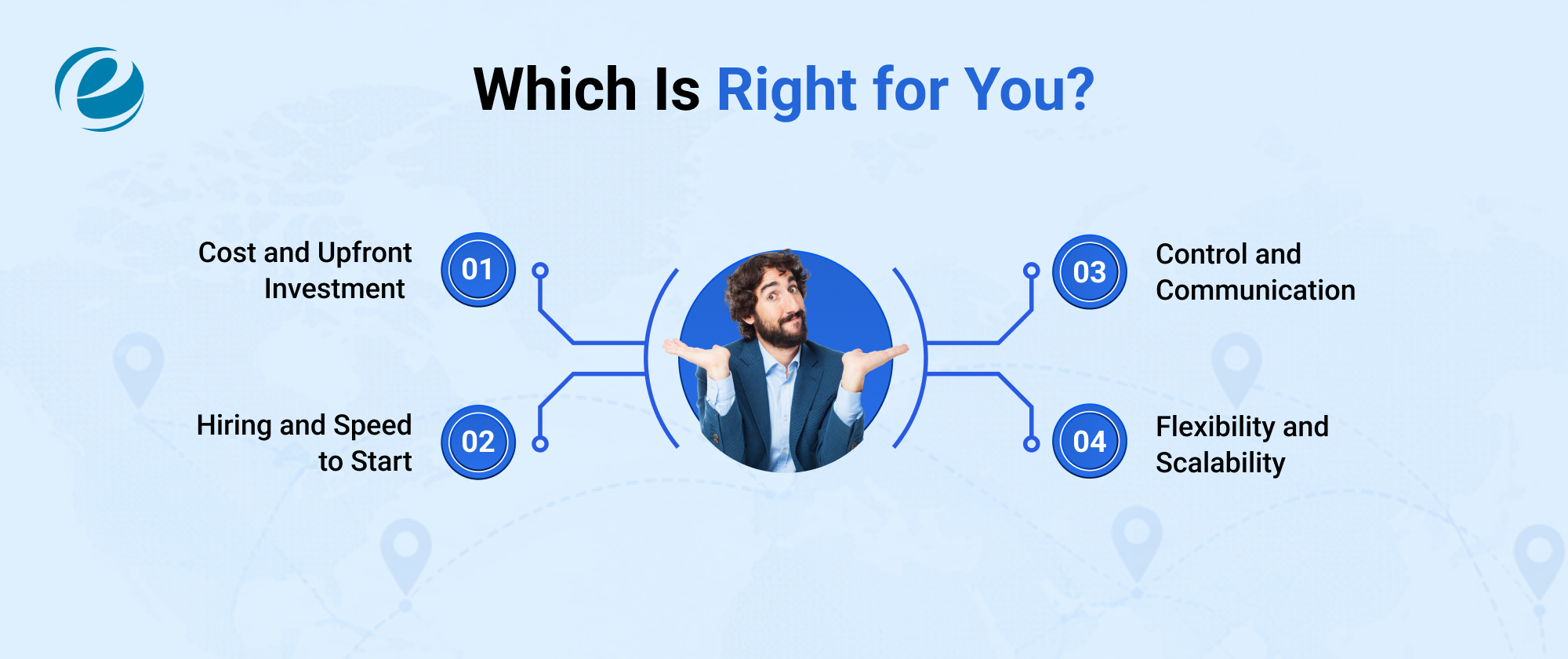
If you are a startup and want to build an MVP on a tight budget, offshore outsourcing is right for you because of its speed and cost. However, if you are creating core software that needs long-term ownership by people who fully work in your company, an in-house model makes more sense once you can afford to build that team. For a quick snapshot, check out the table below, which compares in-house vs. offshore development outsourcing.
| Factor | In-House Development | Offshore Outsourcing |
| Cost | Higher cost | More cost-effective |
| Upfront investment | High | Lower |
| Hiring | Time-consuming | Faster access to talent |
| Speed to start | Slower | Faster |
| Control | High | Moderate |
| Communication | Easier and more direct | May involve time zone or communication challenges |
| Scalability | Needs additional hiring | Easier to scale resources |
| Best for | Core products and long-term development | MVPs, startups, and cost-conscious businesses |
| Main advantage | Control and long-term ownership | Cost savings and flexibility |
| Main challenge | Higher cost and hiring effort | Less direct control |
Cost and Upfront Investment
In-house development needs a higher upfront investment. You need to cover salaries, benefits, recruitment, onboarding, and other employee-related costs.
Offshore outsourcing is more cost-effective because you can get development talent without the full hiring costs. This can be a great option if you have a limited budget.
Hiring and Speed to Start
If you build an in-house team, it can take considerable time. Finding qualified developers, taking interviews, and completing the onboarding process can really delay your software development.
However, if you hire or build an offshore development team, you can shorten the overall timeline and start sooner. This can be useful when you need to launch an MVP or meet a tight product deadline.
Control and Communication
An in-house model gives you more control over development. The developers can work closely with your organization, and communication, collaboration, and decision-making are more direct.
With the offshore outsourcing model, you may have less direct control over the development process. It can be challenging to manage different time zones, communication styles, and working processes.
But with an experienced offshore outsourcing software development company, you can reduce these issues through regular communication and workflow.
Flexibility and Scalability
Scaling an in-house team means hiring and onboarding more people. This can cost you time and inflate your budget. Offshoring gives you greater flexibility when you need to increase or decrease development capacity.
Besides, you can also add experienced developers or expand your offshore software development services team. The best part is that you do not have to go through a lengthy hiring process.
So, Which Model is Best for You?
In-house development is a better fit for companies creating core software that needs long-term ownership, close collaboration, and deep technical knowledge.
Offshore outsourcing can be a better option for startups that want an MVP, companies with a limited budget, and businesses that need to scale development fast.
For many businesses, the best solution is a hybrid model. It keeps product strategy and major decisions in-house and outsources development. If you are planning this decision for your software, our guide on onshore vs offshore software development gives you clarity.
Why EmizenTech Is The Best Offshore Software Development Partner
EmizenTech is a trusted, reputable custom software development company. Our team brings together specialized developers, designers, project managers, and technology specialists who work with clients in different regions and industries.
We have delivered multiple projects for startups and established businesses from different regions.
Chomp – Hong Kong, China
Karcher – UAE
Kia Georgio Paint – USA
Our clients come to us with ideas, challenges, and business goals, and we work closely with them to find the right solution. One example of our approach is the way we handle products that start with only an initial concept.
We have been providing IT outsourcing throughout the years and have served over 1200 projects in different regions with a 98% client retention rate.
Additionally, we have delivered projects across e-commerce, mobile app development, and enterprise software. We work as both a dedicated extension of in-house teams and a fully outsourced build partner, depending on what each client needs.
So, if you want to hire an offshore development partner, EmizenTech is the one-stop destination you are looking for.
Conclusion
Hiring an offshore outsourcing software development company comes down to a simple process. You have to define project scope, pick the right engagement model, vet vendors properly, protect the idea with an NDA, and start with a paid trial before committing long-term.
If you skip any of these steps, you will take on a risk you did not need to accept. If you follow these steps in order, you will get what most businesses actually want from offshore development.
Now you have thoroughly understood the process. If you believe that custom software development outsourcing is the best option, or if you need any clarification, book a free consultation with EmizenTech and get the team your company requires.
FAQs
How much does it cost to hire offshore developers?
The cost to hire an offshore developer ranges from $20-$30/hr. It varies depending on the developer’s experience level, location, tech stack, and engagement model.
What is the difference between offshore and nearshore development?
Offshore development is a process in which organizations outsource developers or a development team from a different country to build software. However, nearshore development means hiring developers from a nearby country to develop software. The main difference between the two is the time zones. Offshore development has a large time difference, while nearshore has matching time zones.
How long does it take to hire and onboard an offshore team?
It takes 2 to 6 weeks to hire and onboard an offshore team for individual talent or a small team through an agency. But if you want a fully integrated, high-performing team, then the time can be up to 3 to 5 months.
Should a startup choose staff augmentation or a dedicated team?
If you already have an in-house team and just need extra hands for a defined period, then staff augmentation is a better fit. If you are developing software from scratch with a roadmap that will keep changing, a dedicated team works out better over time.
How do I make sure an offshore vendor is legitimate?
You can check verified reviews on Clutch or GoodFirms, ask for direct client references and actually call them, and confirm the company has a registered business address. Besides, you can also look for a real, visible team on LinkedIn rather than a handful of thin profiles.
Can I hire an offshore developer for an existing codebase or only new projects?
You can hire for both. Many vendors specialize in maintaining or extending existing systems. You have to make sure they audit the current code before quoting, since unfamiliar codebases take longer to price accurately.
How do I choose an offshore development partner?
To choose an offshore development partner, you can look at their:
- Technical expertise
- Communication standards
- Vetting process
- Pricing transparency
- Code quality
- Security practices
- Time-zone compatibility
- Case studies
How do I hire an offshore outsourcing software development company?
You can hire an offshore software development company by doing the following:
- Define project scope & requirements
- Select engagement model
- Shortlist offshore vendors
- Vet their technical expertise and portfolio
- Check reviews and verify legitimacy
- Evaluate communication & time-zone overlap
- Discuss pricing and get a detailed quote
- Review the contract, NDA, and IP ownership terms
- Run a paid trial project before signing





 +1 (989) 535-9295
 info@emizentech.com
 emizentech


