 Add us as a preferred source on Google
Imagine a Friday night dinner with six friends, one card on the table, and nobody wanting to figure out who owes what. Someone opens an app, taps a name, types a number, and the money disappears before the waiter brings the check back. That tiny moment happens billions of times a day now, and it’s a big part of why the peer-to-peer payments app has quietly become one of the most-used pieces of software on anyone’s phone.
Zelle alone moved more than a trillion dollars in payments during 2025, a 20% jump from the year before, and roughly 84% of U.S. consumers say they’ve used some form of P2P transfer service. In this blog, you will learn about the most popular P2P apps of 2026, how they compare on fees and features, and what it takes to build one yourself.
What Is a Peer-to-Peer (P2P) Payments App, and How Does It Work?
A peer-to-peer payments app is software that lets two people send and receive money straight from their phones, no cash, checks, or trip to the bank required. Instead of routing everything through a merchant or a point-of-sale system, a peer-to-peer payment app moves funds using nothing more than a phone number, email address, or username.
Here’s roughly how it works. A user links a bank account, debit card, or the app’s own wallet balance, picks a recipient, types in an amount, and hits confirm. The app checks both parties’ identities, pushes the transfer through a secure payment network or the ACH system, and drops the money into the recipient’s balance or bank account, usually within seconds.
Key Features to Look for in a Peer-to-Peer Payment App

Not every peer to peer payment app is built the same way, and the differences show up fast once real money’s on the line. Here’s what’s actually worth checking before you pick one:
- Instant verification and onboarding: Signing up should take minutes, using just a phone number, email, or bank login.
- Real-time or near-instant transfers: The best peer to peer payment apps move money in seconds, especially domestically.
- Transparent fee structure: Standard transfers should be free; fees should only show up for instant cash-outs or credit card funding.
- Strong authentication: Biometric login, PIN protection, and two-factor authentication are the baseline now, not extras.
- Request and split-bill tools: This feature helps users to request money or split a group expense evenly, saving everyone a headache.
- Fraud monitoring and alerts: The real-time alerts and AI-driven fraud detection catch something suspicious before it becomes a real loss.
- Cross-platform compatibility: A reliable payment app should work equally well on iOS, Android, or the web.
- Clear transaction history: The searchable records make tax season and expense tracking much less painful.
Apps that nail these basics and stay genuinely simple to use are the ones people actually keep on their phones. It’s also why e-wallet-style apps that bundle payments with loyalty and rewards keep gaining ground; our breakdown of e-wallet mobile app development covers how that combination gets built.
Are Peer-to-Peer Payment Apps Safe?
Generally, yes. Most of these platforms use bank-grade encryption, tokenization, and multi-factor authentication to keep transactions locked down. The real risk isn’t the app’s security architecture, though; it’s how the system is designed to work. P2P payments are meant to be instant and mostly irreversible, so there’s no real undo button once your money lands somewhere.
A few safety habits worth building before you use any of these apps:
- Always double-check the recipient’s details before hitting confirm. Usernames and phone numbers are easy to mistype.
- Only send money to people you actually know and trust. Most apps offer zero purchase protection on personal payments, unlike PayPal’s Goods & Services option.
- Turn on two-factor authentication and biometric locks wherever the app supports them.
- Watch for scam patterns, fake buyer or seller requests, romance scams, and urgent “send me money now” messages from a contact that’s actually been hacked.
- Report unauthorized transactions right away. There are some apps and banks that investigate fraud claims, but recovery is never guaranteed once the funds have moved.
Fraud losses tied to bank transfers and payment apps hit roughly $2.95 billion in 2024, per the FTC. Basic vigilance matters just as much as the app’s own security.
Top 10 Peer-to-Peer Payments Apps in 2026

Here are the 10 best peer-to-peer payments app options this year, ranked on adoption, features, and how reliable they actually are day to day. If you only remember 5 peer to peer payment apps from this list, make it Venmo, Cash App, Zelle, PayPal, and Wise; together they cover almost every transfer scenario.
1. Venmo
Venmo is still the most social peer-to-peer payments app in the U.S., and its public activity feed is honestly a big part of why people stick around, odd as sharing your lunch purchases with friends might sound. Owned by PayPal, it runs on the ACH network and handles bank transfers, debit cards, and its own in-app balance. Split-bill requests are quick, group payments feel natural, and it’s built for casual money moving between people who already know each other.
2. Cash App
Built by Block, formerly Square, Cash App blends everyday peer-to-peer transfers with stock and Bitcoin investing in one place, a combination not many competitors bother offering. Its Cash App Card doubles as a Visa debit card you can spend from, and the interface stays simple despite all that functionality. It’s become one of the more versatile peer-to-peer payments/cash app options out there, useful for splitting rent one minute and buying a fraction of a stock the next.
3. Zelle
Zelle sits directly inside more than 2,000 U.S. bank and credit union apps, so there’s no separate download and no balance to manage. Money moves straight bank-to-bank, with no wallet in the middle and no cash-out delay. That makes it the best option for rent, utility splits, and reimbursing a friend who banks in the Zelle network. The catch is trust: transfers are near-instant and hard to reverse, so it works best between people who genuinely know each other.
4. PayPal
PayPal’s been around since 1998, long before anyone imagined paying a friend from their phone, and it’s still the most globally recognized name in the space. Friends & Family covers casual personal transfers, while Goods & Services adds buyer protection for anyone paying a stranger or an online seller. That protection layer is what really sets PayPal apart from the more purely social apps; it’s here, hard to beat for freelancers dealing with people they don’t fully trust.
5. Apple Cash
Apple Cash lives right inside iMessage and the Wallet app, so sending money to a friend can happen mid-conversation without ever opening a separate app. That kind of integration only works if you’re already deep in the Apple ecosystem, which is both its biggest strength and its obvious limit. Transfers funded from a debit card or existing balance are simple and fast. Android users don’t get any of this; it’s an iPhone-only experience.
6. Google Pay
Google Pay pairs peer-to-peer transfers with contactless NFC payments and loyalty card storage, and it works fine across both Android and iOS, already ahead of a few competitors here. In markets like India, it runs entirely on UPI rails, meaning instant, genuinely free transfers rather than the fee-shaded experience common elsewhere. That infrastructure difference is a good reminder that not all “free” transfers are built the same way underneath.
7. Revolut
Revolut goes well beyond basic P2P transfers, packing in multi-currency wallets, budgeting tools, and crypto trading into one app. For people who travel constantly or juggle several currencies, that depth is genuinely useful and hard to replicate elsewhere. For someone who just wants to split a dinner bill once a month, though, so all those extra features can feel like a lot of app to open for a simple task. It’s a tool built for frequent travelers first, casual users second.
8. Wise
Wise built its reputation on low-cost, transparent cross-border transfers using the real mid-market exchange rate instead of a marked-up one most banks quietly apply. It’s less of a casual social payments app and more of a purpose-built tool for moving money across borders. Expats sending money home and freelancers getting paid by overseas clients are likely to rely on it heavily, and for good reason, since the savings compared to a traditional bank wire add up fast over time.
9. Remitly
Remitly focuses specifically on international remittances, with strong coverage in corridors between the U.S. and Latin America, Asia, and Africa. It offers both express and economy transfer speeds, letting senders choose between paying more for speed or saving money and waiting a bit longer. That flexibility matters for people sending money home regularly, where a day or two in delivery time isn’t always a dealbreaker, but the exchange rate absolutely is.
10. Chime (Pay Anyone)
Chime’s Pay Anyone feature lets users send money to contacts using nothing but a phone number, with funds pulled straight from a linked Chime checking account. It’s not really trying to compete head-on with Venmo or Cash App as a social payments app. Instead, it’s increasingly used alongside a primary payment app, as one more feature bundled into a broader mobile banking setup rather than as a standalone transfer tool on its own.
Comparison Table of the Best Peer-to-Peer Payment Apps
If you still find it difficult to choose the suitable peer-to-peer payments app, then you can look at this quick comparison table to make it easy:
| App | Standard Transfer Fee | Instant Transfer Fee | Best For | Availability |
| Venmo | Free | 1.75% (min $0.25, max $25) | Social splits among friends | US only |
| Cash App | Free | 0.5%–2.5% | Payments + investing | US, UK |
| Zelle | Free | N/A (instant by default) | Bank-to-bank transfers | US only |
| PayPal | Free (Friends & Family) | Varies | Global reach + buyer protection | 200+ countries |
| Apple Cash | Free (debit-funded) | Small Fee | iMessage-native transfers | iOS only |
| Google Pay | Free | Free (UPI markets) | Cross-platform + NFC payments | Global |
| Revolut | Free (in-network) | Varies by plan | Multi-currency wallets | Global |
| Wise | Small, transparent fee | N/A | Low-cost international transfers | Global |
| Remitly | Varies by speed | Higher for express | Remittance corridors | Global |
| Chime | Free | N/A | Banking + free P2P combo | US only |
So, the right choice depends on your goals and purpose for using these apps.
How to Choose the Right Peer-to-Peer Payments App?
The best peer to peer payment app really just depends on what you’re trying to do with it. A few questions can help you narrow your options:
- Who are you paying? For friends and family on the same app, Venmo or Zelle works fine. For strangers or online sellers, PayPal’s buyer protection is the safer option.
- Do you need speed or savings? Zelle and Apple Cash lean toward instant, fee-free transfers. Wise and Remitly lean toward lower costs, sometimes trading away a bit of speed.
- Domestic or international? Not every app handles cross-border transfers. Wise, PayPal, and Revolut do; Zelle and Venmo don’t.
- Do you want extra features? Cash App and Revolut bundle in investing tools; Chime bundles in full banking. If all you need is transfers, a simpler app avoids clutter.
- What device are you on? Apple Cash is locked to iOS, while Google Pay and PayPal work fine across platforms.
Weighing these questions against how you actually send money, rather than chasing whatever’s most popular, is the fastest way to land on the best peer-to-peer payment apps 2026 has to offer for your situation. Our roundup of the best e-wallet mobile apps is worth a look too.
Thinking About Building Your Own Peer-to-Peer Payments App?
New peer to peer payments apps keep launching every year, and given how fast this market is growing, it’s no surprise that businesses, from neobanks to super apps, keep looking to build their own instead of leaning on third-party platforms. Owning the payment layer means owning the customer relationship, the transaction data, and the freedom to design fee structures or payout logic around your actual business model.
This flexibility matters most for platforms with unusual payout needs marketplaces, gig-economy apps, or fintech products where a generic P2P app doesn’t fit use cases like split payouts, escrow, or multi-currency settlement. Before committing to a build, it’s worth understanding the operational headaches first; our guide on the challenges of developing e-wallet apps covers the compliance and security obstacles that come up most often.
How to Develop a Peer-to-Peer Payments App – Steps and Cost
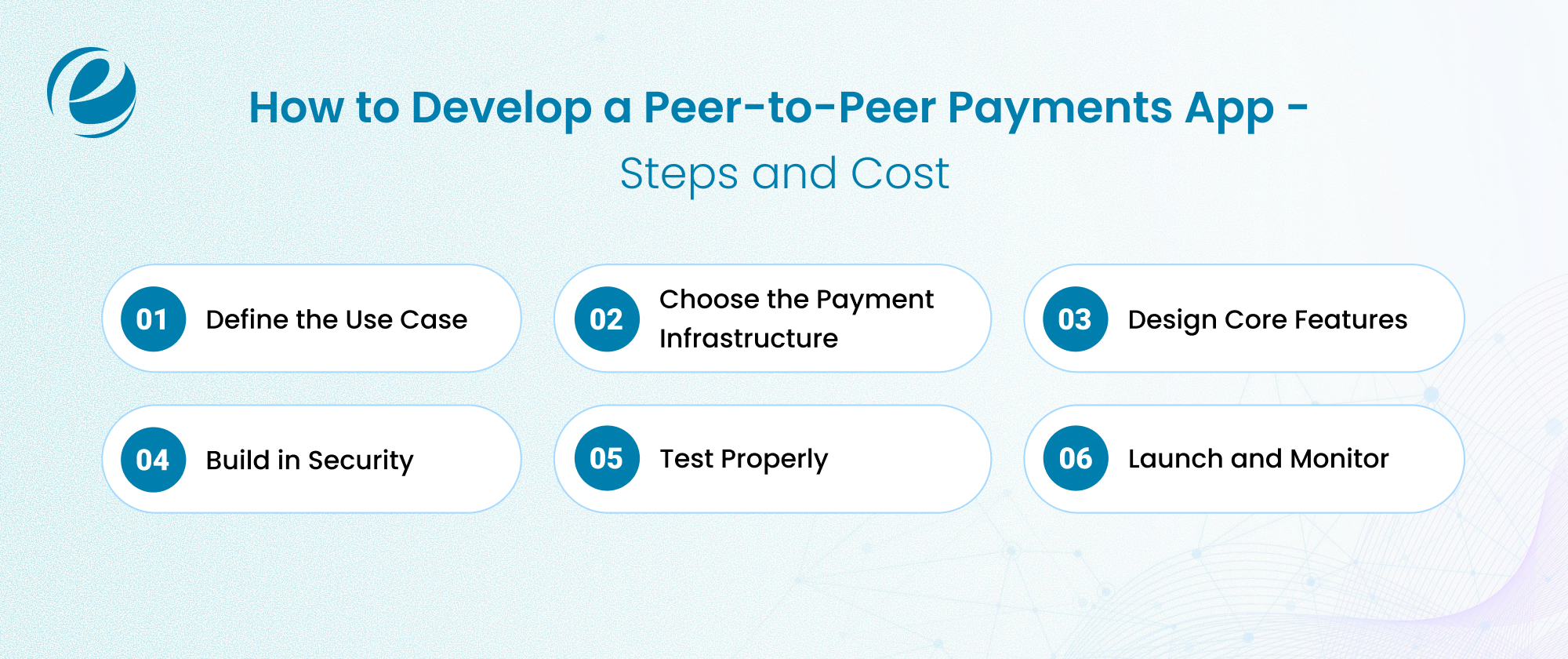
Building a peer-to-peer payments app takes a lot more than designing a money-transfer screen. Here’s a realistic breakdown of what the process actually looks like:
1. Define the Use Case
Decide upfront whether the app runs domestically or across borders and pin down which regulations apply licenses, KYC/AML rules, and data protection laws all shift by region.
2. Choose the Payment Infrastructure
Most builds plug into an existing payment processor or banking-as-a-service provider instead of building rails from scratch, making the difference between a nine-month launch and a two-year one.
3. Design Core Features
At minimum: account verification, linked funding sources, transfer and request flows, transaction history, and push notifications. Bill-splitting and QR-code payments are common extras.
4. Build in Security
Encryption, tokenization, biometric authentication, and real-time fraud detection can’t be bolted on later; they belong in the architecture from the first sprint.
5. Test Properly
The payment apps demand comprehensive testing across edge cases, failed transactions, network interruptions, and concurrent transfers on top of the usual QA checklist for security assurance.
6. Launch and Monitor
After launch, watching success rates, fraud patterns, and drop-off points becomes an ongoing job, not a one-time box to check.
Estimated cost:
- Basic peer-to-peer payments app: $40,000–$80,000.
- Mid-complexity payments app: $80,000–$150,000.
- Enterprise-grade platforms: $200,000+
If you are stuck with choosing the suitable tech stack, then see the guide to fintech app development for the broader tech stack decisions involved.
Why Choose EmizenTech for Peer-to-Peer Payments App Development?

EmizenTech has built fintech and mobile products across payment, wallet, and banking use cases, giving our team real, hands-on experience with the compliance, security, and infrastructure decisions this kind of platform demands. Here’s what clients usually point to:
- Fintech-specific expertise: The direct experience with payment gateway integrations, KYC/AML workflows, and secure transaction architecture.
- End-to-end development: From scoping and compliance mapping through design, backend development, and post-launch support.
- Security-first engineering: The encryption, tokenization, and fraud detection built in from the start, not bolted on later.
- Scalable architecture: The apps are built to handle growing transaction volumes without the need of a costly rebuild later.
- Proven fintech software delivery: Our broader fintech software development services cover the range of products our team has delivered.
If you’re weighing development partners, it’s worth reviewing our general mobile app development capabilities to make sure you are giving your project into the right hands.
Conclusion
These apps have quietly gone from a simple convenience to the default way people move money, and 2026’s top players, Venmo, Cash App, Zelle, PayPal, Apple Cash, and the rest, each cover a different need, from bill-splitting to cross-border remittances. Choosing the right app depends on how and where you actually send money. For businesses eyeing this space, building a peer-to-peer payments app is a serious but achievable investment, especially with the right development partner handling compliance, security, and scale from the start.
FAQs
What is the best peer-to-peer payment app in 2026?
There's no single best answer. Zelle wins on free, instant bank transfers; Venmo wins on social splitting; PayPal wins on buyer protection; and Wise wins on low-cost international transfers. The best choice depends on how you plan to use it.
Are peer-to-peer payment apps free to use?
Most are free for standard transfers funded by a bank account or debit card. Fees typically show up only for instant transfers, credit card funding, or international transactions, and they vary by app and provider.
How much does it cost to build a peer-to-peer payments app?
A basic app typically runs $40,000–$80,000, while mid-complexity builds with added features land closer to $80,000–$150,000. Enterprise-grade platforms with custom integrations can climb past $200,000 depending on overall scope.
Can I send money internationally with a P2P app?
Yes, apps like PayPal, Wise, Revolut, and Remitly all support international transfers, though fees, exchange rates, and delivery times shift quite a bit depending on the destination country and provider.





 +1 (989) 535-9295
 info@emizentech.com
 emizentech


