 Add us as a preferred source on Google
 In the rapidly evolving retail landscape, pricing strategies and customer loyalty are being redefined, thanks to revolutionary advancements in point-of-sale (POS) software for retail. Once a fundamental tool for processing transactions, the POS system has evolved into a powerful tool that drives business decisions, enhances customer experiences, and streamlines operations. Retailers are leveraging these systems to integrate sales with core business functions, making them more than just cash registers.
Looking ahead, businesses that adapt to the latest POS retail software trends will not only meet consumer demands but also gain a competitive edge. From contactless payments to seamless omnichannel integration, these innovations are transforming how companies engage with their customers. Advanced analytics now empower data-driven decisions, while sustainability is rising as a key priority, aligning with consumer preferences for eco-friendly practices.
Staying ahead of POS trends is crucial for businesses to remain competitive. By adopting the latest technologies, companies can streamline their operations, enhance customer experiences, and make more informed decisions. This leads to enhanced efficiency, higher customer satisfaction, and stronger brand loyalty, ultimately boosting profitability and long-term success.
In this blog, we will explore the top POS software trends for 2025, revealing how they are revolutionizing retail operations and setting the stage for future growth.
Market Statistics for POS software for retail
In today’s fast-paced world, point-of-sale (POS) solutions play a central role in transactions for both businesses and consumers. The need for greater efficiency and seamless integration with other business operations will continue to drive demand for POS software across various sectors and geographic regions. Let’s take a look at key POS system market statistics to gain a better understanding of the market.
- The global point of sale market size was valued at $29.02 billion in 2023. This market is predicted to reach $110.22 billion by 2032. It is expected to exhibit an annual growth rate of 16.1% over the forecast period.
- The retail point-of-sale (POS) software market was estimated to be worth $5.66 billion in 2024. The market is projected to reach $9.87 billion by 2031, with an annual growth rate of 7.2% from 2024 to 2031.
- Approximately 15% of U.S. businesses utilize point-of-sale (POS) solutions that incorporate Artificial Intelligence (AI) capabilities. Additionally, 40% of U.S.-based companies plan to implement AI-based point-of-sale (POS) solutions within the following year.
- The market for AI in retail is expected to reach $13.07 billion by 2025 and is projected to increase to $53.74 billion by 2030.
- It is estimated that the U.S. point-of-sale market will expand significantly, reaching an estimated value of approximately $17.39 billion by 2032, driven by the increasing adoption of mobile and digital wallets. Point of Sale (POS) solutions are enhancing the user experience.
What is POS software for a retail shop?
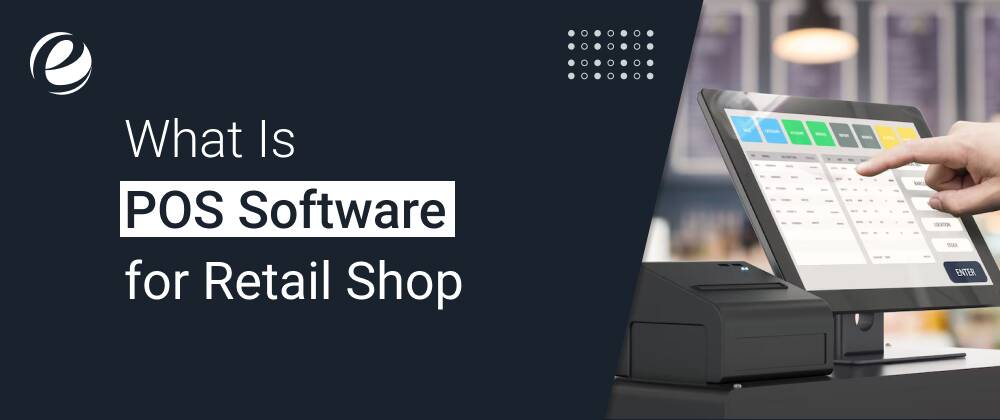
A point-of-sale (POS) system for a retail shop is a combination of software and hardware used to complete sales and manage daily store operations. It’s more than just a cash register; it helps process transactions, accepts various types of payments, and prints receipts. Modern POS software for retail shops offers a wide range of features that extend beyond sales, enabling shop owners to run their businesses more efficiently.
Today’s POS software can track inventory, manage customer information, run loyalty programs, and provide sales reports. Many systems are cloud-based, allowing you to access your store data from anywhere, at any time. Some POS solutions also integrate with other tools, such as customer relationship management (CRM) software, to provide a more personalized shopping experience.
With a reliable POS system, retail stores can streamline checkouts, minimize errors, and maintain a more accurate understanding of what’s selling. It can also help make smarter business decisions by showing what products are performing best, when the busiest times are, and how customers are shopping. Overall, point-of-sale (POS) software for retail is an essential tool for modern retailers seeking to enhance customer service, increase efficiency, and expand their business.
Top 10 POS Trends Impacting The Retail Industry
As most stores now utilize POS systems, it makes sense to continually expand their capabilities to enhance operations and deliver the best customer experience. Below are the top 10 retail software POS trends
1. Cloud-Based POS Systems
Cloud-based POS technology is changing how retail stores operate. Instead of being tied to one register or local server, these systems allow sales to happen from any location in the store. Store employees can assist customers by checking prices or completing sales at the counter using a tablet or a mobile cart. This flexibility improves customer service and reduces checkout lines.
Another major benefit is real-time access to sales data anytime. Managers can track performance, manage inventory, and make quick decisions even when away from the store. Since everything is stored in the cloud, there’s less risk of losing important data due to hardware failure.
These systems are easier to update and come with helpful tools such as customer tracking, loyalty programs, and advanced reporting. For retailers looking to expand or grow quickly, cloud-based POS software for retail
2. Contactless Transactions
Contactless payments are an essential feature for today’s businesses. These transactions use technologies like NFC (Near Field Communication) and QR codes, letting customers pay with a tap using their phone, smartwatch, or card. The process is fast, easy, and doesn’t require physical contact, something customers especially value after the pandemic. Most shoppers, especially younger ones, expect stores to offer this feature.
Services like Apple Pay, Google Pay, and Samsung Pay are becoming more common, and stores that accept them are seen as modern and up-to-date. Beyond retail, contactless payments are also used in restaurants and public transportation.
Stores benefit through faster checkout lines, higher customer satisfaction, and increased security. Contactless payments eliminate or reduce the need to carry or handle cash, which saves and lowers the risk of errors. This growing trend helps businesses offer safe and convenient shopping experiences.
3. Omnichannel Integration
Today’s shoppers have many ways to buy online, in-store, or on mobile. Omnichannel integration helps retailers connect these experiences into one smooth journey. For example, a shopper might look for a product online, try it in-store, and then buy it through the store’s app. Omnichannel POS systems make this possible by syncing inventory, sales, and customer info across all platforms. This makes it easier for customers to shop and helps businesses understand what shoppers want and how they buy. Features like shared shopping carts, inventory updates, and easy returns boost customer satisfaction.
Retailers can also use this valuable data to create targeted promotions and better manage stock. Trends like buy-online-pick-up-in-store (BOPIS) and app-only deals are growing because of this. While setting up these systems can be time-consuming and expensive, the payoff is worth it. Businesses that embrace omnichannel strategies stay ahead of competitors and build stronger customer loyalty.
4. Revolutionizing Retail Pricing Decisions With AI-Powered POS
One of the main ways POS technologies are changing retail is their ability to impact pricing decisions. Nowadays, with AI technology, POS devices can analyze huge amounts of live data to build dynamic pricing models that adjust based on current market conditions, customer preferences, and inventory levels.
The dynamic pricing strategy is an artificial intelligence-driven technique that lets businesses adjust prices instantly based on changes in demand, competitor prices, and inventory status. Software retail POS can now apply price adjustments in real time, ensuring goods are priced competitively while maximizing profits.
This flexibility allows retailers to stay agile in an ever-changing market. They can quickly respong to shifts in demand or supply and react to promotional campaigns from competitors. By using AI in pricing, retail stores can enhance their pricing strategies, improve inventory turnover, and boost profitability.
5. AI in POS Systems
Artificial Intelligence (AI) helps POS devices become smarter and more efficient for businesses. By 2025, many shops and restaurants will use AI to make better decisions, save time, and improve customer satisfaction. A major use of AI is in predictive analytics. AI studies past sales and trends to predict which products are likely to sell well. This helps businesses stock popular items and avoid running out or wasting inventory.
AI can also improve personalization. POS systems can suggest items to customers based on what they’ve bought before, making shopping more enjoyable and increasing sales. Another powerful tool is dynamic pricing AI, which changes prices based on product demand, stock levels, and competitor prices.
For business operations, AI helps with things like scheduling staff and managing supply chains. As AI in retail continues to evolve, POS systems may soon include voice commands, automated reports, and fraud alerts, making them even more efficient and useful.
6. Creating Customer Loyalty Through Enhanced Experience
AI and the latest POS retail software
POS platforms integrated with AI can analyze customer data immediately, allowing the retailer to customize the buying experience. By tracking purchases, browsing habits, and preferences, an AI-powered POS can recommend products customers are likely to buy. Personalization not only enhances the customer experience but also boosts sales by encouraging additional purchases.
7. Eco-Friendly POS Options
Today, more consumers are concerned about the planet and want to support businesses that are too. Retailers can use environmentally friendly POS solutions to show their commitment to sustainable practices. A simple method is to use digital receipts instead of printed ones, reducing paper usage. Many POS platforms now let customers receive receipts via SMS or email.
Some POS equipment is made from recycled or sustainable materials, helping reduce environmental impact. Eco-friendly features can help build customer loyalty, especially among younger or environmentally-conscious shoppers.
Additionally, going green can save money over time. Using less paper, ink, and waste means lower operating costs. As more customers seek out eco-friendly options, businesses that reduce their carbon footprint are more likely to stand out. Incorporating green POS solutions is a simple but powerful way to make a difference and keep customers happy.
8. Personalized Shopping Experience
POS software for retail is aiding retailers in providing customers with a personalised and pleasant shopping experience. Thanks to modern POS software, retailers can monitor purchases made by customers and offer products that match what customers like. The result is a more personalized shopping experience that can help increase sales. Loyalty programs are easier to manage using POS platforms that allow customers to receive discounts or reward points based on their purchase history.
A few stores make use of gamification, such as badges, points, or even surprise deals, to keep their customers engaged and returning. Another useful feature is dynamic pricing, which offers special discounts based on customer behavior or in-store traffic.
Each of these features makes customers feel appreciated and valued. The personalized shopping experience not only increases sales but also helps build stronger relationships with customers. Businesses that use their POS software to create these personalized moments are more likely to turn casual shoppers into loyal customers.
9. Enhanced Security Features
As more consumers use electronic transactions, keeping these transactions secure is more essential than ever. The latest POS platforms have more security options to protect customer data and help businesses stay safe. Two essential tools are encryption and tokenization.
Tokenization converts sensitive data into a secure code, so even if hackers access the data, they can’t use it. Encryption scrambles information so it can’t be read without a special key. These tools help prevent data theft and fraud, which can damage a company’s reputation.
Modern POS systems also help retailers comply with privacy laws and security regulations, such as GDPR and PCI compliance. Many systems now come with regular software updates and alerts to detect suspicious activity. As digital payments continue to grow quickly, having a secure system isn’t a luxury it’s a necessity. Retailers that invest in secure POS systems can protect their business, earn customer trust, and reduce the risk of costly issues.
10. Smarter Inventory Management
Maintaining inventory records manually can be very time-consuming and prone to mistakes. This is why many companies use POS software for retail that includes inventory management features. These systems update stock levels whenever a sale is made, so managers always know what inventory is available.
This helps prevent problems like running out of popular products or over-ordering items that aren’t selling. For small businesses, this is especially helpful as it saves time and improves inventory control. The systems can even send alerts when stock is low or predict what to reorder based on past sales. By using these advanced tools, businesses can reduce lost profits, minimize waste, and operate more efficiently.
Top Things To Consider in Retail POS Software
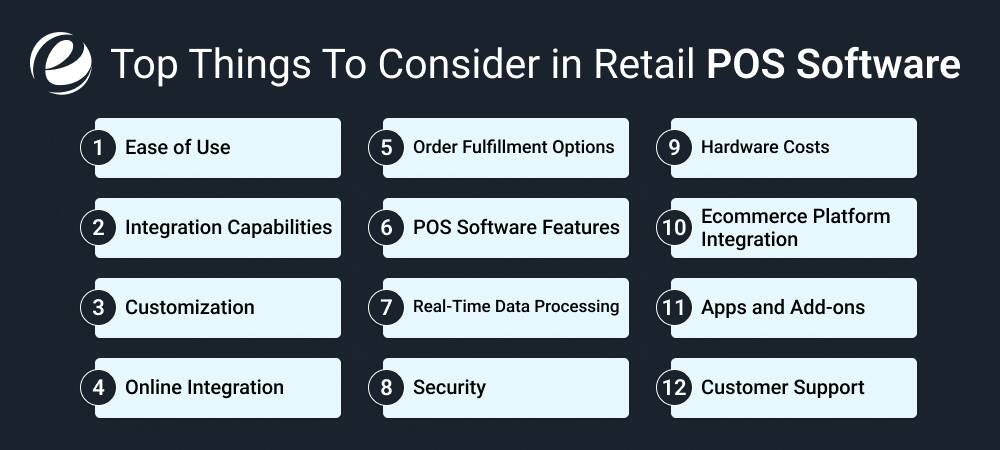
Selecting the best retail POS software is essential to the success and efficiency of your company. There are a few things you should consider when choosing the right POS system to meet your needs.
1. Ease of Use
The POS software for retail
Choose a provider that offers excellent customer support, including 24/7 live chat and phone assistance. Fast and responsive support can help you resolve issues quickly, reducing downtime.
2. Integration Capabilities
Ensure that the POS software is fully compatible with your other business tools, such as accounting software (e.g., QuickBooks), CRM systems, and e-commerce platforms (e.g., Shopify). This reduces the need for manual data entry and streamlines operations.
Make sure the system works with your existing equipment or identify if new hardware is needed. Confirm that it supports essential peripherals like barcode scanners, receipt printers, and cash drawers.
3. Customization
Every retail store is unique, so your POS software for retail should be easy to customize. You should be able to adjust menus, add features, set user roles, and modify reports. This allows the system to align with your company’s workflow and branding.
A customizable system helps employees work faster and more efficiently. It also enables your team to perform better. Flexible POS software grows with your business and enhances your customers’ shopping experience.
4. Online Integration
Modern retail POS software should be able to connect to an eCommerce retail store. This allows you to control the online and in-store sales through one system. The inventory is kept in sync to ensure that you don’t oversell or have to replenish your stock unexpectedly.
Customers enjoy a smooth and uniform shopping experience regardless of whether they purchase online or in person. All of your purchases are in one spot, which makes it easier to manage your time, decreases the chance of errors, and can help your company increase its reach across different platforms.
5. Order Fulfillment Options
The retail POS system should support flexible order fulfillment options, including in-store pickup, local delivery, and shipping. This helps meet customer needs wherever they choose to shop. It’s essential that the system clearly tracks the status of every order from purchase to delivery.
Simple order management saves time, prevents confusion, and improves the customer experience. The more fulfillment options you offer, the more competitive and efficient your business becomes.
6. POS Software Features
Find the POS system with the capabilities you want, like sales monitoring, discount tracking, loyalty programs, and management of inventory. Certain POS platforms offer options for analytics, marketing, and management of multiple stores.
Take note of the features that are most important to your company and how they can assist you in expanding your business. Certain features will simplify your daily work and allow you to serve your clients better.
7. Real-Time Data Processing
Utilizing the cloud-based POS system provides real-time information on inventory, sales and customer details. That means you can always access the relevant information at the correct moment to make informed decisions.
It is possible to see what’s in demand and track the performance of your store and quickly react to any change. Synchronizing data in real-time across all devices assists teams to stay in the same place and eliminates errors caused by inaccurate or inaccessible information.
8. Security
Security is an essential aspect in every POS system. Your business should be protected from theft of data, fraud as well as unauthorized access. Consider features such as security logins for users, user permissions as well as encryption and automated update.
These tool help to keep customers’ details secure, and offer security. Secure POS can also help you comply with the legal requirements and prevent expensive problems that can hurt your company or damage its brand.
9. Hardware Costs
Before choosing a POS system, make sure you understand what hardware it requires, such as registers, printers, barcode scanners, and tablets. Some systems are only compatible with specific devices, which can increase costs.
Be sure to know whether the hardware is included or if you need to purchase it separately. A reliable POS software for retail
10. E-commerce Platform Integration
Select a POS system that integrates seamlessly with your eCommerce platform, such as Shopify, WooCommerce, or BigCommerce. This integration allows you to track your product listings, inventory, and customer information across both online and offline channels.
It enables you to manage your business from one central location. With seamless connectivity, this reduces the need for manual effort, eliminates errors, and provides customers with a consistent shopping experience across all platforms.
11. Apps and Add-ons
A flexible POS should support mobile retail apps and other add-ons to enhance its capabilities. These can assist with email marketing, financial tracking, delivery management, accounting, and loyalty points. Some apps are free, while others come at a premium price.
Connecting essential add-ons allows the system to grow alongside your business. Choose a POS system that includes an app store or marketplace, enabling you to customize the setup according to your needs.
12. Customer Support
A strong support system is crucial for resolving issues quickly. The POS service provider should offer 24/7 assistance via chat, phone, or email. Look for helpful training resources, such as videos or a reference library.
An experienced support team will ensure that any issues won’t hinder your business operations. Choose a company known for its reliable and friendly customer service so you can always get help whenever you need it.
Key features of a POS Retail Software
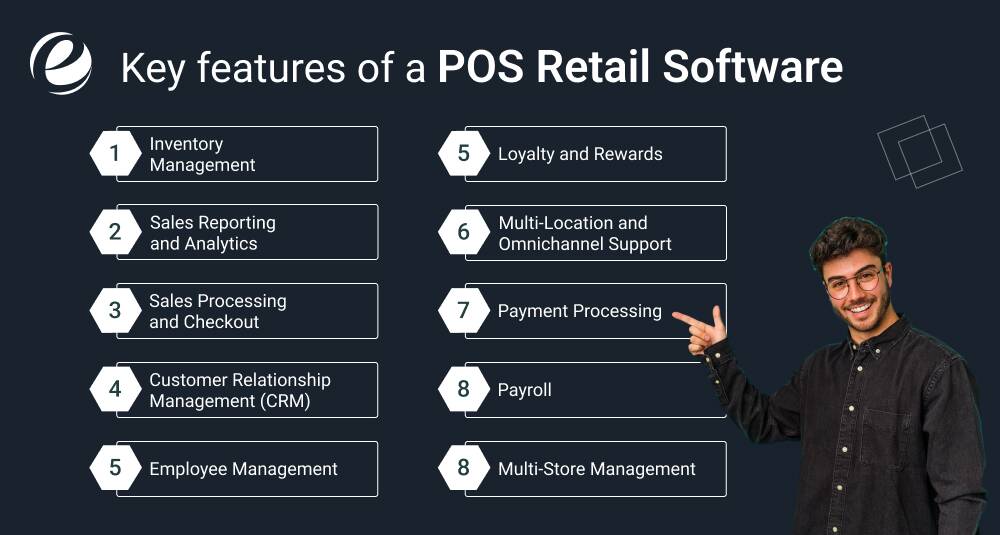
A POS system goes beyond simply being a device to ring up sales. Its features can streamline operations, reduce mistakes, and provide insights to improve your business. Here are the top features that every retail store should consider:
1. Inventory Management
Manually managing stock isn’t easy and can lead to errors. The POS system tracks inventory in real-time, ensuring you don’t lose revenue. It sends alerts when items are out of stock and allows bulk uploads to quickly update inventory lists. This feature helps save time and keeps the inventory up-to-date, which is especially useful for businesses that sell a wide range of products.
2. Sales Reporting and Analytics
Retail POS software provides detailed reports that help you understand which items are selling, when, and why. You can track bestsellers, slow-moving products, and peak sales times. This information allows you to plan inventory more effectively, adjust prices, and run smarter promotions. With the right insights, you can grow your business faster and eliminate uncertainties.
3. Sales Processing and Checkout
Quick and easy checkouts will keep customers satisfied. Efficient POS software scans items quickly, instantly calculates totals, and completes payments in just two steps. This reduces wait times and minimizes the chance of errors. Whether it’s cash, credit card, or even digital payments, your POS will handle them all seamlessly.
4. Customer Relationship Management (CRM)
CRM tools within the POS help build long-lasting relationships with your customers. Track what your customers buy, when, and how often. Use this information to offer incentives, discount coupons, or personalized offers. An integrated CRM POS enhances customer satisfaction by making each customer feel appreciated and valued.
5. Employee Management
With built-in employee management tools, your POS system helps you manage employees effectively. Employees can log in and out via the system. Access levels can be assigned based on roles, ensuring that only authorized team members can view sensitive data. The software also tracks sales performance, allowing you to identify top performers and provide support when necessary.
6. Loyalty and Rewards
Rewards programs that are integrated into POS systems ensure that customers are engaged for a long time after they have made a purchase. The system can design custom reward plans using your customer’s purchases and the payment history that are stored within the system. Although some POS software systems offer this feature, many permit integration with loyalty platforms from third parties to provide these benefits to increase the retention of customers.
7. Multi-Location and Omnichannel Support
If you manage more than one shop or offer online sales, your POS will need to sync all data in real-time. If it’s inventory, or customer information, the latest updates must be visible throughout all locations. This helps ensure smooth operation and prevents mismatches in stock, making it easier to manage physical retail stores as well as online sales using one platform.
8. Payment Processing
POS Systems can handle a variety of payment options, including cash, credit card, online or via remote. Certain businesses require only the convenience of a store-based checkout. Others require electronic invoices or web-based payments integration. Flexible POS software for retail allows you to accept payment wherever your customers are located, which ensures seamless transactions, whether selling either in person or online.
9. Payroll
When you have payroll integrated with your POS system, it is easier to regulate employee payments. Payroll reports are created automatically in the system, based upon attendance and performance related data points collected within the system. It also calculates taxes and generates reports, thus, it saves time, ensuring precision. The feature is helpful for the companies having a lot of employees to minimize errors and admin work.
10. Multi-Store Management
In the case of businesses that have multiple sites, a multi-store administration option lets you manage every aspect of your store from the same screen. It allows you to track inventory as well as consolidate purchase histories of your customers and move stock across locations. Additionally, the system provides unidirectional reports and analytics that aid you in making educated decisions throughout all locations, enhancing general efficiency.
Why Emizentech is the Right Choice for Retail POS Development
At EmizenTech, we specialize in creating innovative POS solutions tailored for retail businesses. Our team has years of experience in POS software development, ensuring we understand your unique needs and long-term goals. We offer customized solutions, whether you need new POS software for retail built from the ground up or want to enhance your existing setup with advanced features like AI-powered inventory management, sales analytics, or real-time data tracking.
Over the years, as an e-commerce development company we’ve helped retailers streamline their operations by integrating automated stock control and predictive sales forecasting into their POS systems. Our goal is to provide you with the most efficient, scalable solution that will improve your business performance and customer experience. Whatever your retail needs, EmizenTech is here to help.
Schedule a free consultation today and share your retail POS software development requirements with us.
Challenges of Implementing POS software for Retail
Using a POS (Point of Sale) system in a store can really help improve how things run, but it comes with some challenges. Here are the main challenges and their solutions:
High Initial Cost
Challenge: Setting up a POS system can be expensive, especially for small businesses, with costs for hardware, software, and installation.
Solution: Look for payment plans or cheaper, cloud-based POS systems. Start with basic features and upgrade later to manage costs.
System Integration
Challenge: Connecting the new POS system to your current systems (like inventory or accounting) can be tricky and cause problems.
Solution: Choose a POS system that easily connects with your other tools. Get help from IT professionals to make sure everything works smoothly.
Data Security
Challenge: POS systems handle sensitive customer and payment information, which could be at risk of being hacked or stolen.
Solution: Use encryption and strong security features to protect data. Keep security updates regular and follow industry rules to keep customer trust and avoid problems.
Lack of Troubleshooting Help
Challenge: Technical problems with the POS system can cause delays and annoy customers, especially if there is no quick help.
Solution: Pick a POS provider with 24/7 support or have an IT team ready to fix issues fast, reducing downtime and keeping customers happy.
Training Employees
Challenge: Employees may find it hard to learn how to use the new POS system, which can slow down work and lead to mistakes.
Solution: Provide easy training, step-by-step guides, and ongoing support to help employees get comfortable with the system and improve over time.
Wrapping up
The role of retail POS system software
While challenges exist, retailers who embrace these advancements and plan their implementation carefully will be well-positioned for growth. Key trends, such as contactless payments, omnichannel integration, advanced analytics, sustainability, and AI-powered solutions, are reshaping the industry. Adopting these technologies is essential not just for keeping up with change but for driving business growth, efficiency, and customer loyalty.
FAQs
What are the advantages of using the retail POS software?
Retail POS software improves efficiency, controls the inventory, monitors the sales, records customer information, and minimizes errors made by humans. It streamlines checkouts, improves business operations, and enhances the customer's overall experience.
Can I integrate retail POS software with other business systems?
Yes, a lot of POS platforms can be integrated with additional software like accounting software, inventory management systems, and e-commerce platforms for a better flow of operations.
What is the cost of developing custom POS retail software?
The cost of developing custom POS retail software can vary greatly depending on factors like features, complexity, and the development team's location. On average, it can range from $10,000 to $100,000+ or more.
Can retail POS software can be used on mobile devices?
Most POS platforms are cloud-based and are compatible with tablets or smartphones. This allows employees and the owner to oversee the business from any location.



 +1 (989) 535-9295
 info@emizentech.com
 emizentech


