 Add us as a preferred source on Google
Are you wondering how modern warehouses keep everything organized, speedy, and efficient? Warehouse management software (WMS) is the answer to your question. WMS is a game-changing technology that enhances the way businesses manage their inventory, their orders, and their shipments. Along with the expedited change in how consumers behave in the marketplace, having a robust warehouse management system software is critical for any business that needs to be competitive and meet increased demand from customers.
From traditional warehouse inventory management software to more advanced artificial intelligence warehouse management software, WMS has come a long way, providing smarter automation capabilities, enhanced real-time tracking, and easier reporting and analytics.
This fully comprehensive guide will cover everything you need to know about warehouse management systems and inventory management software, the benefits of management systems and software, the types and features of warehouse management systems, and how AI in warehouse management is changing industries. Whether you are managing a small warehouse or a larger-scale distribution center, learning about warehouse management systems is potentially advantageous for business operations and overall success.
Let’s start with some amazing market stats!
Global Warehouse Management Software Market Size & Forecast 2025 to 2030
According to Grand View Research, the global warehouse management software market is flourishing with a projected value of approximately $8.38 billion by 2030, with a CAGR from 2025 – 2030 of 19.9%. The demand is being pushed by the increased market for warehouse inventory management software in e-commerce, manufacturing, and healthcare.
The largest growth in the market is driven by cloud-based warehouse management system software as private companies engage migration strategies that stretch across multiple platforms and channels, and yield some of their control on the premises of cloud systems to cloud software providers as the cost-rationalization decision relative to cloud service scales.
According to Markets and Markets, the warehouse management systems market was worth $4.02 billion in 2024 and is predicted to be worth $8.56 billion in 2029, at a CAGR of 16.3%. The increase of the WMS in the market is a result of the additional automation, increased instantaneous decision-making, and workflow opportunities available by the combination of Artificial Intelligence warehouse management software, IoT, and robotics, all of which can drive down costs, improve accuracy, and increase the speed of operations that can be appreciated by warehouses globally.
What is a Warehouse Management System?
A warehouse management system (WMS) is a type of warehouse management software that can help a business be more organized and efficient when it comes to managing things in the warehouse. Not just for receiving and storing goods, warehouse management consists of managing everything related to picking or shipping an order!
With warehouse management system software, a business generally has a live view of its inventory, can reduce errors and costs, and speed up the daily tasks it has to complete. This warehouse inventory management software makes it easier to identify exactly what an organization has in stock, as well as which location it is stored in, and keeps the overall accuracy of that inventory and productivity high.
In recent years, artificial intelligence warehouse management software has gained popularity. AI solutions, otherwise known as AI warehouse management, utilize smart technology to automate tasks, utilize space, and forecast inventory demand. AI in warehouse management helps organizations save time and money while helping with their decisions.
Many organizations will approach a software development company to develop a custom warehouse management system. Whether an organization needs to utilize new software development trends or wants to improve its overall process of working in a warehouse, warehouse management software is an essential part of managing how a warehouse operates and getting it to run efficiently.
How Does a WMS Work?
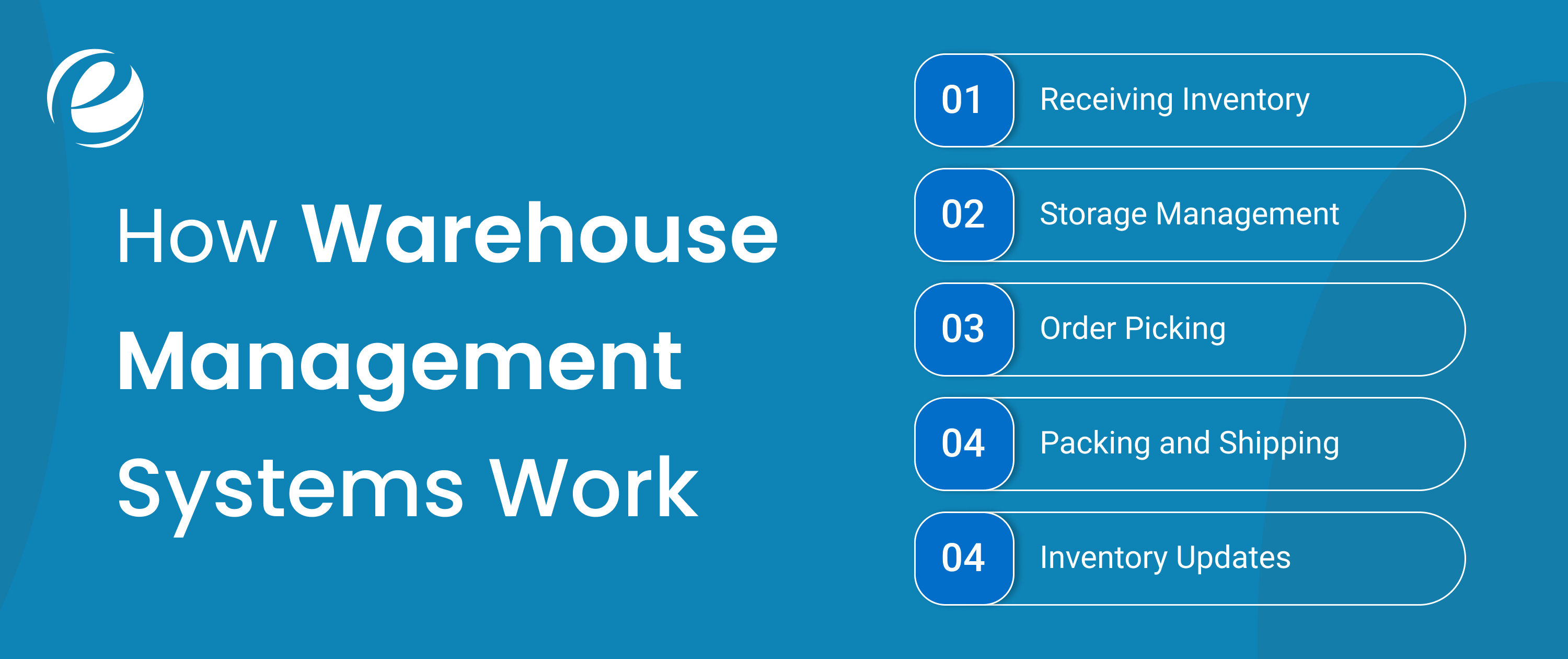
A warehouse management system (WMS) is a software package that streamlines and automates all facets of a warehouse operation. WMS software is used to track inventory, manage stock locations, and direct order fulfillment quickly and accurately. New technology, such as artificial intelligence warehouse management software, allows these systems to improve business efficiency and decrease errors in warehouse management systems.
Receiving Inventory
Once the items arrive at the warehouse, the warehouse inventory management software will receive goods into the warehouse and reconcile items against the purchase order. This stage is crucial in order to have accurate stock levels at the start of the process.
Storage Management
Once everything is reconciled, the WMS controls directions on where to put the products away, maximizing available space and ease of access. New technology, such as AI in warehouse management systems, now enables the storage strategy to be intelligent when assigning where stocks are to be put away.
Order Picking
When a customer order has been received, warehouse management systems will direct operatives to the exact location of all items within the warehouse system. The result is a quick picking process whilst reducing errors in handling.
Packing and Shipping
WMS will monitor the packing and shipping of goods, ensuring the correct items are dispatched to the customer.
Inventory Updates
The inventory records are updated continuously, while the warehouse management software constantly operates in a real-time environment, allowing businesses to have a clear picture of stock levels.
Key Benefits of Warehouse Management Systems
Well, warehouse management systems have become essential tools for any business aspiring to improve or enhance its warehouse operations. Warehouse management systems assist in improving accuracy, eliminating operational costs, and enhancing workflows. Now, much further into the future, AI warehouse management software carries out the harder tasks, helping decision-making and raising the supply chain’s efficiency.
Here are 5 major profits of WMS software:
1. Improved Inventory Accuracy
Warehouse management software provides for real-time updates so that businesses may never lose track of the stock in-store, decreasing errors and controls against being out of stock or in excess.
2. Increased Operational Efficiency
AI integrated with warehouse management can automate repetitive tasks and help optimize storage, which enables your warehouse to run smoothly and will ultimately speed up all processes.
3. Better Order Fulfillment
A warehouse management system software will streamline your picking, packing, and shipping process so you can fulfill orders faster and more accurately, which results in satisfied customers.
4. Cost Savings
A warehouse management system will reduce operational costs by allowing accurate picking, packing, and shipping, reducing labor, and optimizing resource usage.
5. Real-Time Data and Analytics
Artificial intelligence warehouse management software will offer real-time visibility and analytics that will enable better decisions to be made and greater oversight and control.
Types of Warehouse Management Systems
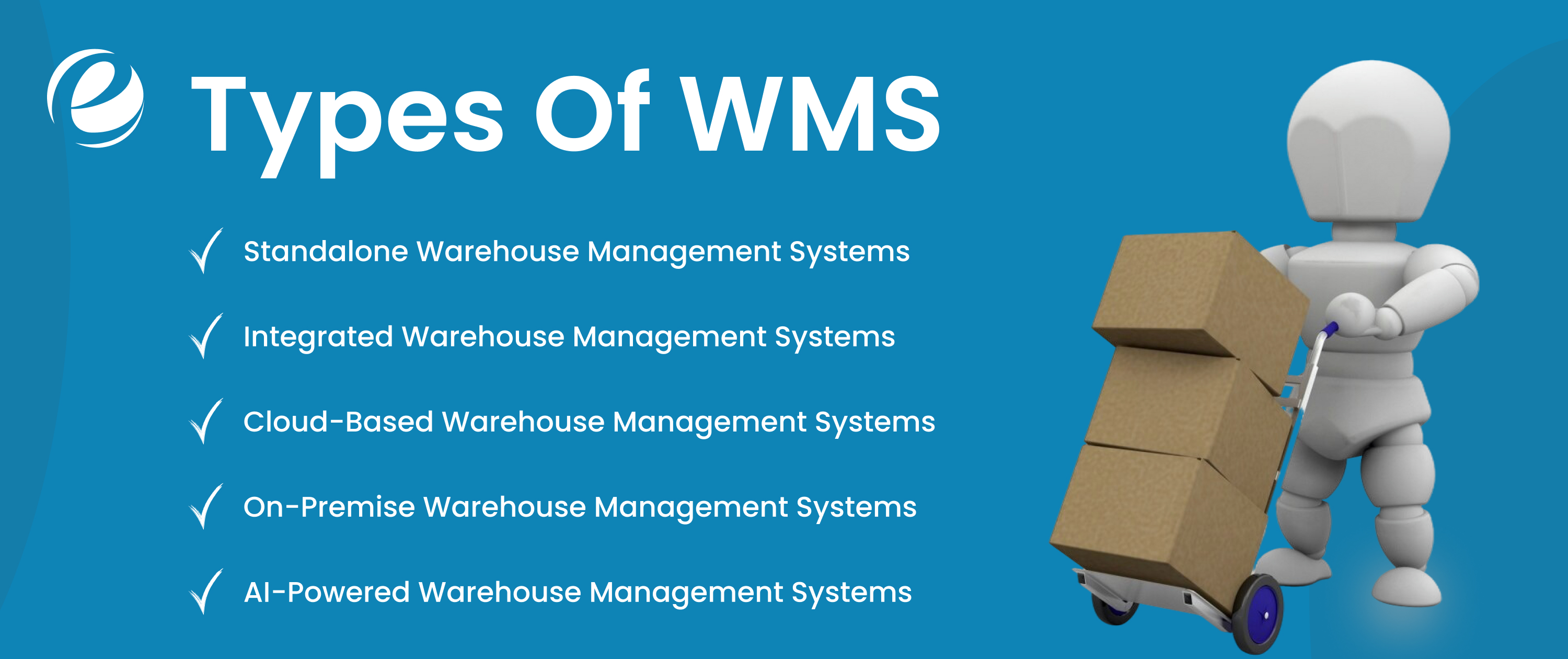
There are many varieties of warehouse management systems designed to serve different warehouse and business needs. By using the best warehouse management software to suit your specific needs, a warehouse can operate in a much more efficient manner by improving inventory tracking and accuracy, order management, and optimizing warehouse storage space.
Recent days have seen reports that artificial intelligence warehouse management software offers numerous intelligent features and possible automation that attach to a warehouse management system, continuing to enhance and improve the process.
Here are 5 of the more common types of warehouse management systems:
Standalone Warehouse Management Systems
Standalone WMS is a basic warehouse management system software that only offers basic inventory and order management. They are best used by small businesses needing simple warehouse inventory management software.
Integrated Warehouse Management Systems
These WMS solutions fully integrate with other software/solutions such as ERP or CRM suites, offering the ability to have a holistic view of business operations and share data across departments for intelligent decision making.
Cloud-Based Warehouse Management Systems
Cloud warehouse management system software is hosted on the internet, generally referred to as software as a service (SaaS), therefore offering more scalability with easy access from any location. Many organizations are adopting cloud-based systems due to the ease of scaling, with a small upfront cost.
On-Premise Warehouse Management Systems
On-premise WMS is similar to cloud-based, but all of the software is installed locally in the company’s infrastructure. While this offers more customization and control, it offers more maintenance and upkeep; therefore, this is preferred by many businesses that have more stringent corporate data security.
AI-Powered Warehouse Management Systems
Utilizing warehousing management software that incorporates artificial intelligence, these sophisticated systems utilize automated tasks and workflows to predict stock needs and streamline the entire process, creating efficiencies.
Features of an Effective Warehouse Management System
An effective warehouse management system is critical to smooth and precise functions in a warehouse. Deploying effective warehouse management software helps your business sustain full control of inventory while increasing the accuracy of orders, enhancing your efficiency. The artificial intelligence warehouse management software broader capabilities bring together smarter features and capabilities to warehouses with warehouse management software.
5 key features of an effective warehouse management system software:
Real-Time Inventory Tracking
This feature provides visibility to available stock instantly to decrease errors and confirm products are available when needed. Warehouse inventory management systems provide guidance for keeping records up to date to decrease errors and maintain efficiencies.
Barcode and RFID Scanning
An efficient WMS will make use of bar code or RFID technology to improve data capture performance and decrease data entry errors. The benefit of artificial intelligence in warehouse management adds efficiency to your scanning capability, improving speed and accuracy.
Order Management Automation
Automation of the order processing operation will lead to the fastest and most accurate fulfillment. A warehouse management system can help you better manage, pick, pack, ship, and hold items in a warehouse efficiently.
Reporting and Analytics
An effective warehouse management software will have functions of reporting and analytics attached to it, thus giving businesses the power to work with the data in order to make more efficient decisions, not only in cost but also in the furtherance of warehouse efficiency.
Integration Capabilities
Particularly, a WMS that is good will be such a system that can be integrated into other business software, thus allowing for data exchange between the two systems, which, consequently, leads to better coordination of business processes. A mobile app development company that has been brought in to do the job can make some adjustments to personalize those integrations, making them more compatible with your business.
Top 10 Warehouse Management Softwares
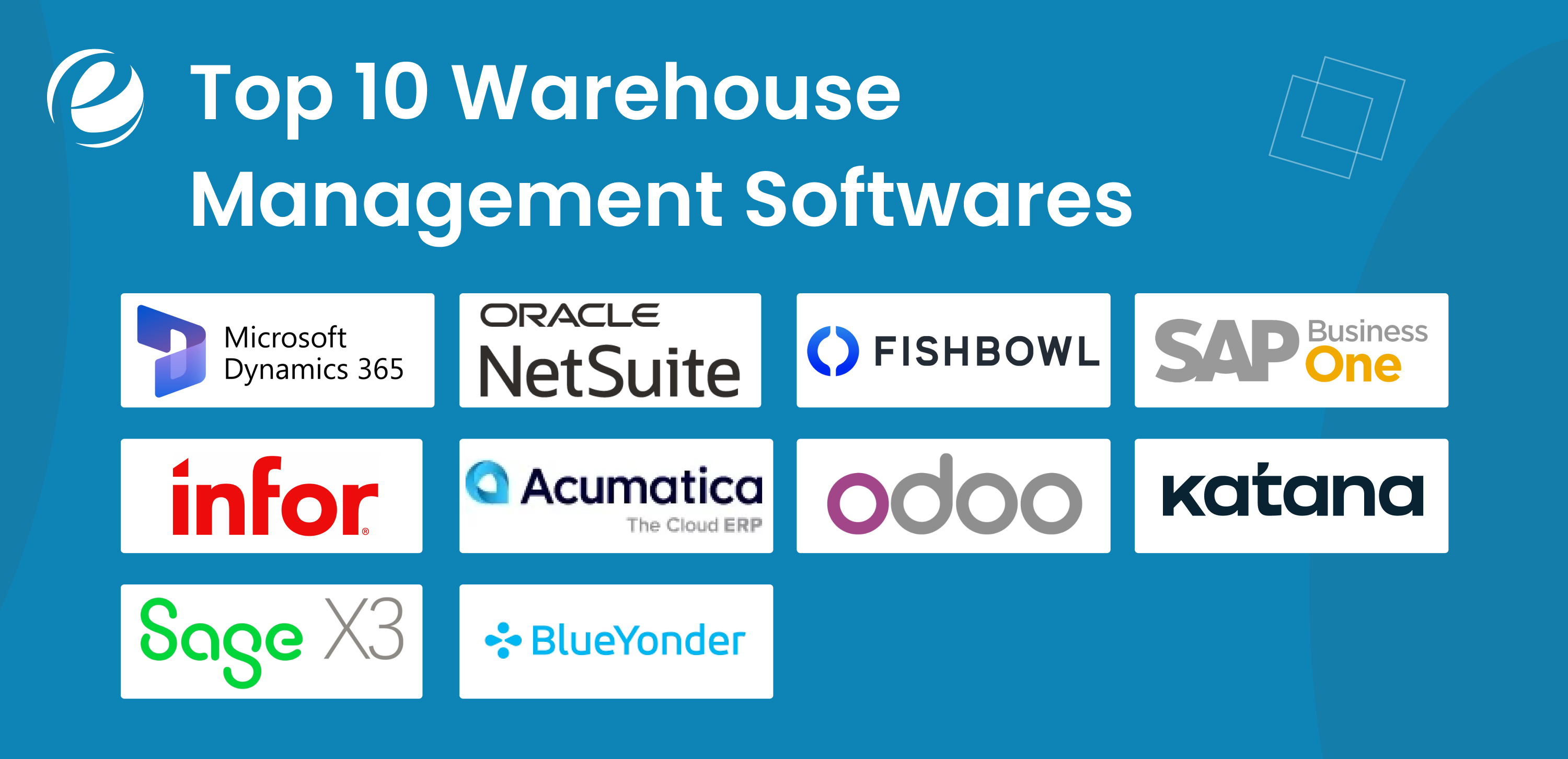
The best warehouse management software solutions that make businesses’ warehouse operations not only easy but also accurate in inventory processes and overall efficiency increase are at the top of the list. By harnessing the power of a top-tier warehouse management platform, businesses can realize the benefits of tracking inventory in real-time, automating order fulfillment, and utilizing their space to the fullest extent.
AI (Artificial Intelligence) has been a leading factor behind the success of warehouse management software as it has been able to enhance general warehousing processes through the introduction of smarter automation and predictive analytics, which have, in turn, led to the creation of WMS as a powerful tool for modern businesses.
| Software | Launched Year | App Size (Approx.) | Platform Availability | Key Features |
| Microsoft Dynamics 365 | 2016 | Varies | Cloud, Windows | Real-time tracking, supply chain integration, scalable |
| SAP Business One | 2002 | Varies | Cloud, On-premise | Inventory tracking, reporting, logistics management |
| Oracle NetSuite | 1998 | Varies | Cloud | Multi-warehouse support, analytics, workflow automation |
| Infor WMS | 2002 | Varies | Cloud, On-premise | 3D warehouse visualization, labor optimization, AI-driven |
| Fishbowl Inventory | 2001 | ~200 MB | Windows, Cloud | Multi-warehouse support, inventory & order automation |
| Acumatica WMS | 2008 | Varies | Cloud, Mobile | Real-time tracking, ERP integration, scalable |
| Odoo | 2005 | ~100 MB | Cloud, On-premise, Mobile | Modular ERP, inventory & order processing |
| Katana | 2017 | Varies | Cloud, Web-based | eCommerce integration, real-time tracking |
| Sage X3 | 2000 | Varies | Cloud, On-premise | Real-time inventory, ERP integration, extensive control |
| Blue Yonder WMS | 1985 | Varies | Cloud, On-premise | AI automation, demand forecasting, labor management |
Here are the 10 most commonly used warehouse management systems by businesses:
1. Microsoft Dynamics 365
Whether your business needs advanced or simpler operations, Dynamics 365 can prove to be a flexible, complete warehouse management system software designed for both supply chain operations and financial operations. This warehouse management system is structured to meet your business’s needs using a variety of methods, which makes it the top choice for distribution businesses because of its ability to provide real-time tracking.
2. SAP Business One
For the small or medium-sized business, SAP Business One is a scalable warehouse inventory management software that is known for its advanced features. Although the data complexity can become unwieldy with larger account sizes, Business One’s idea is to give you real-time inventory management and sophisticated reporting that can cater to your complex logistics needs.
3. Oracle NetSuite
This warehouse management software is a cloud-based solution that allows for scalability and advanced analytic capabilities. NetSuite allows users to support multi-warehouse operations and includes advanced workflow automation grants across enterprise business solutions.
4. Infor WMS
Infor WMS is best designed for complex logistics arrangements. They offer real-time inventory management and 3D warehouse visualization using labour optimization tools. WMS is a method to support AI within warehouse management. WMS uses AI to improve operational efficiencies and predictive capabilities to improve operations within any warehouse.
5. Fishbowl Inventory
Fishbowl is a user-friendly warehouse management system software suitable for small to medium-sized businesses. Fishbowl supports multiple warehouses and automates inventory control and order fulfillment by streamlining operational efficiencies.
6. Acumatica WMS
Acumatica has sophisticated solutions for real-time tracking and easy integration with other business applications to allow growing companies to achieve operational excellence. It features flexible and scalable software.
7. Odoo
Odoo is a modular ERP solution with an integrated warehouse management system software component that can facilitate inventory management and order processing and can be tailored to an organization’s specific needs.
8. Katana
Katana is a warehouse inventory management software that allows integration with the world of eCommerce, offering real-time tracking and multi-warehouse features to help optimize the way online sellers operate.
9. Sage X3
Sage includes warehouse management features to manage complex warehouse operations, real-time inventory updates, and a comprehensive integrated solution with ERP that works well for midsize and larger companies.
10. Blue Yonder (formerly JDA) WMS
An advanced warehouse management system using AI warehouse management technology for intelligent automation, demand forecasting, and labor management, that helps elevate the performance of the entire supply chain.
How to Select the Right Warehouse Management System?
Choosing the most appropriate measures to implement warehouse systems directly affects warehouse stability and inventory precision. First, consider your business offerings specifically and the functions you expect from warehouse management software. Look for functionality that can support real-time inventory tracking, order automation, and software solution integration. In contemporary terms, warehouse management systems that leverage artificial intelligence can deliver intelligent automation and predictive elements that improve operations.
Consider your software options by determining how precisely the software reflects your workflow, its ability to scale, and its simple operation. Alternatively, many companies use delivery or architecture software development companies in strategic partnerships, giving us the potential to customize systems using the latest software development trends, aligning systems around your specific needs. Selecting the right Warehouse Management Systems Software will guarantee optimized warehouse operations, reduce risks, and give you more control, while at the same time ensuring long-term growth.
Final Words
Warehouse management software is an absolute requirement for businesses attempting to simplify warehouse operations and obtain higher levels of inventory accuracy. Advanced warehouse management system software allows businesses to automate their operations, lessen mistakes, and increase productivity. Artificial intelligence warehouse management software will increase productivity to a greater degree, taking into consideration smarter automation, predictive analytics, and better decision-making. With the right warehouse management software, a company will achieve a smooth workflow and higher customer satisfaction.
Today, the right selection and implementation of a warehouse management system software has become a necessity for keeping a business commercially viable. Most companies which are providing on demand app development services offer the best results, so partner with such software development companies in order to customize their WMS to suit the specific needs, following the latest trends of software development. What matters is whether it’s a little warehouse or a vast distribution center; AI-based warehouse management and warehouse inventory management software are used for operational excellence, cost reduction, and long-term success.

FAQ’s
What is an example of a warehouse management system?
Microsoft Dynamics 365 is an example of a warehouse management system, but it also offers real-time inventory control and supply-chain integration features.
What are the three main components of a warehouse management system?
The basic features of a warehouse management system are inventory management, order fulfillment, and shipping management. The three features are in concert tracking stock, processing orders, and handling shipments efficiently.
What is the main purpose of a warehouse management system?
The goals are to improve inventory control, efficiently run the warehouse, and ensure correct order fulfillment within the warehouse.
How does AI improve warehouse management systems?
It improves the warehouse management system by providing general AI warehouse management software that increases the efficiency of mundane task automation, optimizes storage, forecasts inventory requirements, and provides insights for decision-making.





 +1 (989) 535-9295
 info@emizentech.com
 emizentech


