
 Add us as a preferred source on Google
Are you still operating with Excel spreadsheets and paper-based logs when it comes to equipment maintenance? With fast-moving industrial paradigms, CMMS is not considered as an option but an absolute necessity.
What is CMMS? It is a software application that assures the maintenance activities are done from work order management, asset tracking, and preventive scheduling. Industries of today use computerized maintenance management systems to keep downtime in check, to extend the lifespan of assets, and to ensure compliance.
CMMS software is quickly finding favor the world over because it replaces working practices fraught with human error with automated, data-driven workflows that guarantee higher productivity at lower cost.
By virtue of real-time information and mobile capabilities, CMMS is making organizations very different in terms of asset management, with types like productivity improvements and predictive maintenance. Let’s find out why the adoption of CMMS maintenance is a strategic move for any asset-intensive business toward operational excellence.
CMMS Market Statistics 2025–2030
- According to Grand View Research, Global study of the computerized maintenance management system software market during the period 2024-2030 reveals an opening price of much under USD 1.29 billion and an anticipated cost of USD 2.41 billion in 2030, with the market to register a CAGR of 11.1% from 2025 to 2030.
- However, Future Market Insights predicts that the market will gain significant traction, increasing from USD 2.19 billion in 2025 to USD 5.37 billion by 2035, at a CAGR of nearly 10.4%.
- Cloud CMMS benefits enterprises and is forecast to grow at a 11.8% CAGR owing to factors such as remote access demand, real-time monitoring, and lower IT overheads.
- Manufacturing is the largest sector, to have 22.4% of revenue in 2024, where agencies use CMMS for predictive maintenance and compliance.
- In contrast, Asia-Pacific is expected to register the highest CAGR of 12.3%, as industrial digitalization through China, Japan, and India is a priority under initiatives such as “Make in India” and “Made in China 2025.”
What is Computerized Maintenance Management System?
A Computerized Maintenance Management System (CMMS) works as a software platform that centralizes and streamlines maintenance operations through digitized work orders, asset records, and schedules of preventive maintenance. This provides the entire organization with a single maintenance-related data truth, which opens up the ability to change from reactive repairs to predictive and evidence-based maintenance.
CMMS (Computerized Maintenance Management System)
CMMS refers to a digital solution that helps organizations manage, track, and optimize maintenance activities across their physical assets of machinery, vehicles, and infrastructure. Essentially, it is a centralized database in which a maintenance team can enter work orders, track asset performance, and schedule preventive maintenance. An old manual system, such as paper logs, was prone to human error and had little transparency.
What is CMMS in maintenance?
What is CMMS in maintenance context emphasizes the shift from reactive maintenance to asset reliability and conformance with safety standards. Advanced computerized maintenance management systems are integrated with IoT sensors and enterprise software systems to gain real-time insight into asset health for the execution of predictive maintenance strategies.
How CMMS works?
CMMS software automates core maintenance processes by linking assets, work orders, and inventory in a single system. Work orders will be produced automatically and assigned to technicians, while repair history and spare parts levels will be tracked so that maintenance can be carried out in time, thus reducing downtime. The shortening of time brings more CMMS benefits that include cost reductions and increased operational efficiency.
Looking to understand What is Supplier Relationship Management Software? This comprehensive guide covers everything you need to know about SRM systems and their benefits.
Why is CMMS Important?
Digital technologies have helped modern organizations in maintaining operations and minimizing maintenance costs over time, thus extending asset lifespan. From work orders to asset usage monitoring to preventive maintenance reminders, a CMMS comes with a new set of business methods for businesses that manage physical infrastructure. The major CMMS benefits include enhancing efficiency, compliance, and analytics-based decision-making across industries.
Challenges of traditional maintenance methods
- Paper logs or spreadsheet-based methods cause inaccuracies in data and loss of work orders.
- Reactive maintenance causes unexpected failures of machinery and high-priced emergency repairs.
- Lack of real-time visibility enhances downtime and endangers safety.
- Poor inventory maintenance causes a delay either because of a lack of spare parts or overstocking.
- Inefficient scheduling and communication cause a reduction in technician productivity and accountability.
How CMMS solves these challenges?
- If work orders require assignment, the computerized maintenance management system software will streamline their generation, and further, it tracks work orders to their completion and maintains an audit trail for asset maintenance.
- The goal of this schedule is to decrease the chances of asset failure outside planned parameters and increase operational flow time.
- Decreasing response time while increasing operational insight during maintenance requires a CMMS and real-time asset condition monitoring. Tracking inventory levels and getting notified of low inventories will eliminate panic when ordering parts and, therefore, ensure that spare parts are used in a correct and proper manner.
- Central data to report according to policies or make decisions in unison as a maintenance department.
Role of computerized maintenance management system in asset lifecycle
- A CMMS is based on the understanding of costing an asset from the acquisition by an organization to its life stage during the process and climax toward termination of the asset lifecycle.
- This service knowledge will enable you to evaluate the level of performance, and planning and budgeting can become more accurate.
- Scheduled service or preventive maintenance, therefore, gives peace of mind to operations that the equipment is in operating condition and does not become a liability at the termination of asset life.
- Analytics can justify the planning and budgeting of such a new expansion or equipment that supports the capital budget.
Laying down the predictive analytics would help the service maintain long-term reliability of a new asset through the integration of AI Software Development Services into CMMS software.
What Does a Computerized Maintenance Management System Software Do?
Computerized maintenance management systems help with the planning, distribution, and optimization of maintenance activities on physical assets. It gives proper centralization to important information, including work orders, asset histories, and inventory levels, so that maintenance can be done proactively and efficiently. Through routine activities automation and information provided in real-time, a computerized maintenance management system software improves operational reliability, reduces downtime, and ensures rational asset management decisions.
1. Streamlining day-to-day operations
- This software automates work order creation, assignment, and tracking, thereby removing manual effort and delays.
- Now, preventive maintenance is scheduled on time, but very rarely does it end in emergency repair.
- Mobile updates the work status, and the use of manuals from the field enhances the response time.
- With a better prioritization of tasks and certainty of workload, supervisors can allocate resources for such tasks effectively and make sure that the task is completed within the stipulated period.
- Notifications for overdue tasks or warnings for low stock levels are generated automatically, allowing operations to proceed smoothly without the need for any manual oversight.
2. Centralizing maintenance data
- Generally, this computerized maintenance management system software contains asset records, work histories, and spare inventory, all stored securely in a database.
- Pre-approved access must allow maintenance documents to be accessed from O&M manuals, safety procedures, and all other requirements.
- Repair history allows good forecasting and decision-making.
- If provided, the cloud system would bring multiline real-time data access and greater coordination.
- Centralized reporting may assist in tracking KPIs, budgeting analyses, and performance analyses of maintenance teams.
3. Improving regulatory compliance & audits
- Besides all other factors under CMMS, there is a scheduling mechanism for managing compliance-related activities, i.e., safety inspections and calibration checks.
- The digital audit trail indicates evidence of said maintenance actions per ISO, OSHA, and FDA standards.
- Auto-scheduled reminders regularly remind you of impending compliance deadlines, reducing the risk of being fined.
- Maintaining these workflows guarantees best practices and conformity in all maintenance operations.
- Reports can be turned out instantly to satisfy both industry standards and procedures of internal auditors.
4. Integration with IoT, AI, and ERP systems (unique angle not deeply covered in references)
- Connecting to IoT devices supports real-time condition monitoring, and the CMMS will execute work orders based on the actual performance of assets.
- Forecasting for failure by using AI-based analytics in the CMMS by analyzing historical data and the latest sensor data moves organizations from preventive to true predictive maintenance.
- Linking the CMMS platforms with Enterprise Resource Planning allows costs for maintenance to be aligned with purchasing and accounting processes in a single-enterprise view.
- Using AI-sourcing forecasting based on previous usage or failure patterns will make sure spare parts inventory levels are optimized.
Correct integration with AI App Development Services allows rules and dashboards to be customized based on specific situations and to organize operations.
Key Features of CMMS Software
Computerized Maintenance management systems software provides a digital platform for modern maintenance teams, and they are comprehensive enough to improve the management process so that the reliability of assets increases and employees can make smarter decisions.

A digital platform allows organizations to manage assets and automate maintenance processes with complete visibility into critical processes, which equalizes the benefits and long-term ROI of computerized maintenance management system software.
1. Asset & Equipment Tracking
Implementing computerized maintenance management systems provides organizations with a centralized way to track all physical assets, which can include machines, vehicles, building systems, and other infrastructure.
These organizations will now have access to everything related to maintenance history and lifecycle, all in one location. With accurate records related to equipment, asset visibility will improve for monitoring and management, and this allows for early intervention that drives asset uptime and reliability.
2. Preventive & Predictive Maintenance Scheduling
Through the implementation of preventive analytics and technological advances for predictive maintenance, users can minimize reactive work and prolong equipment’s useful life across their enterprise.
By providing scheduling tools in the form of meters, sensors, or calendar dates, the team can have the reassurance that the work was performed for critical maintenance and work was completed before equipment failures, thereby minimizing downtime costs.
3. Work Order Management
CMMS simplifies the entire work order life cycle from when a work request is created to assignment, completion, and documentation. Technicians provide straightforward instructions to follow, while managers can track work order progress.
Managing work orders through a centralized format increases efficiency and provides proven accountability for all maintenance compliance.
4. Inventory & Spare Parts Management
Managing inventory in CMMS manages useful spare parts availability by integrating inventory counts in real time, managing stock levels, and automatically creating triggers for low inventories.
Inventory management reduces delay and overstock of parts and will reduce or eliminate costs for emergency work.
5. Reporting & Analytics
The CMMS provides a comprehensive reporting and analytical report of data, insightful dashboards and tracking, KPI metrics, regulatory tracking, time in decision-making, and performance evaluation of leaders.
The reporting functions reduce trends for requested items, validate estimated requirements for future budgeting, and provide assurance that the data is practical.
6. Mobile Access & Cloud-based CMMS software
Modern computerized maintenance management system software running in the cloud provides maintenance teams with mobile access so technicians can manage work orders, audit and track assets, and update records from anywhere in the world, using connected devices.
The real-time access to information mediated by a cloud-based CMMS reduces response time, increases efficiency and accuracy of data, and allows for business continuity regardless of location.
If you also want to know about WMS, then consider our Warehouse Management Software Comprehensive Guide in detail.
Computerized Maintenance Management Systems Benefits
When organizations leverage computerized maintenance management systems, the impact on efficiency and reliability can be transformative. Computerized management systems can give your organization tangible CMMS benefits as a result of improving efficiencies via automating maintenance workflows, reducing downtime, and accelerating outcomes for data-informed decisions across multiple industries.
1. CMMS benefits for businesses
CMMS features provide business impacts by improving efficiencies through centralizing work orders, data, and records, and inventory, reducing human error and delaying asset visibility.
Similarly, mobile access to CMMS features increases productivity, time management, and the ability to complete work. All these initiatives, through streamlining, can ensure that assets are maintained in a timely manner.
2. Cost savings & ROI from CMMS software
By reducing emergency repairs and improving life expectancy through preventative maintenance, organizations can save a significant amount of money.
A CMMS allows for tracking inventory in real-time to avoid overstock and ordering rush inventory. It also enables employees to be more efficient in their labor, driving down costs and improving the ROI of CMMS software.
3. CMMS advantages for different industries (manufacturing, healthcare, facilities management, oil & gas, etc.)
From reduced machine downtime and continuing production, manufacturing is clearly benefiting from CMMS advantages. The healthcare sector uses a CMMS to ensure that medical equipment is compliant, and most importantly, patient safety is ensured.
Facilities management teams have reduced HVAC and electrical work time, and oil & gas operations continue to benefit from assuring compliance with regulations, asset ownership, and asset integrity and operational safety environments identified as higher risk environments.
Future of Computerized Maintenance Management Systems Software
The fast pace of AI, IoT, and cloud technology advancements is shaping the future of computer maintenance management systems software, making computerized maintenance management systems more intelligent, accessible, and proactive.
The development of smart computerized maintenance systems software is taking computerized maintenance management systems from being a straight record-keeping platform to a predictive, mobile-first platform that drives operational excellence in all sectors.
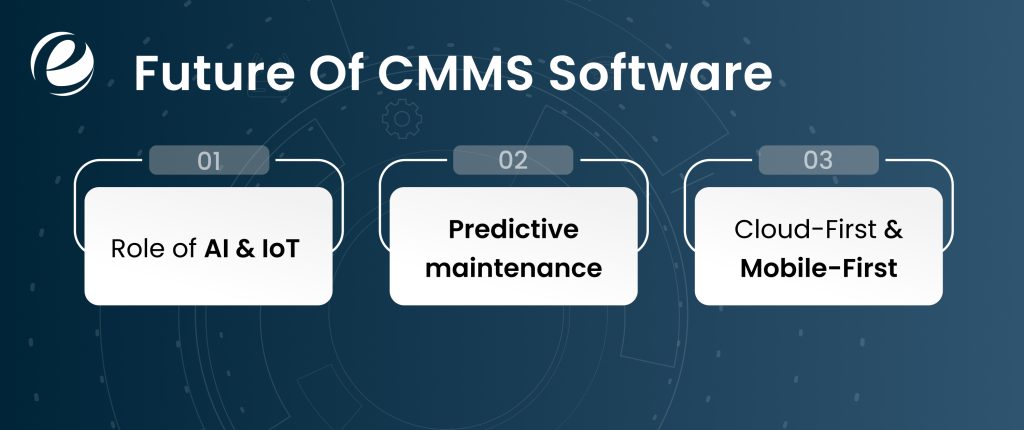
1. Role of AI & IoT in CMMS
AI and IoT are applied to computerized maintenance management systems to facilitate real-time monitoring and intelligent decisions. IoT sensors collect raw data from machinery in a live process, and AI interprets this data to identify the problem and suggest eventual actions, thus providing computerized maintenance management systems with the benefit of reducing downtime and creating efficiency.
2. Predictive maintenance becoming standard
CMMS Software has evolved to include predictive maintenance functions, meaning our work is less about scheduled checks and more about predicting failures based on data analytics to avoid unplanned breakdowns and extend the useful life of an asset. When computerized maintenance management system software can do this effectively, it highlights one of the main CMMS advantages, which is cost-effective reliability.
3. Cloud-first & mobile-first CMMS software
Most new computerized maintenance management system software in today’s market is designed with cloud-based access first, followed by mobile access. With cloud-based CMMS software, teams can access work orders and asset data in real-time from anywhere. This facilitates cloud-first access and real-time data flows from CMMS solutions, and ensures access across mobile devices for scalability and integration with AI Development Services to enhance workflow.

Final Words
The question of what is CMMS, can easily be answered by simply saying it is a digital backbone for modern maintenance operations. If computerized maintenance management systems make the work of managing work orders, asset history, and strengths of preventive maintenance schedules available in one centralized location, then a CMMS can be used to change how an organization manages its physical infrastructure. The benefits of using CMMS software include reducing downtime, reducing costs, improving compliance, and extending asset life.
A modern computerized maintenance management system software harnesses AI, IoT, and cloud to carry out predictive maintenance, real-time monitoring, and mobile access. The transition, therefore, results in better uptime, enhanced decision-making, and ROI. An organization wishing to adopt such kind of software or want to build CMMS then they need a professional software development company. Well, CMMS finds its advantages in increasing scalability, safety, and clarity of operations; hence, it is a worthwhile venture for any asset-intensive organization.
What is computerized maintenance management system software used for?
CMMS software centralizes maintenance tasks and records, reducing downtime and boosting efficiency.
What is a computerized maintenance management system in simple terms?
A CMMS replaces paper logs to track maintenance, schedule repairs, and extend asset life while preventing unplanned breakdowns.
Is CMMS the same as asset management software?
No, CMMS manages maintenance tasks like work orders and preventive schedules, while asset software covers the full asset lifecycle. Many CMMS now include advanced asset tracking.
Who uses CMMS the most?
CMMS is mainly used in manufacturing, healthcare, oil & gas, and facilities to maintain expensive equipment, ensuring safety, compliance, and uptime.
How much does CMMS software cost?
CMMS software costs vary, typically $50–$100/user/month for cloud systems, with enterprise versions costing much more, depending on features and deployment.





 +1 (989) 535-9295
 info@emizentech.com
 emizentech


