
 Add us as a preferred source on Google
 According to Statista, revenue for the Customer Relationship Management Software market is forecast to reach US$ 103.51 billion in 2026.
Businesses no longer view CRM as an optional add-on; it’s now one of the most crucial strategic decisions they can’t avoid. Knowing the CRM implementation cost beforehand helps.
As a rough range, it falls between $3,000 for small businesses and $450,000+ for large enterprises. However, costs are highly influenced by factors such as your business size, complexity, and the integrations you want to adopt. In this blog, you will gain insights into the cost of implementing CRM.
What is CRM Implementation?
CRM implementation is a roadmap for planning, configuring, integrating, and deploying CRM software into your existing business operations to align workflows, manage clients, and provide employee training as needed. Implementing such a software solution means optimizing your current business operations with automation.
However, don’t confuse implementation with installation: you are not just installing software; you’re implementing it in real time and making it a daily part of your business ecosystem to close deals faster, communicate internally across departments, and support clients by resolving queries in a timely way.
What Does CRM Implementation Actually Cost in 2026?
CRM implementation costs can actually be divided into four blocks. Generally, more than half of vendors know about two or three of them. Still, an experienced vendor will always maintain transparency and give you an exact breakdown of the costs involved, so you don’t face issues of hidden costs mid-project.
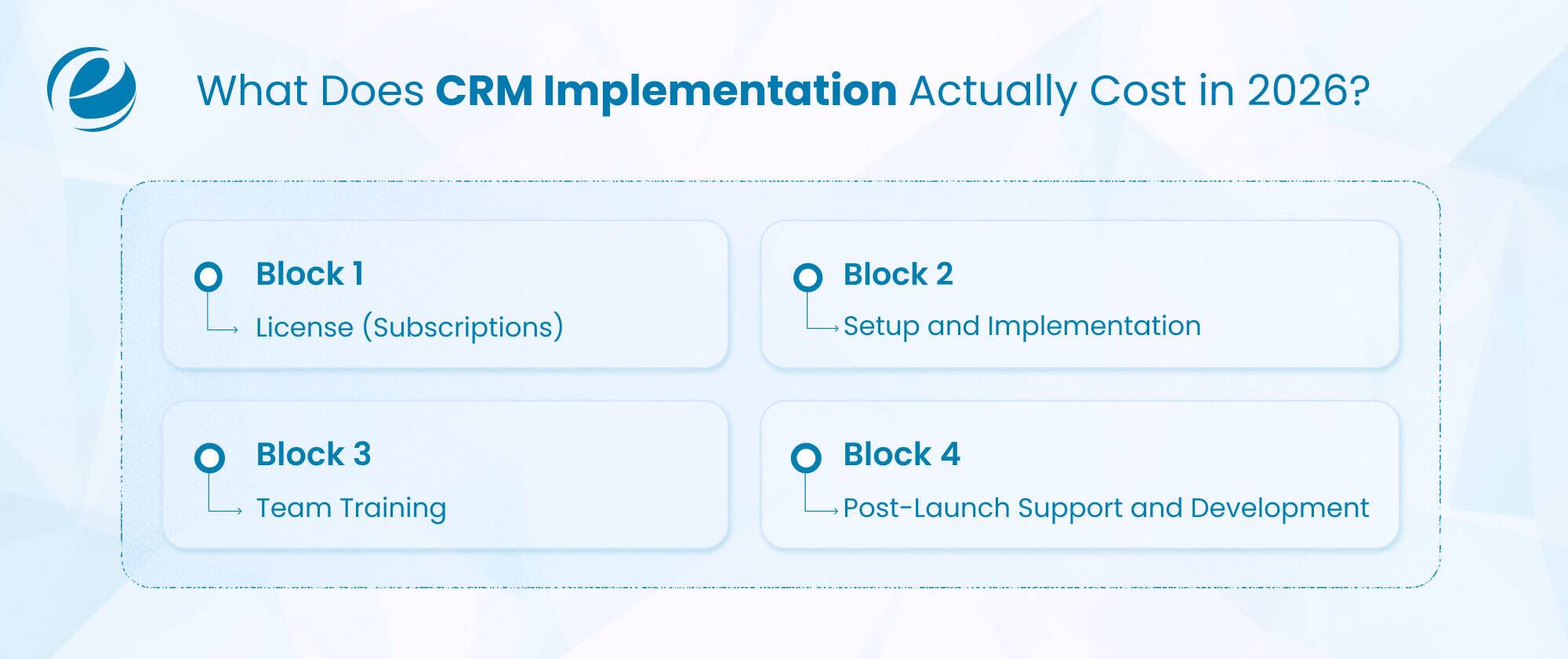
Block 1: License (Subscriptions)
License or subscription fees are charged monthly or annually for platform access. However, the cost depends on the number of users and the pricing levels. Each platform has its own pricing range, from beginner to advanced, as the number of features increases. For your reference, you can check the table mentioned below for the most common systems on the market:
| CRM | Entry Tier | Mid Tier | Note |
| Pipedrive | $14/mo/user (Lite, annual) | $39/mo/user (Growth, annual) | Annual billing saves up to 35% vs monthly |
| Kommo (amo) | $25/mo/user (Base) | $35/mo/user (Advanced) | 6-month minimum commitment, no monthly billing option |
| HubSpot | Free | $100/mo/user (Sales Hub Professional, annual) | Free plan is heavily restricted; Professional includes a mandatory onboarding fee |
| Salesforce | $25/mo/user (Starter Suite) | $100/mo/user (Pro Suite, annual) | Unlimited users on both tiers |
| Zoho CRM | $14/mo/user (Standard) | $23/mo/user (Professional) | Powerful, but complex to configure |
Block 2: Setup and Implementation
During setup and implementation, you either pay a vendor or have an in-house team focused solely on CRM implementation. Again, here also the complete lifecycle from configuration to migration, and building reports and dashboards is followed. However, user licenses and team training are typically billed separately.
It is among the variable parts of a CRM budget. As you know, pricing depends mostly on process complexity and the number of integrations required. As a rough guide:
- Simple/basic implementation (one pipeline, 1–2 integrations): $800–$1,500
- Mid-level implementation (multiple pipelines, telephony, email, basic automations): $2,000–$4,000
- Complex implementation (multiple departments, custom fields, API integrations, analytics): $5,000–$12,000+
These figures can vary. They can vary by vendor, region, or even the CRM platform. However, these estimates show what small and medium-sized businesses actually pay for CRM implementation work. Don’t rely on a vendor who just gives you a quotation without analyzing and auditing your business processes. Because it may mean you’ll receive a limited package, or they’ve quietly built a buffer into the price to cover unexpected complexity later.
Block 3: Team Training
Training is among the most overlooked aspects in the CRM budget lineage. Avoiding it makes the process costlier. Overlooking training means your sales executives may not understand the importance of CRM or how to use it effectively, which makes their work harder and slows things down.
The worst outcome is shifting back to those bulky spreadsheets within weeks of a costly implementation. Understanding the cost of implementing a CRM system is one thing; several CRM examples show the adverse impacts of inadequate training. Therefore, what you can do is seek the help of a CRM manager or introduce the right training format as per your team size and comfort level with adopting new software:
- Online video guides: the cheapest option, typically $0–300 when bundled with implementation.
- Live workshops with the team: usually $300–800 per session.
- Ongoing Q&A support: vendors commonly offer 1–3 months of post-launch support to answer questions, generally priced at $200–500 per month.
A credible, reliable vendor will provide built-in training in the base implementation package without turning it into an upselling opportunity.
Block 4: Post-Launch Support and Development
Post-implementation support is crucial to understanding the true cost of CRM implementation. Mere execution doesn’t mean the work is over; it continues through the maintenance and support required as the CRM evolves. Skipping it means creating roadblocks and is one reason your CRM adoption can fail.
Treat your CRM software as a living system and not a one-time setup. Support costs typically start around $100 per month for basic consulting and can range from $500 to $1,000 per month for active, ongoing system development.
CRM Implementation Cost Breakdown
Understanding CRM implementation cost breakdown helps organizations make informed decisions and avoid budget overruns. Costs can vary depending on business size and complexity. For example, a small business may pay around $5,000 for a basic CRM implementation setup alone.
However, for enterprises, costs include licensing, customization, integrations, data migration, training, and support. After assessing all factors, we prepare a quotation. Below is a detailed, structured breakdown of each cost component involved in CRM implementation:
1. CRM Software Licensing Cost
This is the basic cost for any CRM implementation. Pricing is mostly influenced by the platform you use, features, and the number of users. If you plan to implement AI-based CRM platforms, the subscription cost will be a little higher than for standard ones.
| CRM | Estimated Cost Range |
| Baisc CRM | $10 – $50 per user per month |
| Mid-Tier CRM | $50 – $150 per user per month |
| Enterprise CRM | $150 – $300+ per user per month |
2. CRM Implementation and Setup Cost
Implementation refers to the execution phase, where you configure CRM platforms to align with your business processes. Efficient implementation ensures attainable results and minimizes long-term friction. For the estimated cost range, check out the table below.
| Business Type | Estimated Cost Range |
| CRM for Small Business | $5,000 – $15,000 |
| CRM for Medium Business | $15,000 – $50,000 |
| CRM for Enterprise Business | $50,000 – $150,000+ |
3. Customization Cost
Customization enhances CRM capabilities. Because all features are tailored to your business needs, it improves the organization’s overall productivity and usability. For estimates, refer to the stats below.
| Customization Levels | Estimated Cost Range |
| Basic Customization | $5,000 – $20,000 |
| Advanced Customization | $20,000 – $100,000+ |
4. Integration Cost
Integrating CRM systems with your existing business tools facilitates data consistency and operational efficiency. Seamless interactions reduce manual effort and improve cross-functional visibility. The integration cost ranges are given below:
| Integration Type | Estimated Cost Range |
| Simple Integrations | $2,000 – $10,000 |
| Moderate Integrations | $10,000 – $30,000 |
| Complex Integrations | $30,000 – $100,000+ |
5. Data Migration Cost
Data migration is the process of moving existing data from your current CRM system to a new one, and the costs related to it are known as CRM data migration costs. These estimations directly impact your business performance and decision-making accuracy. For more information on the pricing structure, see the grid format below.
| Datasets | Estimated Cost Range |
| Small datasets | $2,000 – $10,000 |
| Medium datasets | $10,000 – $30,000 |
| Large enterprise datasets | $30,000 – $100,000+ |
6. Training and Change Management Cost
Training is an inevitable part of CRM and essential for success. Proper training and development ensure your employees can use the system effectively without hassle. As soon as your company’s staff adopts the system, the impact can be visible on your business ROI. See the data grid below related to training and management costs.
| Team Size | Estimated Cost Range |
| Small Teams | $1000 – $5,000 |
| Medium Teams | $5,000 – $20,000 |
| Large Enterprises | $20,000 – $50,000+ |
How to Calculate Your CRM Implementation Budget
To calculate the average cost of CRM implementation and estimate the budget, follow the steps mentioned below. This is a common industry rule of thumb, not a precise formula; treat the multipliers below as a rough starting point, not an exact calculation.
Step 1: Evaluate your annual license cost
Step 2: For the first year, multiply it by 4-5x
Step 3: For the second year, multiply it by 2-3x
Step 4: For three years and beyond, multiply it by 1.5 – 2x
Following these steps will give you a realistic view of the total cost of ownership. With that, the estimates for the first year would be as follows:
| Estimates | Percentage |
| Platform License | 30% – 40% |
| Implementation and Setup | 25% – 35% |
| Data Migration | 5% – 10% |
| Integrations | 10% – 15% |
| Training and Development | 5% – 10% |
| Post-Launch Support and Maintenance | 10% – 15% |
Check your budgets to make sure they align with your estimates; then you are good to go. Otherwise, you can implement it in phases. Implementing in phases does not mean a half-built CRM.
The main emphasis is on priority functionality, such as contact management, pipeline management, and basic reporting. In later phases, you can consider adding advanced features like marketing automation and custom integrations.
Factors Affecting CRM Implementation Costs
CRM pricing isn’t one-size-fits-all; the final cost depends on a handful of factors that vary from business to business. The factors below will help you evaluate which attributes are worth paying attention to
1. Software Modules
The CRM comes with basic modules such as order processing and contact management. However, if you plan to use a customized CRM system that provides automation, marketing, and personalized campaigns, implementation costs will be higher because personalization adds complexity.
2. Timeline
Timelines in CRM project completions matter a lot. Generally, CRM developers or partners work on an hourly basis, so the longer your project runs, the higher the implementation cost climbs. To get a working estimate, multiply the projected hours by the developer’s hourly rate, but treat it as a starting benchmark, not a final number.
Actual timelines often shift once a vendor audits your process and discovers additional complexity, so build in a buffer rather than budgeting exactly to the estimate.
3. Team Distribution
Team composition and location play a major role in determining CRM implementation costs. Developer rates vary significantly by region; for example, if your company is based in Asia and you hire a developer from the USA, costs will be noticeably higher, since US hourly rates for CRM development and consulting typically run well above rates in many parts of Asia. Where you source for your implementation team matters and should be weighed carefully against your budget.
4. Business Scalability
As your business expands, scalability becomes a challenge. In CRM, you pay for each user who utilizes the system. The more users you have, the higher the cost will be, and vice versa. It also increases installation charges based on how many people use the CRM. To keep costs within your budget, evaluate how many people will use the CRM.
CRM Implementation Pricing By Platform
| Platform | Simple Implementation | Moderate Implementation | Complex Implementation | Typical License Range* |
| HubSpot | $5,000– $15,000 | $15,000– $50,000 | $50,000– $150,000+ | Free–$150+/seat/month |
| Salesforce | $10,000– $30,000 | $30,000– $150,000 | $150,000– $500,000+ | $25–$330+/user/month |
| Microsoft Dynamics 365 | $15,000– $45,000 | $45,000– $100,000 | $100,000– $250,000+ | ~$65–$200+/user/month |
| Zoho CRM | $2,500– $10,000 | $10,000– $30,000 | $30,000– $75,000+ | Free–$52/user/month |
How to Optimize CRM Costs Without Losing Value
Follow these 3 tips to optimize the cost of implementing a CRM system without losing value.
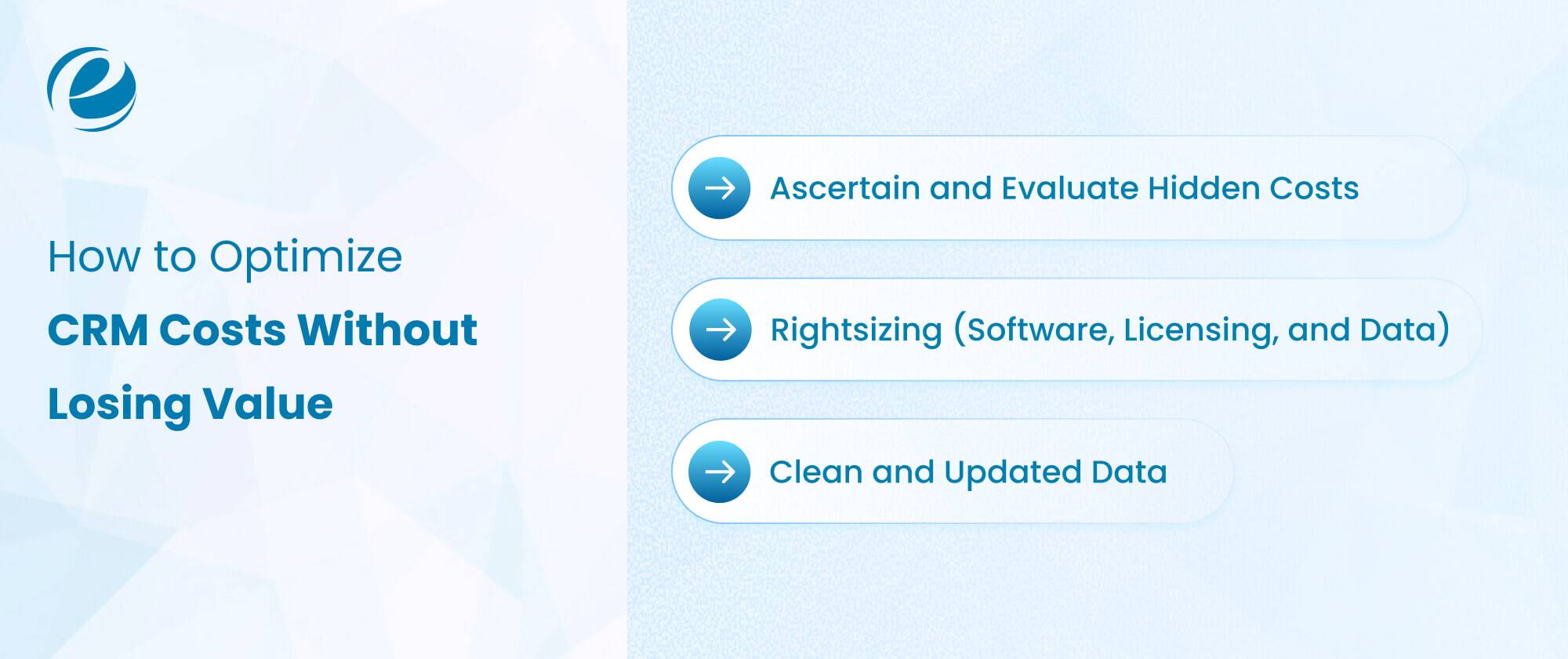
1. Ascertain and Evaluate Hidden Costs
If you think software pricing is only its final cost, you may be headed in the wrong direction, because there are several hidden charges involved when you want to implement changes or customize your existing software solutions.
To name a few: system customization, integration with existing solutions, employee training, and maintenance; together, these contribute to hidden costs.
Generally, cloud-based solutions are considered a budget-friendly option, but when personalized to the next level, they will definitely impact the overall implementation budget.
2. Rightsizing (Software, Licensing, and Data)
Without proper knowledge and technical know-how, several companies tend to purchase the complete bundled package for on-premises software. The problem isn’t the purchase itself, but the unnecessary features that aren’t relevant and add to the final CRM implementation cost. In such scenarios, the ideal approach is rightsizing.
Also known as a measure for restructuring or reorganizing software, hardware, or the complete infrastructure to attain higher value. Rightsizing can also be used when evaluating user licenses, contact numbers, etc., for cost. This lets you set up a recurring inventory of users who actually use the license in real time, helping you identify dormant users.
This way, you can clean up unused space and avoid paying for it without disrupting your routine and daily business operations.
3. Clean and Updated Data
CRM systems typically cap how many contact records you can store, not how many team members can log in; that’s a separate, per-seat licensing question. Storage limits vary by plan: some tiers cap you at a set number of records (for example, 100,000 on a mid-tier plan), while higher tiers offer millions. If you keep adding new contacts without ever archiving old ones, you’ll hit that ceiling faster than expected, and a cluttered database makes it harder to tell which records are still relevant.
Running a regular data cleanup, removing duplicate entries, merging fragmented records, and archiving contacts that haven’t engaged in months keeps your database within plan limits and keeps your reporting and segmentation accurate.
Why Choose EmizenTech for CRM Implementation
CRM implementation cost can be a complete headache or burden if you are partnered with someone who doesn’t maintain transparency and charges you for unrealistic things under the name of hidden costs. The right CRM software development company will always focus on custom CRM development, automation, AI integrations, and enhancing customer data management. Partnering with Emizentech means gaining all of the mentioned factors and in-depth expertise, especially when customizing platforms like Zoho, Salesforce, and HubSpot.
To Wrap Up
CRM implementation costs are vital, and skipping or avoiding them means ignoring the need for configuration, proper setup, and data migration. It results in low user adoption and a completely wasted software investment. So instead of avoiding them, optimize them: collaborate with a reliable, trusted CRM development partner.
FAQs
Does CRM implementation require ongoing maintenance?
Yes, CRM implementation requires ongoing maintenance, especially to maintain data accuracy, optimal performance, and user adoption.
How long does CRM implementation take?
- A complete CRM implementation takes between 1 week and 12 months. To break it down even more simply for you:
- Small business with less than 20 users: Implementation cost is between $500 and $5,000.
- Medium enterprise with up to 200 users: Implementation charges lie between $10,000 and $50,000
- Large enterprise (100+ users): Implementation costs range from $50,000 to $500,000+.
Can small businesses afford CRM implementation?
Affordability is never a concern. The important thing is the need, and yes, small businesses can afford CRM.
Should I hire a CRM implementation company or implement it in-house?
You can hire a CRM implementation company if your project is complex, requires multiple system integrations, or has strict deadlines. You can opt for in-house if you have a single, streamlined workflow and strict budgets.


 +1 (989) 535-9295
 info@emizentech.com
 emizentech


