 Add us as a preferred source on Google
Ever wonder what really distinguishes Machine Learning from Artificial Intelligence, and which one suits your business perfectly? Both technologies are changing the face of the industry; thus, the question of which one fits your unique needs is not that easy to answer. Do you want to make complex tasks self-operating or simply use data in a smarter way? Knowing what is done by AI and what is done by machine learning will help you make the right decision. The question is Machine Learning vs AI main.
AI or machine learning gives one the keys to the business value that could be occasioned by using the technologies in a number of ways. These might range from the automation of routine tasks and the involvement of customer services to the provision of predictive insights and the enhancement of the business’s general efficiency.
However, the decision of whether to use AI or machine learning depends on where you want to take your company in the future, what data you have at hand, and what challenges you are facing. This is a simple explanation of the technologies, their differences narrated, and directions on how to pick the tech that can lift your business.
Machine Learning vs AI Market Growth Forecast 2025-2030 Key Stats and Trends
According to Grand View Research, the AI market all over the world is extremely big and rapidly increasing. From 2025 to 2030, it will grow at a rate of 36% per annum, reaching $1.8 trillion by 2030. Generative AI in Healthcare, finance, retail, automotive, and manufacturing industries.
Over time, the development and expansion of machine learning (ML), a crucial AI branch, has been nothing less than spectacular. From a market value of $55.8 billion in 2024, the machine learning market is predicted to reach $282 billion by 2030 with an impressive annual growth rate of above 30%. (Source: Statista, Grand View Research )
One of the major areas in the market of artificial intelligence, and the largest in terms of value, is the use of machine learning technologies. Basically, machine-learning technology is the driving force behind many of the practical AI applications like recommendation systems, fraud detection, voice recognition, and driverless cars. (Source: Statista)
What is Artificial Intelligence (AI)?
Artificial Intelligence (AI) is the technology that allows machines and computers to perform tasks that require human intelligence. AI is the act of machines learning from data, computing, and analyzing patterns, making decisions, understanding language, and problem-solving, like people do.
AI is a profound technology that innovates across various sectors, including vending, establishing remote workshops, virtual assistants, and developing autonomous vehicles. AI is not just robots, but also analyzes tons of data in nanoseconds and enhances business insights and automated tasks better than humans can.
Key Highlights:
- AI allows machines to simulate human thinking and human decision-making
- AI learns from data automatically and improves automatically
- AI enables efficiencies in applications like voice recognition, recommendation engines, and autonomous vehicles
- AI assists a prism of industries like health care, finance, and marketing
- AI is the backbone for the functionality of the latest trending technology, like generative AI.
Note: Check out all of the innovative Artificial Intelligence App Ideas. You will find that AI is changing everything from customer support to smart automation in today’s businesses.
What is Machine Learning (ML)?
Machine Learning (ML) is a form of artificial intelligence that allows computers to identify patterns from information and use what they have learned to become more proficient and improve their performance. In this case, computers are not being programmed to carry out a task but are identifying patterns from vast information sets to predict an outcome or take action based on that information learned.
Machine Learning is the foundation behind many of the smart systems we encounter today, such as recommendation systems on Netflix, fraud detection in banking, and enhancing speech recognition capabilities. Essentially, feeding information into a model and training that model on the information allows the model to learn in order to adapt to future decisions.
Key Highlights:
- ML gives machines the ability to learn and continue to grow without human intervention.
- ML is about determining and exposing hidden information to accurately determine an outcome or conclusion.
- Machine learning is a subset of artificial intelligence and has building blocks in AI.
- ML can enable applications like image recognition, natural language processing, and personalization.
- Access to high-quality data and the larger amount of data used to train the model are benefits to increasing the accuracy of the model.
- ML will adapt dynamically to its environment, which may change rapidly.
Difference Between AI and Machine Learning
Today, AI and ML are in the process of changing and streamlining operations. AI is basically a broader concept encompassing any machine that tries to perform tasks considered to require a higher level of decision-making and cognition in the human world.
Machine learning is a subset of AI and refers more particularly to algorithms that enable systems to learn and improve automatically from experience without being explicitly programmed. Industries will make the difference in choosing which of those technologies best fits their application.
1. Scope and Definition
AI has a larger scope than simply referring to technologies that imitate human intelligence, e.g., reasoning and problem-solving. AI is a framework that includes all technologies that mimic human intelligence. Machine learning, as a defined form, refers to various algorithms that have a component that looks at past data to facilitate predicting or determining a decision.
2. Objective in Industry
AI is about automating something that humans found hard to automate, whether that be customer service outputs or autonomous driving. Machine Learning has been in use in the analysis of big data, recognition of AI, and machine learning paradigms that automate decision-making and forward-looking predictions.
3. Methods Used
AI will involve the use of rule-based systems (RBS), genetic algorithms (GA), and neural networks (NN). Machine Learning is also a set of machine learning algorithms that will employ supervised and unsupervised learning, which learn based on the data provided to the program.
4. Implementation Complexity
AI implementations generally represent the construction and integration of the intelligent system, which entails many sometimes complex processes. Machine Learning is represented in a much simpler implementation; it has a particular interest in training a model or an algorithm to work with rich data, and then over time, improvements based on the new data, in order to potentially iteratively arrive at a long-term accuracy.
5. Industry Applications
AI is applied in chatbots, preference-based experience personalization, or intelligent automation in finance and healthcare. AI that utilizes machine learning applications to improve fraud detection, predictive maintenance, and modeling and analysis of customer behaviour.
Benefits of Machine Learning and AI for Your Business
Machine learning and AI have consequently altered the direction of the industry. And due to efficiency, processes promote a healthier decision-making process that prioritizes a data-driven process better than ever before.
While these technologies assess an endless amount of data in a moment, they now give businesses a never-before-seen amount of power towards personalization of customer experience, while automating everyday tasks and allocating human work to strategic work assignments.
Once an organization uses AI and machine learning, it is able to take its operation to a competitive level with faster speed and accurate decision-making, and increased ability to innovate.
1. Faster Decision Making
AI and ML processes information, make assessments, and provide insights in the blink of an eye. The assessment of data occurs in seconds and provides example insights in minutes, and the data assessed is at the fingertips of business executives. With this amount of speed, the executives can work together to make decisions based on the knowledge they assimilated from the insights AI and ML have provided.
2. Personalized Customer Experience
Customized client experiences are created with services and products that meet the satisfaction of the individual expectations of consumers, resulting in even higher levels of satisfaction and loyalty.
3. Cost Reduction
AI provides cost savings and accuracy reduction involving humans and costs incurred due to human error.
4. Accurate Demand Forecasting
AI has demonstrated the accuracy of predicting trends in the market along with customer needs, with unprecedented improvements resulting in higher inventory management and dwindling wastage.
5. Enhanced Security
AI-based models can harness their ability to detect threats and alerts late, risking the loss of data and assets.
6. Improved Efficiency
Automation and intelligent systems may ensure the onward flow of the nation’s productivity with daylight operations until tiring.
This straightforward explanation highlights how Machine Learning vs AI technologies assist different business functions in making an informed decision regarding tech adoption. AI ML consulting services help businesses realize the maximum potential of AI and machine learning by providing an expert analysis, a customized solution, and a guaranteed service level that stands behind the tech to deliver actionable results.
What are AI and Machine Learning Trends?
Moving fast, the dynamism exhibited by AI and Machine Learning has given way to the crystallization of 2025, which will remain an innovative year in evolving industries. At the center of AI evolution are efforts by business and tech leaders to make AI more intelligent, efficient, and accessible, with further advancements in reasoning and automation.
It consequently aims to enhance productivity, improve performance, and give specialized experiences with moral and security concerns taken into consideration.
1. Generative AI Expansion
Generative AI Models like ChatGPT have become commonplace and are fundamentally changing content generation, customer interactions, and process automation across industries.
2. Advanced Natural Language Processing (NLP)
AI systems can now handle content context, tone, and nuance with much more sophistication, which enables AI to conduct realistic human-like conversations and allows AI assistants to be “smart”.
3. Edge Computing and Real-Time Data
Bringing the processing closer to the source of data allows low-latency responses to the data, which is essential in instances such as critical response in autonomous vehicles, health care devices, and triggering personal retail experiences.
4. Ethical and Responsible AI
As focus on transparency, fairness, and accountability increases in AI deployments, AI systems will do a better job of minimizing bias, and provide assurances and compliance that the operational boundaries of the AI systems are understood and do not abuse automation as humans do.
5. Automated Machine Learning (AutoML)
Through AutoML tools, it has never been easier to state how a machine learning model is created, as AutoML tools automate both feature engineering and model selection. This potential will allow non-experts to reasonably explore the AI space for potential opportunities.
AI-Powered Interview Platforms are transforming recruitment by automating candidate screening, reducing bias, and helping businesses hire top talent faster.
6. Hybrid AI Models
By hybridizing machine learning with rules-based and symbolic reasoning ability, AI would be better able to create understanding and problem-solving in specific domains.
Which is Best For Your Business? Artificial Intelligence or Machine Learning
Determining which technology is right for your business, Artificial Intelligence or Machine Learning, can be somewhat difficult. Both terms are widely used in the technology world, and there are additional costs associated with both solutions that add to reader confusion.
Are you looking to automate complex work processes at scale across your enterprise, or just trying to make better-informed decisions based on existing business data? Knowing what both AI and ML can do, and the particular capacities of each, can be important to determine the right solution that can solve your actual business problem and help to remain competitive in the digital age.
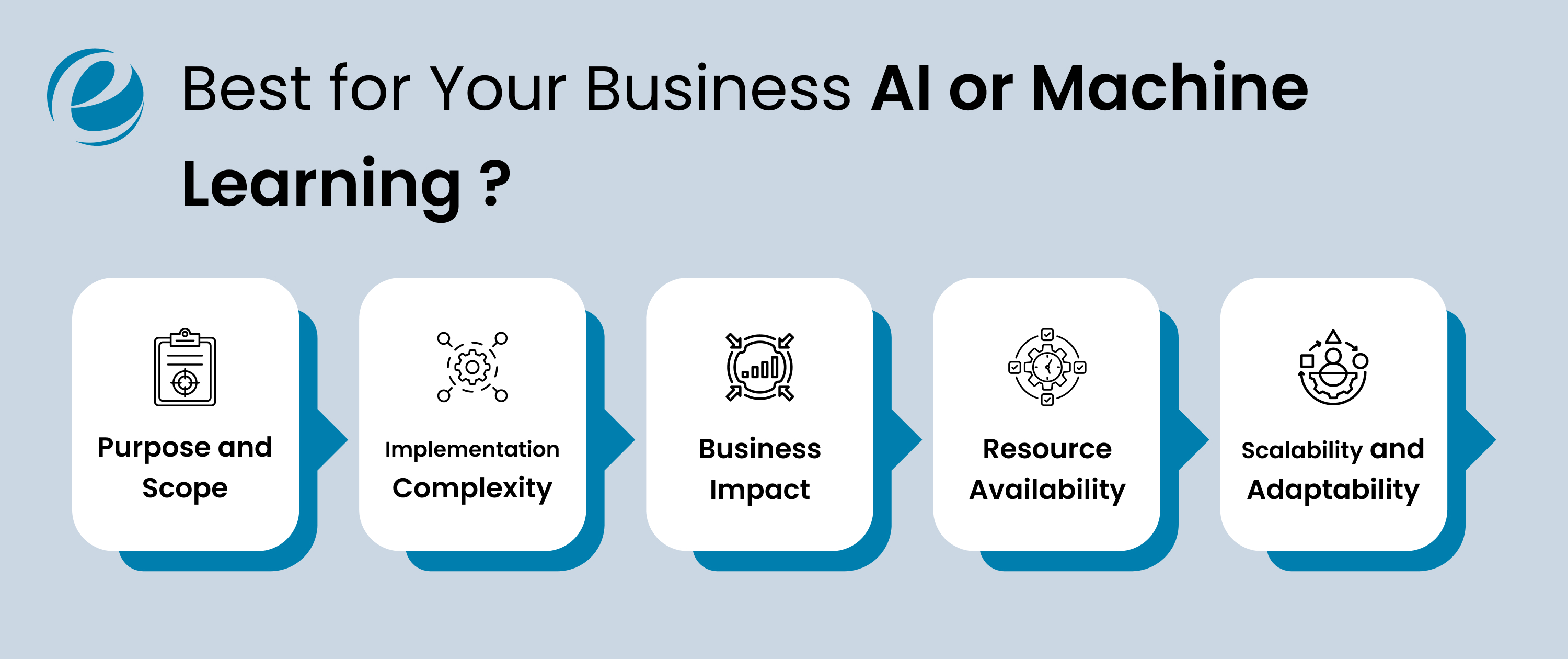
1. Purpose and Scope
AI has the potential to do a lot of jobs that involve thinking, defining, and decoding language, making it an excellent choice for automating complex jobs in an organization. Machine learning is particularly effective at quickly interpreting a lot of data and finding patterns, leading to better data-informed decisions by the business.
2. Implementation Complexity
AI solutions can be large and require more effort to be implemented if the intention is to automate multiple processes. Machine learning projects can be more easily kicked off if there is good data and the goal is just outlining results or spotting trends.
3. Business Impact
AI can disrupt processes in other areas, such as customer service, if it turns systems into a more intelligent automated system. Machine learning is strong for improvements, such as projecting sales forecasts, suggesting purchases to consumers, and catching issues early.
4. Resource Availability
Machine learning works most efficiently when you have labour resources who can learn what the data means and can continue to promote learning to the models. Therefore, if you are leveraging AI, you may need even more resources from a maintenance and ongoing update perspective to continue proper functioning of the AI.
5. Scalability and Adaptability
AI can span multiple breadths of the business and fulfil a number of roles. Machine learning continues to improve with more data, so this is a benefit in that organizations that are looking to benefit from an organization that needs to change appreciate adaptability.
Well, evaluating the resource availability, scalability, and adaptability will help organizations determine if they should work through the options available from a for a full breadth of automation, or consider how Machine Learning vs Artificial Intelligence capabilities could help with targeted data insights.
Why Partner with Us for AI & ML Development?
Emizentech recognizes that each mobile app development company is different and has various AI and machine learning requirements. Our job is to collaborate with you, as your partner, not just a service you are paying for. Our business line of work requires us to listen to your business objectives carefully and diligently work together to develop AI-powered solutions that create growth for your business. When we talk about AI, Machine Learning, and developing AI models, we understand that incorporating the technology as part of your leadership, we are bound to go as far as ensuring that your customizable solutions fit into your system and processes.
We also believe there is a delicate balance between great human-centered design and technical capability. Our AI and machine learning specialists have years of experience designing solutions for industries such as generative AI in Ecommerce, healthcare, and finance. We develop smart and scalable options that solve problems. We also keep up-to-date with advancements and innovations in AI/ML technology so we can employ the best of species MLOps techniques. With transparency, quality, and ongoing support as our pillars for success, we will work with you not just through development but in a long-lasting relationship as your best digital partners.
You get faster project turnaround, agile development, and flexible pricing through a partnership with us. Your business is important to us, and we work around the clock to exceed client expectations so that your AI and ML undertakings deliver truly measurable benefits. Our software development service takes your business to the next level. When an organization chooses Emizentech, they choose a team that cares about their growth just as much as they do, ready to innovate, ready to solve problems, and ready to help businesses prosper in the AI-powered world.
Final Words
Machine Learning vs Artificial Intelligence are both innovative technologies with the power to create transformational opportunities for an organization by automating repetitive functions, improving decision-making capabilities within an organization, and providing pathways for new growth. AI is the wider term that defines the technology utilized by machines or computers to imitate or carry out complicated tasks that typically require human intelligence.
Machine learning is a more specific term that describes the manner in which a computer learns to make a decision based upon data. There is no doubt that both AI and machine learning will continue to innovate while improving the operational efficiency of numerous industries.
The right selection of technology will always depend upon what the goals, needs, and resources are available to your organization. Whether you want access to the functions of AI or want to focus on the data-driven functions of machine learning, both can provide advantages to your business that can assist with future growth and success.
Being aware of emerging AI and machine learning and working with a reputable AI development company can help you maximize the potential of these transformative technologies.
FAQ’s
What is the difference between AI and machine learning?
AI is a broader term to define machines that can perform tasks using human-like intelligence. Machine Learning is a subset of AI that contains methods for machines to learn from data and improve from experience without being specifically programmed.
Which is more important, AI or ML?
AI and ML both are important, but serve different purposes. AI is the larger goal of creating "smart" machines; machine learning is just how we get there, the machines are trained with data. The way I see it, machine learning is a subset of AI, but AI is a much broader term.
What are the 4 types of artificial intelligence?
The four types are: Narrow AI (ANI): AI designed for a specific task General AI (AGI): AI that has human-like intelligence over many tasks Super AI(ASI): AI smarter than humans in every area (still theoretical) Reactive Machines: The most basic AI is driven by its inputs, but it does not learn or remember.
What are the ethical concerns related to AI and machine learning?
Dealing with issues like bias in AI models, transparency, and accountability are considered the ethical dilemmas, while matters of automatization and its impact on jobs belong to a different category.
How long does it typically take to see results from AI or ML investments?
Some changes may be experienced, but normally, the investment in AI can show profits from a period encompassing a few months up to a year, with the complexity of the solution and the quality of data available possibly factoring into the consideration.




 +1 (989) 535-9295
 info@emizentech.com
 emizentech


